
Opening your dashboard
Class 9 Biology Chapter 9 Economic Importance of Bacteria and Fungi: Practice Questions
42 questions on Chapter 9, each worked through on its own page with the AI tutor. Class 9 Biology, ICSE 2026-27.
42 questions
1–5 marks · Mixed difficulty
- 11 mark
Question 1
Bloom's level: Remember
Bacteria that are shaped like a comma are called :
- 21 mark
Question 2
Bloom's level: Remember
The disease germs that some countries are feared to be packing into 'germ bombs' are those of :
- 31 mark
Question 3
Bloom's level: Remember
Which one of these bacteria lives freely in the soil (not inside root nodules) and fixes atmospheric nitrogen ?
- 41 mark
Question 4
Bloom's level: Remember
In bread mould (Rhizopus), the swollen tip of an erect hypha, which turns dark as the spores inside it mature, is called the :
- 51 mark
Question 5
Bloom's level: Understand
Which statement about bacterial diseases is correct ?
- 61 mark
Question 6
Bloom's level: Understand
Leather is tanned mainly with chemicals called tanning agents. The part played by bacteria in tanning is that they :
- 71 mark
Question 7
Bloom's level: Understand
There are more bacteria living normally on your skin than there are humans on Earth. These skin bacteria are actually useful because they :
- 81 mark
Question 8
Bloom's level: Apply
A villager bitten by a cobra is rushed to hospital. The doctor injects anti-venine serum at once rather than a vaccine. This is because the serum :
- 91 mark
Question 9
Bloom's level: Apply
After a long course of strong antibiotics, a patient shows signs of a shortage of B-complex vitamins, even though his diet has not changed. The most likely reason is that the antibiotics :
- 101 mark
Question 10
Bloom's level: Analyse
Assertion (A): Pasteurised milk, if left in a warm kitchen for a day, can still turn sour.
Reason (R): Pasteurisation kills all the bacteria in milk, including their spores.
- 111 mark
Question 11
Bloom's level: Evaluate
Assertion (A): A farmer who grows beans in a field before sowing wheat can use less nitrogen fertiliser for the wheat.
Reason (R): Rhizobium in the root nodules of beans converts free nitrogen into nitrogen compounds, which are used by the host plant and also by plants sown later in the same soil.
- 121 mark
Question 12
Bloom's level: Analyse
Assertion (A): The greenish fungus growing on a rotting orange should not be eaten or used as a medicine.
Reason (R): Penicillin, the first antibiotic, is produced by a mould.
- 132 marks
Question 13
Bloom's level: Understand
Most bacteria cannot move on their own. Explain how they still spread from place to place, and how a bacterium that has flagella moves.
- 142 marks
Question 14
Bloom's level: Understand
Explain how bacteria help in obtaining the fibres of flax and hemp that are used for making rope and linen.
- 152 marks
Question 15
Bloom's level: Understand
Rhizopus has no mouth and cannot take in solid bread. Explain how its hyphae obtain food from a slice of bread.
- 162 marks
Question 16
Bloom's level: Understand
Bacteria are sometimes described as "both friends and foes" of human beings. Explain this statement with one example of each role.
- 172 marks
Question 17
Bloom's level: Apply
Under ideal conditions, a certain bacterium divides once every 30 minutes. A jug of warm milk contains 5 such bacteria at 8 a.m. Assuming none die, how many will there be at 11 a.m. ?
- 182 marks
Question 18
Bloom's level: Apply
Suggest the most suitable method of preservation in each case, giving a reason :
(a) A dairy wants to kill most disease-causing bacteria in fresh milk without boiling it.
(b) A fisherman in a village without electricity wants to keep his catch for several months.
- 192 marks
Question 19
Bloom's level: Apply
Anthrax germs are feared as a possible bioweapon. Using what you know about bacterial spores, explain why such germs could cause harm "generation after generation".
- 202 marks
Question 20
Bloom's level: Apply
A newborn baby is given the BCG vaccine. State the disease it protects against, the kind of bacteria it contains, and how it gives protection.
- 212 marks
Question 21
Bloom's level: Analyse
A health worker lists these diseases. Sort them by the host they attack — plants, cattle or humans — and pick out the one disease in the list that is not caused by a bacterium :
whooping cough, anthrax, black rot, typhoid, bacterial blight, bovine tuberculosis, ringworm
- 222 marks
Question 22
Bloom's level: Evaluate
Riya says, "All fungi are harmful because they spoil our food." Do you agree ? Justify your answer with examples.
- 234 marks
Question 23
Bloom's level: Apply
In a winery, yeast (Saccharomyces cerevisiae) ferments the glucose in crushed grapes.
(a) Write the balanced chemical equation for this fermentation.
(b) When 180 g of glucose is fermented completely, 92 g of ethanol is formed. Find the mass of carbon dioxide given off. How much ethanol would 900 g of glucose give ?
(c) Fermentation in the vat stops by itself when the ethanol reaches about 12%. Explain why.
- 245 marks
Question 24
Bloom's level: Apply
Case: Farmer Harpal grew gram (a leguminous crop) in his field. When he uprooted a few plants, he saw small swellings on the roots. After the harvest, he ploughed the remaining stems and leaves back into the soil. Next season, the wheat he sowed there needed much less urea.
(a) What are the swellings on the roots? Name the bacterium living in them.
(b) The ploughed-in plant remains contain nitrogenous compounds. Explain, step by step, how bacteria turn them into nitrates that wheat can absorb, naming the bacteria involved.
(c) Some soil bacteria work in the opposite direction and can reduce the nitrates in a field. Name one such bacterium and the process.
- 253 marks
Question 25
Bloom's level: Apply
A laboratory is asked to prepare anti-tetanus serum.
(a) Which kind of animal is used, and what is injected into it ?
(b) Why are several injections given, instead of one ?
(c) How is the serum finally obtained from the animal's blood ?
- 264 marks
Question 26
Bloom's level: Analyse
Case: In summer, Kabir's family tested how long cooked dal stayed fresh under different conditions :
Condition Time before it smelt sour Open bowl in the kitchen at 8 hours Covered bowl in the kitchen at 10 hours Covered bowl in a refrigerator at 72 hours Boiled again and sealed while hot in a sterilised jar more than 10 days (a) How many times longer did the dal stay fresh in the refrigerator than in the open bowl in the kitchen ?
(b) Covering the bowl in the warm kitchen helped only a little. Explain why.
(c) Kabir concluded, "The refrigerator kills bacteria." Using the data, show why the boiled and sealed jar lasted longest, and correct Kabir's conclusion.
- 274 marks
Question 27
Bloom's level: Analyse
The main steps in making cheese are given below in a jumbled order :
- P : The curd is kept at a suitable temperature and humidity.
- Q : Salt is added to the curd.
- R : Lactic acid bacteria (Lactobacillus) are added to milk.
- S : The curd is processed to remove moisture.
(a) Arrange the steps in the correct order and name each step.
(b) In which steps do microorganisms play the main part? What do they do in each ?
(c) Two steps remove moisture from the curd. Identify them and explain why removing moisture matters.
- 285 marks
Question 28
Bloom's level: Evaluate
Case: Raju has started growing white button mushrooms in a shed. His practices are :
- He made compost of wheat straw, chicken manure and fertiliser and kept it at about for one week.
- To save time, he spread the "mushroom seed" on the compost and skipped the casing step.
- To keep the shed warm, he closed all windows and kept the temperature at about .
(a) Was his composting method correct? Give a reason.
(b) Judge the effect of skipping casing on his crop.
(c) Evaluate his third practice and suggest what he should do instead.
- 295 marks
Question 29
Bloom's level: Create
Construct a revision chart in the form of a table that sorts the economic importance of microbes into four boxes: useful bacteria, harmful bacteria, useful fungi and harmful fungi. Give at least two examples in each box, naming the organism or the product wherever possible. End with a one-line conclusion.
- 305 marks
Question 30
Bloom's level: Create
Plan a simple experiment to show that yeast gives out carbon dioxide when it ferments sugar.
(a) List the materials and describe the experimental set-up and a control.
(b) State the result you expect in each set-up, and how you would test the gas.
(c) State the conclusion and one precaution.
- 311 mark
Question 31
Class 9 Sample Paper 1 · Section A
Name the following:
A bacterium present in the root nodules of leguminous plants.
- 325 marks
Question 32
Class 9 Sample Paper 1 · Section E
Bacteria are economically important microorganisms. Explain.
- 331 mark
Question 33
Which one of the following bacteria breaks down the nitrates of the soil and releases free nitrogen into the atmosphere ?
- 341 mark
Question 34
Which one of the following correctly distinguishes antitoxins from antibiotics ?
- 351 mark
Question 35
Assertion (A): Yeast is a unicellular organism.
Reason (R): Yeast reproduces asexually by budding.
- 362 marks
Question 36
(i) What is meant by a bioweapon ?
(ii) Give one reason why a bioweapon is dangerous to the whole population and not only to the people who are attacked.
- 372 marks
Question 37
(i) Fresh milk kept in a kitchen in summer turns sour much sooner than the same milk kept in a refrigerator. Explain why.
(ii) State the temperature and the time of heating used in the pasteurization of milk, and say what is done to the milk immediately afterwards.
- 382 marks
Question 38
The figure shows a part of the root system of a bean plant growing in the soil.
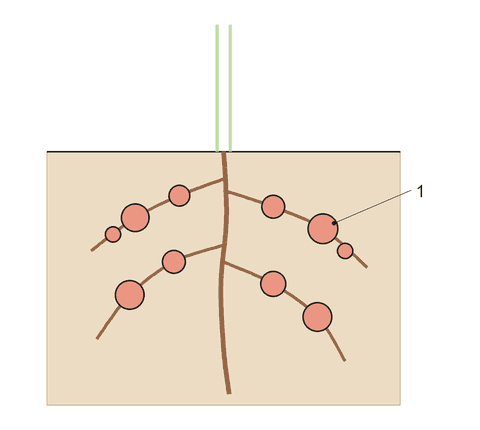
(i) Name the swellings marked 1 and the bacteria living in them.
(ii) State what these bacteria do with the nitrogen of the air and one benefit this brings to the farmer.
- 392 marks
Question 39
(i) Name the product that bacteria form when they act on alcohol.
(ii) Name the process in which bacteria loosen the fibres of the stems of flax, and state one use of the fibres so obtained.
- 403 marks
Question 40
(i) Name the fungus from which the antibiotic penicillin is obtained.
(ii) Name a skin disease of humans which is caused by a fungus, and a common fungus that spoils bread.
(iii) Give the common name and the scientific name of the mushroom that is widely cultivated for food.
- 414 marks
Question 41
A baker adds yeast to the dough, and a vineyard owner uses yeast to ferment the sugar of crushed grapes.
(i) Name the kind of respiration by which yeast breaks down the sugar here, and name the two products formed.
(ii) Which product of this reaction makes the dough rise, and which product is wanted in the making of wine ?
(iii) When the ethanol in the grape juice reaches about 12 per cent, the fermentation stops. Why ?
- 424 marks
Question 42
(i) Draw a neat, labelled diagram of a rod-shaped bacterium having a flagellum. Show and label at least five parts.
(ii) Why are bacteria described as prokaryotes ?
(iii) One bacterium is placed in a flask of warm nutrient broth. It divides by fission, and each new cell divides again, once every 20 minutes. How many bacteria will there be after 2 hours ? (Assume that no bacterium dies.)