
Opening your dashboard
Class 9 Biology Chapter 7: Respiration in Plants Solutions
44 textbook questions with step-by-step answers, free to read, for ICSE 2026-27.
Get talked through Ch 7, not just shown the answer
Reading a finished solution is not the same as being able to do it. The AI tutor takes one question at a time and works it with you, in your own words, until you can.
- Ask it out loud, in your own words
- It gives you the next step, not the answer
- Stuck on part (ii)? Start there
44 questions with solutions
1–10 marks · Mixed difficulty
- 13 marks
Question 1
Write the important aspects about the overall chemical equation of respiration, pertaining to the following :
(i) number of steps for glucose to break down into and .
(ii) involvement of enzymes.
(iii) forms of energy liberated.
Solve with AIWritten solution
Solution:
Concept: The overall equation of respiration shows only the start (glucose and oxygen) and the end (carbon dioxide, water and energy). It hides a long chain of small chemical steps inside the cell.
Step 1 — Part (i): number of steps.
Glucose is not broken down in one single step. It is broken down in a series of small chemical steps, in two main phases: glycolysis in the cytoplasm, which splits glucose into pyruvic acid, and the Krebs cycle in the mitochondria, which breaks pyruvic acid down to carbon dioxide and water.
Step 2 — Part (ii): involvement of enzymes.
Each step of this chain is controlled by its own particular enzyme. That is why respiration can go on smoothly at body temperature, without the high heat that burning needs.
Step 3 — Part (iii): forms of energy liberated.
Part of the energy is given off as heat. A large part is trapped as chemical energy in ATP (adenosine triphosphate), which the cell later uses for its work.
Watch out: The equation looks like one reaction, but it is only the overall result of many enzyme-controlled steps.
Therefore, (i) many steps, in glycolysis and the Krebs cycle; (ii) each step has its own enzyme; (iii) energy is set free as heat and as chemical energy stored in ATP.
- 21 mark
Question 2
List three ways in which respiration is different from burning.
Solve with AIWritten solution
Solution:
Concept: Respiration and burning both combine food or fuel with oxygen and release energy, but they happen in very different ways.
Step 1 — Where and at what temperature.
Respiration is a biochemical process inside living cells and goes on at body temperature. Burning is a physico-chemical process outside cells and needs a high temperature (the ignition point).
Step 2 — How many steps.
Respiration takes place in many small steps, each controlled by an enzyme. Burning takes place all at once, without enzymes.
Step 3 — How the energy comes out.
In respiration much of the energy is stored as ATP, some is lost as heat and no light is given out. In burning all the energy comes out at once as heat and light.
Watch out: Any three clear differences earn the marks; do not list a similarity (both use oxygen) as a difference.
Therefore, respiration is cellular, works at body temperature and goes in enzyme-controlled steps storing energy as ATP, while burning is non-cellular, needs a high temperature and releases all its energy at once as heat and light.
- 31 mark
Question 3
Name the three inlets of oxygen for respiration in plants.
Solve with AIWritten solution
Solution:
Concept: Plants have no special breathing organs. Oxygen simply diffuses in from the air through openings and thin surfaces.
Step 1 — Leaves.
Oxygen enters the leaves through the stomata, the tiny pores in the leaf epidermis.
Step 2 — Stems.
Oxygen enters woody stems through the lenticels, the small openings in the bark.
Step 3 — Roots.
Oxygen from the air in the soil spaces diffuses in through the general surface of the roots, mainly the root hairs.
Therefore, the three inlets are stomata, lenticels and the general surface of the roots.
- 42 marks
Question 4
Give the overall chemical equation for the two kinds of respiration in plants :
(i) Aerobic
(ii) Anaerobic
Solve with AIWritten solution
Solution:
Concept: In aerobic respiration glucose is broken down completely, using oxygen. In anaerobic respiration, plants break glucose down only partly, without oxygen, to ethyl alcohol (ethanol).
Step 1 — Aerobic respiration.
One molecule of glucose combines with six molecules of oxygen and gives six molecules each of carbon dioxide and water, with a large amount of energy.
Step 2 — Anaerobic respiration in plants.
Without oxygen, one molecule of glucose gives two molecules of ethyl alcohol and two of carbon dioxide, with only a little energy.
Note: 38 ATP is the textbook (and ICSE) figure; careful modern measurements give about 30–32 ATP per glucose, because some energy is lost in moving substances across the mitochondrial membranes. Use 38 in the examination.
Watch out: In plants the anaerobic product is ethyl alcohol, not lactic acid (lactic acid forms in animal muscles).
Therefore, aerobic: glucose + 6 oxygen → 6 carbon dioxide + 6 water + 38 ATP; anaerobic: glucose → 2 ethyl alcohol + 2 carbon dioxide + 2 ATP.
- 51 mark
Question 5
Mention any one difference other than those reflected in the two chemical equations given above.
Solve with AIWritten solution
Solution:
Concept: The two equations already show the oxygen used, the products and the energy, so the difference asked for must be something else, such as how long each kind can go on.
Step 1 — Aerobic respiration.
A plant respires aerobically all through its life, in every living cell.
Step 2 — Anaerobic respiration.
A plant part respires anaerobically only for a short time, when oxygen is short, for example in roots of a water-logged field. The alcohol formed is harmful, so the part cannot live this way for more than a few days.
Watch out: Do not repeat a point the equations already show, such as 'uses oxygen' or 'forms alcohol'.
Therefore, aerobic respiration goes on throughout life, while anaerobic respiration in a plant is only temporary.
- 61 mark
Question 6
Certain organisms respire only anaerobically throughout their lives. Name any two such organisms.
Solve with AIWritten solution
Solution:
Concept: Organisms that respire only without oxygen all their lives are called obligate anaerobes. For them, oxygen is even harmful. They are mostly bacteria.
Step 1 — First example.
Clostridium tetani, the bacterium that causes tetanus, lives only where there is no oxygen, such as deep wounds and soil.
Step 2 — Second example.
Clostridium botulinum, which grows in badly canned food, also respires only anaerobically. (Methane-producing microbes of marshes and cattle stomachs are other examples.)
Note: Many books name yeast here. Yeast does ferment sugar without air, but when oxygen is present it respires aerobically, so it is not an anaerobe throughout its life.
Therefore, two lifelong anaerobes are the bacteria Clostridium tetani and Clostridium botulinum.
- 72 marks
Question 7
In experiments on respiration, the seeds taken as control are boiled. Why ?
Solve with AIWritten solution
Solution:
Concept: A control is set up exactly like the experiment but differs in only one condition, so that any result can be traced to that one condition. Here that condition is being alive.
Step 1 — What boiling does.
Boiling kills the seeds, so they can no longer respire.
Step 2 — Why this helps.
Both flasks are kept in the same way. If oxygen is used up, carbon dioxide is given out or heat is produced only in the flask of living seeds, the change must be caused by respiration of the living seeds, not by anything else in the set-up.
The killed seeds are also washed with an antiseptic, so that bacteria growing on them do not respire and spoil the control.
Therefore, the control seeds are boiled to kill them, so that any change seen only with living seeds is shown to be due to respiration.
- 82 marks
Question 8
What is the use of the following in the experiments on respiration ?
(i) Soda lime
(ii) Limewater
Solve with AIWritten solution
Solution:
Concept: Carbon dioxide is the gas that respiration gives out, so the experiments need one chemical that removes it and another that shows it.
Step 1 — Soda lime.
Soda lime absorbs carbon dioxide. It is used to remove carbon dioxide from the air entering a set-up, or to take up the carbon dioxide released by the seeds.
Step 2 — Limewater.
Limewater tests for carbon dioxide: it turns milky when carbon dioxide passes through it, because insoluble calcium carbonate forms.
Watch out: Soda lime only removes carbon dioxide and gives no colour change; it is limewater that shows the gas.
Therefore, soda lime absorbs carbon dioxide, and limewater detects carbon dioxide by turning milky.
- 91 mark
Question 9
Suppose we conduct an experiment to demonstrate respiration in a green plant. What special precaution is required to be taken in it ?
Solve with AIWritten solution
Solution:
Concept: A green plant photosynthesises in light. Photosynthesis uses up carbon dioxide and gives out oxygen, which hides the carbon dioxide that respiration gives out.
Step 1 — The problem.
In light, the carbon dioxide released by respiration would be used up at once in photosynthesis, so the experiment would show no carbon dioxide.
Step 2 — The precaution.
The experiment is done in the dark, or the bell jar with the plant is covered with a black cloth, so that no photosynthesis can take place.
Therefore, the plant must be kept in the dark (bell jar covered with black cloth) to prevent photosynthesis.
- 102 marks
Question 10
In experiment no. 5, we are using mercury in the test tube and the beaker. Why can't we use water instead ?
Solve with AIWritten solution
Solution:
Concept: This experiment shows that germinating seeds can respire without air. So the seeds must get no oxygen at all, and the gas they give out must stay where we can see it.
Step 1 — Water contains air.
Water always has some air (oxygen) dissolved in it. The seeds could use this oxygen and respire aerobically, so the experiment would not prove anaerobic respiration. Mercury holds no dissolved air.
Step 2 — Carbon dioxide dissolves in water.
The carbon dioxide given out would dissolve in water and would not collect at the top of the tube. It does not dissolve in mercury, so it collects above the mercury and pushes the level down, which we can see.
Watch out: Mercury is poisonous; this experiment is now shown only as a teacher's demonstration, never done by students.
Therefore, mercury is used because, unlike water, it contains no dissolved oxygen and does not dissolve the carbon dioxide released.
- 111 mark
Question 11
Fill in the blanks :
In anaerobic respiration in plants, the end product is .......... and .......... instead of .......... in animals.
Solve with AIWritten solution
Solution:
Concept: Without oxygen, plants break glucose down only partly, into ethyl alcohol and carbon dioxide; animal muscles break it down into lactic acid instead.
Step 1 — First two blanks.
In plants the end products are ethyl alcohol (ethanol) and carbon dioxide.
Step 2 — Third blank.
In animals (for example in tired muscles) the end product is lactic acid, with no carbon dioxide.
Therefore, in anaerobic respiration in plants, the end product is ethyl alcohol and carbon dioxide instead of lactic acid in animals.
- 124 marks
Question 12
The table below is intended to give certain differences between photosynthesis and respiration, but a few points are given wrongly. Strike out the wrong ones and write the correct words instead.
PHOTOSYNTHESIS RESPIRATION (i) Results in loss in weight Results in gain in weight (ii) Sucrose is the product Sucrose is broken down (iii) Occurs in green cells only Occurs in all cells (iv) Uses water and oxygen Uses glucose and oxygen Solve with AIWritten solution
Solution:
Concept: Photosynthesis builds glucose from carbon dioxide and water (the plant gains weight). Respiration breaks glucose down using oxygen (the plant loses weight).
Step 1 — Row (i).
Both entries are wrong. Photosynthesis makes food, so it gives a
lossgain in weight; respiration uses food up, so it gives againloss in weight.Step 2 — Row (ii).
Both entries are wrong. The direct product of photosynthesis is
sucroseglucose, and respiration breaks downsucroseglucose.Step 3 — Row (iii).
Both entries are correct as given. Photosynthesis needs chlorophyll, so it occurs only in green cells; respiration occurs in every living cell.
Step 4 — Row (iv).
Photosynthesis uses water and
oxygencarbon dioxide. The respiration entry, 'uses glucose and oxygen', is correct.Watch out: Photosynthesis gives out oxygen; it does not use it.
Therefore, (i) photosynthesis gain, respiration loss; (ii) glucose in both; (iii) correct; (iv) photosynthesis uses water and carbon dioxide.
- 131 mark
Question 13
Choose the correct answer from the options given below :
Glycolysis is a process
Solve with AIAnswer
(A) in which glycogen is broken down into glucose
(B) which occurs in mitochondria
- Correct
(C) in which glucose is broken down into pyruvate
(D) that occurs next to Krebs cycle.
Answer: (C) in which glucose is broken down into pyruvate
Concept: Respiration has two main phases. Glycolysis (glyco = sugar, lysis = splitting) is the first: in the cytoplasm, one glucose molecule is split into two molecules of pyruvic acid (pyruvate).
Step 1 — Recall what glycolysis does.
Glycolysis starts with glucose and ends with pyruvate, in the cytoplasm.
Step 2 — Match with the options.
Only option (C) describes this.
Watch out: Glycolysis comes first; the Krebs cycle follows it inside the mitochondria.
Why the other options are wrong:
- (A) in which glycogen is broken down into glucose: This describes the breakdown of glycogen to glucose (glycogenolysis), not glycolysis.
- (B) which occurs in mitochondria: This is wrong because glycolysis occurs in the cytoplasm; the Krebs cycle is the phase in the mitochondria.
- (D) that occurs next to Krebs cycle: This is wrong because glycolysis comes before the Krebs cycle, not after it.
Therefore, glycolysis is the process in which glucose is broken down into pyruvate, option (C).
- 141 mark
Question 14
In plants, a common function is performed by?
Solve with AIAnswer
(A) Stomata and veins
- Correct
(B) Stomata and lenticels
(C) Lenticels and sepals
(D) Lenticels and hydathodes
Answer: (B) Stomata and lenticels
Concept: Stomata (pores in leaves) and lenticels (openings in the bark of stems) both let gases pass in and out of the plant, including the oxygen and carbon dioxide of respiration.
Step 1 — Find the common job.
Gaseous exchange is a job shared by stomata and lenticels.
Step 2 — Check the other pairs.
In every other pair the two parts do quite different jobs.
Why the other options are wrong:
- (A) Stomata and veins: This is wrong because veins carry water and food; they do not exchange gases.
- (C) Lenticels and sepals: This is wrong because sepals protect the flower bud; they are not openings for gases.
- (D) Lenticels and hydathodes: This is wrong because hydathodes give out drops of liquid water (guttation), not respiratory gases.
Therefore, stomata and lenticels perform a common function, gaseous exchange, option (B).
- 151 mark
Question 15
Anaerobic respiration normally occurs in
Solve with AIAnswer
(A) Grass
(B) Cactus
(C) Coconut
- Correct
(D) Baker's yeast
Answer: (D) Baker's yeast
Concept: Baker's yeast is a single-celled fungus. In bread dough and sugary juice, where air is short, it normally respires anaerobically (ferments), giving ethyl alcohol and carbon dioxide; the gas makes the dough rise.
Step 1 — Look at the word 'normally'.
Green plants such as grass, cactus and coconut respire aerobically; they turn to anaerobic respiration only for short spells when oxygen is lacking.
Step 2 — Pick the organism that ferments as a rule.
Yeast in dough is the usual example of anaerobic respiration.
Watch out: Yeast can also respire aerobically when plenty of air is present; it ferments in airless, sugary places.
Why the other options are wrong:
- (A) Grass: This is wrong because grass normally respires aerobically.
- (B) Cactus: This is wrong because a cactus normally respires aerobically.
- (C) Coconut: This is wrong because a coconut palm normally respires aerobically; green plants respire anaerobically only for short periods.
Therefore, anaerobic respiration normally occurs in baker's yeast, option (D).
- 161 mark
Question 16
On oxidation of 1 molecule of glucose, .......... ATP is produced through aerobic respiration.
Solve with AIAnswer
(A) 2
(B) 20
(C) 18
- Correct
(D) 38
Answer: (D) 38
Concept: In aerobic respiration one glucose molecule is broken down completely to carbon dioxide and water, and the textbook yield is 38 ATP; anaerobic respiration gives only 2 ATP.
Step 1 — Recall the aerobic yield.
Glycolysis gives a small yield and the Krebs cycle with the mitochondria gives most of the rest; the book's total is 38 ATP per glucose.
Step 2 — Match with the options.
38 is option (D).
Note: 38 ATP is the textbook (and ICSE) figure; careful modern measurements give about 30–32 ATP per glucose, because some energy is lost in moving substances across the mitochondrial membranes. Use 38 in the examination.
Watch out: 2 ATP is the anaerobic yield; do not confuse the two.
Why the other options are wrong:
- (A) 2: This is wrong because 2 ATP is the yield of anaerobic respiration (or of glycolysis alone).
- (B) 20: This is wrong because 20 ATP is not the yield of either kind of respiration.
- (C) 18: This is wrong because 18 ATP is not the yield of either kind of respiration.
Therefore, aerobic respiration of one glucose molecule produces 38 ATP, option (D).
- 171 mark
Question 17
Respiration in plants occurs :
Solve with AIAnswer
(A) Only in stomata
(B) Only in leaves
(C) Only in lenticels
- Correct
(D) In all the parts
Answer: (D) In all the parts
Concept: Respiration is a process of every living cell. Leaves, stems, roots, flowers, fruits and seeds all respire, day and night.
Step 1 — Separate openings from cells.
Stomata and lenticels are only openings through which gases pass; respiration itself takes place inside living cells.
Step 2 — Choose the option that covers every part.
Since every living cell respires, respiration occurs in all the parts of the plant.
Watch out: The word 'only' in options (A) to (C) makes each of them false.
Why the other options are wrong:
- (A) Only in stomata: This is wrong because stomata are openings for gases; respiration goes on in living cells everywhere.
- (B) Only in leaves: This is wrong because stems, roots, flowers and fruits also respire, not only leaves.
- (C) Only in lenticels: This is wrong because lenticels are openings in stems; respiration is not limited to them.
Therefore, respiration in plants occurs in all the parts, option (D).
- 181 mark
Question 18
Which of the following is produced during anaerobic respiration in plants ?
Solve with AIAnswer
(A) Soda lime
- Correct
(B) Ethyl alcohol
(C) Lime water
(D) None of these
Answer: (B) Ethyl alcohol
Concept: When plant cells are short of oxygen, they break glucose down only partly. The products are ethyl alcohol, carbon dioxide and a little energy.
Step 1 — Recall the products.
Anaerobic respiration in plants gives ethyl alcohol and carbon dioxide.
Step 2 — Match with the options.
Ethyl alcohol is option (B).
Watch out: Soda lime and limewater are laboratory chemicals used in respiration experiments; they are not products.
Why the other options are wrong:
- (A) Soda lime: This is wrong because soda lime is a laboratory chemical used to absorb carbon dioxide.
- (C) Lime water: This is wrong because limewater is a laboratory reagent used to test for carbon dioxide.
- (D) None of these: This is wrong because ethyl alcohol is produced, so 'none of these' cannot be right.
Therefore, ethyl alcohol is produced during anaerobic respiration in plants, option (B).
- 191 mark
Question 19
Glycolysis takes place in :
Solve with AIAnswer
(A) Chloroplast
(B) Mitochondria
- Correct
(C) Cytoplasm
(D) Ribosomes
Answer: (C) Cytoplasm
Concept: Glycolysis, the splitting of glucose into pyruvic acid, is the first phase of respiration and takes place in the cytoplasm, outside the mitochondria.
Step 1 — Recall the sites.
Glycolysis occurs in the cytoplasm; the Krebs cycle that follows occurs in the mitochondria.
Step 2 — Match with the options.
The cytoplasm is option (C).
Watch out: The mitochondria are called the 'powerhouses' of the cell, but glycolysis happens before pyruvate enters them.
Why the other options are wrong:
- (A) Chloroplast: This is wrong because chloroplasts are the site of photosynthesis.
- (B) Mitochondria: This is wrong because mitochondria are the site of the Krebs cycle, the second phase.
- (D) Ribosomes: This is wrong because ribosomes are the site of protein synthesis.
Therefore, glycolysis takes place in the cytoplasm, option (C).
- 201 mark
Question 20
Lime water turns milky upon absorption of carbon dioxide gas due to the formation of :
Solve with AIAnswer
- Correct
(A) Calcium carbonate
(B) Sodium carbonate
(C) Calcium chloride
(D) Sodium chloride
Answer: (A) Calcium carbonate
Concept: Limewater is a clear solution of calcium hydroxide. Carbon dioxide reacts with it to form calcium carbonate, which does not dissolve, so tiny white particles make the liquid milky.
Step 1 — Write the reaction.
Calcium hydroxide and carbon dioxide give calcium carbonate and water.
Step 2 — Match with the options.
Calcium carbonate is option (A).
Why the other options are wrong:
- (B) Sodium carbonate: This is wrong because limewater contains no sodium, and sodium carbonate dissolves in water anyway.
- (C) Calcium chloride: This is wrong because calcium chloride is not formed here, and it dissolves in water.
- (D) Sodium chloride: This is wrong because sodium chloride is not formed here, and it dissolves in water.
Therefore, limewater turns milky because insoluble calcium carbonate forms, option (A).
- 211 mark
Question 21
Which of the following is the main substrate for any kind of respiration ?
Solve with AIAnswer
(A) Starch
(B) Oxygen
- Correct
(C) Glucose
(D) Sucrose
Answer: (C) Glucose
Concept: The substrate of respiration is the food that is broken down to release energy. In both aerobic and anaerobic respiration this is glucose.
Step 1 — Separate food from oxygen.
Oxygen is needed only in aerobic respiration, and it is not the food broken down.
Step 2 — Separate glucose from stored sugars.
Starch and sucrose must first be changed into glucose before respiration can use them, so glucose is the main substrate.
Why the other options are wrong:
- (A) Starch: This is wrong because starch must first be broken down to glucose.
- (B) Oxygen: This is wrong because oxygen is not the food broken down, and anaerobic respiration does not use it.
- (D) Sucrose: This is wrong because sucrose must first be broken down to glucose.
Therefore, glucose is the main substrate for any kind of respiration, option (C).
- 221 mark
Question 22
Which of the following is a catabolic process ?
Solve with AIAnswer
(A) Photosynthesis
- Correct
(B) Respiration
(C) Both (a) and (b)
(D) None of these
Answer: (B) Respiration
Concept: Catabolic processes break large molecules into smaller ones and release energy. Anabolic processes build large molecules and store energy.
Step 1 — Classify photosynthesis.
Photosynthesis builds glucose from carbon dioxide and water and stores light energy, so it is anabolic.
Step 2 — Classify respiration.
Respiration breaks glucose down and releases energy, so it is catabolic.
Why the other options are wrong:
- (A) Photosynthesis: This is wrong because photosynthesis builds food; it is anabolic.
- (C) Both (a) and (b): This is wrong because only respiration is catabolic, so 'both' (options (A) and (B)) cannot be right.
- (D) None of these: This is wrong because respiration is catabolic, so 'none of these' cannot be right.
Therefore, respiration is the catabolic process, option (B).
- 236 marks
Question 23
Fill in the blanks :
(a) .......... are the openings found on older stems.
(b) Glycolysis occurs in the .......... of the cells.
(c) .......... is a respiratory substance.
(d) Rate of .......... is more than the rate of .......... in the daytime in the case of green plants.
(e) .......... is a chemical which absorbs oxygen of the air.
(f) .......... is used to create vacuum to show anaerobic respiration.
Solve with AIWritten solution
Solution:
Concept: Each blank is a key term of plant respiration or of the experiments used to show it.
Step 1 — Blank (a).
The openings found on older (woody) stems are the lenticels.
Step 2 — Blank (b).
Glycolysis occurs in the cytoplasm of the cells.
Step 3 — Blank (c).
Glucose is the respiratory substance (substrate) that is broken down to release energy.
Step 4 — Blank (d).
In daytime, the rate of photosynthesis is more than the rate of respiration in green plants, so they give out more oxygen than they use.
Step 5 — Blank (e).
Alkaline pyrogallol (pyrogallic acid in caustic potash) is the chemical that absorbs the oxygen of the air.
Step 6 — Blank (f).
Mercury is used in the test-tube to keep out all air, creating an air-free space, to show anaerobic respiration.
Watch out: Pyrogallol absorbs oxygen; soda lime and potassium hydroxide absorb carbon dioxide.
Therefore, (a) lenticels; (b) cytoplasm; (c) glucose; (d) photosynthesis, respiration; (e) alkaline pyrogallol; (f) mercury.
- 245 marks
Question 24
Name the following :
(a) Energy currency of cell.
(b) Oxidative breakdown of carbohydrates to release energy.
(c) An organism which respires throughout life anaerobically.
(d) A common phase in both aerobic and anaerobic respiration.
(e) A chemical which removes from the air.
Solve with AIWritten solution
Solution:
Concept: Each part asks for one term from the chapter.
Step 1 — Part (a).
The energy currency of the cell is ATP (adenosine triphosphate).
Step 2 — Part (b).
The oxidative breakdown of carbohydrates to release energy is respiration (aerobic respiration).
Step 3 — Part (c).
An organism that respires anaerobically throughout life is the bacterium Clostridium (for example Clostridium tetani, the tetanus germ).
Step 4 — Part (d).
The phase common to both aerobic and anaerobic respiration is glycolysis.
Step 5 — Part (e).
A chemical that removes carbon dioxide from the air is soda lime (or potassium hydroxide).
Note: Many books name yeast here. Yeast does ferment sugar without air, but when oxygen is present it respires aerobically, so it is not an anaerobe throughout its life.
Therefore, (a) ATP; (b) respiration; (c) Clostridium; (d) glycolysis; (e) soda lime.
- 251 mark
Question 25
Do the plants respire all day and all night or only at night ?
Solve with AIWritten solution
Solution:
Concept: Respiration goes on all the time in every living cell, because cells need energy every moment.
Step 1 — Answer the question.
Plants respire all day and all night, not only at night.
Step 2 — Why it seems to happen only at night.
In daytime photosynthesis is faster than respiration. It uses up the carbon dioxide that respiration gives out, so respiration is hidden. At night there is no photosynthesis, so the carbon dioxide of respiration can be seen.
Watch out: Plants do not 'breathe in carbon dioxide by day'; they respire by day too, but photosynthesis masks it.
Therefore, plants respire all day and all night.
- 264 marks
Question 26
Mention if the following statements are true or false. If false, rewrite them correctly.
(a) Aerobic respiration of one mole of glucose yields 138 ATP (T/F)
(b) Anaerobic respiration in plants yields lactic acid. (T/F)
(c) Carbon dioxide readily dissolves in lime water. (T/F)
(d) All leaves of a green plant normally respire anaerobically at night. (T/F)
Solve with AIWritten solution
Solution:
Concept: Check each statement against the facts of respiration: the ATP yield, the products in plants, the limewater test and when respiration is aerobic.
Step 1 — Statement (a).
False. The figure 138 is wrong. Aerobic respiration of one molecule of glucose yields 38 ATP (so one mole of glucose yields 38 moles of ATP).
Step 2 — Statement (b).
False. Anaerobic respiration in plants yields ethyl alcohol (ethanol) and carbon dioxide; lactic acid forms in animal muscles.
Step 3 — Statement (c).
True. Carbon dioxide is readily taken up by limewater, reacting with it to form calcium carbonate, which turns it milky.
Step 4 — Statement (d).
False. All leaves of a green plant normally respire aerobically at night, and in the day as well; anaerobic respiration happens only when oxygen is short.
Note: 38 ATP is the textbook (and ICSE) figure; careful modern measurements give about 30–32 ATP per glucose, because some energy is lost in moving substances across the mitochondrial membranes. Use 38 in the examination.
Therefore, (a) F: 38 ATP; (b) F: ethyl alcohol and carbon dioxide; (c) T; (d) F: leaves respire aerobically.
- 276 marks
Question 27
Define :
(a) Respiration
(b) Combustion
(c) ATP
Solve with AIWritten solution
Solution:
Concept: A definition must state exactly what the term is, so that it fits nothing else.
Step 1 — Respiration.
Respiration is the biochemical (catabolic) process in living cells by which glucose is broken down (oxidised) step by step by enzymes, releasing energy for life processes, with carbon dioxide and water as end products in aerobic respiration.
Step 2 — Combustion.
Combustion is the burning of a fuel at a high temperature in a single step, in which it combines with oxygen and releases all its energy as heat and light.
Step 3 — ATP.
ATP, adenosine triphosphate, is the compound in which the energy released in respiration is stored and from which the cell draws energy for its work; it is called the energy currency of the cell.
Therefore, respiration is enzyme-controlled, stepwise breakdown of glucose in cells to release energy; combustion is one-step burning at high temperature giving heat and light; ATP is adenosine triphosphate, the cell's energy currency.
- 283 marks
Question 28
Name :
(a) Two raw materials of respiration.
(b) Two end products of aerobic respiration.
(c) Two microbes which normally respire anaerobically.
Solve with AIWritten solution
Solution:
Concept: List what goes into respiration (raw materials), what comes out (end products), and which microbes usually respire without oxygen.
Step 1 — Part (a).
The two raw materials of respiration are glucose and oxygen.
Step 2 — Part (b).
The two end products of aerobic respiration are carbon dioxide and water (energy is also released).
Step 3 — Part (c).
Two microbes that normally respire anaerobically are yeast (in sugary, airless places such as dough and fruit juice) and bacteria such as Clostridium.
Watch out: Yeast ferments where air is short, but it can respire aerobically when oxygen is present; Clostridium never uses oxygen.
Therefore, (a) glucose and oxygen; (b) carbon dioxide and water; (c) yeast and Clostridium.
- 292 marks
Question 29
Write the full form of ATP and ADP.
Solve with AIWritten solution
Solution:
Concept: ATP and ADP are the two forms of the cell's energy carrier; they differ by one phosphate group.
Step 1 — ATP.
ATP stands for adenosine triphosphate (three phosphate groups).
Step 2 — ADP.
ADP stands for adenosine diphosphate (two phosphate groups). When ATP gives up energy for work, it loses one phosphate and becomes ADP.
Therefore, ATP is adenosine triphosphate and ADP is adenosine diphosphate.
- 302 marks
Question 30
What happens to the energy liberated in respiration ?
Solve with AIWritten solution
Solution:
Concept: The energy set free in respiration is not all lost as heat; most of it is trapped in ATP for the cell to use.
Step 1 — Stored as ATP.
A large part of the energy is used to make ATP from ADP and phosphate. The cell then uses ATP for its life activities, such as making proteins, absorbing minerals, growth and movement.
Step 2 — Used again and again.
When ATP releases its energy it becomes ADP again, and more ATP is made as more glucose is broken down.
Step 3 — Lost as heat.
The rest of the energy is given off as heat.
Therefore, most of the energy is stored as chemical energy in ATP and used for the cell's work, and the rest is given off as heat.
- 312 marks
Question 31
How is the tilling of the soil useful for the crops growing in it ?
Solve with AIWritten solution
Solution:
Concept: Roots are living tissue and need oxygen for respiration; they take it from the air in the soil spaces.
Step 1 — What tilling does.
Tilling (ploughing) loosens the soil and makes air spaces between the soil particles.
Step 2 — Why roots need this air.
The air spaces supply oxygen to the roots. With it the roots respire aerobically and get the energy to grow and to absorb water and minerals.
Step 3 — What happens without it.
In hard, packed or water-logged soil there is little air, so roots respire poorly (or anaerobically, forming harmful alcohol) and the crop suffers.
Therefore, tilling loosens the soil so air reaches the roots, giving them oxygen for respiration, energy for growth and for absorbing water and minerals.
- 322 marks
Question 32
Why is it usually difficult to demonstrate respiration in green plants ?
Solve with AIWritten solution
Solution:
Concept: In light a green plant carries out photosynthesis and respiration at the same time, and photosynthesis is the faster of the two.
Step 1 — Gases cancel out.
The carbon dioxide released in respiration is used up at once in photosynthesis, and more oxygen is given out than respiration uses.
Step 2 — Respiration is hidden.
So no carbon dioxide escapes from a green plant in light, and respiration seems absent.
Step 3 — How to overcome it.
The experiment must be done in the dark (or with the plant covered by a black cloth), so that only respiration takes place.
Therefore, photosynthesis in light uses up the carbon dioxide of respiration and masks it, so the plant must be kept in the dark.
- 332 marks
Question 33
Can cell respiration occur in any organism at a temperature of about 65°C ? Give reason.
Solve with AIWritten solution
Solution:
Concept: Every step of respiration is controlled by an enzyme, and enzymes are proteins. Most enzymes work best at moderate temperatures and are destroyed (denatured) by strong heat.
Step 1 — Ordinary organisms.
At about 65 °C the enzymes of ordinary plants, animals and microbes are denatured and the protoplasm is damaged, so cell respiration stops and the cells die.
Step 2 — The exception.
A few heat-loving microbes (thermophilic bacteria and archaea of hot springs) have enzymes that stay stable at such temperatures, so they can respire at 65 °C or even hotter.
Watch out: The reason is the enzymes, not a lack of oxygen or glucose.
Therefore, no, in ordinary organisms respiration cannot occur at about 65 °C because its enzymes are destroyed; only a few heat-loving microbes can respire at that temperature.
- 3410 marks
Question 34
Distinguish between the following pairs :
(a) Aerobic and anaerobic respiration
(b) Respiration and combustion
(c) Stomata and lenticels
(d) Photosynthesis and respiration
(e) Anaerobic respiration in plants and animals
Solve with AIWritten solution
Solution:
Concept: To distinguish two things, compare them point by point on the same features, side by side.
Step 1 — Aerobic and anaerobic respiration.
Aerobic respiration uses oxygen and breaks glucose down completely; anaerobic respiration does without oxygen and stops halfway.
Aerobic respiration Anaerobic respiration Takes place in the presence of oxygen. Takes place without oxygen. Complete breakdown of glucose to carbon dioxide and water. Incomplete breakdown to ethyl alcohol and carbon dioxide (in plants). Much energy: 38 ATP per glucose. Little energy: 2 ATP per glucose. Step 2 — Respiration and combustion.
Both release energy by oxidation, but in very different ways.
Respiration Combustion Cellular, biochemical process at body temperature. Non-cellular, physico-chemical process at a high temperature. Goes in many steps, each controlled by an enzyme. Takes place in a single step, without enzymes. Energy stored as ATP, some heat, no light. All energy released as heat and light. Step 3 — Stomata and lenticels.
Both let gases in and out, but they differ in where they are and how they work.
Stomata Lenticels Minute pores in the epidermis of leaves (and young green stems). Openings in the bark of older (woody) stems. Each bordered by two guard cells, so they open and close. Filled with loosely packed cells; no guard cells, so always open. Step 4 — Photosynthesis and respiration.
The raw materials of one are the products of the other.
Photosynthesis Respiration Only in green cells, only in light. In all living cells, at all times. Uses carbon dioxide and water; gives out oxygen. Uses glucose and oxygen; gives out carbon dioxide and water. Food made, energy stored: gain in weight (anabolic). Food broken down, energy released: loss in weight (catabolic). Step 5 — Anaerobic respiration in plants and animals.
The products differ, and so does the heat given off.
In plants In animals Products are ethyl alcohol and carbon dioxide. Product is lactic acid only (no carbon dioxide). Heat energy released is less (plants produce little heat). Heat energy released is more. Note: 38 ATP is the textbook (and ICSE) figure; careful modern measurements give about 30–32 ATP per glucose, because some energy is lost in moving substances across the mitochondrial membranes. Use 38 in the examination.
Watch out: For each pair give matching points on the same feature; two unrelated facts do not make a difference.
Therefore, the five pairs differ as set out in the tables of Steps 1 to 5.
- 359 marks
Question 35
How do the following structures help in respiration in plants?
(a) Lenticels
(b) Stomata
(c) Root hairs
Solve with AIWritten solution
Solution:
Concept: Plants have no breathing organs. Oxygen enters and carbon dioxide leaves by simple diffusion, through openings and thin surfaces in contact with air.
Step 1 — Lenticels.
Lenticels are openings in the bark of woody stems, filled with loosely packed cells with air spaces between them. Through these spaces oxygen diffuses in to the living cells of the stem and carbon dioxide diffuses out.
Step 2 — Stomata.
Stomata are pores in the leaves. Through them oxygen enters the air spaces inside the leaf and reaches every cell, and the carbon dioxide of respiration escapes, which is easy to detect at night.
Step 3 — Root hairs.
Root hairs have thin walls in contact with the air in the soil spaces. Oxygen diffuses into them and carbon dioxide diffuses out, so the root cells can respire.
Therefore, lenticels exchange gases for woody stems, stomata for leaves, and root hairs for roots, all by diffusion.
- 363 marks
Question 36
How are aerobic and anaerobic respirations different in plants ?
Solve with AIWritten solution
Solution:
Concept: Whether oxygen is present decides how far glucose is broken down, what is formed and how much energy is released.
Step 1 — Oxygen.
Aerobic respiration uses oxygen; anaerobic respiration takes place without oxygen.
Step 2 — Breakdown and products.
Aerobic respiration breaks glucose down completely to carbon dioxide and water; anaerobic respiration breaks it down only partly, to ethyl alcohol and carbon dioxide.
Step 3 — Energy.
Aerobic respiration gives much energy (38 ATP) per glucose; anaerobic respiration gives only 2 ATP.
Step 4 — Duration.
Aerobic respiration goes on throughout life; anaerobic respiration happens only for short periods, for example in germinating seeds or roots short of air.
Therefore, aerobic respiration uses oxygen, breaks glucose down fully to carbon dioxide and water with much energy and goes on all the time, while anaerobic respiration uses no oxygen, gives ethyl alcohol and carbon dioxide with little energy and is only temporary.
- 373 marks
Question 37
Explain why respiration is said to be the reverse of photosynthesis.
Solve with AIWritten solution
Solution:
Concept: Two processes are called the 'reverse' of each other when the raw materials of one are the products of the other and the energy change is opposite.
Step 1 — Compare the equations.
Photosynthesis uses carbon dioxide and water and gives glucose and oxygen; respiration uses glucose and oxygen and gives carbon dioxide and water.
Step 2 — Compare what happens to food.
Photosynthesis makes glucose (anabolic, the plant gains weight); respiration breaks glucose down (catabolic, the plant loses weight).
Step 3 — Compare the energy.
Photosynthesis stores light energy as chemical energy in glucose; respiration releases that stored energy.
Watch out: The reverse is true only for the overall result; the two use different steps, enzymes and cell parts.
Therefore, respiration is called the reverse of photosynthesis because its raw materials are the products of photosynthesis, it breaks down the glucose photosynthesis makes, and it releases the energy photosynthesis stores.
- 383 marks
Question 38
What is respiration ? How are respiration and burning similar and how are they different?
Solve with AIWritten solution
Solution:
Concept: Respiration and burning are both oxidations that release energy, but respiration is a slow, controlled process in living cells.
Step 1 — What respiration is.
Respiration is the biochemical process in living cells by which glucose is broken down step by step by enzymes to release energy (as ATP and some heat), with carbon dioxide and water as end products.
Step 2 — How they are similar.
Both use oxygen, both release energy, and both give carbon dioxide and water as end products when a food or fuel such as glucose is oxidised.
Step 3 — How they are different.
They differ in place, temperature, steps and the form of energy.
Respiration Burning Inside living cells, at body temperature. Outside cells, needs a high temperature. In many steps, each controlled by an enzyme. In one step, without enzymes. Energy stored as ATP, some heat, no light. All energy released at once as heat and light. Therefore, respiration is the enzyme-controlled breakdown of glucose in cells to release energy; like burning it uses oxygen and gives carbon dioxide, water and energy, but unlike burning it is stepwise, at body temperature, and stores energy as ATP without light.
- 399 marks
Question 39
Describe one experiment each you would perform to demonstrate the following phenomena : The germinating seeds (a) produce heat, (b) give out carbon dioxide, (c) can respire even in total absence of air.
Solve with AIWritten solution
Solution:
Concept: In each experiment, living germinating seeds are compared with killed seeds (the control), so that any change seen only with living seeds must be due to their respiration.
Step 1 — Experiment (a): germinating seeds produce heat.
We compare the temperature of living and killed seeds kept in heat-insulated flasks.
- Soak about 30 g of pea or bean seeds for 24 hours and divide them into two lots. Kill one lot by boiling and wash it with an antiseptic (such as dilute formalin) so that bacteria do not grow on it.
- Put the germinating seeds in thermos flask A and the killed seeds in thermos flask B. Insert a thermometer in each and plug the mouths with cotton wool.
- After a few hours the thermometer in A shows a higher reading, while that in B shows no rise. So germinating seeds give out heat in respiration.
Step 2 — Experiment (b): germinating seeds give out carbon dioxide.
We test the gas collected over living and killed seeds with limewater.
- Put moist cotton wool in two flasks A and B. Place soaked (germinating) seeds in flask A and an equal number of boiled seeds with a little antiseptic in flask B. Cork both and keep them under the same conditions.
- After a day or two, tilt each flask so that its gas flows over limewater in a test-tube, and shake.
- The gas from flask A turns limewater milky; that from B does not. So germinating seeds give out carbon dioxide.
Step 3 — Experiment (c): germinating seeds respire without air.
We keep seeds where no air can reach them, under mercury, and look for a gas.
- Fill a test-tube completely with mercury and invert it in a dish of mercury. Push 8–10 soaked, peeled pea seeds under its mouth; they float up to the top of the tube, surrounded by mercury and no air.
- After about two days the mercury level in the tube falls, because a gas has collected at the top.
- A small piece of potassium hydroxide pushed up into the tube absorbs the gas and the mercury rises again, so the gas is carbon dioxide. A control with killed seeds gives no gas. So the seeds have respired without air (anaerobic respiration).
Watch out: Mercury vapour is poisonous; experiment (c) is now shown only as a teacher's demonstration, with care.
Therefore, the higher thermometer reading over living seeds shows heat, the milky limewater shows carbon dioxide, and the gas collecting over mercury shows that germinating seeds respire even without air.
- 403 marks
Question 40
Draw a neat and labelled diagram showing the experimental set up (initial and final stages) to demonstrate anaerobic respiration in germinating seeds.
Solve with AIWritten solution
Solution:
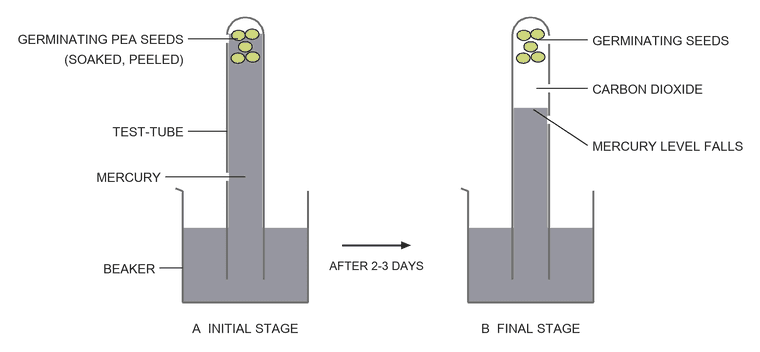
Concept: Soaked, peeled pea seeds are trapped at the top of an inverted test-tube full of mercury, so no air can reach them. The carbon dioxide they give out by anaerobic respiration collects at the top and pushes the mercury down.
Step 1 — Draw the set-up.
Draw two stages side by side and label the seeds, test-tube, mercury, beaker, carbon dioxide and the fallen mercury level.
Step 2 — Explain the initial stage (A).
At the start the tube is full of mercury up to the seeds; there is no gas and no air in the tube.
Step 3 — Explain the final stage (B).
After 2–3 days the mercury level falls, because the seeds release carbon dioxide by anaerobic respiration and the gas collects at the top. A piece of potassium hydroxide pushed into the tube absorbs the gas and the mercury rises again, which proves the gas is carbon dioxide.
Watch out: The seeds must be peeled, because air trapped under the seed coat would let them respire aerobically.
Therefore, the diagram shows the mercury level falling from A to B as carbon dioxide from anaerobic respiration collects at the top of the tube.
- 414 marks
Question 41
The following two chemical reactions are supposed to indicate a certain process occurring in the green plants under two different conditions :
(a) ..........
(b) ..........
(i) Fill in the blanks of each reaction.
(ii) Name the process represented by the two chemical equations.
(iii) What are the conditions under which the two reactions (a) and (b) are occurring ?
Solve with AIWritten solution
Solution:
Concept: Reaction (a) breaks glucose down completely, using oxygen; reaction (b) breaks it down partly, without oxygen. Both are respiration.
Step 1 — Part (i): fill in the blanks.
Balance the atoms: in (a) the missing product is six molecules of water; in (b) it is two molecules of ethyl alcohol.
So the blanks are in (a) and (ethyl alcohol) in (b).
Step 2 — Part (ii): name the process.
Both equations show respiration: (a) is aerobic respiration and (b) is anaerobic respiration.
Step 3 — Part (iii): the conditions.
Reaction (a) takes place normally, in the presence of oxygen (air). Reaction (b) takes place when oxygen is absent or short, for example in germinating seeds or roots kept without air, and only for a short time.
Note: 38 ATP is the textbook (and ICSE) figure; careful modern measurements give about 30–32 ATP per glucose, because some energy is lost in moving substances across the mitochondrial membranes. Use 38 in the examination.
Therefore, (i) six water molecules and two ethyl alcohol molecules; (ii) respiration, aerobic in (a) and anaerobic in (b); (iii) (a) with oxygen, (b) without oxygen.
- 428 marks
Question 42
Given below is a set of six experimental set-ups (A-F), kept in this state for about 24 hours.

(a) In how many flasks, the different plant parts have been kept under observation?
(b) What is the purpose of keeping a test-tube containing limewater in each flask?
(c) In which tube/tubes the limewater will turn milky?
(d) What is the purpose of the set-up F?
(e) What conclusion can you draw from this experiment?
Solve with AIWritten solution
Solution:
Concept: Every living part of a plant respires and gives out carbon dioxide, which limewater detects by turning milky.
Step 1 — Part (a).
Plant parts are kept in five flasks, A to E: flowers, fruits, leaves, pieces of stem and roots.
Step 2 — Part (b).
The limewater detects carbon dioxide: it turns milky if the plant part in that flask gives out carbon dioxide in respiration.
Step 3 — Part (c).
The limewater turns milky in the tubes of flasks A, B, C, D and E, the five flasks that hold living plant parts.
Step 4 — Part (d).
Set-up F, with no plant part, is the control. Its limewater stays clear, which shows that the milkiness in A to E is caused only by the plant parts, not by the air in the flask.
Step 5 — Part (e).
Since flowers, fruits, leaves, stems and roots all gave out carbon dioxide, all parts of a plant respire.
Watch out: The flasks should be kept in the dark; in light, the green leaves in C would use up their carbon dioxide in photosynthesis.
Therefore, (a) five; (b) to detect carbon dioxide; (c) A to E; (d) F is the control; (e) all parts of a plant respire.
- 439 marks
Question 43
The following diagram refers to an apparatus which is used to demonstrate a physiological process :

(a) What is the purpose of keeping potassium hydroxide solution in the test tubes X and Y?
(b) Why has the coloured water risen in tubing 1?
(c) What is the purpose of keeping boiled peas soaked in a disinfectant in test tube Y?
(d) Name the biological process which causes the above rise.
(e) Define the biological process shown in the experiment.
Solve with AIWritten solution
Solution:
Concept: Germinating peas take in oxygen and give out carbon dioxide. If the carbon dioxide is absorbed, the air in the tube shrinks by the volume of oxygen used, and the outside air pressure pushes water up the tubing.
Step 1 — Part (a).
Potassium hydroxide absorbs the carbon dioxide given out by the peas, so any change in the volume of air shows only the oxygen used up.
Step 2 — Part (b).
The germinating peas in X use up oxygen in respiration, and the carbon dioxide they release is absorbed by the potassium hydroxide. So the volume of air in X decreases and its pressure falls, and the outside air pressure pushes the coloured water up tubing 1.
Step 3 — Part (c).
Test-tube Y is the control. Boiled (dead) peas do not respire, and the disinfectant kills bacteria on them so that the bacteria do not respire either. So the water in tubing 2 does not rise, showing that the rise in tubing 1 is due to the living peas.
Step 4 — Part (d).
The process is respiration (aerobic respiration).
Step 5 — Part (e).
Respiration is the biochemical process in living cells by which glucose is oxidised step by step by enzymes, releasing energy, with carbon dioxide and water as end products.
Watch out: The water rises because oxygen is used up, not because carbon dioxide is given out; without the potassium hydroxide the two gas volumes would almost cancel.
Therefore, (a) to absorb carbon dioxide; (b) oxygen used by the peas lowers the air pressure in X; (c) Y is the control; (d) respiration; (e) as defined in Step 5.
- 4410 marks
Question 44
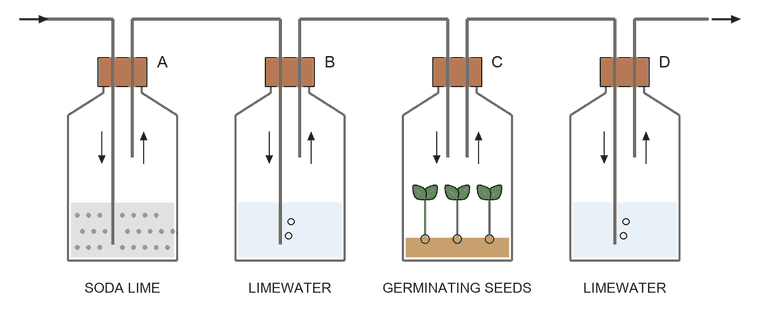
In order to study and prove a particular physiological process in plants, the following experiment was set up. Study the same and then answer the questions that follow :
(a) Name the physiological process being studied.
(b) What is the function of soda lime in the bottle 'A' and why is limewater placed in bottle 'B'?
(c) What change would you expect to observe in bottle 'D'?
(d) Represent the physiological process named in (a) above in the form of a chemical equation.
(e) In order to obtain accurate results, the bottle 'C' should be covered with a piece of black cloth. Why?
(f) If bottle 'C' was fitted with a 3-holed rubber stopper and a thermometer were introduced in such a way that its bulb reaches close to the germinating seeds, what would you observe? Why?
Solve with AIWritten solution
Solution:
Concept: Air free of carbon dioxide is drawn over germinating seeds. Any carbon dioxide that reaches bottle D must have come from the respiration of the seeds.
Step 1 — Part (a).
The process studied is respiration: germinating seeds give out carbon dioxide.
Step 2 — Part (b).
Soda lime in A absorbs carbon dioxide from the incoming air. The limewater in B stays clear, which confirms that the air entering C is free of carbon dioxide.
Step 3 — Part (c).
The limewater in D turns milky, because it receives the carbon dioxide given out by the seeds in C.
Step 4 — Part (d).
Respiration of glucose in the seeds can be written as follows.
Note: 38 ATP is the textbook (and ICSE) figure; careful modern measurements give about 30–32 ATP per glucose, because some energy is lost in moving substances across the mitochondrial membranes. Use 38 in the examination.
Step 5 — Part (e).
The seedlings in C have green parts. In light they would photosynthesise and use up the carbon dioxide they release. The black cloth keeps them in the dark and prevents photosynthesis.
Step 6 — Part (f).
The thermometer would show a rise in temperature, because the germinating seeds release heat energy during respiration.
Watch out: B must stay clear; if it turned milky, the soda lime was not removing all the carbon dioxide and the result in D would prove nothing.
Therefore, (a) respiration; (b) soda lime removes carbon dioxide, limewater in B checks it is removed; (c) D turns milky; (d) the equation in Step 4; (e) to prevent photosynthesis; (f) temperature rises as respiration releases heat.
What Class 9 Biology Ch 7 covers
The sections of the chapter, in the order the book takes them. Every question above comes from one of these.
- 01What Is Respiration
- 02Respiration vs. Burning (Combustion)
- 03The Entire Plant Respires
- 04Two Kinds of Respiration – Aerobic and Anaerobic
- 05Experiments on Respiration in Plants
- 06Respiration Contrasted With Photosynthesis
More ways to study this chapter
The same chapter asked three other ways. Practise it, revise it, and see what the board has set on Ch 7 before.
Class 9 Biology Ch 7 questions students ask
How many questions are there in Class 9 Biology Ch 7?
44 questions. Every one is solved step by step on this page.
Are these Class 9 Biology solutions free?
Yes. Every question and its full working is free to read, with no account needed.
Can I download the Class 9 Biology Ch 7 solutions as a PDF?
There is no PDF to download. Every solution is on this page instead, which means it is searchable, always the current syllabus, and readable on a phone. Use your browser's print option if you want it on paper.