Solution:
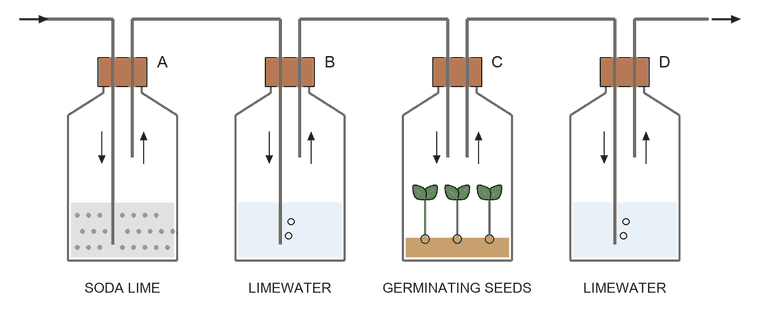
Concept: Air free of carbon dioxide is drawn over germinating seeds. Any carbon dioxide that reaches bottle D must have come from the respiration of the seeds.
Step 1 — Part (a).
The process studied is respiration: germinating seeds give out carbon dioxide.
Step 2 — Part (b).
Soda lime in A absorbs carbon dioxide from the incoming air. The limewater in B stays clear, which confirms that the air entering C is free of carbon dioxide.
Step 3 — Part (c).
The limewater in D turns milky, because it receives the carbon dioxide given out by the seeds in C.
Step 4 — Part (d).
Respiration of glucose in the seeds can be written as follows.
C6H12O6+6O2→6CO2+6H2O+energy (38 ATP)
Note: 38 ATP is the textbook (and ICSE) figure; careful modern measurements give about 30–32 ATP per glucose, because some energy is lost in moving substances across the mitochondrial membranes. Use 38 in the examination.
Step 5 — Part (e).
The seedlings in C have green parts. In light they would photosynthesise and use up the carbon dioxide they release. The black cloth keeps them in the dark and prevents photosynthesis.
Step 6 — Part (f).
The thermometer would show a rise in temperature, because the germinating seeds release heat energy during respiration.
Watch out: B must stay clear; if it turned milky, the soda lime was not removing all the carbon dioxide and the result in D would prove nothing.
Therefore, (a) respiration; (b) soda lime removes carbon dioxide, limewater in B checks it is removed; (c) D turns milky; (d) the equation in Step 4; (e) to prevent photosynthesis; (f) temperature rises as respiration releases heat.