
Question 403 marksMedium
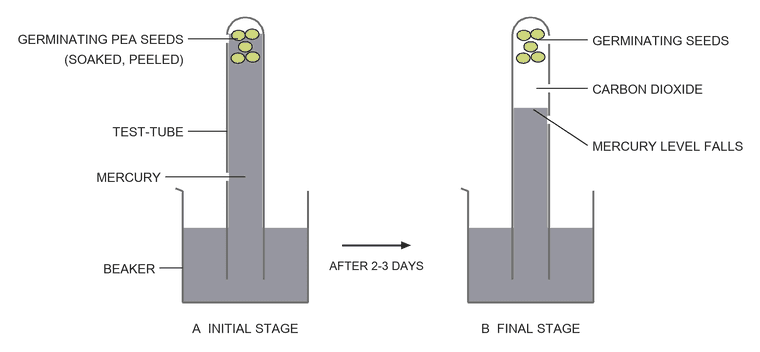
Draw a neat and labelled diagram showing the experimental set up (initial and final stages) to demonstrate anaerobic respiration in germinating seeds.
Confirming your payment
Sign up now and get 250 free tokens.
Respiration in Plants · Question 40 of 44
Draw a neat and labelled diagram showing the experimental set up (initial and final stages) to demonstrate anaerobic respiration in germinating seeds.
Solution:
Concept: Soaked, peeled pea seeds are trapped at the top of an inverted test-tube full of mercury, so no air can reach them. The carbon dioxide they give out by anaerobic respiration collects at the top and pushes the mercury down.
Step 1 — Draw the set-up.
Draw two stages side by side and label the seeds, test-tube, mercury, beaker, carbon dioxide and the fallen mercury level.
Step 2 — Explain the initial stage (A).
At the start the tube is full of mercury up to the seeds; there is no gas and no air in the tube.
Step 3 — Explain the final stage (B).
After 2–3 days the mercury level falls, because the seeds release carbon dioxide by anaerobic respiration and the gas collects at the top. A piece of potassium hydroxide pushed into the tube absorbs the gas and the mercury rises again, which proves the gas is carbon dioxide.
Watch out: The seeds must be peeled, because air trapped under the seed coat would let them respire aerobically.
Therefore, the diagram shows the mercury level falling from A to B as carbon dioxide from anaerobic respiration collects at the top of the tube.