
Opening your dashboard
Class 9 Biology Chapter 7 Respiration in Plants: Practice Questions
43 questions on Chapter 7, each worked through on its own page with the AI tutor. Class 9 Biology, ICSE 2026-27.
43 questions
1–5 marks · Mixed difficulty
- 11 mark
Question 1
Bloom's level: Remember
The Krebs cycle, in which pyruvate is broken down into carbon dioxide and water with the release of ATP, takes place in the :
- 21 mark
Question 2
Bloom's level: Remember
Through which openings does the living tissue of a woody tree trunk mostly receive the oxygen it uses ?
- 31 mark
Question 3
Bloom's level: Remember
Plants carry out two kinds of respiration, aerobic and anaerobic. Another name for anaerobic respiration is :
- 41 mark
Question 4
Bloom's level: Understand
ATP is described as the energy currency of the cell because :
- 51 mark
Question 5
Bloom's level: Understand
Which statement is true of both respiration and the burning of coal ?
- 61 mark
Question 6
Bloom's level: Understand
Plants do not need a special system for carrying respiratory gases, unlike animals, because :
- 71 mark
Question 7
Bloom's level: Apply
A potted plant was over-watered so that water stood in its pot for a week. Its roots began to rot. The main reason is that :
- 81 mark
Question 8
Bloom's level: Apply
Yeast breaks down 4 molecules of glucose by anaerobic respiration. The number of ATP molecules formed is :
- 91 mark
Question 9
Bloom's level: Apply
In the experiment to show that a potted green plant gives out carbon dioxide, a student forgets to cover the bell jar with black cloth and keeps the set-up in bright sunlight. The limewater in the flask through which air leaves the bell jar will most likely :
- 101 mark
Question 10
Bloom's level: Analyse
Assertion (A): In the experiment to show that germinating seeds give out heat, the boiled seeds in the control flask are washed with dilute formalin or carbolic acid.
Reason (R): These antiseptics prevent bacteria from growing on the dead seeds; such bacteria would respire and give out heat.
- 111 mark
Question 11
Bloom's level: Analyse
Assertion (A): Photosynthesis results in a gain in dry weight of the plant.
Reason (R): Photosynthesis takes place only in cells that contain chlorophyll.
- 121 mark
Question 12
Bloom's level: Evaluate
Assertion (A): Plants produce a large amount of heat in respiration compared with animals.
Reason (R): In plants, the respiratory gases simply diffuse in and out from cell to cell.
- 132 marks
Question 13
Bloom's level: Remember
(a) List three activities in a plant that need energy.
(b) Name the simple carbohydrate whose breakdown makes this energy available.
- 142 marks
Question 14
Bloom's level: Understand
Explain the difference between an anabolic and a catabolic process, and state which of the two respiration is, with a reason.
- 152 marks
Question 15
Bloom's level: Understand
Explain why the leaves of a green plant hardly take in oxygen from the air on a bright afternoon, but do take it in at night.
- 162 marks
Question 16
Bloom's level: Understand
Respiration is called a biochemical process, whereas burning is called a physico-chemical process. Explain this difference.
- 172 marks
Question 17
Bloom's level: Apply
5 molecules of glucose are broken down by a plant cell.
(a) How many molecules of carbon dioxide and of ATP are formed if the breakdown is aerobic ?
(b) How many molecules of ATP and of ethanol are formed if the same glucose is broken down anaerobically ?
- 182 marks
Question 18
Bloom's level: Apply
In the four-flask set-up used to show that germinating seeds give out carbon dioxide, air passes through KOH solution (flask A), limewater (flask B), germinating seeds (flask C) and limewater (flask D). A student leaves out flask A. Explain why her result in flask D can no longer prove her point, and what flask B would now show.
- 192 marks
Question 19
Bloom's level: Apply
Yeast is mixed into dough for bread and the dough is kept in a warm place. After a few hours it has risen and become spongy. Explain this using what you know about respiration.
- 202 marks
Question 20
Bloom's level: Apply
A plant cell uses ATP to build proteins from amino acids. State what happens to the ATP when its energy is used, and explain how the cell gets back its ATP.
- 212 marks
Question 21
Bloom's level: Analyse
A potted plant was sealed in a glass jar with moist air, and the carbon dioxide in the jar was measured.
Time Condition Carbon dioxide in jar 8 a.m. Start 0.04% 2 p.m. 6 hours in bright light 0.01% 8 p.m. Next 6 hours in darkness 0.04% Interpret the change in each 6-hour period.
- 222 marks
Question 22
Bloom's level: Evaluate
A student says, "Anaerobic respiration is better for plants than aerobic respiration because it does not need oxygen." Do you agree? Give two reasons for your judgement.
- 233 marks
Question 23
Bloom's level: Understand
(a) Name the first phase of glucose breakdown, which is shared by respiration with oxygen and respiration without oxygen, and state where it occurs.
(b) Explain why anaerobic respiration releases far less energy than aerobic respiration from the same amount of glucose.
(c) Write the balanced chemical equation for each kind of respiration in plants.
- 244 marks
Question 24
Bloom's level: Apply
Eight soaked and peeled pea seeds are pushed into a test tube completely filled with mercury, and the tube is inverted in a dish of mercury. After two days the mercury level in the tube has fallen and a gas has collected at the top.
(a) Name the gas and the kind of respiration that produced it.
(b) Why did the mercury level fall ?
(c) A small stick of potassium hydroxide is now slipped into the tube. What will happen to the mercury level, and why ?
(d) Describe a suitable control for this experiment.
- 254 marks
Question 25
Bloom's level: Apply
Case: To protect a young mango tree from insects, a gardener coated its whole trunk and all its branches with a thick layer of waterproof paint. Over the next few weeks the bark began to die in patches, although the leaves and roots were untouched.
(a) Name the openings in the stem that were blocked by the paint.
(b) Explain why the living cells under the bark were harmed.
(c) Why were the leaves and roots not affected in the same way? Suggest a safer way to protect the trunk.
- 264 marks
Question 26
Bloom's level: Analyse
Case: To show that germinating seeds give out heat, Kabir put soaked, living pea seeds in thermos flask A and boiled pea seeds (not treated with any antiseptic) in thermos flask B. Each flask had a thermometer and a cotton plug. His readings were :
Day Flask A Flask B 0 3 (a) Find the rise in temperature in each flask over the three days.
(b) Analyse why the temperature in flask B also rose.
(c) What change should Kabir make so that flask B becomes a proper control? What should he then expect ?
- 273 marks
Question 27
Bloom's level: Analyse
Seeds of a pea plant kept under water and the leg muscles of a sprinter both start to respire without oxygen for a short time.
(a) Name the end products of this respiration in each case.
(b) State two other differences between respiration in plants and respiration in animals.
(c) Which of the two end products from (a) is useful in making bread? Give a reason.
- 284 marks
Question 28
Bloom's level: Evaluate
Case: Two fruit sellers stored ripe mangoes for a week in a hot market. Seller X kept them in tightly sealed plastic bags; seller Y kept them in open wooden crates in a cool, airy corner. Seller X's mangoes began to smell of alcohol and spoiled faster.
(a) Name the kind of respiration that went on in the sealed bags after some time, and write its word equation.
(b) Explain why the mangoes in the bags smelt of alcohol.
(c) Judge which method of storage is better and justify your answer with two reasons.
- 295 marks
Question 29
Bloom's level: Create
Design an experiment to compare the amount of carbon dioxide given out by germinating pea seeds and by dry pea seeds, using limewater.
(a) List the materials and describe the set-up of your flasks, including a control.
(b) Explain how you will make the comparison fair and how you will measure the result.
(c) Draw up a results table and state the result you expect, with a reason.
- 305 marks
Question 30
Bloom's level: Create
Construct a flow chart summarising the breakdown of glucose in a plant cell. It must show :
(a) the first phase, its product and where it occurs;
(b) the path with oxygen: the phase, its site, its end products and the energy released;
(c) the path without oxygen: the end products and energy in plants, and the end product in animals for comparison.
- 311 mark
Question 31
Which one of the following substances is formed when a plant cell respires aerobically and also when it respires anaerobically ?
- 321 mark
Question 32
The living cells of the root of a potted plant obtain the oxygen they need for respiration :
- 331 mark
Question 33
Assertion (A): The leaves of a green plant do not respire during the daytime.
Reason (R): During the daytime, the carbon dioxide produced in the leaves is used as a raw material for photosynthesis.
- 342 marks
Question 34
In a plant cell, a molecule of glucose is broken down completely with the help of oxygen.
(i) Name the two major phases of this breakdown in the order in which they occur, and state the part of the cell in which each one takes place.
(ii) In which two forms is the energy of the glucose molecule set free ? Which one of them does the cell use for its activities ?
- 352 marks
Question 35
A lump of sugar burns in a flame, while the glucose in a living cell is oxidised in respiration.
(i) State two ways in which these two processes are alike.
(ii) The burning sugar gives out a flame, but a respiring cell is never damaged by the energy it sets free. Give two reasons.
- 362 marks
Question 36
State one difference between respiration in a flowering plant and respiration in a mammal with respect to each of the following :
(i) the way in which oxygen reaches the cells lying deep inside the body
(ii) the amount of heat produced
- 372 marks
Question 37
Germinating bean seeds are placed on wet cotton wool in conical flask P. Boiled bean seeds, with wet cotton wool and a little carbolic acid, are placed in conical flask Q. A small tube of soda lime hangs inside each flask. Each flask is corked, and a delivery tube from it dips into a beaker of water. The flasks are left for a few days.
(i) In the delivery tube of which flask does the water rise higher ? Explain why.
(ii) The corks are then removed and a burning paper is put into each flask. State what is seen in flask P and what this shows.
- 384 marks
Question 38
The figure shows a set-up used to study a life process in a potted green plant. Air is drawn slowly through the apparatus by a suction pump. Every joint, and the rim of the bell jar, is smeared with vaseline.
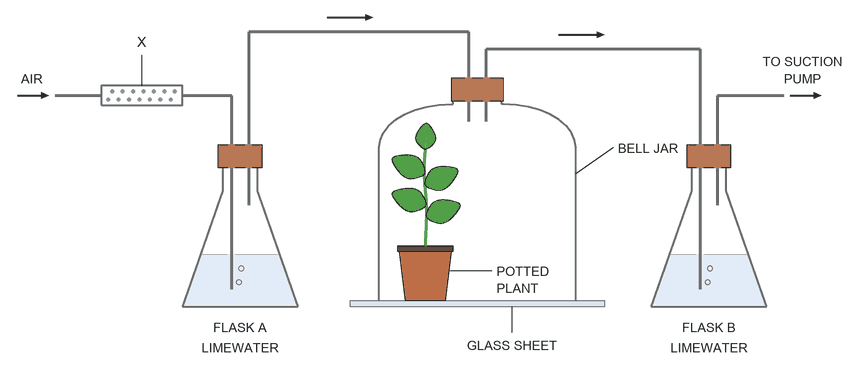
(i) Name the substance X that is packed in the tube, and state its function.
(ii) What is seen in the limewater of flask A and in the limewater of flask B after some time ? Give a reason for each observation.
(iii) State the one precaution, connected with light, without which this experiment does not succeed. Explain why it is needed.
- 394 marks
Question 39
Ten soaked pea seeds, with their seed coats peeled off, were pushed into a test tube filled with mercury. The tube was inverted in a beaker of mercury (stage A). Stage B shows the same set-up two days later.
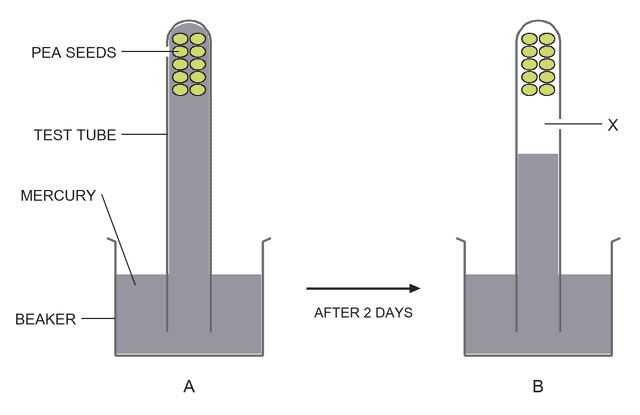
(i) Identify X. What does its presence tell you about the seeds, which have had no air for two days ?
(ii) Into which two substances is glucose broken down in these seeds ? How many ATP molecules are obtained from one molecule of glucose in this way ?
(iii) Why were the seed coats peeled off ? State what will finally happen to the seeds if they are left in the tube for many more days, and why.
- 403 marks
Question 40
The cells of a soaked pea seed broke down 10 molecules of glucose. Of these, 4 molecules were broken down completely, using oxygen. The other 6 molecules were broken down after the seed had been cut off from air.
(i) Calculate the total number of ATP molecules formed from the 10 molecules of glucose.
(ii) Calculate the total number of carbon dioxide molecules released.
(iii) Name the other product formed, besides carbon dioxide, from the 6 molecules of glucose, and state how many molecules of it were formed. Why is this breakdown described as incomplete ?
- 411 mark
Question 41
Class 9 Sample Paper 1 · Section A
What are the products of aerobic respiration?
- 421 mark
Question 42
Class 9 Sample Paper 1 · Section A
Write the function of the following:
(b) Stomata
- 432 marks
Question 43
Class 9 Sample Paper 2 · Section B
Differentiate between photosynthesis and respiration.