
Opening your dashboard
Class 9 Biology Chapter 7 Respiration in Plants: Competency-Based Questions (CBQ)
40 questions on Chapter 7, each worked through on its own page with the AI tutor. Class 9 Biology, ICSE 2026-27.
40 questions
1–5 marks · Mixed difficulty
- 11 mark
Question 1
Cognitive domain: Application
To keep a footpath clean, workers laid cement right up to the trunks of the roadside trees, leaving no open soil around them. Within a year several of these trees became weak, although they were watered through a pipe. Which inlet of oxygen for respiration was affected the most directly by the cement ?
- 21 mark
Question 2
Cognitive domain: Analysis
Three air-tight flasks P, Q and R were set up on wet cotton wool as shown, each with its delivery tube dipping into coloured water. After two days the rise of the coloured water in each delivery tube was measured.
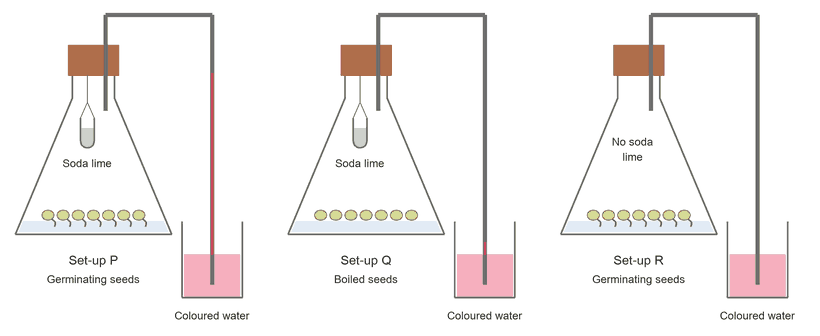
Set-up Seeds Soda lime in the flask Rise of water in the tube P Germinating Present 6.0 cm Q Boiled, with antiseptic Present 0.4 cm R Germinating Absent 0 cm Which is the best explanation for the result in set-up R ?
- 31 mark
Question 3
Cognitive domain: Application
A certain poison stops all the activity of the mitochondria in the cells of a root but leaves the cytoplasm unaffected. Which step of the breakdown of glucose can still go on in these cells ?
- 41 mark
Question 4
Cognitive domain: Understanding
One gram of glucose is burnt on a spoon over a flame. Another gram of glucose is used up by the cells of a sprouting potato lying in a basket. Which statement is true only of the glucose used by the potato cells ?
- 51 mark
Question 5
Cognitive domain: Application
Assertion (A): A healthy potted plant kept in a completely dark cupboard for several days loses weight.
Reason (R): Respiration occurs at all times, whereas photosynthesis occurs only in the presence of light.
- 61 mark
Question 6
Cognitive domain: Understanding
Assertion (A): Soaked pea seeds placed in a test tube completely filled with mercury go on giving out carbon dioxide for a day or two.
Reason (R): Any part of a plant can go on respiring without oxygen for as long as it has food stored in it.
- 71 mark
Question 7
Cognitive domain: Application
After a flood, the cells of a seed buried in water-logged soil get no oxygen and have to respire anaerobically for a short while.
To obtain as much ATP as one molecule of glucose gives in aerobic respiration, such a cell must break down ______ molecules of glucose anaerobically, and in doing so it gives out ______ molecules of carbon dioxide.
- 81 mark
Question 8
Cognitive domain: Understanding
The innermost living cells of a thick sugarcane stem lie many cells away from the outside air, and a plant has no blood. A deer's leg muscles also lie deep inside its body.
The inner cells of the sugarcane stem receive their oxygen by cell to cell ______, whereas in the deer the respiratory gases are transported by the ______.
- 91 mark
Question 9
Cognitive domain: Analysis
At noon, a green leaf produces 12 units of oxygen every hour by photosynthesis, and its cells use 2 units of oxygen every hour in respiration. Assume that its rate of respiration stays the same at night.
At noon the leaf gives out ______ units of oxygen every hour, but at midnight it takes in ______ units of oxygen every hour from the atmosphere.
- 102 marks
Question 10
Cognitive domain: Application
To show that heat is evolved during respiration, the chapter uses thermoflasks whose mouths are plugged with cotton wool. Ravi repeats the experiment with germinating seeds in an ordinary thin glass bottle closed tightly with a rubber stopper. His thermometer shows hardly any rise in temperature.
Give one reason connected with the bottle and one reason connected with the stopper for Ravi's poor result.
- 112 marks
Question 11
Cognitive domain: Evaluation
Anu's grandmother tells her: "Never sleep under a big tree at night. At night a tree gives out so much carbon dioxide that the air under it becomes harmful to breathe."
How far is the grandmother's statement correct ? Judge it on the basis of your chapter.
- 122 marks
Question 12
Cognitive domain: Analysis
One gram of glucose was used up in each of two situations, X and Y, and the following observations were made.
Observation Situation X Situation Y Temperature at which it took place About 30°C Several hundred °C Light given out None Yes Time taken Many hours A few seconds ATP formed Yes No Identify which situation is the respiration of germinating seeds and which is burning. Explain two of the observations for the situation you have identified as respiration.
- 135 marks
Question 13
Cognitive domain: Analysis
Case: Nisha soaked gram seeds and divided them into four equal lots of 100 seeds each. She dried lot 1 completely in an oven at once and weighed it. The other three lots were left to germinate on wet cotton wool in a dark cupboard; one lot was taken out every two days, dried completely and weighed. A fifth lot of 100 seeds, boiled and treated with antiseptic, was kept in the same cupboard for six days and then dried and weighed.
Lot Days in the dark cupboard Dry mass of 100 seeds or seedlings 1 0 20.0 g 2 2 18.8 g 3 4 17.2 g 4 6 15.0 g 5 (boiled) 6 20.0 g (a) Calculate the loss in dry mass of the living seeds in six days, and express it as a percentage of the starting dry mass.
(b) The seedlings in lot 4 were bigger than the seeds in lot 1, yet their dry mass was less. Name the process responsible and explain how it reduces the dry mass.
(c) Why did the dry mass of lot 5 not change ? What is the use of this lot in the experiment ?
(d) Predict what would happen to the dry mass if seedlings like those of lot 4 were now grown in sunlight for two weeks. Give a reason.
- 145 marks
Question 14
Cognitive domain: Evaluation
Case: After an untimely shower, a farmer heaped his damp, freshly harvested wheat grains in a closed store-room. Three days later he pushed his hand into the heap and found the inside distinctly warm. A neighbour said, "A fire is about to start in the heap. Sprinkle water on it to cool it." The farmer's daughter, a Class IX student, disagreed and said the grains should instead be spread out in the sun.
(a) What is the source of the warmth inside the heap ? Explain in terms of what happens to the energy of glucose.
(b) Evaluate the neighbour's advice. Will sprinkling water solve the problem ? Give a reason.
(c) Justify the daughter's suggestion, giving two ways in which spreading the grains in the sun helps.
(d) Why did the store-room make the problem worse than if the damp grains had lain in the open ?
- 155 marks
Question 15
Cognitive domain: Creativity
Case: Meena has learnt that every step of respiration is carried out by an enzyme. She wonders whether germinating seeds respire more slowly in the cold. In the laboratory she can use, with her teacher's help, the apparatus of the experiment that shows that oxygen is used up in respiration: flasks with a small tube of soda lime hung inside, and delivery tubes dipping into coloured water. A refrigerator and a ruler are also available.
(a) Design an experiment for Meena. State the one thing she should change and two things she must keep the same. Mention the control she needs.
(b) What should she measure ? Draw a table for her readings.
(c) Predict the result, and explain how it would answer her question.
- 161 mark
Question 16
Cognitive domain: Application
A rain-fed field of young maize plants is being watched through the monsoon. Four things are going on in the plants. Which one of them is carried out with energy supplied by ATP, which the cells make by respiration ?
- 171 mark
Question 17
Cognitive domain: Analysis
Four plant parts were cut from their plants, and each was placed in its own closed chamber of air, in the dark and at the same temperature. The carbon dioxide given out by of each part in one hour was measured. (Hypothetical data.)
Plant part Carbon dioxide given out (mg per g per hour) Growing root tip Soaked, germinating pea seed Mature leaf Dry pea seed Which conclusion is best supported by these readings ?
- 181 mark
Question 18
Cognitive domain: Understanding
A packet of glucose powder lies for months on a kitchen shelf, where the temperature is about and there is plenty of air, and it stays unchanged. Yet in the living cells of soaked gram seeds kept on wet cotton wool beside it, glucose is broken down all the time at the same temperature. What is the main reason for this difference ?
- 191 mark
Question 19
Cognitive domain: Analysis
Three pots P, Q and R of the same size were filled with the same garden soil, and one young tomato plant of the same size and age was planted in each. They were kept in the same light for ten days. (Hypothetical data.)
Pot How it was kept Roots after ten days P Standing on a dry tray, with the soil well drained White and firm Q Standing in a tray of water, so that the soil was water-logged Brown, soft and rotting R Standing in a tray of water, so that the soil was water-logged, but with air bubbled slowly through the soil among the roots by a fine tube from a small aquarium pump White and firm Which conclusion do these results support best ?
- 201 mark
Question 20
Cognitive domain: Analysis
In the experiment to show that a potted green plant gives out carbon dioxide, air free from carbon dioxide is drawn over the plant, which is kept in the dark inside a bell jar. The limewater in the flask on the outlet side turns milky. Sanjay objects: "The carbon dioxide may have come from the tiny organisms living in the soil of the pot, not from the plant." Which extra set-up would best test his objection ?
- 211 mark
Question 21
Cognitive domain: Analysis
Assertion (A): A growing root tip can go on doing work that needs energy for hours, although each of its cells holds only a very small amount of ATP at any moment.
Reason (R): The ADP formed when ATP is used is converted back into ATP, using the energy set free in the breakdown of glucose.
- 221 mark
Question 22
Cognitive domain: Understanding
Assertion (A): Certain bacteria living in the oxygen-free mud at the bottom of a pond get their energy by respiring anaerobically throughout their lives.
Reason (R): Anaerobic respiration does not release any energy at all.
- 231 mark
Question 23
Cognitive domain: Application
A glass bottle is half filled with moist soil, planted with a few small green plants and then sealed with a cork. It is kept near a window in the light. The plants stay healthy for a long time, although the bottle is never opened and no air is let in. Which statement best explains why the air in the bottle does not run out of oxygen or of carbon dioxide ?
- 241 mark
Question 24
Cognitive domain: Analysis
The bar chart compares what becomes of the energy stored in the same amount of glucose when it is burnt in a flame and when it is respired in a plant cell. (Approximate values.)
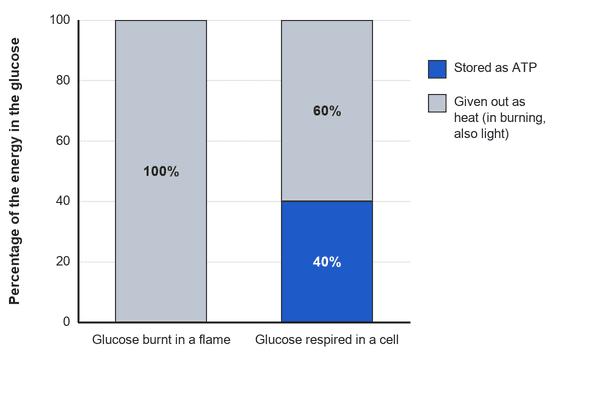
Which statement is supported by the bar chart ?
- 251 mark
Question 25
Cognitive domain: Understanding
A bean seedling growing in a pot and a rabbit sitting in a cage are both alive and respiring. Which statement is true of both of them ?
- 262 marks
Question 26
Cognitive domain: Evaluation
Ritu says: "A green plant makes its own food by photosynthesis, so it has no need to respire. Respiration is only for animals, which cannot make their food."
Evaluate her statement. Give two reasons for your judgement.
- 272 marks
Question 27
Cognitive domain: Application
Some soaked pea seeds were sealed in a glass jar and kept at the same temperature for several days. The oxygen used and the carbon dioxide given out by the seeds were measured on two days. Each amount is a number of molecules per hour, in units of molecules, so means molecules. (Hypothetical data.)
Day Oxygen used per hour Carbon dioxide given out per hour First day Fourth day (a) Which kind of respiration went on in the seeds on each day ? Give the evidence from the readings.
(b) Use the chemical equations of the chapter to find how many molecules of glucose were broken down per hour on each day, and how many molecules of ATP were formed per hour on each day.
- 282 marks
Question 28
Cognitive domain: Evaluation
Gopal says: "A plant cell breaks down glucose by a simpler method than an animal cell. So a plant cell gets only molecules of ATP from each molecule of glucose, while an animal cell gets ."
Evaluate his statement. Give two reasons for your judgement.
- 292 marks
Question 29
Cognitive domain: Analysis
Two conical flasks, each wrapped in a thick layer of cotton wool, held of the same sugar solution at . Flask X contained living yeast cells and flask Y contained yeast cells that had been killed by boiling. After four hours, air from each flask was passed through limewater. (Hypothetical data.)
Observation Flask X (living yeast) Flask Y (killed yeast) Temperature of the solution after four hours Limewater Turned milky Stayed clear Flame or light seen None None (a) State one observation which shows that the breakdown of the sugar in flask X is like the burning of sugar.
(b) State one observation or condition that shows it is not the same as burning.
- 302 marks
Question 30
Cognitive domain: Analysis
Rohan set up the four-flask experiment to show that germinating seeds give out carbon dioxide. As the control he used flask C with boiled seeds and a little carbolic acid. After two days the limewater in the last flask of the control train turned slightly milky. The flask of potassium hydroxide solution, through which the air first passes, was in place in the control train as well.
Give one reason connected with the seeds and one reason connected with the potassium hydroxide flask that could explain the result.
- 312 marks
Question 31
Cognitive domain: Analysis
The graph shows how fast a leaf uses carbon dioxide in photosynthesis, and how fast it gives out carbon dioxide in respiration, at different light intensities. (Hypothetical data.)

(a) At what light intensity does the leaf neither take in nor give out carbon dioxide ? Give a reason.
(b) How much carbon dioxide does the leaf take in from the air each hour at light intensity ?
- 323 marks
Question 32
Cognitive domain: Evaluation
Three students wrote the following about the respiration and the burning of glucose.
Asha: "Respiration is just a very slow burning of glucose, so it also gives out light."
Bilal: "The end products of the two are different. Burning gives carbon dioxide and water, but respiration gives ethanol."
Charu: "Respiration takes place in a series of steps controlled by enzymes and a part of its energy is stored as ATP, while burning takes place in a single step."
Evaluate each statement, saying whether it is correct, and correct it if it is not.
- 333 marks
Question 33
Cognitive domain: Understanding
A school laboratory received four unlabelled samples of living cells, W, X, Y and Z, from a plant or from an animal. The following was noted.
- W: Kept in a tube without air for a few minutes, it formed lactic acid.
- X: The cells lie deep inside a thick stem, and oxygen reaches them by diffusion from cell to cell.
- Y: Kept under mercury without air for two days, it gave out carbon dioxide and a smell of alcohol.
- Z: Oxygen reaches its cells through the blood.
(a) Say whether each sample is from a plant or from an animal.
(b) Write the equation for the breakdown of glucose in Y.
- 343 marks
Question 34
Cognitive domain: Creativity
A student compares the ATP of a cell to the rechargeable battery of a mobile phone.
(a) Complete the comparison by stating what in the cell is like (i) a charged battery, (ii) a flat battery, and (iii) a charger that has been plugged in.
(b) Suggest one way in which the ATP of a cell is not like the battery of a phone.
- 353 marks
Question 35
Cognitive domain: Application
Potato tubers grow underground, in the dark. They are full of starch, which is made from the sugar that the green leaves make and send down to them. A potato tuber kept in a closed jar with a little limewater turns the limewater milky after a day.
(a) Name the process that gives out the carbon dioxide in the tuber.
(b) Why can the tuber not make glucose itself by photosynthesis ?
(c) On a sunny day at noon, compare the exchange of oxygen and carbon dioxide between the air and (i) the tuber, (ii) a green leaf of the same plant. Explain the difference.
- 363 marks
Question 36
Cognitive domain: Application
In the experiment that shows that oxygen is used up in respiration, a flask holds of germinating seeds and a small tube of soda lime, and its delivery tube dips into coloured water. The inside of the delivery tube has a cross-section of . After hours the water has risen by in the tube. (Hypothetical data.)
(a) Find the volume of oxygen used, taking it as equal to the cross-section multiplied by the rise.
(b) Predict how the rise in hours would change if of dry, unsoaked seeds of the same kind were used instead. Give a reason.
(c) Find the volume of oxygen used by of the seeds in one hour.
- 375 marks
Question 37
Cognitive domain: Analysis
Case: After heavy rain, a field of young maize plants stayed under water. To study the effect, a student kept potted maize plants completely under water in a tank, and noted how many plants were alive and how much ethanol was found in their roots after different numbers of days. (Hypothetical data.)
Days under water Plants alive (out of ) Ethanol in the roots (units) (a) What percentage of the plants had died after days ?
(b) What does the ethanol in the roots show about the respiration of the roots ? Why could the plants live for the first days ?
(c) The ethanol went on increasing, but all the plants had died by the th day. Explain why this respiration could not keep the plants alive.
- 384 marks
Question 38
Cognitive domain: Creativity
Case: Anita's teacher says that every living part of a plant respires, even a ripe fruit that has been plucked from the plant. To test this, Anita is given two wide glass jars with tight lids, fresh limewater in small cups, two ripe bananas of the same size and ripeness, a pan of boiling water, a thermometer and some carbolic acid.
(a) Describe a set-up with which she could test the statement. State the control she should use and why it is needed.
(b) State what she should observe in each jar after a day, and what it will show.
(c) Name two conditions that she must keep the same for the two jars, and give a reason for one of them.
- 395 marks
Question 39
Cognitive domain: Analysis
Case: A research report measured the oxygen used by a resting mouse and by a pot of bean seedlings, each kept in its own air-filled chamber for one hour. The animal was not harmed. Soda lime in each chamber absorbed the carbon dioxide. (Hypothetical data.)
Chamber Living material Mass Oxygen used in one hour M Resting mouse S Bean seedlings (a) Find the oxygen used by of each in one hour, and how many times greater the rate is for the mouse.
(b) During the hour, the body of the mouse stayed warm, while the seedlings stayed at the temperature of the air in their chamber. Using what your chapter says about the heat produced in respiration by plants and by animals, explain how this fits the oxygen figures of part (a).
(c) Chamber S was kept in the dark. Explain why the experiment would not have shown the oxygen used by the seedlings if it had been kept in bright light.
- 404 marks
Question 40
Cognitive domain: Evaluation
Case: A school magazine carried this paragraph on respiration in plants.
"(1) Every part of a plant respires, and the roots take in oxygen from the air between the soil particles. (2) Respiration in plants takes place only at night, when photosynthesis has stopped. (3) The first phase of the breakdown of glucose, called glycolysis, takes place in the mitochondria and gives pyruvate. (4) When roots are short of oxygen, they can respire without oxygen for a short time and form ethanol and carbon dioxide."
(a) Which two statements are not correct ?
(b) Rewrite each of them correctly.
(c) Glycolysis is the same first phase in both kinds of respiration, and it gives molecules of ATP from one molecule of glucose. Aerobic respiration gives molecules of ATP in all from one molecule of glucose. The editor wants to add a fifth statement: "(5) Most of the ATP that a plant cell gets from a molecule of glucose in aerobic respiration is made in its cytoplasm." Find how many of the molecules of ATP are not given by glycolysis, and what percentage of the this is. Use your answers to judge statement (5).