
Opening your dashboard
Class 9 Biology Chapter 4: The Flower Solutions
30 textbook questions with step-by-step answers, free to read, for ICSE 2026-27.
Get talked through Ch 4, not just shown the answer
Reading a finished solution is not the same as being able to do it. The AI tutor takes one question at a time and works it with you, in your own words, until you can.
- Ask it out loud, in your own words
- It gives you the next step, not the answer
- Stuck on part (ii)? Start there
30 questions with solutions
1–10 marks · Easy difficulty
- 18 marks
Question 1
Mention if the following statements are true (T) or false (F)
(i) Flowers can be complete or incomplete. T/F
(ii) A flower typically has six floral whorls. T/F
(iii) Bracts are usually green, but sometimes large and colourful. T/F
(iv) Nasturtium has nectaries. T/F
(v) Stamens and carpels are the male and female parts T/F
(vi) The prefix "gamo-" is used whenever any of the floral whorls are fused T/F
(vii) Stigma may be simple or divided into two or more lobes. T/F
(viii) Papaya is monoecious plant. T/F
Solve with AIWritten solution
Solution:
Concept: A typical flower has four whorls on the thalamus: calyx (sepals), corolla (petals), androecium (stamens) and gynoecium (carpels). Check each statement against these facts.
Step 1 — (i) Complete or incomplete.
A flower with all four whorls is complete; if one or more whorls are missing it is incomplete. So the statement is True (T).
Step 2 — (ii) Number of whorls.
A typical flower has four floral whorls, not six. So the statement is False (F).
Step 3 — (iii) Bracts.
Bracts are usually green and leaf-like, but in some plants, such as Bougainvillea, they are large and colourful. So the statement is True (T).
Step 4 — (iv) Nasturtium.
Nasturtium has a very prominent nectary, a spur that holds the nectar. So the statement is True (T).
Step 5 — (v) Male and female parts.
The stamens produce pollen (male) and the carpels bear ovules with the egg (female). So the statement is True (T).
Step 6 — (vi) The prefix gamo-.
Gamo- means fused: fused sepals are gamosepalous, fused petals gamopetalous and fused carpels gamocarpellary (also called syncarpous). So, as the book intends, the statement is True (T). Stamens joined by their filaments are given their own names instead (monadelphous, diadelphous, polyadelphous).
Step 7 — (vii) Stigma.
The stigma may be simple or divided into two or more lobes, and it may even be feathery. So the statement is True (T).
Step 8 — (viii) Papaya.
Papaya usually bears male and female flowers on different plants, so it is dioecious, not monoecious. The statement is False (F).
Watch out: Monoecious = male and female flowers on ONE plant (maize); dioecious = on TWO different plants (papaya).
Therefore, (i) T, (ii) F, (iii) T, (iv) T, (v) T, (vi) T, (vii) T, (viii) F.
- 21 mark
Question 2
Bougainvillea flower has :
Solve with AIAnswer
(A) Large sepals
(B) Large nectary
(C) Large colourful petals
- Correct
(D) Large colourful bracts
Answer: (D) Large colourful bracts
Concept: A bract is a leaf-like structure in whose axil a flower arises. In Bougainvillea the bracts are large and brightly coloured and are easily mistaken for petals; the actual flowers are small and tube-like.
Step 1 — Recall what is showy in Bougainvillea.
The pink, purple or orange 'petals' of Bougainvillea are really bracts. The small tubular flower is attached on the inner side of each bract.
Step 2 — Match with the options.
Large colourful bracts is option (D).
Watch out: The coloured parts look like petals, but they are bracts.
Why the other options are wrong:
- (A) Large sepals: the sepals of Bougainvillea are not large; the showy parts are bracts.
- (B) Large nectary: a very prominent nectary is a feature of Nasturtium, not Bougainvillea.
- (C) Large colourful petals: the colourful parts are bracts, not petals; the true flower is small.
Therefore, the Bougainvillea flower has large colourful bracts, option (D).
- 31 mark
Question 3
A flower is said to be complete when :
Solve with AIAnswer
(A) It has the corolla and calyx
(B) It has the corolla and gynoecium
(C) It has the androecium and gynoecium
- Correct
(D) It has all the four whorls.
Answer: (D) It has all the four whorls.
Concept: A complete flower has all four floral whorls: calyx, corolla, androecium and gynoecium. If any whorl is missing, the flower is incomplete.
Step 1 — List the four whorls.
From outside inwards the whorls are calyx (sepals), corolla (petals), androecium (stamens) and gynoecium (carpels).
Step 2 — Apply the definition.
Only option (D) says that all four whorls are present.
Watch out: A flower with stamens and carpels is bisexual, but it is complete only if sepals and petals are present too.
Why the other options are wrong:
- (A) It has the corolla and calyx: calyx and corolla are only the two non-essential whorls; the stamens and carpels are missing.
- (B) It has the corolla and gynoecium: the calyx and the androecium are missing.
- (C) It has the androecium and gynoecium: the calyx and the corolla are missing; such a flower is bisexual but not complete.
Therefore, a flower is complete when it has all the four whorls, option (D).
- 41 mark
Question 4
The part of the flower that gives rise to the fruit is
Solve with AIAnswer
(A) Sepals
(B) Petals
- Correct
(C) Ovary
(D) Stamens
Answer: (C) Ovary
Concept: After fertilisation the ovary enlarges and ripens into the fruit, while the ovules inside it become the seeds.
Step 1 — Recall what happens after fertilisation.
Once the eggs in the ovules are fertilised, the ovary wall grows and ripens to form the fruit wall.
Step 2 — Match with the options.
The ovary is option (C).
Watch out: Ovary → fruit and ovule → seed; do not swap them.
Why the other options are wrong:
- (A) Sepals: the sepals usually fall off, or stay as a dry persistent calyx, as in brinjal; they do not form the fruit.
- (B) Petals: the petals wither and fall off after fertilisation.
- (D) Stamens: the stamens wither and fall off once their pollen has been shed.
Therefore, the fruit develops from the ovary, option (C).
- 51 mark
Question 5
The part of the flower that gives rise to the seed is
Solve with AIAnswer
(A) Ovary
(B) Placenta
- Correct
(C) Ovule
(D) Pollen grain
Answer: (C) Ovule
Concept: After fertilisation each ovule develops into a seed, and the ovary that holds the ovules becomes the fruit.
Step 1 — Recall what the ovule contains.
Each ovule encloses an egg cell. After fertilisation the egg forms the embryo, and the whole ovule matures into a seed.
Step 2 — Match with the options.
The ovule is option (C).
Watch out: Ovary → fruit and ovule → seed; do not swap them.
Why the other options are wrong:
- (A) Ovary: the ovary becomes the fruit, not the seed.
- (B) Placenta: the placenta is the tissue that attaches the ovules to the ovary wall; it stays in the fruit as the place where the seeds are attached and does not become a seed.
- (D) Pollen grain: pollen grains carry the male gametes to the ovule; they do not turn into seeds.
Therefore, the seed develops from the ovule, option (C).
- 61 mark
Question 6
The essential whorls of a flower are the
Solve with AIAnswer
(A) Calyx and corolla
(B) Stamen and ovary
(C) Calyx and epicalyx
- Correct
(D) Androecium and gynoecium
Answer: (D) Androecium and gynoecium
Concept: The essential whorls are the ones directly concerned with reproduction: the androecium (stamens, male) and the gynoecium (carpels, female). The calyx and corolla are non-essential (accessory) whorls.
Step 1 — Decide which whorls make gametes.
The stamens produce pollen (male) and the carpels bear the ovules (female). Without them no seeds can form, so they are essential.
Step 2 — Match with the options.
Androecium and gynoecium is option (D).
Watch out: The question asks for whorls; a single part such as the ovary is not a whorl.
Why the other options are wrong:
- (A) Calyx and corolla: calyx and corolla are the non-essential (accessory) whorls; they only protect and attract.
- (B) Stamen and ovary: a stamen is one member of the androecium and the ovary is only one part of the pistil; neither is a whole whorl.
- (C) Calyx and epicalyx: the calyx and the epicalyx are both accessory sepal-like whorls.
Therefore, the essential whorls are the androecium and the gynoecium, option (D).
- 71 mark
Question 7
Floral stalk is technically termed as :
Solve with AIAnswer
(A) Petiole
(B) Peduncle
- Correct
(C) Pedicel
(D) Funicle
Answer: (C) Pedicel
Concept: The stalk of a single flower is the pedicel. Other stalks have their own names: a leaf stalk is the petiole, an inflorescence stalk is the peduncle and an ovule stalk is the funicle.
Step 1 — Pick out the key words.
The question asks for the stalk of a flower (one flower), technically named.
Step 2 — Name it.
The stalk of an individual flower is the pedicel, option (C).
Watch out: Pedicel = stalk of one flower; peduncle = stalk of a whole inflorescence.
Why the other options are wrong:
- (A) Petiole: the petiole is the stalk of a leaf.
- (B) Peduncle: the peduncle is the main stalk of an inflorescence (a group of flowers).
- (D) Funicle: the funicle is the stalk that joins an ovule (later a seed) to the placenta.
Therefore, the floral stalk is the pedicel, option (C).
- 81 mark
Question 8
Which part of the pistil serves as the landing place for pollen grains ?
Solve with AIAnswer
(A) Style
(B) Ovary
- Correct
(C) Stigma
(D) Ovules
Answer: (C) Stigma
Concept: The pistil has three parts: the stigma at the top, the style in the middle and the ovary at the base. The stigma is covered with hairs or sticky glandular papillae that hold the pollen.
Step 1 — Recall the job of each part.
The stigma receives the pollen, the style connects the stigma to the ovary, and the ovary holds the ovules.
Step 2 — Match with the options.
The landing place for pollen is the stigma, option (C).
Why the other options are wrong:
- (A) Style: the style is the slender stalk that only connects the stigma to the ovary.
- (B) Ovary: the ovary is at the base of the pistil and encloses the ovules; pollen does not land there.
- (D) Ovules: the ovules lie hidden inside the ovary, so pollen cannot land on them.
Therefore, pollen grains land on the stigma, option (C).
- 91 mark
Question 9
Perianth is the collective term for a group of :
Solve with AIAnswer
(A) Sepals
- Correct
(B) Tepals
(C) Bracts
(D) Petals
Answer: (B) Tepals
Concept: When the sepals and petals look so alike that they cannot be told apart, each is called a tepal, and the tepals together form the perianth.
Step 1 — Recall the collective names.
Sepals together form the calyx, petals together form the corolla, and tepals together form the perianth.
Step 2 — Match with the options.
Perianth is the group of tepals, option (B).
Watch out: The perianth is used only when sepals and petals cannot be told apart.
Why the other options are wrong:
- (A) Sepals: sepals together are called the calyx.
- (C) Bracts: bracts are leaf-like structures in whose axil a flower arises; they are not part of the perianth.
- (D) Petals: petals together are called the corolla.
Therefore, the perianth is the collective term for tepals, option (B).
- 101 mark
Question 10
The condition of androecium, when all the stamens are free from each other is termed as :
Solve with AIAnswer
(A) Polyadelphous
(B) Polysepalous
- Correct
(C) Polyandrous
(D) Polypetalous
Answer: (C) Polyandrous
Concept: The androecium is the whorl of stamens. When all the stamens are free from one another it is polyandrous (poly = many, andros = male), as in Petunia.
Step 1 — Note the condition.
The question describes stamens that are all free, not joined in any group.
Step 2 — Name it.
Free stamens make a polyandrous androecium, option (C).
Watch out: PolyANDROUS (free stamens) and polyADELPHOUS (stamens in several bundles) look alike; read the ending.
Why the other options are wrong:
- (A) Polyadelphous: polyadelphous stamens are united by their filaments into several bundles, as in Bombax.
- (B) Polysepalous: polysepalous describes free sepals, not stamens.
- (D) Polypetalous: polypetalous describes free petals, not stamens.
Therefore, free stamens form a polyandrous androecium, option (C).
- 111 mark
Question 11
The flower which contains both stamens and carpels is called as :
Solve with AIAnswer
(A) Unisexual
(B) Pistillate
(C) Staminate
- Correct
(D) Hermaphrodite
Answer: (D) Hermaphrodite
Concept: A flower with both stamens (male parts) and carpels (female parts) is a bisexual or hermaphrodite flower, e.g. hibiscus, rose.
Step 1 — Note what the flower has.
The flower in the question has both stamens and carpels, so it has both sexes.
Step 2 — Name it.
A flower with both sexes is hermaphrodite (bisexual), option (D).
Why the other options are wrong:
- (A) Unisexual: a unisexual flower has only stamens or only carpels.
- (B) Pistillate: a pistillate flower has only carpels (it is a female flower).
- (C) Staminate: a staminate flower has only stamens (it is a male flower).
Therefore, a flower with both stamens and carpels is hermaphrodite, option (D).
- 125 marks
Question 12
Match the parts in Column A with the flowers or parts of flower in Column B.
Column A Column B (a) Polyadelphous (i) Polypetalous (b) Pollen grains (ii) Calyx, corolla (c) Free petals (iii) Nectar (d) Non-essential (iv) Bombax (e) Sweet fragrant liquid (v) Pollen sac Solve with AIWritten solution
Solution:
Concept: Match each term in Column A with its example, its meaning, or the place where it is found in Column B; each item of Column B is used once.
Step 1 — (a) Polyadelphous.
Stamens united in several bundles are found in (iv) Bombax.
Step 2 — (b) Pollen grains.
Pollen grains are formed in the anther's (v) pollen sacs.
Step 3 — (c) Free petals.
A corolla of free petals is (i) polypetalous.
Step 4 — (d) Non-essential.
The non-essential whorls are the (ii) calyx and corolla, which do not take part in reproduction directly.
Step 5 — (e) Sweet fragrant liquid.
The sweet fragrant liquid made by nectaries is (iii) nectar.
Therefore, (a)–(iv) Bombax, (b)–(v) Pollen sac, (c)–(i) Polypetalous, (d)–(ii) Calyx, corolla, (e)–(iii) Nectar.
- 135 marks
Question 13
Name :
(a) Four whorls of the flower
(b) Two types of unisexual flowers
(c) Two main parts of a Stamen
(d) Three main parts of a Pistil
(e) Three types of stamens on the basis of their cohesion.
Solve with AIWritten solution
Solution:
Concept: A flower is built of four whorls; the stamen and the pistil each have named parts, and stamens are named by how their filaments join (cohesion).
Step 1 — (a) Four whorls.
From outside inwards: calyx, corolla, androecium and gynoecium.
Step 2 — (b) Unisexual flowers.
A flower with only stamens is a staminate (male) flower, and one with only carpels is a pistillate (female) flower.
Step 3 — (c) Parts of a stamen.
A stamen has a thread-like filament and an anther at its tip.
Step 4 — (d) Parts of a pistil.
Each carpel of the pistil has a stigma, a style and an ovary.
Step 5 — (e) Stamens by cohesion.
Stamens joined by their filaments are monadelphous (one group), diadelphous (two groups) or polyadelphous (several groups).
Watch out: Polyandrous means FREE stamens, so it is not a type of cohesion.
Therefore, (a) calyx, corolla, androecium, gynoecium; (b) staminate and pistillate; (c) filament and anther; (d) stigma, style, ovary; (e) monadelphous, diadelphous, polyadelphous.
- 144 marks
Question 14
Give two examples of each :
(a) Monoecious palnts
(b) Dioecious plants
(c) Imperfect flowers
(d) Bisexual flowers
Solve with AIWritten solution
Solution:
Concept: Monoecious plants carry male and female flowers on the same plant; dioecious plants carry them on different plants; imperfect (unisexual) flowers have only stamens or only carpels; bisexual flowers have both.
Step 1 — (a) Monoecious plants.
Male and female flowers on the same plant: maize, cucumber (also pumpkin).
Step 2 — (b) Dioecious plants.
Male and female flowers on different plants: papaya, palm (date palm).
Step 3 — (c) Imperfect flowers.
Unisexual flowers, having only stamens or only carpels: the flowers of papaya, cucumber (also maize and palm).
Step 4 — (d) Bisexual flowers.
Flowers with both stamens and carpels: hibiscus, rose (also lily, tomato).
Watch out: A monoecious PLANT can still bear unisexual (imperfect) FLOWERS, as in cucumber.
Therefore, (a) maize, cucumber; (b) papaya, palm; (c) papaya, cucumber; (d) hibiscus, rose.
- 155 marks
Question 15
Fill in the blanks with suitable words :
(a) The floral parts are borne on the .......... in four whorls.
(b) The collective name of petals is .......... .
(c) .......... and corolla are accessory whorls of the flower.
(d) .......... attaches the ovules to the wall of the ovary.
(e) The sweet fragrant liquid of flowers is termed as .......... .
Solve with AIWritten solution
Solution:
Concept: Each blank needs one term from the description of the parts of a flower.
Step 1 — (a) Where the parts are borne.
The floral parts are borne in four whorls on the thalamus (receptacle), the swollen tip of the flower stalk.
Step 2 — (b) Petals together.
The petals together are called the corolla.
Step 3 — (c) Accessory whorls.
The calyx and corolla are the accessory (non-essential) whorls.
Step 4 — (d) What holds the ovules.
The placenta attaches the ovules to the wall of the ovary.
Step 5 — (e) The sweet liquid.
The sweet fragrant liquid of flowers is nectar; it attracts insects for pollination.
Therefore, (a) thalamus, (b) corolla, (c) Calyx, (d) Placenta, (e) nectar.
- 165 marks
Question 16
Note the relationship between the first two words and suggest a suitable word/words for the blank place.
(a) Sepals : Calyx :: Petals : ..........
(b) Stamens : .......... :: Pistil : Gynoecium
(c) Petals : Polypetalous :: Stamens : ..........
(d) Green petals : Sepaloid :: Coloured sepals : ..........
(e) Pollen grains : Anther :: Ovules : ..........
Solve with AIWritten solution
Solution:
Concept: In each analogy, find how the first two words are related and keep the same relation on the right side of ::.
Step 1 — (a) Collective name.
Sepals together form the calyx, so petals together form the corolla.
Step 2 — (b) Collective name.
The pistil (carpels) together form the gynoecium, so stamens together form the androecium.
Step 3 — (c) The free condition.
Free petals are polypetalous, so free stamens are polyandrous.
Step 4 — (d) Looking like the other whorl.
Green petals look like sepals (sepaloid), so coloured sepals look like petals: they are petaloid.
Step 5 — (e) Where they are formed.
Pollen grains are formed in the anther, so ovules are formed in the ovary.
Watch out: For (c), polyadelphous means stamens in several bundles, not free stamens.
Therefore, (a) Corolla, (b) Androecium, (c) Polyandrous, (d) Petaloid, (e) Ovary.
- 173 marks
Question 17
Name the type of androecium found in
(a) China rose
(b) Bombax
(c) Pea
Solve with AIWritten solution
Solution:
Concept: The androecium is named by how the filaments of the stamens are joined: one group (monadelphous), two groups (diadelphous) or several groups (polyadelphous).
Step 1 — (a) China rose.
All the filaments are united into one staminal tube round the style, with only the anthers free: monadelphous.
Step 2 — (b) Bombax.
The filaments are united in several bundles: polyadelphous.
Step 3 — (c) Pea.
Nine of the ten stamens are united and one is free, making two groups: diadelphous.
Therefore, (a) China rose: monadelphous, (b) Bombax: polyadelphous, (c) Pea: diadelphous.
- 188 marks
Question 18
Explain briefly the following terms :
(a) Incomplete flower
(b) Staminate flower
(c) Pistillate flower
(d) Bisexual flower
Solve with AIWritten solution
Solution:
Concept: These terms depend on which whorls a flower has (complete or incomplete) and which sex organs it has (staminate, pistillate, bisexual).
Step 1 — (a) Incomplete flower.
An incomplete flower is one in which one or more of the four floral whorls is missing, e.g. the papaya flower.
Step 2 — (b) Staminate flower.
A staminate flower is a unisexual flower that has only stamens (a male flower).
Step 3 — (c) Pistillate flower.
A pistillate flower is a unisexual flower that has only carpels (a female flower).
Step 4 — (d) Bisexual flower.
A bisexual (hermaphrodite) flower has both stamens and carpels, e.g. hibiscus.
Watch out: Staminate comes from stamen (male); pistillate comes from pistil (female).
Therefore, an incomplete flower lacks one or more whorls, a staminate flower has only stamens, a pistillate flower has only carpels, and a bisexual flower has both.
- 194 marks
Question 19
What is the difference between :
(a) Flower and inflorescence ?
(b) Petals and petaloid tepals ?
Solve with AIWritten solution
Solution:
Concept: A flower is one unit, an inflorescence is a group of flowers; petals are found when sepals and petals look different, tepals when they look alike.
Step 1 — (a) Flower and inflorescence.
A flower is a single specialised shoot that bears the floral whorls for reproduction. An inflorescence is the arrangement of many flowers on the flowering axis of a plant.
Step 2 — (b) Petals and petaloid tepals.
Petals are the coloured members of the second whorl (corolla) and are clearly different from the green sepals. Petaloid tepals are found when the sepals and petals cannot be told apart: all the members of the perianth are coloured and look like petals.
Therefore, a flower is one reproductive shoot while an inflorescence is the arrangement of many flowers; petals differ from the sepals, while petaloid tepals are petal-like members of a perianth whose sepals and petals look alike.
- 2010 marks
Question 20
Define the terms :
(a) Flower
(b) Inflorescence
(c) Placentation
(d) Bract
(e) Epicalyx
Solve with AIWritten solution
Solution:
Concept: A definition gives the exact meaning in one precise sentence, using the chapter's key words.
Step 1 — (a) Flower.
A flower is a specialised shoot whose leaves are modified into floral parts for reproduction.
Step 2 — (b) Inflorescence.
An inflorescence is the mode of arrangement of flowers on the axis of a plant.
Step 3 — (c) Placentation.
Placentation is the manner in which the ovules are arranged (attached) on the wall of the ovary.
Step 4 — (d) Bract.
A bract is a leaf-like structure in whose axil a flower arises.
Step 5 — (e) Epicalyx.
The epicalyx is a second series of sepals (episepals) just outside the calyx, as in Hibiscus.
Watch out: Placentation is the ARRANGEMENT of ovules; the placenta is the tissue that holds them.
Therefore, the five terms are defined as above.
- 218 marks
Question 21
Where are the following structures/parts located and what are their functions ?
(a) Placenta
(b) Thalamus
(c) Anther
(d) Stigma
Solve with AIWritten solution
Solution:
Concept: For each part, first say where it lies in the flower, then what it does.
Step 1 — (a) Placenta.
It lies inside the ovary, on the ovary wall or on the central axis. It attaches the ovules to the ovary and passes food to them.
Step 2 — (b) Thalamus.
It is the swollen tip of the flower stalk (pedicel). It bears all the floral whorls: calyx, corolla, androecium and gynoecium.
Step 3 — (c) Anther.
It is at the tip of the filament of each stamen. It produces pollen grains in its four pollen sacs and releases them when mature.
Step 4 — (d) Stigma.
It is at the top of the style of the pistil. It receives the pollen grains during pollination; its hairs or sticky papillae hold them.
Therefore, the placenta (in the ovary) holds the ovules, the thalamus (tip of the stalk) bears the whorls, the anther (tip of the filament) makes pollen, and the stigma (top of the style) receives pollen.
- 2210 marks
Question 22
Distinguish between the following pairs :
(a) Monoecious and Dioecious plants
(b) Perfect and Imperfect flowers
(c) Unisexual and Bisexual flowers
(d) Essential and Non-essential whorls of a flower
(e) Polyandrous and Polyadelphous stamens
Solve with AIWritten solution
Solution:
Concept: To distinguish two terms, state the one feature in which they differ, and give an example of each where possible.
Step 1 — (a) Monoecious and dioecious plants.
These differ in where the male and female flowers grow:
Monoecious plants Dioecious plants Male and female flowers grow on the same plant Male and female flowers grow on different plants e.g. maize, cucumber e.g. papaya, palm Step 2 — (b) Perfect and imperfect flowers.
In the book's usage these differ in whether all four whorls are present:
Perfect (complete) flower Imperfect (incomplete) flower Has all four floral whorls One or more whorls are missing e.g. hibiscus e.g. papaya Note: In current botany, 'perfect' means bisexual (having both stamens and carpels) and 'imperfect' means unisexual, while 'complete' means having all four whorls; so a perfect flower need not be complete.
Step 3 — (c) Unisexual and bisexual flowers.
These differ in the sex organs present:
Unisexual flower Bisexual flower Has either stamens or carpels Has both stamens and carpels e.g. papaya e.g. hibiscus Step 4 — (d) Essential and non-essential whorls.
These differ in their role in reproduction:
Essential whorls Non-essential whorls Androecium and gynoecium Calyx and corolla Directly concerned with reproduction Protect the reproductive parts or attract pollinators Step 5 — (e) Polyandrous and polyadelphous stamens.
These differ in whether the stamens are joined:
Polyandrous Polyadelphous Stamens free from each other Filaments united in several bundles e.g. Petunia e.g. Bombax Watch out: Monoecious and dioecious describe PLANTS; unisexual and bisexual describe FLOWERS.
Therefore, the five pairs differ as shown in the tables.
- 236 marks
Question 23
Why are the following described as stated :
(a) The androecium of pea flower is diadelphous
(b) Ray florets of sunflower as neuters
(c) Salvia sepals as petaloid
Solve with AIWritten solution
Solution:
Concept: Each description names a visible condition of the flower part, so explain the structure that earns the name.
Step 1 — (a) Pea androecium is diadelphous.
A pea flower has ten stamens. Nine of them are united by their filaments into a staminal tube and one is free, so the stamens form two groups. Di = two, adelphous = bundles (brothers), hence diadelphous.
Step 2 — (b) Ray florets of sunflower are neuters.
The ray florets round the edge of a sunflower head have no working stamens or pistil; any pistil present is sterile. They cannot take part in reproduction, so they are called neuter. Their large coloured strap-like petals attract insects to the head.
Step 3 — (c) Salvia sepals are petaloid.
The sepals of Salvia are brightly coloured like petals instead of green, so they are described as petaloid (petal-like).
Therefore, pea stamens are in two groups (9 + 1), sunflower ray florets have no working sex organs, and Salvia sepals are coloured like petals.
- 243 marks
Question 24
What are bracts ? State their function.
Solve with AIWritten solution
Solution:
Concept: A bract is a leaf-like structure in whose axil a flower or an inflorescence arises.
Step 1 — Define a bract.
Bracts are leaf-like structures in whose axil a flower or an inflorescence arises. They may be green like leaves or brightly coloured, as in Bougainvillea.
Step 2 — State the functions.
A bract does different jobs depending on its colour:
- Green bracts protect the young flower bud and, being green, also carry out photosynthesis.
- Large, coloured bracts attract insects for pollination when the flowers themselves are small, as in Bougainvillea.
Therefore, bracts are leaf-like structures bearing flowers in their axils; they protect the bud, make food when green, and attract insects when coloured.
- 253 marks
Question 25
Explain the terms Monadelphous, Diadelphous and Polyadelphous using suitable diagrams. In each case name a flower possessing such an androecium.
Solve with AIWritten solution
Solution:
Concept: The word adelphous literally means 'group of brothers'. The prefix tells into how many bundles the filaments of the stamens are united: mono = one, di = two, poly = several.
Step 1 — Monadelphous.
The filaments are united into one group, a staminal tube, and only the anthers are free. Example: China rose (also cotton).
Step 2 — Diadelphous.
The filaments are united in two bundles: nine form a tube and one stays free. Example: Pea.
Step 3 — Polyadelphous.
The filaments are united in several bundles. Example: Bombax.
Step 4 — Draw the diagrams.
Draw the three kinds side by side and label the staminal tube, the free stamen and one bundle:

Labels: staminal tube; free stamen; one bundle; monadelphous (China rose), diadelphous (Pea), polyadelphous (Bombax).
Watch out: In every case the anthers stay free; only the filaments are joined.
Therefore, monadelphous = one bundle (China rose), diadelphous = two bundles (Pea), polyadelphous = several bundles (Bombax).
- 261 mark
Question 26
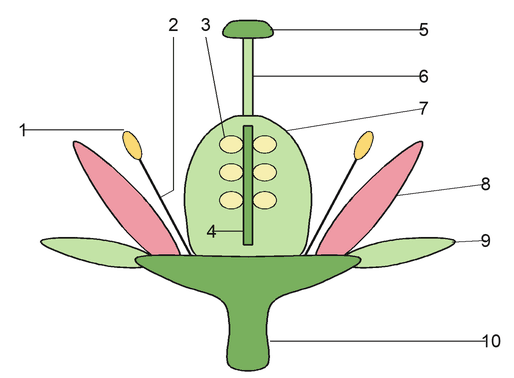
The figure given below represents generalised arrangement of the different parts of a bisexual flower. Name the parts numbered 1-10.
 Solve with AI
Written solution
Solution:
Concept: A bisexual flower has, from outside inwards, the calyx (sepals), the corolla (petals), the androecium (stamens) and the gynoecium (pistil), all borne on the thalamus.
Step 1 — The male parts (1, 2).
The numbers on the stamen point to its swollen tip, 1 — anther, and its thin stalk, 2 — filament.
Step 2 — Inside the ovary (3, 4).
The small rounded bodies inside the ovary are 3 — ovules, and the central tissue to which they are attached is 4 — placenta.
Step 3 — The pistil (5, 6, 7).
The pistil has the knob at the top, 5 — stigma, the slender stalk, 6 — style, and the swollen base, 7 — ovary.
Step 4 — The accessory whorls and the base (8, 9, 10).
The long coloured part is 8 — petal, the short green outer part is 9 — sepal, and the swollen top of the stalk that bears all the parts is 10 — thalamus (receptacle).
Watch out: The style and the filament are both thin stalks: the style belongs to the pistil, the filament to a stamen.
Therefore, 1 anther, 2 filament, 3 ovule, 4 placenta, 5 stigma, 6 style, 7 ovary, 8 petal, 9 sepal, 10 thalamus (receptacle).
- 274 marks
Question 27
Given alongside are two figures (A & B) of a certain part of a flower. Study the figures carefully and answer the following questions:
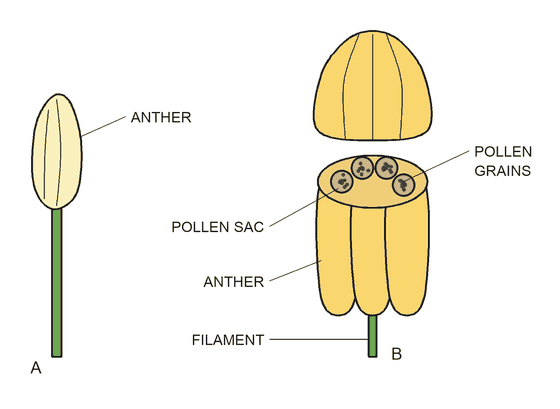
(a) Which major organ of a flower does the figure A represent ? What is the collective term for this organ ?
(b) Are the contents of the pollen sacs in B male or female ?
(c) Can you state how the contents of the pollen sacs would come out ?
Solve with AIWritten solution
Solution:
Concept: A stamen has a filament and an anther; the anther has two lobes with two pollen sacs each (four in all), full of pollen grains.
Step 1 — (a) Identify A.
Figure A has a thin filament with an anther at its tip, so it is a stamen, the male organ of the flower. The stamens together are called the androecium.
Step 2 — (b) Contents of the pollen sacs.
The pollen sacs in B contain pollen grains, which form the male gametes. So the contents are male.
Step 3 — (c) How the pollen comes out.
When the anther is fully mature, the walls of the pollen sacs rupture (dehisce) and the powdery pollen grains are set free, ready to be carried to a stigma.
Therefore, (a) A is a stamen, collectively the androecium; (b) the contents are male; (c) the mature pollen sacs burst open and release the pollen grains.
- 281 mark
Question 28
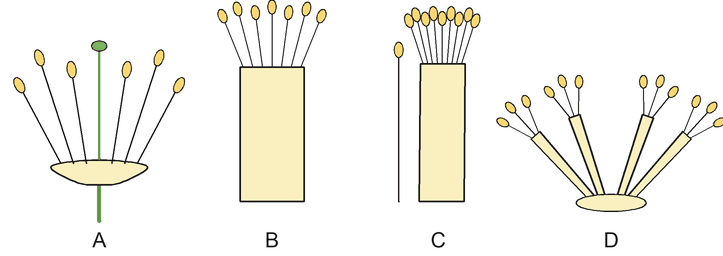
The figures (A, B, C and D) given below represent different kinds of androecium. Name the kinds of androecium (A, B, C and D) and give one example of a flower having each.
 Solve with AI
Written solution
Solution:
Concept: Kinds of androecium are named by how the filaments are joined: all free (polyandrous), one tube (monadelphous), two bundles (diadelphous) or several bundles (polyadelphous).
Step 1 — A.
Every stamen stands on its own, free from the others: polyandrous, e.g. Petunia.
Step 2 — B.
All the filaments are joined into one tube with only the anthers free: monadelphous, e.g. China rose.
Step 3 — C.
One stamen stands free beside a tube of nine joined stamens, giving two groups: diadelphous, e.g. Pea.
Step 4 — D.
The filaments are joined in several separate bundles: polyadelphous, e.g. Bombax.
Watch out: Count the groups of filaments, not the anthers.
Therefore, A polyandrous (Petunia), B monadelphous (China rose), C diadelphous (Pea), D polyadelphous (Bombax).
- 297 marks
Question 29
Draw a neat diagram of male (♂) and female (♀) reproductive organs of aflower.
(a) Label two important parts of the male reproductive organ.
(b) Label four important parts of the female reproductive organ.
(c) Write the collective name/whorl of each reproductive organ.
(d) Name the unicellular, sexual structures produced in each.
(e) Name the parts of the female reproductive organ that develop into a fruit and seed respectively.
Solve with AIWritten solution
Solution:
Concept: The male reproductive organ of a flower is the stamen and the female reproductive organ is the pistil (carpel).
Step 1 — Draw the two organs.
Draw a stamen and a pistil side by side and label them:

Step 2 — (a) Parts of the male organ.
The stamen has an anther (which makes pollen) and a filament (which holds the anther up).
Step 3 — (b) Parts of the female organ.
The pistil has a stigma (receives pollen), a style (joins the stigma to the ovary), an ovary (the swollen base) and ovules (inside the ovary).
Step 4 — (c) Collective names (whorls).
The stamens together form the androecium; the carpels together form the gynoecium.
Step 5 — (d) The single-celled sexual structures.
The stamen produces pollen grains; each is formed as a single cell and later forms the two male gametes. The pistil produces the egg cell (female gamete) inside each ovule.
Step 6 — (e) Fruit and seed.
After fertilisation the ovary becomes the fruit and each ovule becomes a seed.
Watch out: The pollen grain is shed as a 2- or 3-celled structure; it is the gametes it forms that fuse with the egg.
Therefore, (a) anther, filament; (b) stigma, style, ovary, ovule; (c) androecium and gynoecium; (d) pollen grains and the egg cell; (e) ovary → fruit, ovule → seed.
- 3010 marks
Question 30
Draw either an entire flower or a part of it showing the following conditions :
(a) Polysepalous calyx
(b) Gamosepalous calyx
(c) Polypetalous corolla
(d) Gamopetalous corolla
(e) Bracteate flower
Solve with AIWritten solution
Solution:
Concept: The prefix poly- means free and gamo- means fused; a bracteate flower is one that arises in the axil of a bract.
Step 1 — (a) Polysepalous calyx.
Draw the sepals free from one another, each separately attached to the thalamus.
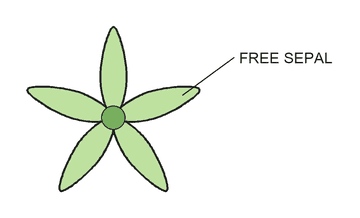
Label: free sepal.
Step 2 — (b) Gamosepalous calyx.
Draw the sepals fused along their sides into a cup, with only their tips free.
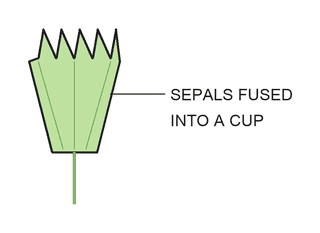
Label: sepals fused into a cup.
Step 3 — (c) Polypetalous corolla.
Draw the petals free from one another.

Label: free petal.
Step 4 — (d) Gamopetalous corolla.
Draw the petals fused into a tube or funnel, with free lobes at the top.
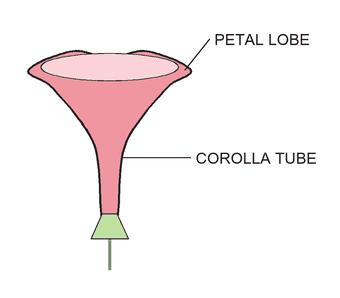
Labels: corolla tube, petal lobe.
Step 5 — (e) Bracteate flower.
Draw a stem with a bract on it and the flower's stalk (pedicel) arising from the axil of the bract, the angle between the bract and the stem.
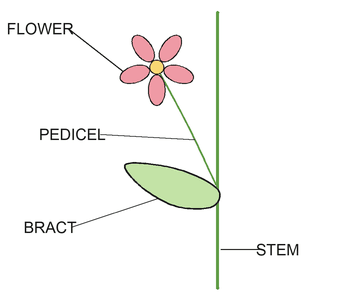
Labels: bract, pedicel, flower, stem.
Watch out: In (e) the pedicel starts in the angle above the bract; it must not grow out of the bract itself.
Therefore, the five conditions are drawn and labelled as shown.
What Class 9 Biology Ch 4 covers
The sections of the chapter, in the order the book takes them. Every question above comes from one of these.
- 01Structure of a Bisexual Flower
- 02Complete and Incomplete Flowers
- 03Sexuality in Flowers
- 04General Description of the Floral Parts
- 05Inflorescence and Placentation
More ways to study this chapter
The same chapter asked three other ways. Practise it, revise it, and see what the board has set on Ch 4 before.
Class 9 Biology Ch 4 questions students ask
How many questions are there in Class 9 Biology Ch 4?
30 questions. Every one is solved step by step on this page.
Are these Class 9 Biology solutions free?
Yes. Every question and its full working is free to read, with no account needed.
Can I download the Class 9 Biology Ch 4 solutions as a PDF?
There is no PDF to download. Every solution is on this page instead, which means it is searchable, always the current syllabus, and readable on a phone. Use your browser's print option if you want it on paper.