
Opening your dashboard
Class 9 Biology Chapter 4 The Flower: Competency-Based Questions (CBQ)
40 questions on Chapter 4, each worked through on its own page with the AI tutor. Class 9 Biology, ICSE 2026-27.
40 questions
1–5 marks · Mixed difficulty
- 11 mark
Question 1
Cognitive domain: Application
In the school garden, Asha watches honeybees on the nasturtium flowers. Each bee pushes itself deep down to the bottom of the flower, stays there for a few seconds and then flies to the next flower. What is the bee collecting there, and how does the plant gain from these visits ?
- 21 mark
Question 2
Cognitive domain: Analysis
The figure shows a bisexual flower cut lengthwise. Four of its parts are lettered P, Q, R and S.
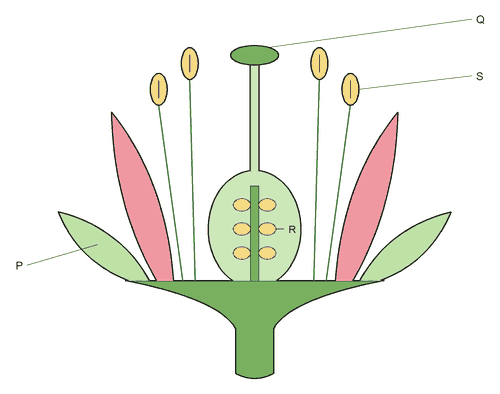
A plant breeder wants the seeds of this flower to be formed only with pollen that she brings from another plant. So, while the flower is still a bud, she must carefully remove the parts that would produce this flower's own pollen. Which lettered parts should she remove ?
- 31 mark
Question 3
Cognitive domain: Application
Mrs Nair grows a cucumber vine on her terrace. She notices that many of its yellow flowers wither and drop off without forming any cucumber. When she looks closely, the flowers that drop have only stamens. The flowers that form cucumbers have a small swollen part below the petals and have no stamens. What is the best explanation ?
- 41 mark
Question 4
Cognitive domain: Analysis
Students examined four flowers W, X, Y and Z from four different plants and noted which whorls were present.
Flower Calyx Corolla Stamens Carpels W Present Present Present Present X Present Absent Present Present Y Present Present Present Absent Z Present Present Absent Absent Which flower is incomplete and yet bisexual ?
- 51 mark
Question 5
Cognitive domain: Understanding
Assertion (A): If the pollen sacs of an anther fail to rupture, the flower cannot give out its pollen even though pollen grains have been formed in it.
Reason (R): The pollen grains are contained within the pollen sacs, and these rupture on maturing to liberate the pollen grains.
- 61 mark
Question 6
Cognitive domain: Analysis
Assertion (A): The ray florets of a sunflower form seeds, because a pistil can be seen in them.
Reason (R): The ray florets of a sunflower are pistillate but sterile, and they are described as neuter flowers.
- 71 mark
Question 7
Cognitive domain: Application
On a nature walk, Anil picks up a fallen flower that is new to him. He counts 15 stamens in it. Their anthers are free, but the filaments are joined to form 3 separate bundles of 5 stamens each.
Complete the sentence :
The androecium of this flower is ______, because the filaments of its stamens are united in ______ groups.
- 81 mark
Question 8
Cognitive domain: Understanding
Sneha opens a white lily flower to find its sepals and petals. She finds six white, petal-like parts which all look alike, and nothing green below them. She cannot say which of them are sepals and which are petals.
Complete the sentence :
Such parts are called ______, and since they are not green, the perianth of this flower is described as ______.
- 91 mark
Question 9
Cognitive domain: Application
Farmer Balbir shows his son a sunflower head that has just begun to open. A ring of tiny flowers at the edge of the disc is already open, while those in the middle are still tightly closed buds.
Complete the sentence :
A sunflower head is not a single flower but an ______, and the flowers at the edge open first because they are the ______ flowers of the head.
- 102 marks
Question 10
Cognitive domain: Evaluation
For a class chart, Jatin has written : "Placentation — the arrangement of flowers on a plant. To study it, count the flowers on a branch."
Judge Jatin's entry. Correct it, and suggest what he should actually look at to study placentation.
- 112 marks
Question 11
Cognitive domain: Evaluation
Tara says, "If a plant bears unisexual flowers, then one plant alone can never give fruits. Two plants must always be grown side by side."
Is Tara's statement always true ? Justify your answer with examples from the chapter.
- 122 marks
Question 12
Cognitive domain: Understanding
A Bougainvillea creeper and a Gul Mohur tree both look brilliantly coloured when in bloom. Yet in Bougainvillea the actual flowers are small, and in Gul Mohur it is not only the petals that are red.
Explain which part gives the colour in each plant, and give the term used for it. How does such colour help a flower ?
- 134 marks
Question 13
Cognitive domain: Application
Case: Three flowers on Imran's tomato plant were damaged in one week. Tomato flowers are bisexual.
- Flower 1 had just opened fully when a strong wind tore off all its petals.
- Flower 2 was still a bud when beetles ate up all its anthers.
- Flower 3 had its whole pistil eaten by a caterpillar.
The other flowers of the plant were healthy, and bees visited the plant every day.
(a) Which of the three flowers lost essential parts ? What makes a part of a flower "essential" ?
(b) Flower 1 later formed a tomato. Explain why the loss of its petals did not stop this.
(c) Flower 2 also formed a tomato with seeds. Suggest how this was possible although it made no pollen of its own.
(d) Flower 3 never formed a tomato. Explain why.
- 145 marks
Question 14
Cognitive domain: Analysis
Case: Members of a school nature club examined all the open flowers on four plants P, Q, R and S of four different kinds, and sorted the flowers into three types.
Plant Staminate flowers Pistillate flowers Bisexual flowers P 24 9 0 Q 60 0 0 R 0 35 0 S 0 0 12 (a) Which of these plants bears unisexual flowers and is monoecious ? Give the reason.
(b) Plants Q and R are two plants of the same kind. What term is used for such a kind of plant ? Name one example from your chapter.
(c) Each flower that has an ovary can form one fruit. What is the largest number of fruits that each plant can form from these flowers, and what is the total for the four plants ?
(d) Plant Q has the largest number of flowers, yet the club decides that it will bear no fruit at all. Is the club right ? Explain. Is plant Q still useful to plant R ?
- 155 marks
Question 15
Cognitive domain: Creativity
Case: The nature club wants a pocket-sized "flower key" card. Any student should be able to pick up an unknown flower, answer a few yes/no questions on the card, and reach two results : whether the flower is complete or incomplete, and whether it is bisexual, staminate, pistillate or neuter.
(a) Design the key. Write the yes/no questions in the order in which they should be asked, and show what each answer leads to.
(b) Draw a table in which a student can record the findings for five flowers.
(c) Test your key on these two flowers and write the two results for each : a male flower of pumpkin, which has sepals, petals and stamens only ; and a flower which has sepals and petals but neither working stamens nor a working pistil.
- 161 mark
Question 16
Cognitive domain: Analysis
A school nature club surveyed flowers collected from a garden. (Hypothetical data.)
- of the flowers were staminate and were pistillate.
- All the remaining flowers were bisexual.
- Every bisexual flower had sepals, but of the bisexual flowers had no petals.
How many of the flowers were complete ?
- 171 mark
Question 17
Cognitive domain: Application
Neha examined two flowers in the school garden. In a china rose flower, the filaments of all the stamens were joined into one tube around the style, and the anthers stood free on the upper part of the tube. In a Petunia flower, each stamen had its own separate filament, not joined to the filament of any other stamen.
What do her observations show ?
- 181 mark
Question 18
Cognitive domain: Analysis
The figure shows four plants P, Q, R and S. The flowers (red dots) are arranged on the axis of each plant in a different way.
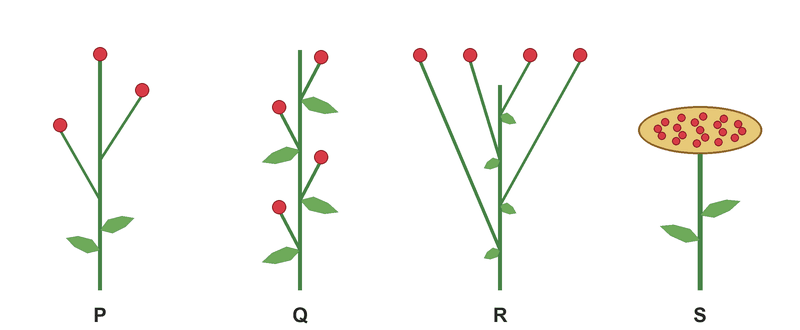
Meena studied one of these plants and noted down three points : (i) every flower stalk springs from the axil of a leaf ; (ii) the flower stalks of the lower leaves are longer than those of the upper leaves ; (iii) all the open flowers reach about the same level and form a cluster.
Which plant did Meena study ?
- 191 mark
Question 19
Cognitive domain: Understanding
A student records the essential parts of four flowers with two symbols : ♂ means that stamens are present and ♀ means that carpels are present.
Flower Record F1 ♂ ♀ F2 ♂ F3 ♀ F4 none Which two flowers have a part that can grow into a fruit ?
- 201 mark
Question 20
Cognitive domain: Analysis
Assertion (A): A bunch of roses cut from a plant and tied together in a bouquet is an inflorescence.
Reason (R): Inflorescence is the mode of arrangement of flowers on the axis of a plant.
- 211 mark
Question 21
Cognitive domain: Analysis
Assertion (A): In a pea flower, nine of the ten stamens are united by their filaments and one stamen is free.
Reason (R): The word diadelphous means that the filaments of the stamens are united in several groups.
- 221 mark
Question 22
Cognitive domain: Application
Kiran pulled off, one whorl at a time, all the sepals, all the petals, all the stamens and then the pistil of a mustard flower. A small, slightly swollen knob was left at the tip of the flower stalk.
What is this knob, and what was its role in the flower ?
- 231 mark
Question 23
Cognitive domain: Analysis
Ravi wants to find out whether the petals of a flower are needed for the flower to form a fruit. A bean plant in his garden has many flowers that have just opened.
Which plan gives the fairest test ?
- 241 mark
Question 24
Cognitive domain: Analysis
A gardener found a flower on a flowering plant in which one of the petals had grown as a small green leaf-like part. The other parts of the flower looked normal.
Which idea from the chapter explains this best ?
- 251 mark
Question 25
Cognitive domain: Understanding
A student studied pollen grains from four garden plants under a microscope. (Hypothetical data.)
Plant Shape of the grains Size of a grain W Round, covered with spines Large X Oval and smooth Small Y Round, with a net-like pattern Medium Z Oval, with ridges Medium Which conclusion does the table support ?
- 262 marks
Question 26
Cognitive domain: Application
A gardener nipped off every flower bud, as soon as it appeared, from a few of her marigold plants. These plants stayed healthy and green for the whole season. At the end of the season they had no seeds at all, while the plants that she left alone were full of seeds.
Explain the difference. What does it show about the function of the flower ?
- 272 marks
Question 27
Cognitive domain: Evaluation
A student says : "A tomato contains many seeds, so it must have been formed from many flowers."
Evaluate this statement.
- 282 marks
Question 28
Cognitive domain: Application
While cutting a tomato, Ravi sees a small green star-shaped cap at the stalk end of the fruit.
(a) From which whorl of the flower does the green cap come ? Give a reason.
(b) What does the cap show about the behaviour of this whorl after the flower has opened ?
- 292 marks
Question 29
Cognitive domain: Evaluation
Priya says : "The flower of this plant sits directly on the stem and has no stalk, so it is an incomplete flower."
Is she correct ? Explain.
- 302 marks
Question 30
Cognitive domain: Application
A school garden has two flowers. Flower A has five petals that are free from one another and spread out flat. Flower B has its petals joined into a funnel around the stamens and the pistil. A sudden shower falls on the garden.
(a) Whose stamens and pistil are better sheltered, A's or B's ? Give a reason.
(b) Give the technical term for the corolla of each flower.
- 312 marks
Question 31
Cognitive domain: Understanding
The green head of broccoli that we eat is a compact mass of many tiny, unopened flower buds, crowded together on the branches of a thick, fleshy axis.
Is this head one flower or an inflorescence ? Give a reason.
- 323 marks
Question 32
Cognitive domain: Analysis
Each of the four whorls of a flower (sepals, petals, stamens and carpels) may be there or may be missing. A student treats every different pattern of whorls as one kind of flower, and finds that there are kinds in all.
(a) How many of the kinds are complete flowers ?
(b) How many are bisexual ?
(c) How many are neuter ?
Give a reason for each answer.
- 333 marks
Question 33
Cognitive domain: Analysis
The figure shows the top view of three corollas P, Q and R.

(a) Match each corolla with one of these : the usual arrangement of petals in a single whorl ; a double whorl, as in poppy ; a spiral arrangement, as in water lily.
(b) How many petals does Q have, and in how many whorls are they arranged ?
(c) Why can the petals of R not be counted as belonging to separate whorls ?
- 343 marks
Question 34
Cognitive domain: Creativity
Class 9 is preparing a "memory aid" poster for the chapter on the flower.
(a) Make up a short sentence whose first letters help to recall the four whorls of a flower in order, from the outside to the inside.
(b) Make up one memory aid that helps to tell monadelphous, diadelphous and polyadelphous apart.
(c) Explain why each of your memory aids is correct.
- 353 marks
Question 35
Cognitive domain: Application
The figure shows cross-sections of the ovaries of two flowers, M and N. In M, three parts are marked P, Q and R.
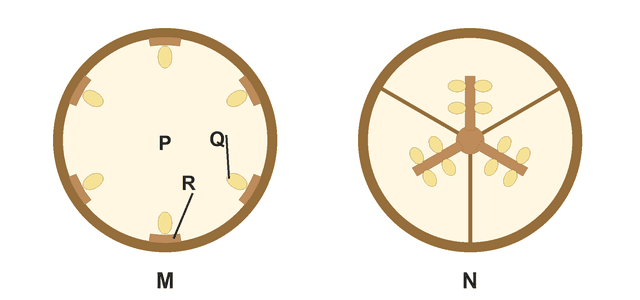
(a) Name the parts P, Q and R.
(b) State the number of chambers and the number of ovules in each of M and N.
(c) What will the ovules and the whole ovary turn into in the mature fruit ?
- 363 marks
Question 36
Cognitive domain: Evaluation
In a class discussion, the teacher asks the students to imagine that a hailstorm will destroy two of the four whorls of every flower on a tomato plant in bloom, and that they may choose which two whorls are spared.
- Jaya says : "I would spare the calyx and the corolla, because they are the most beautiful parts."
- Ali says : "I would spare the androecium and the gynoecium."
Whose plan is better if they want the plant to form tomatoes with seeds ? Give reasons. State also one risk in the better plan.
- 375 marks
Question 37
Cognitive domain: Analysis
Case: A botany club examined the androecium of four flowers, A, B, C and D, from four different plants. (Hypothetical data.)
Flower Number of stamens What was seen A The filaments of all the stamens are united in one group; the anthers are free B The filaments of stamens are united in one group and stamen is free C The filaments are united in groups of stamens each D All the stamens are free from one another Each anther is two-lobed in the usual way.
(a) Name the condition of the androecium in each flower.
(b) Find the number of pollen sacs in each flower and in all the four flowers together.
(c) The teacher says that one of these flowers is a pea flower and another is a Bombax flower. Identify them and give a reason.
- 385 marks
Question 38
Cognitive domain: Analysis
Case: A farmer opened five ripe pods of a pea plant and counted the seeds in each pod. The ovary of every pea flower of this plant held ovules. The ovules that did not grow into seeds had withered. (Hypothetical data.)
Pod 1 2 3 4 5 Seeds in the pod (a) Find the total number of seeds in the five pods and the mean number of seeds per pod.
(b) How many ovules withered in each pod, and how many in all ?
(c) Name the tissue that fixed the ovules to the wall of the ovary, and the term for the manner in which the ovules are fixed. State what the pod and the seeds were in the flower.
- 394 marks
Question 39
Cognitive domain: Evaluation
Case: A student made a poster on the flower with five statements. Some of them are wrong.
- A complete flower has stamens and carpels only.
- The stamens and the carpels are the essential parts of a flower.
- The androecium is the collective name of the carpels.
- A bract is a leaf-like structure in whose axil a flower arises.
- A flower that has only stamens is a pistillate flower.
(a) Which three statements are wrong ?
(b) Rewrite each wrong statement correctly.
(c) Why are the stamens and carpels called the essential parts ?
- 405 marks
Question 40
Cognitive domain: Creativity
Case: For the science exhibition, Class 9 is making a card game called "Flower Detective". Each card describes a mystery flower through three clues, and the player has to name its kind (complete or incomplete, and bisexual, staminate, pistillate or neuter).
(a) Write one card whose answer is "complete and bisexual". Give the three clues and the answer.
(b) Write one card whose answer is "pistillate and incomplete". Give the three clues and the answer.
(c) Write one "trick card" in which the stamens and the carpels cannot be seen from outside, yet the flower is bisexual. Give the three clues and explain how the player should solve it.