
Question 3010 marksEasy
Draw either an entire flower or a part of it showing the following conditions :
(a) Polysepalous calyx
(b) Gamosepalous calyx
(c) Polypetalous corolla
(d) Gamopetalous corolla
(e) Bracteate flower
Confirming your payment
Sign up now and get 250 free tokens.
The Flower · Question 30 of 30
Draw either an entire flower or a part of it showing the following conditions :
(a) Polysepalous calyx
(b) Gamosepalous calyx
(c) Polypetalous corolla
(d) Gamopetalous corolla
(e) Bracteate flower
Solution:
Concept: The prefix poly- means free and gamo- means fused; a bracteate flower is one that arises in the axil of a bract.
Step 1 — (a) Polysepalous calyx.
Draw the sepals free from one another, each separately attached to the thalamus.
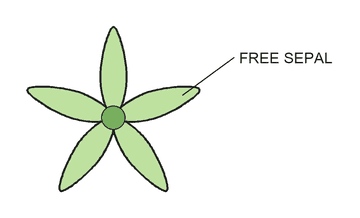
Label: free sepal.
Step 2 — (b) Gamosepalous calyx.
Draw the sepals fused along their sides into a cup, with only their tips free.
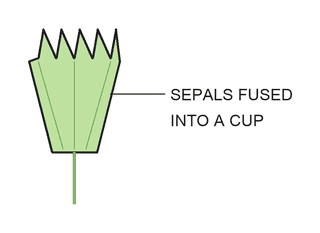
Label: sepals fused into a cup.
Step 3 — (c) Polypetalous corolla.
Draw the petals free from one another.

Label: free petal.
Step 4 — (d) Gamopetalous corolla.
Draw the petals fused into a tube or funnel, with free lobes at the top.
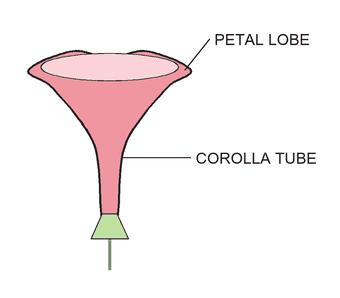
Labels: corolla tube, petal lobe.
Step 5 — (e) Bracteate flower.
Draw a stem with a bract on it and the flower's stalk (pedicel) arising from the axil of the bract, the angle between the bract and the stem.
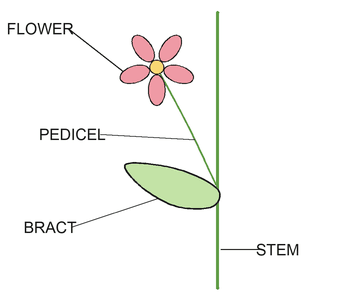
Labels: bract, pedicel, flower, stem.
Watch out: In (e) the pedicel starts in the angle above the bract; it must not grow out of the bract itself.
Therefore, the five conditions are drawn and labelled as shown.