
Question 281 markEasy
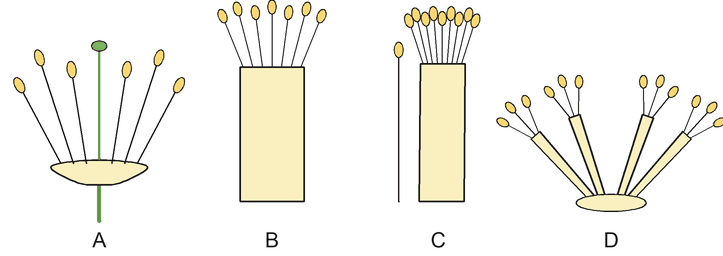
The figures (A, B, C and D) given below represent different kinds of androecium. Name the kinds of androecium (A, B, C and D) and give one example of a flower having each.
Confirming your payment
Sign up now and get 250 free tokens.
The Flower · Question 28 of 30
The figures (A, B, C and D) given below represent different kinds of androecium. Name the kinds of androecium (A, B, C and D) and give one example of a flower having each.
Solution:
Concept: Kinds of androecium are named by how the filaments are joined: all free (polyandrous), one tube (monadelphous), two bundles (diadelphous) or several bundles (polyadelphous).
Step 1 — A.
Every stamen stands on its own, free from the others: polyandrous, e.g. Petunia.
Step 2 — B.
All the filaments are joined into one tube with only the anthers free: monadelphous, e.g. China rose.
Step 3 — C.
One stamen stands free beside a tube of nine joined stamens, giving two groups: diadelphous, e.g. Pea.
Step 4 — D.
The filaments are joined in several separate bundles: polyadelphous, e.g. Bombax.
Watch out: Count the groups of filaments, not the anthers.
Therefore, A polyandrous (Petunia), B monadelphous (China rose), C diadelphous (Pea), D polyadelphous (Bombax).