
Opening your dashboard
Class 9 Biology Chapter 4 The Flower: Practice Questions
47 questions on Chapter 4, each worked through on its own page with the AI tutor. Class 9 Biology, ICSE 2026-27.
47 questions
1–5 marks · Mixed difficulty
- 11 mark
Question 1
Bloom's level: Remember
In which flower are the petals arranged spirally ?
- 21 mark
Question 2
Bloom's level: Remember
In a bisexual flower, the whorl located at the very centre is the :
- 31 mark
Question 3
Bloom's level: Remember
In a sunflower head, where the axis is flattened into a disc, the youngest flowers are found :
- 41 mark
Question 4
Bloom's level: Remember
The word adelphous, used when naming how the stamens of a flower are joined in bundles, literally means :
- 51 mark
Question 5
Bloom's level: Understand
A flower has sepals, petals and stamens but no carpels. It is best described as :
- 61 mark
Question 6
Bloom's level: Understand
Green sepals are useful to a flower because they :
- 71 mark
Question 7
Bloom's level: Apply
A villager grows a single date palm tree in his courtyard. It flowers every year but never bears any fruit. The most likely reason is that :
- 81 mark
Question 8
Bloom's level: Apply
The petals of a Datura flower are joined together to form a long funnel. Its corolla is :
- 91 mark
Question 9
Bloom's level: Apply
When a pea pod is opened, each seed is found attached to the inner edge of the pod by a small stalk-like tissue. This attachment comes from the :
- 101 mark
Question 10
Bloom's level: Analyse
Assertion (A): Sepals and petals are called the non-essential parts of a flower.
Reason (R): Sepals and petals are not directly concerned with reproduction; they only protect the reproductive parts or make the flower attractive.
- 111 mark
Question 11
Bloom's level: Evaluate
Assertion (A): The epicalyx of Hibiscus is a second whorl of petals.
Reason (R): In Hibiscus there is an extra whorl of small, green, sepal-like parts, called the epicalyx, just outside the calyx.
- 121 mark
Question 12
Bloom's level: Analyse
Assertion (A): A single maize plant can produce seeds even though its flowers are unisexual.
Reason (R): Maize is monoecious : its male and female flowers grow on the same plant.
- 132 marks
Question 13
Bloom's level: Understand
Reproduction is the most important function of a living organism. Explain why the flower is so important to a flowering plant.
- 142 marks
Question 14
Bloom's level: Understand
A flower is described as a specialised shoot. Explain this description.
- 152 marks
Question 15
Bloom's level: Apply
Classify each flower as bisexual, staminate, pistillate or neuter :
(a) A rose flower with both stamens and carpels.
(b) A papaya flower with carpels only.
(c) A cucumber flower with stamens only.
(d) A flower with sepals and petals but neither stamens nor carpels.
- 162 marks
Question 16
Bloom's level: Understand
Explain how a stigma that is lobed, feathery and covered with hairs or glandular papillae suits its function.
- 171 mark
Question 17
Bloom's level: Apply
A female papaya flower has a calyx, a corolla and a gynoecium. Is it a complete flower ? Give a reason.
- 182 marks
Question 18
Bloom's level: Analyse
Study the two flowers described below :
Feature Flower X Flower Y Petals Large, brightly coloured Small, dull Smell Sweet fragrance None Nectaries Present at base of petals Absent Which flower is more likely to be pollinated by insects ? Analyse how each of the three features helps.
- 192 marks
Question 19
Bloom's level: Evaluate
A student says, "Sepals are always green, and once the flower opens they have no further use." Evaluate this statement.
- 202 marks
Question 20
Bloom's level: Apply
In plant P, single flowers grow at the tip of the main stem and at the tips of the side branches. In plant Q, the flowers grow from the axils of the leaves along the stem.
(a) What is the term for this difference in the way flowers are arranged ?
(b) If all the shoot tips of both plants are cut off, which plant will lose all its flowers ? Why ?
- 212 marks
Question 21
Bloom's level: Understand
The flower is usually the most beautiful and conspicuous part of a plant. Explain how this is linked to its function.
- 222 marks
Question 22
Bloom's level: Analyse
Every unisexual flower is an incomplete flower, but not every incomplete flower is unisexual. Explain with an example.
- 234 marks
Question 23
Bloom's level: Apply
Case: A farmer planted ten papaya seedlings in a row. When they flowered, four trees bore flowers with only stamens and six bore flowers with only carpels. Only those six trees produced fruit. His neighbour's cucumber vines each bore both kinds of flowers on the same vine.
(a) Is papaya monoecious or dioecious ? Is cucumber monoecious or dioecious ?
(b) Why did the four trees never produce fruit ?
(c) The farmer plans to cut down the four non-fruiting trees to make space. Advise him whether this is wise, with a reason.
- 245 marks
Question 24
Bloom's level: Analyse
Case: Two flowers X and Y were picked from the same plant and cut lengthwise. They are shown below :
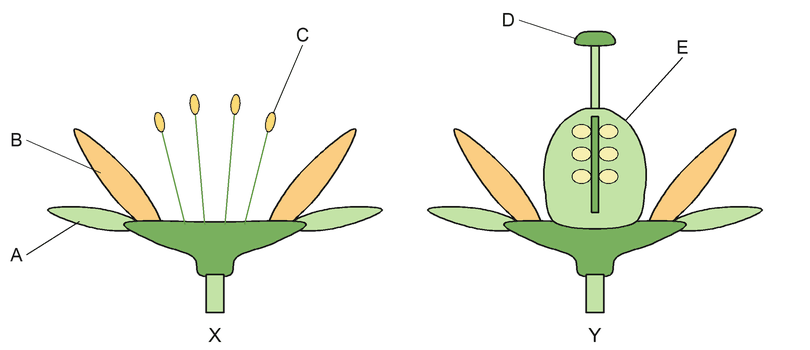
(a) Name the parts labelled A, B, C, D and E.
(b) Classify X and Y as complete or incomplete, and as staminate or pistillate. Give a reason for each.
(c) What kind of plant is this — monoecious or dioecious ? Which of the two flowers can develop into a fruit ? Explain.
- 253 marks
Question 25
Bloom's level: Understand
Describe the structure of an anther and explain how its pollen grains are released. Then state how the style and the ovary of a carpel are built.
- 264 marks
Question 26
Bloom's level: Apply
A student examines a china rose (Hibiscus) flower and notes :
- an extra ring of small green leaf-like parts just below the sepals;
- five sepals joined together at the base;
- five large red petals, free from one another;
- many stamens whose filaments are united into one tube around the style.
(a) Name the extra ring of parts.
(b) Use the correct technical term to describe the calyx, the corolla and the androecium.
(c) Is the flower complete and bisexual ? Explain.
- 274 marks
Question 27
Bloom's level: Apply
A bisexual flower has sepals, petals, stamens and a pistil of carpel containing ovules. Each anther is two-lobed in the usual way.
(a) How many floral parts are borne on the thalamus altogether ?
(b) How many pollen sacs does the flower have ?
(c) If each pollen sac holds about pollen grains, about how many pollen grains does the flower produce ?
(d) What is the largest number of seeds its fruit can contain ? Give a reason.
- 284 marks
Question 28
Bloom's level: Evaluate
Rahul says : "The petals are the most essential part of a flower, because a flower without bright petals can never reproduce."
Evaluate his statement. Give four points in your answer.
- 295 marks
Question 29
Bloom's level: Create
Construct a revision table on the four whorls of a bisexual flower. For each whorl give :
(a) its position (first to fourth), (b) its collective name, (c) the name of its individual unit, (d) whether it is essential or non-essential, and (e) its main function.
- 305 marks
Question 30
Bloom's level: Create
Plan a classroom activity to study the parts of a large bisexual flower such as Hibiscus or Datura.
(a) List the materials you need.
(b) Write the steps to separate and arrange the four whorls in order on a sheet of paper.
(c) Describe how you would examine the inside of the ovary, and design a table to record your counts and observations.
- 311 mark
Question 31
Which one of the following gives the four whorls of a bisexual flower in the correct order, from the outermost to the innermost ?
- 321 mark
Question 32
In most flowers, the nectaries (groups of nectar-secreting cells) are situated :
- 331 mark
Question 33
Assertion (A): A papaya tree that bears only staminate flowers cannot produce fruits.
Reason (R): A fruit is formed from the ovary, which is a part of the carpel.
- 342 marks
Question 34
In the flower of a lily, the members of the two outer whorls look so alike that a sepal cannot be told apart from a petal.
(i) What are such floral members called ? Give their collective name.
(ii) In the lily these members are white or brightly coloured. Which term describes them ? What would they be called if they were green ?
- 352 marks
Question 35
(i) Which part of a stamen produces the pollen that forms the male gametes, and which part of a carpel bears the ovule that encloses the female gamete ?
(ii) A flower of tomato is described as hermaphrodite, but a flower of palm is not. Explain.
- 362 marks
Question 36
The figure shows all the ten stamens of a pea flower, drawn after the other floral parts have been removed.
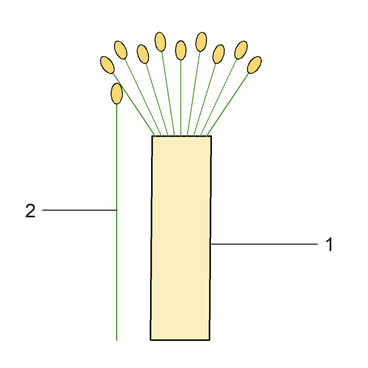
(i) Name the condition of the androecium shown. How many stamens make up the part numbered 1 ?
(ii) State one way in which the androecium of a china rose flower differs from this one, and name the condition found in china rose.
- 372 marks
Question 37
(i) Differentiate between placenta and placentation.
(ii) What do the ovules turn into in a mature fruit ? Name any two fruits in which the different arrangements of these structures can be seen.
- 384 marks
Question 38
The figure shows a bisexual flower cut lengthwise. Seven of its parts are numbered.
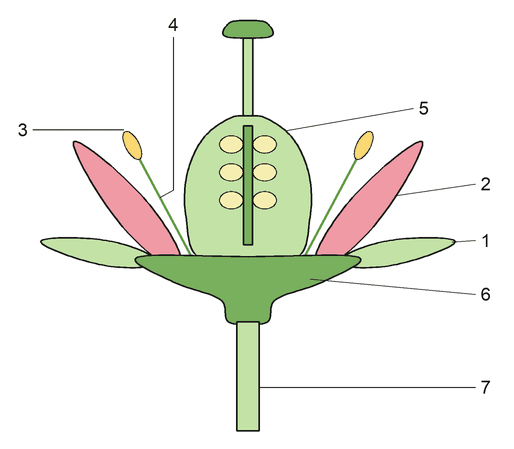
(i) Give the collective names of the whorls formed by parts like 1 and by parts like 2. Why are these two whorls called the non-essential parts of the flower ?
(ii) Name parts 3 and 4. Name the organ that these two parts make up together, and state whether it is a male or a female organ.
(iii) Name parts 5, 6 and 7. What is a flower called when part 7 is absent ?
- 394 marks
Question 39
The figure shows a pistil made of a single carpel, cut lengthwise.
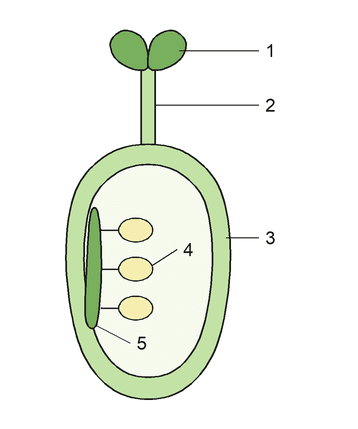
(i) Identify the three regions of the pistil numbered 1, 2 and 3.
(ii) State the function of part 1 during pollination. Mention one feature of part 1 that helps it to carry out this function.
(iii) Name parts 4 and 5. What does part 4 enclose, and what is the function of part 5 ?
- 403 marks
Question 40
(i) What is meant by the term inflorescence ?
(ii) Describe any two ways in which flowers may be arranged on the axis of a plant.
(iii) In the head of a sunflower, state the shape of the axis and the positions of the youngest and the oldest flowers on it.
- 411 mark
Question 41
Class 9 Sample Paper 1 · Section A
What are diadelphous flowers?
- 421 mark
Question 42
Class 9 Sample Paper 1 · Section A
Name the following:
A flower that contains only stamens.
- 431 mark
Question 43
Class 9 Sample Paper 1 · Section A
Write the function of the following:
(d) Ovary in plants
- 442 marks
Question 44
Class 9 Sample Paper 1 · Section B
Differentiate between calyx and corolla.
- 451 mark
Question 45
Class 9 Sample Paper 2 · Section A
What are monadelphous flowers?
- 461 mark
Question 46
Class 9 Sample Paper 2 · Section A
Name the following:
A flower that contains only carpels.
- 471 mark
Question 47
Class 9 Sample Paper 2 · Section A
Fill in the blank:
Stamens are collectively called ...........