
Opening your dashboard
Class 9 Biology Chapter 13: Skin – "The Jack of All Trades" Solutions
40 textbook questions with step-by-step answers, free to read, for ICSE 2026-27.
Get talked through Ch 13, not just shown the answer
Reading a finished solution is not the same as being able to do it. The AI tutor takes one question at a time and works it with you, in your own words, until you can.
- Ask it out loud, in your own words
- It gives you the next step, not the answer
- Stuck on part (ii)? Start there
40 questions with solutions
1–10 marks · Mixed difficulty
- 11 mark
Question 1
List the four ways in which the skin serves as a protective layer for our body.
Solve with AIWritten solution
Solution:
Concept: Protection is the first and most important job of the skin. It works as a covering that keeps harmful things out and keeps the body's own water in.
Step 1 — Think of what the skin keeps out and what it keeps in.
The skin lies between the body and the outside world, so it must guard against blows, germs, harmful rays and drying out.
Step 2 — List the four ways.
The skin protects the body in these four ways.
- It protects the underlying tissues from mechanical shocks (injury).
- It holds the body fluids in and prevents excessive loss of water by evaporation.
- It prevents harmful substances and disease-causing germs from entering the body.
- It protects the body against excess ultraviolet light from the sun.
Watch out: Write four separate ways; 'it protects the body' on its own is not an answer.
Therefore, the skin protects against mechanical shocks, water loss, germs and harmful substances, and excess ultraviolet light.
- 21 mark
Question 2
Cross out the items in the following list which are not the functions of the human skin :
Sensation, respiration, storage of glycogen, excretion, digestion, temperature regulation, synthesis of vitamin D, secretion of hormone
Solve with AIWritten solution
Solution:
Concept: The functions of the skin are protection, sensation, temperature regulation, storage of fat, excretion (through sweat) and synthesis of vitamin D. Anything outside this list is not a skin function.
Step 1 — Check each item against the list.
We compare every item in the question with the known functions of the skin.
Step 2 — Items that are skin functions (keep them).
Sensation (touch, pain, heat, cold), excretion (water, salts and a little urea in sweat), temperature regulation and synthesis of vitamin D (in sunlight) are all real skin functions.
Step 3 — Items that are not skin functions (cross them out).
Respiration is done by the lungs, digestion by the alimentary canal, and secretion of hormones by the endocrine glands. The skin stores food as fat, not as glycogen; glycogen is stored in the liver and muscles.
Watch out: Storage is a skin function only for fat, so 'storage of glycogen' must be crossed out.
Therefore, cross out respiration, storage of glycogen, digestion and secretion of hormone.
- 31 mark
Question 3
Name the three sub-layers of the epidermis from outer to inner.
Solve with AIWritten solution
Solution:
Concept: The epidermis is the outer layer of the skin. Seen in a vertical section it shows three regions one above the other.
Step 1 — Start at the surface.
The outermost region is made of flattened dead cells full of keratin: the cornified layer (stratum corneum).
Step 2 — Move inwards.
Below it lies a thin granular layer, whose cells are changing into cornified cells.
Step 3 — Reach the deepest region.
The innermost region is the malpighian layer (stratum malpighi or germinative layer), whose living cells keep dividing to replace the cells worn off above.
Watch out: The order is asked from OUTER to inner; do not start with the malpighian layer.
Therefore, from outer to inner: cornified layer → granular layer → malpighian layer.
- 44 marks
Question 4
Write True (T) or False (F) for the following statements :
(i) Stratum corneum is made of dead cells having keratin.
(ii) The malpighian layer is hard and resistant to bacterial invasion.
(iii) The pigment melanin which imparts colouration to the skin is found in the malpighian layer.
(iv) The dermis is very thick on palms and soles.
Solve with AIWritten solution
Solution:
Concept: The outer cornified layer is dead, tough and keratinised; the inner malpighian layer is living, soft and keeps dividing, and it holds the pigment melanin.
Step 1 — Statement (i).
The stratum corneum is made of flattened dead cells filled with keratin, a tough protein. So the statement is True.
Step 2 — Statement (ii).
The hard, germ-resistant layer is the outer cornified layer. The malpighian layer is made of soft, living, dividing cells. So the statement is False.
Step 3 — Statement (iii).
The pigment melanin, which gives colour to the skin, is found in the malpighian layer. So the statement is True.
Step 4 — Statement (iv).
The book states that the skin layer below the epidermis is very thick on the palms and soles, so as the book intends, the statement is True.
Watch out: 'Hard' describes the dead cornified layer, never the living malpighian layer.
Note: the skin of the palms and soles is thick mainly because its epidermis (cornified layer) is very thick; the dermis is thickest on the back.
Therefore, (i) True, (ii) False, (iii) True, (iv) True.
- 56 marks
Question 5
Match the items in Column I with those in Column II.
Column I Column II (i) Air spaces a. Hairs are lifted (ii) Mammary glands b. Sebaceous glands (iii) "Goose-flesh" c. Rudimentary in males (iv) Traces of urea d. Races of hot countries (v) More numerous sweat pores e. Grey hair (vi) Oily secretion f. Sweat Solve with AIWritten solution
Solution:
Concept: Each item in Column I is linked with a structure, a cause or an example in Column II. Match by asking what each item does or where it is found.
Step 1 — Hair colour and the erector muscles.
(i) Air spaces → e. Grey hair: grey or white hair has little melanin, and tiny air spaces in the hair make it look silvery. (iii) 'Goose-flesh' → a. Hairs are lifted: the erector muscles pull the hairs upright.
Step 2 — The glands.
(ii) Mammary glands → c. Rudimentary in males: they are fully developed only in females. (vi) Oily secretion → b. Sebaceous glands: they secrete the oily sebum.
Step 3 — Sweat.
(iv) Traces of urea → f. Sweat: sweat carries water, salts and a little urea. (v) More numerous sweat pores → d. Races of hot countries: more sweat glands help them lose more heat.
Step 4 — Write the matched pairs.
The table pairs each item in Column I with its match in Column II.
Column I Column II (i) Air spaces e. Grey hair (ii) Mammary glands c. Rudimentary in males (iii) "Goose-flesh" a. Hairs are lifted (iv) Traces of urea f. Sweat (v) More numerous sweat pores d. Races of hot countries (vi) Oily secretion b. Sebaceous glands Watch out: Sebum is oily and comes from the sebaceous glands; sweat is watery and carries the urea.
Therefore, (i)–e, (ii)–c, (iii)–a, (iv)–f, (v)–d, (vi)–b.
- 62 marks
Question 6
How do hairs provide the sensation of touch ?
Solve with AIWritten solution
Solution:
Concept: The skin is a sense organ. Some of its nerve endings are wrapped around the roots of the hairs, inside the hair follicles.
Step 1 — Where the nerve endings are.
Nerve fibres extend up to the bases of the hairs and surround each hair follicle.
Step 2 — What happens when a hair is touched.
A hair acts like a small lever. When it is touched or bent, its root moves inside the follicle and stimulates these nerve endings.
Step 3 — The result.
The nerve carries the message to the brain and we feel the touch, even before the skin surface itself is touched (for example, an insect crawling on the arm).
Watch out: The hair shaft itself is dead and has no nerves; the feeling comes from the nerve endings at its root.
Therefore, nerve endings around the hair roots are stimulated when a hair moves, which gives the sensation of touch.
- 72 marks
Question 7
How is the outer surface of the skin made waterproof?
Solve with AIWritten solution
Solution:
Concept: Sebaceous glands open into the hair follicles and pour out an oily secretion called sebum. Oil does not mix with water.
Step 1 — Name the secretion.
The sebaceous glands secrete sebum, which passes up the hair follicle to the skin surface.
Step 2 — How it waterproofs the skin.
Sebum spreads as a thin oily film over the hairs and the outer surface of the skin. Because oil repels water, the surface becomes oily and waterproof.
Step 3 — Extra benefits.
The oily film also keeps the epidermis soft and supple and reduces loss of moisture by evaporation.
Watch out: Sweat glands do not waterproof the skin; sweat is watery.
Therefore, the skin is made waterproof by sebum, the oily secretion of the sebaceous glands.
- 81 mark
Question 8
The statements given below have some parts printed in bold face. In case these parts are incorrect, rewrite these in correct form.
All mammals are ectothermal.
Solve with AIWritten solution
Solution:
Concept: In each statement only the part printed in bold may be wrong. If it is wrong, replace it with the correct term; if it is right, write the statement unchanged.
Step 1 — Recall how mammals keep their temperature.
Mammals keep a nearly constant body temperature whatever the surroundings, by producing heat inside the body. Such animals are endothermal (warm-blooded or homeothermal).
Step 2 — Judge the bold word.
Ectothermal (cold-blooded) animals, like frogs and lizards, take their body temperature from the surroundings. So the bold word is wrong.
Watch out: Ecto- means outside (heat from outside); endo- means inside (heat made inside).
Therefore, all mammals are endothermal (warm-blooded).
- 91 mark
Question 9
The statements given below have some parts printed in bold face. In case these parts are incorrect, rewrite these in correct form.
Hibernation is also known as summer sleep.
Solve with AIWritten solution
Solution:
Concept: In each statement only the part printed in bold may be wrong. If it is wrong, replace it with the correct term; if it is right, write the statement unchanged.
Step 1 — Recall the two kinds of dormancy.
Some cold-blooded animals become inactive to escape harsh seasons. Hibernation is the inactive state during winter, and aestivation is the inactive state during summer.
Step 2 — Judge the bold words.
Summer sleep is aestivation, so the bold words are wrong for hibernation.
Watch out: Hibernation = winter (hiber- means winter); aestivation = summer.
Therefore, hibernation is also known as winter sleep.
- 101 mark
Question 10
The statements given below have some parts printed in bold face. In case these parts are incorrect, rewrite these in correct form.
Human body temperature normally is 98.6°F (37°C).
Solve with AIWritten solution
Solution:
Concept: In each statement only the part printed in bold may be wrong. If it is wrong, replace it with the correct term; if it is right, write the statement unchanged.
Step 1 — Recall the normal value.
The normal human body temperature, measured in the mouth, is about 37 °C.
Step 2 — Convert 37 °C to the Fahrenheit scale.
We check the bold value with the conversion rule, where is the temperature in degrees Fahrenheit and 37 is the temperature in degrees Celsius.
Step 3 — Judge the bold part.
The value in bold, 98.6 °F, equals 37 °C, so it is correct and needs no change.
Watch out: Body temperature varies slightly through the day and from person to person (about 36.5–37.5 °C is normal).
Therefore, the statement is correct as it stands: human body temperature normally is 98.6 °F (37 °C).
- 111 mark
Question 11
The statements given below have some parts printed in bold face. In case these parts are incorrect, rewrite these in correct form.
Vigorous activity on a cold day overheats you.
Solve with AIWritten solution
Solution:
Concept: In each statement only the part printed in bold may be wrong. If it is wrong, replace it with the correct term; if it is right, write the statement unchanged.
Step 1 — Recall what muscular activity does.
Working muscles release a lot of heat as they use food for energy.
Step 2 — Think of a cold day.
On a cold day the body loses heat fast to the cold air. The extra heat made by vigorous activity only makes up for this loss, so it keeps us warm instead of overheating us.
Step 3 — Judge the bold word.
'Overheats' is wrong for a cold day; it would fit a hot day.
Therefore, vigorous activity on a cold day makes you warm.
- 121 mark
Question 12
The statements given below have some parts printed in bold face. In case these parts are incorrect, rewrite these in correct form.
The principal heat-regulating centre is located in the thyroid.
Solve with AIWritten solution
Solution:
Concept: In each statement only the part printed in bold may be wrong. If it is wrong, replace it with the correct term; if it is right, write the statement unchanged.
Step 1 — Recall the body's thermostat.
Body temperature is controlled by a centre in the brain that senses the temperature of the blood and starts sweating, shivering, vasodilation or vasoconstriction as needed.
Step 2 — Name its location.
This centre is in the hypothalamus, a part of the fore-brain. The thyroid is an endocrine gland in the neck; its hormone affects how fast the body uses food, but it is not the heat-regulating centre.
Therefore, the principal heat-regulating centre is located in the hypothalamus.
- 131 mark
Question 13
The statements given below have some parts printed in bold face. In case these parts are incorrect, rewrite these in correct form.
Increased body heat causes vasoconstriction.
Solve with AIWritten solution
Solution:
Concept: In each statement only the part printed in bold may be wrong. If it is wrong, replace it with the correct term; if it is right, write the statement unchanged.
Step 1 — Think about what the body must do when it is too hot.
An overheated body must lose more heat through the skin.
Step 2 — Name the change in the skin vessels.
The skin blood vessels widen (vasodilation), so more warm blood flows near the surface and more heat is lost. Vasoconstriction (narrowing) happens in the cold, to save heat.
Watch out: Dilation = widening (heat lost); constriction = narrowing (heat saved).
Therefore, increased body heat causes vasodilation.
- 141 mark
Question 14
The statements given below have some parts printed in bold face. In case these parts are incorrect, rewrite these in correct form.
Facial hair in humans contributes to sex differences.
Solve with AIWritten solution
Solution:
Concept: In each statement only the part printed in bold may be wrong. If it is wrong, replace it with the correct term; if it is right, write the statement unchanged.
Step 1 — Recall where facial hair grows.
A moustache and beard grow on the faces of adult men but not on women.
Step 2 — Judge the bold words.
Because facial hair helps to tell the male from the female, it does contribute to sex differences (sexual dimorphism). The bold part is correct.
Therefore, the statement is correct as it stands: facial hair in humans contributes to sex differences.
- 151 mark
Question 15
If for some reason the sebaceous glands fail to function:
Solve with AIAnswer
(A) the body will not be able to regulate the body temperature
(B) the skin will turn darker with more melanin
(C) the hairs will fail to grow
- Correct
(D) the skin will turn dry and rough
Answer: (D) the skin will turn dry and rough
Concept: The sebaceous glands secrete sebum, an oily substance that keeps the skin soft, supple and waterproof.
Step 1 — Recall the job of sebum.
Sebum spreads over the skin and hair as an oily film that stops the skin from drying.
Step 2 — Predict what happens without it.
If the sebaceous glands fail, no sebum reaches the surface, so the skin loses moisture and becomes dry and rough. This is option (D).
Watch out: Sebum oils the skin and hair; it has nothing to do with skin colour or with making the hair grow.
Why the other options are wrong:
- (A) the body will not be able to regulate the body temperature: temperature is regulated by the sweat glands and the skin blood vessels, not by sebum.
- (B) the skin will turn darker with more melanin: skin colour depends on melanin made in the malpighian layer, not on the sebaceous glands.
- (C) the hairs will fail to grow: hair grows from the hair bulb in the follicle; sebum only oils the hair.
Therefore, the skin will turn dry and rough, option (D).
- 161 mark
Question 16
Which one of the following pairs includes the abnormal conditions of skin pigmentation ?
Solve with AIAnswer
(A) Leukoderma, Ringworm
- Correct
(B) Albinism, Leukoderma
(C) Baldness, Albinism
(D) Rickets, Baldness
Answer: (B) Albinism, Leukoderma
Concept: Skin pigmentation means the colour given by the pigment melanin. Leukoderma (vitiligo) is the loss of melanin in white patches; albinism is an inherited condition with little or no melanin anywhere.
Step 1 — Pick out pigment disorders.
Only conditions in which melanin is missing are disorders of pigmentation: leukoderma and albinism.
Step 2 — Find the pair with both.
Option (B) has albinism and leukoderma, so both members of the pair are pigmentation disorders.
Watch out: Every condition in the pair must be a pigment disorder; one correct item is not enough.
Why the other options are wrong:
- (A) Leukoderma, Ringworm: ringworm is a fungal infection of the skin, not a pigmentation disorder.
- (C) Baldness, Albinism: baldness is a loss of hair, not of skin pigment.
- (D) Rickets, Baldness: rickets is a vitamin D deficiency disease of the bones, and baldness is a loss of hair.
Therefore, the pair of abnormal skin-pigmentation conditions is albinism and leukoderma, option (B).
- 171 mark
Question 17
Which one of the organs listed below, functions in regulating our body temperature most actively ?
Solve with AIAnswer
(A) Heart
(B) Lungs
- Correct
(C) Skin
(D) Stomach
Answer: (C) Skin
Concept: Most of the body's heat is lost through the skin, and the skin controls this loss by sweating, vasodilation and vasoconstriction under orders from the hypothalamus.
Step 1 — Ask which organ changes heat loss.
To regulate temperature an organ must be able to lose more heat when the body is hot and less when it is cold.
Step 2 — Choose the organ.
The skin does exactly this, through sweat and through its blood vessels, so it is the most active organ in regulating body temperature: option (C).
Watch out: The hypothalamus is the control centre, but the organ that actually lets out or saves the heat is the skin.
Why the other options are wrong:
- (A) Heart: the heart pumps blood round the body; it does not control how much heat is lost.
- (B) Lungs: the lungs lose only a little heat, in the warm air we breathe out.
- (D) Stomach: the stomach is a digestive organ with no role in heat regulation.
Therefore, the skin regulates body temperature most actively, option (C).
- 181 mark
Question 18
Sweat glands are situated in :
Solve with AIAnswer
(A) Epidermis
- Correct
(B) Dermis
(C) Both
(D) None of the above
Answer: (B) Dermis
Concept: A sweat gland is a coiled tube lying deep in the dermis; only its long duct runs up through the epidermis to open at a sweat pore.
Step 1 — Separate the gland from its duct.
The secreting part of the gland is the coiled part at the bottom. The duct only carries the sweat up.
Step 2 — Locate the gland.
The coiled secreting part lies in the dermis, so the answer is option (B).
Watch out: Do not let the duct, which crosses the epidermis, make you choose 'Both'.
Why the other options are wrong:
- (A) Epidermis: the epidermis holds only the upper part of the duct and the pore, not the gland itself.
- (C) Both: the gland is not in both layers; only its duct crosses the epidermis.
- (D) None of the above: a correct option, the dermis, is given.
Therefore, sweat glands are situated in the dermis, option (B).
- 191 mark
Question 19
The epidermis is highly thickened in :
Solve with AIAnswer
(A) Eyelid
(B) Thigh
(C) Lip
- Correct
(D) Palm
Answer: (D) Palm
Concept: The epidermis becomes thick and hard where the skin faces friction and pressure: the palms, the soles and especially the heels.
Step 1 — Look for the place that rubs most.
We use our palms to grip, push and lift, so their skin is rubbed and pressed all the time.
Step 2 — Choose.
The epidermis is highly thickened in the palm, option (D).
Why the other options are wrong:
- (A) Eyelid: the skin of the eyelid is among the thinnest in the body.
- (B) Thigh: the thigh has skin of ordinary thickness.
- (C) Lip: the lip has a very thin epidermis, so the blood beneath shows through and it looks red.
Therefore, the epidermis is highly thickened in the palm, option (D).
- 201 mark
Question 20
The sense organ which belongs to the integumentary system of our body is :
Solve with AIAnswer
(A) Eyes
(B) Tongue
(C) Ears
- Correct
(D) Skin
Answer: (D) Skin
Concept: The integumentary system is the skin and its derivatives (hair, nails and skin glands). The skin is also the sense organ of touch, pain, pressure, heat and cold.
Step 1 — Find the sense organ that is part of the body covering.
Of the four options, only one is part of the integument itself.
Step 2 — Choose.
The skin is both the integument and a sense organ, option (D).
Why the other options are wrong:
- (A) Eyes: the eyes are sense organs of sight but are not part of the integument.
- (B) Tongue: the tongue is the sense organ of taste in the mouth, not part of the integument.
- (C) Ears: the ears are sense organs of hearing and balance, not part of the integument.
Therefore, the sense organ belonging to the integumentary system is the skin, option (D).
- 211 mark
Question 21
Which of the following tissues stores fat in the lower parts of dermis ?
Solve with AIAnswer
(A) Stratified epithelium
(B) Connective tissue
- Correct
(C) Adipose tissue
(D) Muscular tissue
Answer: (C) Adipose tissue
Concept: Adipose tissue is a special connective tissue whose cells are filled with fat. It lies in the lowest part of the skin, below the dermis proper (subcutaneous fat).
Step 1 — Name the fat-storing tissue.
Tissue whose cells store fat is called adipose tissue.
Step 2 — Choose the most exact option.
Adipose tissue is option (C).
Watch out: Adipose tissue is a kind of connective tissue, so pick the exact name, not the general group.
Why the other options are wrong:
- (A) Stratified epithelium: stratified epithelium forms the epidermis; it does not store fat.
- (B) Connective tissue: connective tissue is too general; the particular connective tissue that stores fat is adipose tissue.
- (D) Muscular tissue: muscular tissue contracts to cause movement; it does not store fat.
Therefore, fat is stored in adipose tissue, option (C).
- 221 mark
Question 22
The visible part of the hair is :
Solve with AIAnswer
(A) Hair bulb
(B) Hair follicle
(C) Hair papilla
- Correct
(D) Hair shaft
Answer: (D) Hair shaft
Concept: A hair has a shaft that projects above the skin and a root hidden in the hair follicle, ending in the swollen hair bulb around the hair papilla.
Step 1 — Separate the visible from the hidden parts.
Only the part of the hair outside the skin can be seen.
Step 2 — Name it.
The visible part is the hair shaft, option (D).
Why the other options are wrong:
- (A) Hair bulb: the hair bulb is the swollen lowest part of the hair root, deep in the skin.
- (B) Hair follicle: the hair follicle is the pit-like sheath that holds the hair root inside the skin.
- (C) Hair papilla: the hair papilla is a small knob of the dermis inside the hair bulb.
Therefore, the visible part of the hair is the hair shaft, option (D).
- 231 mark
Question 23
The principal heat-regulating centre of our body is located in :
Solve with AIAnswer
- Correct
(A) Hypothalamus
(B) Cerebrum
(C) Thalamus
(D) Cerebellum
Answer: (A) Hypothalamus
Concept: The hypothalamus, a part of the fore-brain, acts as the body's thermostat: it senses blood temperature and starts sweating or shivering and widens or narrows the skin vessels.
Step 1 — Recall the thermostat.
The heat-regulating centre is in the hypothalamus.
Step 2 — Choose.
That is option (A).
Why the other options are wrong:
- (B) Cerebrum: the cerebrum controls thinking, memory, voluntary actions and sensations, not body temperature.
- (C) Thalamus: the thalamus relays sensory messages to the cerebrum; it is not the heat centre.
- (D) Cerebellum: the cerebellum keeps balance and co-ordinates muscular movements.
Therefore, the principal heat-regulating centre is in the hypothalamus, option (A).
- 241 mark
Question 24
The activity of the mammary glands is related to which reproductive hormone :
Solve with AIAnswer
(A) Progesterone
- Correct
(B) Prolactin
(C) Oestrogen
(D) Testosterone
Answer: (B) Prolactin
Concept: Prolactin, a hormone of the pituitary gland, makes the mammary glands produce milk after childbirth.
Step 1 — Link the gland with its activity.
The work of the mammary glands is to make milk.
Step 2 — Name the hormone for milk production.
Milk production is started and kept going by prolactin, option (B).
Watch out: Oestrogen and progesterone prepare the breasts in pregnancy, but prolactin makes them secrete milk.
Why the other options are wrong:
- (A) Progesterone: progesterone maintains pregnancy and helps the breast tissue develop, but it does not start milk secretion.
- (C) Oestrogen: oestrogen develops the female sex characters, including the breast ducts, but does not cause milk production.
- (D) Testosterone: testosterone is the male sex hormone.
Therefore, the activity of the mammary glands is related to prolactin, option (B).
- 255 marks
Question 25
Name :
(a) Two principal components of mammalian skin
(b) Two main layers of skin proper
(c) Three regions/sublayers of epidermis
(d) Five derivatives of skin
(e) Two abnormal conditions of skin pigmentation
Solve with AIWritten solution
Solution:
Concept: The skin consists of the skin proper (epidermis and dermis) and its derivatives (structures formed from it).
Step 1 — (a) The two principal components.
The mammalian skin is made of the skin proper and the derivatives of the skin.
Step 2 — (b) The two main layers of the skin proper.
They are the outer epidermis and the inner dermis.
Step 3 — (c) The three sub-layers of the epidermis.
From outside inwards they are the cornified layer (stratum corneum), the granular layer and the malpighian layer (stratum malpighi).
Step 4 — (d) Five derivatives of the skin.
Hair, nails, sebaceous glands, sweat glands and mammary glands all develop from the skin.
Step 5 — (e) Two abnormal conditions of skin pigmentation.
Leukoderma (vitiligo), with white patches, and albinism, with little or no melanin anywhere.
Therefore, (a) skin proper and derivatives; (b) epidermis and dermis; (c) cornified, granular and malpighian layers; (d) hair, nails, sebaceous glands, sweat glands, mammary glands; (e) leukoderma and albinism.
- 265 marks
Question 26
Complete the following sentences :
(a) The contraction of .......... muscle pulls the hair to a somewhat vertical position.
(b) The oily secretion .......... makes the skin waterproof.
(c) .......... of the skin is composed of flattened dead cells.
(d) The hard outer part of the nail is termed as ..........
(e) .......... glands open on the margins of the eyelids.
Solve with AIWritten solution
Solution:
Concept: Each blank needs the exact name of a skin structure or secretion.
Step 1 — (a) The muscle that raises a hair.
The erector (arrector) muscle joins the hair follicle to the upper dermis; when it contracts the hair stands up.
Step 2 — (b) The oily secretion.
Sebum, from the sebaceous glands, makes the skin waterproof.
Step 3 — (c) The layer of flattened dead cells.
The cornified layer (stratum corneum) is made of flattened dead cells.
Step 4 — (d) The hard outer part of the nail.
The hard part we see is the nail plate (body of the nail).
Step 5 — (e) The glands on the eyelid margins.
Meibomian glands open on the margins of the eyelids.
Therefore, (a) erector (arrector), (b) sebum, (c) cornified layer (stratum corneum), (d) nail plate, (e) meibomian.
- 275 marks
Question 27
Correct the following statements by changing only the first or the last word.
(a) Keratin protects us from ultraviolet rays.
(b) Vitamin E can be synthesized when skin is exposed to sunlight.
(c) Blackheads are caused due to hormonal influence and inflammation of the sebaceous gland.
(d) Ceruminous glands are modified sweat glands.
(e) The optimum temperature for enzymatic activity in our body is 41°C to 45°C.
Solve with AIWritten solution
Solution:
Concept: Each statement can be corrected by changing only its first or its last word; find the wrong word and replace it.
Step 1 — (a) Protection from ultraviolet rays.
It is the pigment melanin, not keratin, that absorbs ultraviolet rays. Change the first word: Melanin protects us from ultraviolet rays.
Step 2 — (b) Vitamin made in sunlight.
Sunlight on the skin makes vitamin D. Change the vitamin's letter: Vitamin D can be synthesised when skin is exposed to sunlight.
Step 3 — (c) Inflamed sebaceous glands.
Hormonal changes and infection or inflammation of the sebaceous glands cause acne (pimples); a blackhead is only a clogged, darkened pore. Change the first word: Acne is caused due to hormonal influence and inflammation of the sebaceous gland.
Step 4 — (d) Modified sweat glands.
The mammary glands are modified sweat glands. Change the first word: Mammary glands are modified sweat glands.
Step 5 — (e) Best temperature for body enzymes.
Our enzymes work best close to body temperature, about 37 °C; above about 41 °C they start to be damaged. Correct the last part: the optimum temperature for enzymatic activity in our body is 35 °C to 40 °C.
Watch out: In (b) the wrong word is the vitamin's letter, so 'E' becomes 'D'; the rest stays.
Note on (d): the printed statement is in fact true by current biology, because ceruminous (wax) glands are also modified (apocrine) sweat glands. The book expects a change, and the change above keeps the statement true.
Therefore, (a) Melanin …; (b) Vitamin D …; (c) Acne …; (d) Mammary glands …; (e) … 35 °C to 40 °C.
- 2810 marks
Question 28
Define :
(a) Skin
(b) Piloerection
(c) Heatstroke
(d) Perspiration
(d) Stratum malpighi
Solve with AIWritten solution
Solution:
Concept: A definition says what the thing is and gives its main feature in one or two sentences.
Step 1 — (a) Skin.
The skin is the outermost covering of the body, made of an outer epidermis and an inner dermis, from which hair, nails and skin glands are derived.
Step 2 — (b) Piloerection.
Piloerection is the raising of the hairs to a nearly upright position by the contraction of the erector muscles, which gives the skin a 'goose-flesh' look in cold or during strong emotion.
Step 3 — (c) Heatstroke.
Heatstroke is a dangerous rise in body temperature, to about 40 °C or more, when the body can no longer cool itself in very hot surroundings. For example, in very hot winds sweat is lost faster than the glands can make it, sweating fails and the body overheats. It is a medical emergency and can be fatal.
Step 4 — (d) Perspiration.
Perspiration is the secretion of sweat by the sweat glands and its pouring out through the sweat pores, mainly so that its evaporation cools the body.
Step 5 — (e) Stratum malpighi.
The stratum malpighi is the innermost layer of the epidermis (germinative layer). Its living cells keep dividing to replace the cells worn off from the cornified layer, and it contains the pigment melanin.
Watch out: Heatstroke is not a fever; in a fever the brain's thermostat is reset by an infection, while in heatstroke the cooling system is overwhelmed.
Note: the question prints the label (d) twice; the fifth term, stratum malpighi, is answered here as (e).
Therefore, the five terms are defined as above.
- 2910 marks
Question 29
Distinguish between :
(a) Leukoderma/Vitiligo and Albinism.
(b) Cold blooded and Warm blooded animals.
(c) Vasodilation and Vasoconstriction.
(d) Hibernation and Aestivation.
(e) Pimples and Black heads.
Solve with AIWritten solution
Solution:
Concept: To distinguish two terms, compare them point by point on the same feature, and give an example where one fits.
Step 1 — (a) Leukoderma (vitiligo) and albinism.
Both involve missing melanin, but they differ in extent and cause.
Leukoderma / Vitiligo Albinism Melanin is lost in white patches, small or large, on parts of the body. Little or no melanin anywhere: skin, hair, eyebrows, eyelashes and iris. Develops during life; now known to be mainly an autoimmune loss of the pigment cells. Inherited from birth (a recessive trait). Step 2 — (b) Cold-blooded and warm-blooded animals.
They differ in how they keep their body temperature.
Cold-blooded (ectothermal) Warm-blooded (endothermal) Body temperature changes with the surroundings. Body temperature stays nearly constant. Escape extreme cold or heat by hibernation or aestivation, e.g. frog. Stay active in all seasons, e.g. birds and mammals. Step 3 — (c) Vasodilation and vasoconstriction.
They are opposite changes in the skin blood vessels.
Vasodilation Vasoconstriction Widening of the skin blood vessels. Narrowing of the skin blood vessels. In hot weather: more blood reaches the skin, so more heat is lost. In cold weather: less blood reaches the skin, so heat is saved. Step 4 — (d) Hibernation and aestivation.
Both are inactive periods of cold-blooded animals, in opposite seasons.
Hibernation Aestivation Winter sleep. Summer sleep. Escapes severe cold. Escapes severe heat and dryness. Step 5 — (e) Pimples and blackheads.
Both start in blocked sebaceous openings, but only one is infected.
Pimples Blackheads Trapped sebum lets bacteria grow, so the spot becomes inflamed, often with pus. An open pore plugged with sebum and dead cells; the plug darkens when it meets the air. Red, swollen and infected. Not inflamed; just a dark plug in the pore. Watch out: In (c) and (d) do not swap the pairs: dilation and hibernation go with the first column.
Therefore, the five pairs differ as shown in the tables.
- 305 marks
Question 30
Write the exact location of the following :
(a) Melanin
(b) Keratin
(c) Hypothalamus
(d) Granular layer
(e) Matrix
Solve with AIWritten solution
Solution:
Concept: The location should name the layer or organ where the thing is found, as exactly as possible.
Step 1 — (a) Melanin.
Melanin is found in the cells of the malpighian layer of the epidermis (and in the pigment cells of the hair roots).
Step 2 — (b) Keratin.
Keratin fills the flattened dead cells of the cornified layer of the epidermis, and it also forms the hair and nails.
Step 3 — (c) Hypothalamus.
The hypothalamus is in the fore-brain, at the base of the brain just below the thalamus.
Step 4 — (d) Granular layer.
The granular layer is in the epidermis, between the outer cornified layer and the inner malpighian layer.
Step 5 — (e) Matrix (of the nail).
The nail matrix lies under the fold of skin at the root (base) of the nail; its front part shows through as the whitish half-moon (lunula).
Therefore, (a) malpighian layer; (b) cornified layer, hair and nails; (c) fore-brain, below the thalamus; (d) epidermis, between the cornified and malpighian layers; (e) at the root of the nail, under the skin fold.
- 3110 marks
Question 31
Write the important role(s) of :
(a) Cerumen
(b) Sebum
(c) Keratin
(d) Melanin
(e) Secretion of meibomian glands
Solve with AIWritten solution
Solution:
Concept: For each substance say what it does and how that helps the body.
Step 1 — (a) Cerumen.
Cerumen (ear wax), from the ceruminous glands of the ear canal, traps dust and germs and keeps the canal and the delicate eardrum moist and protected.
Step 2 — (b) Sebum.
Sebum makes the hair and skin surface oily and waterproof, keeps the epidermis supple and reduces water loss by evaporation.
Step 3 — (c) Keratin.
Keratin makes the cornified layer, hair and nails tough, so the skin resists injury, germs and loss of water.
Step 4 — (d) Melanin.
Melanin gives colour to the skin and hair and acts like an umbrella, absorbing the harmful ultraviolet rays of sunlight before they reach the living cells.
Step 5 — (e) Secretion of the meibomian glands.
This oily secretion lubricates the margins of the eyelids, stops tears from overflowing and slows the drying of the tear film.
Therefore, cerumen protects the ear canal and eardrum, sebum oils and waterproofs, keratin toughens, melanin colours and shields from ultraviolet rays, and the meibomian secretion lubricates the eyelid margins.
- 326 marks
Question 32
Give reasons/Explain :
(a) Skin can be considered as an accessory excretory organ.
(b) A normal healthy young person can start perspiring even when the outside atmosphere is intensely cold.
(c) Hairs can be used in forensic investigation.
Solve with AIWritten solution
Solution:
Concept: Sweat carries some wastes out of the body; sweating can also be started by emotions; and hairs from different body parts and people differ.
Step 1 — (a) Skin as an accessory excretory organ.
Sweat contains water, salts (mainly sodium chloride) and traces of urea, so the skin does remove some wastes. But the amount is very small compared with the kidneys, and the main purpose of sweating is to cool the body. So the skin is only an accessory (helping) excretory organ.
Step 2 — (b) Sweating in intense cold.
Sweating is controlled by nerves. Strong feelings such as fright, nervousness or anxiety ('cold sweat'), and nausea or severe pain, can make the sweat glands secrete even when the air is very cold.
Step 3 — (c) Hairs in forensic investigation.
Hairs from different parts of the body (head, beard, chest, armpit) show small differences in shape and structure, and they differ from person to person. A hair with its root also carries cells whose DNA can identify a person. So a hair found at a crime scene can point to the body part and to the person it came from.
Watch out: In (a) say why the skin is only 'accessory': it removes a very small share of the wastes.
Therefore, (a) sweat removes a little salt and urea; (b) emotions and pain can trigger sweating; (c) hairs differ between body parts and people and can carry DNA.
- 332 marks
Question 33
State any two functions of the mammalian skin other than those concerned with heat regulation.
Solve with AIWritten solution
Solution:
Concept: The skin does many jobs besides controlling temperature, so it is called a 'jack of all trades'.
Step 1 — Leave out the heat-regulation jobs.
Sweating, vasodilation and vasoconstriction are about heat, so they are not counted here.
Step 2 — Pick any two other functions.
Any two of the following functions may be given.
- Protection against injury, germs, water loss and excess ultraviolet light.
- Sensation: it is the sense organ of touch, pain, pressure, heat and cold.
- Synthesis of vitamin D when exposed to sunlight.
- Storage of food as a layer of fat.
- Excretion of water, salts and a little urea in sweat.
Therefore, any two of: protection, sensation, synthesis of vitamin D, storage of fat, excretion.
- 342 marks
Question 34
What is "goose-flesh" ? How is it brought about ?
Solve with AIWritten solution
Solution:
Concept: Each hair has a tiny erector (arrector) muscle that runs obliquely from the hair follicle to the upper dermis.
Step 1 — What goose-flesh is.
Goose-flesh is the condition, seen in cold or during strong emotion such as fear, in which the hairs stand up and the skin looks contracted and bumpy (piloerection).
Step 2 — How it is brought about.
The erector muscles contract. One end pulls the hair to a nearly upright position, and the other end pulls down the skin around it, so a small bump forms at each hair.
Step 3 — Why it happens.
In furry mammals the raised hairs trap a thicker layer of air, which keeps them warm. In humans the hairs are too thin for this, so goose-flesh is mainly a leftover of that response.
Therefore, goose-flesh is the raising of hairs with a bumpy skin, caused by contraction of the erector muscles.
- 353 marks
Question 35
Enumerate in a tabular form the different structures found in the epidermis and dermis of the human skin.
Solve with AIWritten solution
Solution:
Concept: The epidermis is a stratified layer with no blood vessels; the dermis is a thick connective-tissue layer that carries the vessels, nerves, glands and hair roots.
Step 1 — List the parts layer by layer.
We put the structures of each layer in its own column.
Epidermis Dermis Cornified layer (stratum corneum) of flattened dead keratinised cells Connective tissue with elastic fibres; its upper part is raised into papillae Granular layer Blood vessels (arteries, veins and capillaries) Malpighian layer (germinative layer) with melanin Nerve fibres and sense organs of touch, pain, pressure, heat and cold Sweat pores and the upper part of the sweat ducts Sweat glands The opening through which the hair shaft comes out Hair follicles with hair root, hair bulb and hair papilla No blood vessels Sebaceous glands and erector muscles of the hairs Step 2 — Add the layer below.
Below the dermis lie the fat cells (subcutaneous adipose tissue).
Watch out: The epidermis has no blood vessels; it gets food from the dermis below it.
Therefore, the epidermis holds the cornified, granular and malpighian layers with pores and duct openings, while the dermis holds the vessels, nerves, sense organs, glands, hair follicles and erector muscles.
- 363 marks
Question 36
Explain the terms "vasodilation" and "vasoconstriction". How do these processes contribute in the regulation of the body temperature?
Solve with AIWritten solution
Solution:
Concept: The more blood flows through the skin, the more body heat is lost to the air. The hypothalamus controls this by changing the width of the skin blood vessels.
Step 1 — Explain the two terms.
Vasodilation is the widening of the small blood vessels (arterioles) of the skin. Vasoconstriction is their narrowing.
Step 2 — In hot weather or hard work.
The skin vessels dilate, so more warm blood flows near the surface. More heat is lost by radiation, convection and conduction. The sweat glands also make more sweat, whose evaporation takes away more heat. The body cools down.
Step 3 — In cold weather.
The skin vessels constrict, so less blood reaches the skin and less heat is lost. Less sweat is formed, and heat production rises through shivering. So body heat is conserved.
Watch out: Dilation lets heat OUT and constriction keeps heat IN; do not reverse them.
Therefore, vasodilation increases heat loss in the heat and vasoconstriction reduces heat loss in the cold, keeping body temperature nearly constant.
- 379 marks
Question 37
How does our skin provide protection to our body against the following ?
(a) Entry of germs.
(b) Excessive loss of heat in severe cold.
(c) Entry of harmful ultra-violet rays.
Solve with AIWritten solution
Solution:
Concept: Each kind of protection comes from a particular layer or structure of the skin.
Step 1 — (a) Against the entry of germs.
The outer layer of the skin keeps germs out in three ways.
- The outer cornified layer of dead, keratinised cells is tough and forms an almost germ-proof barrier.
- Its cells are constantly shed, carrying away germs stuck to them, and new cells replace them from the malpighian layer.
- Sebum keeps the skin supple and unbroken, so few cracks are left for germs to enter.
Step 2 — (b) Against excessive heat loss in severe cold.
In severe cold the skin saves body heat in these ways.
- Vasoconstriction: the skin vessels narrow, so less warm blood reaches the surface and less heat is lost.
- Less sweat is formed, so less heat is lost by evaporation.
- The subcutaneous fat acts as a heat-insulating layer.
- The erector muscles raise the hairs (goose-flesh); in furry mammals this traps a warm layer of air, though in humans the effect is small.
Step 3 — (c) Against harmful ultraviolet rays.
The skin shields the living cells beneath from ultraviolet rays in these ways.
- The pigment melanin in the malpighian layer absorbs ultraviolet rays and acts like an umbrella for the cells beneath.
- With repeated sunlight more melanin is made and the skin tans, giving extra protection.
- The thick cornified layer also cuts down the rays that reach the living cells.
Therefore, (a) the keratinised cornified layer, shedding and sebum keep germs out; (b) vasoconstriction, less sweat and the fat layer save heat; (c) melanin and the cornified layer block ultraviolet rays.
- 382 marks
Question 38
Draw a labelled diagram of the generalised vertical section of the mammalian skin.
Solve with AIWritten solution
Solution:
Concept: A vertical section of the skin shows the epidermis (three layers) on top, the dermis with hair, glands, vessels and nerves below it, and a layer of fat cells at the bottom.
Step 1 — Draw the layers.
Draw the epidermis as three bands (cornified, granular, malpighian) above a wavy junction whose upward bumps are the papillae of the dermis. Below the dermis draw the fat cells.
Step 2 — Add the hair and its parts.
Draw a hair follicle running down into the skin with the hair root inside it, the swollen hair bulb at the bottom around the hair papilla, and the hair shaft above the surface. Join a sebaceous gland to the follicle by a short duct and draw the erector muscle running from the follicle up to the dermis below the gland.
Step 3 — Add the sweat gland, vessels and nerves.
Draw the coiled sweat gland deep in the dermis with its duct opening at a sweat pore, blood vessels with capillary loops into the papillae, and a sensory corpuscle in a papilla with its nerve.
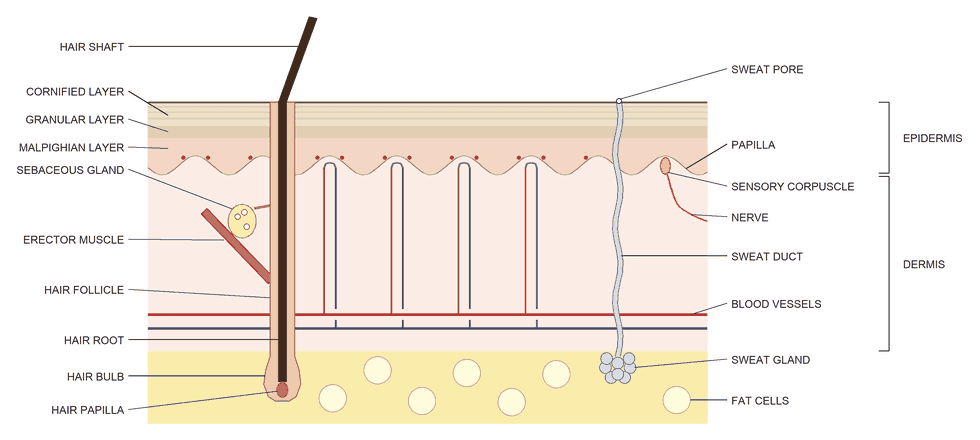
Step 4 — Label every part.
The labels are: hair shaft, sweat pore, cornified layer, granular layer, malpighian layer, epidermis, dermis, papilla, sensory corpuscle, sebaceous gland, erector muscle, hair follicle, hair root, hair bulb, hair papilla, sweat gland, sweat duct, blood vessels, nerve and fat cells.
Watch out: The sebaceous gland must open into the hair follicle; never draw it floating free in the dermis.
Therefore, the labelled vertical section of the skin is as drawn above.
- 397 marks
Question 39
Given below is a diagrammatic sketch of the vertical section of the human skin.
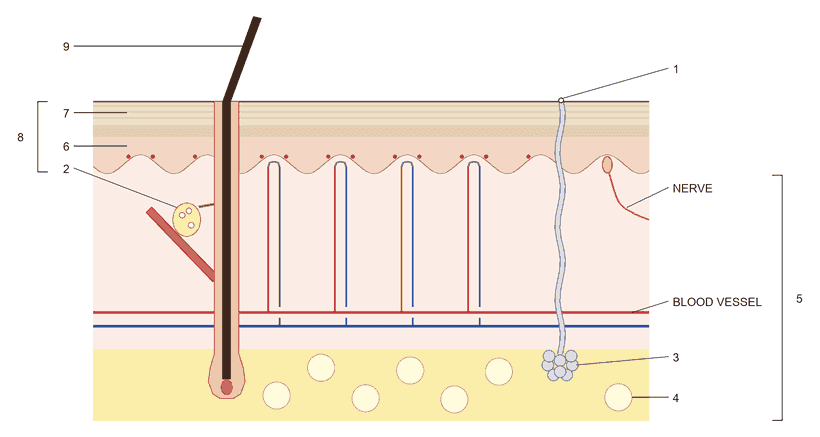
(a) Label the parts numbered from 1 to 9.
(b) State one main function of each of the following parts :
(i) Part 2.
(ii) Part 3.
(iii) Part 4.
(iv) Part 9.
(c) Name any one of the above parts which has at least three functions.
(d) Part 4 may add to one's good appearance or the "figure". State one example of this function which may be common to both men and women.
Solve with AIWritten solution
Solution:
Concept: Read the figure from the surface downwards: the epidermis layers first, then the glands and the fat layer, and the brackets last.
Step 1 — (a) Label the numbered parts.
Each number is matched with the part its guideline or bracket marks.
Number Part 1 Sweat pore 2 Sebaceous gland 3 Sweat gland 4 Fat cells (adipose tissue) 5 Dermis 6 Malpighian layer (germinative layer) 7 Cornified layer (stratum corneum) 8 Epidermis 9 Hair (hair shaft) In this book the fat layer is counted as the lowest part of the dermis, which is why bracket 5 reaches down to the bottom of the section.
Step 2 — (b) One main function of parts 2, 3, 4 and 9.
Each part's main function is given below.
- Part 2 (sebaceous gland): secretes sebum, which makes the hair and skin oily and waterproof.
- Part 3 (sweat gland): secretes sweat, whose evaporation cools the body.
- Part 4 (fat cells): store fat as a food reserve.
- Part 9 (hair): gives the sensation of touch through the nerve endings at its root, and head hair shields the scalp from the sun.
Step 3 — (c) A part with at least three functions.
Part 4, the fat cells. The fat layer serves as a food reserve, a heat-insulating layer and a shock-absorber for the parts beneath.
Step 4 — (d) Fat and good appearance.
The layer of fat under the skin gives smooth, rounded contours to the body; for example, it fills out the cheeks and face and rounds the arms and limbs instead of a bony look, in both men and women.
Watch out: 8 marks the whole epidermis, while 6 and 7 are only two of its layers.
Therefore, (a) 1 sweat pore, 2 sebaceous gland, 3 sweat gland, 4 fat cells, 5 dermis, 6 malpighian layer, 7 cornified layer, 8 epidermis, 9 hair; (b) sebum, sweat, fat storage, touch; (c) part 4; (d) the fat rounds the face and limbs.
- 404 marks
Question 40
The figures A and B given below represent the ways of heat regulation in our body with the help of blood vessels. Study the figures and answer the following questions.
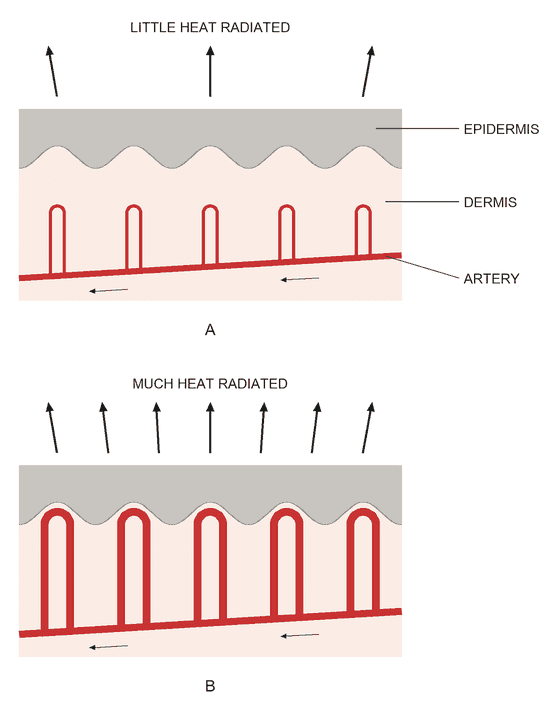
(a) Name the process/condition shown in figures A and B.
(b) During what climatic conditions, do these processes occur in our body ?
(c) What colour change do we see in the facial appearance of a person during these situations?
(d) Do these situations occur due to emotional causes ? If yes, name them.
Solve with AIWritten solution
Solution:
Concept: Skin vessels narrow (vasoconstriction) to save heat and widen (vasodilation) to lose heat. How much blood fills the skin vessels also changes the colour of the face.
Step 1 — (a) Name the processes.
In A the capillary loops are thin and short, and little heat is radiated: this is vasoconstriction. In B the loops are wide and reach up to the epidermis, and much heat is radiated: this is vasodilation.
Step 2 — (b) The climate for each.
A happens in cold weather, to save heat. B happens in hot weather and during strenuous work, to lose heat.
Step 3 — (c) Colour of the face.
In A less blood is in the skin, so the face looks pale (even bluish). In B more blood is in the skin, so the face looks flushed or red.
Step 4 — (d) Emotional causes.
Yes. Fear or fright can cause vasoconstriction, so the face turns pale; shame, embarrassment or anger can cause vasodilation, so the face turns red (blushing).
Watch out: Match the figures by the heat arrows: few arrows (A) = constriction, many arrows (B) = dilation.
Therefore, (a) A vasoconstriction, B vasodilation; (b) A in cold, B in heat; (c) A pale, B red; (d) yes: fear (pale) and shame or anger (blushing).
What Class 9 Biology Ch 13 covers
The sections of the chapter, in the order the book takes them. Every question above comes from one of these.
- 01What Is Skin
- 02Functions of the Skin
- 03Structure of the Skin
- 04The Skin Proper
- 05Derivatives of the Skin
- 06Skin and Heat Regulation of Body
More ways to study this chapter
The same chapter asked three other ways. Practise it, revise it, and see what the board has set on Ch 13 before.
Class 9 Biology Ch 13 questions students ask
How many questions are there in Class 9 Biology Ch 13?
40 questions. Every one is solved step by step on this page.
Are these Class 9 Biology solutions free?
Yes. Every question and its full working is free to read, with no account needed.
Can I download the Class 9 Biology Ch 13 solutions as a PDF?
There is no PDF to download. Every solution is on this page instead, which means it is searchable, always the current syllabus, and readable on a phone. Use your browser's print option if you want it on paper.