
Opening your dashboard
Class 9 Biology Chapter 13 Skin – "The Jack of All Trades": Practice Questions
41 questions on Chapter 13, each worked through on its own page with the AI tutor. Class 9 Biology, ICSE 2026-27.
41 questions
1–5 marks · Mixed difficulty
- 11 mark
Question 1
Bloom's level: Remember
In an adult human, the skin makes up about what fraction of the total body weight ?
- 21 mark
Question 2
Bloom's level: Remember
The skin, together with structures derived from it such as hair and nails, forms the :
- 31 mark
Question 3
Bloom's level: Remember
Keratin, the tough protein of the cornified layer of the epidermis, is also found in :
- 41 mark
Question 4
Bloom's level: Remember
The wax-like cerumen that protects the eardrum from dust and germs is secreted by :
- 51 mark
Question 5
Bloom's level: Understand
Although sweat removes water, salts and some urea, the skin is not really treated as an excretory organ. The best reason is :
- 61 mark
Question 6
Bloom's level: Understand
The skin of a person with albinism looks pinkish because :
- 71 mark
Question 7
Bloom's level: Understand
Frogs hibernate in winter mainly because :
- 81 mark
Question 8
Bloom's level: Apply
Neha notices tiny black dots in the pores on her nose. They are not red, swollen or painful. These are most likely :
- 91 mark
Question 9
Bloom's level: Apply
A cyclist starts shivering on a very cold winter morning. Which two other changes does his body make at the same time ?
- 101 mark
Question 10
Bloom's level: Analyse
Assertion (A): Hair usually turns grey or white in old age.
Reason (R): The colour of hair comes from melanin made by pigment cells in the hair follicle, and its production decreases with age.
- 111 mark
Question 11
Bloom's level: Evaluate
Assertion (A): Drinking plenty of water and taking a little extra salt in summer helps to prevent heatstroke.
Reason (R): Heatstroke occurs when sweating cools the body so much that its temperature falls below normal.
- 121 mark
Question 12
Bloom's level: Analyse
Assertion (A): A very shallow scratch that removes only the outer cornified layer makes the skin bleed.
Reason (R): The epidermis is devoid of blood vessels.
- 132 marks
Question 13
Bloom's level: Understand
The skin is a thin outer layer stretched over the body, yet biologists call it an organ and not just a covering. Explain why.
- 142 marks
Question 14
Bloom's level: Understand
Classify each of the following as part of the skin proper or a derivative of the skin :
granular layer, nails, dermis, sebaceous glands, malpighian layer, hair
- 151 mark
Question 15
Bloom's level: Understand
After a long bath, the skin of your fingertips wrinkles up. How is this useful ?
- 161 mark
Question 16
Bloom's level: Apply
The skin makes up about of an adult's body weight. Calculate the approximate mass of the skin of a man who weighs .
- 172 marks
Question 17
Bloom's level: Apply
There are about 80 sweat pores per on the skin of the back and about 400 per on the palms.
(a) How many sweat pores would you expect in a patch of each ? How many times more are there on the palm ?
(b) Suggest why the palms need so many sweat pores.
- 182 marks
Question 18
Bloom's level: Apply
A patient whose skin has been badly burnt over a large area is kept in a germ-free ward and is given plenty of fluids. Using the functions of the skin, explain the reason for each of these two measures.
- 192 marks
Question 19
Bloom's level: Apply
A needle pricks the fingertip just deep enough to draw a drop of blood. Name, in order from the outside, the layers of the skin it passes through.
- 202 marks
Question 20
Bloom's level: Analyse
Meera was born with normal skin, but at the age of 12 white patches appeared on her hands and neck. Her cousin Kabir has had white hair, white eyebrows and pinkish skin all over his body since birth, and both of Kabir's parents have the same condition.
Identify the condition of each child, and point out the clue in the description that separates the two.
- 212 marks
Question 21
Bloom's level: Evaluate
A student says, "The epidermis is made of dead cells, so it does nothing except cover the body." Do you agree ? Justify your answer.
- 222 marks
Question 22
Bloom's level: Understand
Explain briefly how fat, hair and blood vessels of the skin each help to cut down heat loss in cold weather.
- 234 marks
Question 23
Bloom's level: Apply
Two brothers have the same skin colour in winter. One works all summer as a farmer in the open fields; the other works in an office. By the end of summer the farmer's face and arms have become much darker.
(a) Name the pigment responsible for the change, and the layer of the skin in which it is found.
(b) How is this darkening useful to the farmer ?
(c) What will happen to his skin colour if he works indoors for the next few months ? Will his children be born with darker skin because of his tan ? Give a reason.
- 244 marks
Question 24
Bloom's level: Apply
Case: Arjun ran a 10 km race on a hot afternoon. By the end his face was flushed red and his shirt was soaked with sweat. As he crossed the finish line a breeze started blowing, and he felt cooler at once. He had lost about 2.5 litres (take ) of sweat during the race.
(a) Name the change in the blood vessels of his skin that made his face look red, and explain how it helps the body.
(b) Why did the breeze make him feel cooler ?
(c) Sweat contains about salts. How many grams of salts did Arjun lose ? What should he drink after the race, and why ?
- 254 marks
Question 25
Bloom's level: Analyse
Case: Fifteen-year-old Rhea finds that in the hot, humid monsoon her face becomes very oily and she gets a few red, painful pimples. In the cold, dry winter the same skin becomes rough and leaves a powdery mark when scratched.
(a) Name the glands and the secretion responsible for the oiliness.
(b) Explain the change in her skin from monsoon to winter.
(c) The oily secretion is useful on the skin, so why does it lead to pimples when a pore gets blocked ?
- 263 marks
Question 26
Bloom's level: Analyse
Cutting your hair with scissors does not hurt and the hair keeps growing, but pulling a hair out hurts, and the hair that comes out has a small swollen whitish end.
(a) Which part of the hair is cut by the scissors, and why does cutting it not hurt ?
(b) Why does pulling a hair hurt ? What is the swollen end ?
(c) Which structures must stay in the skin for a new hair to grow at the same spot ?
- 273 marks
Question 27
Bloom's level: Evaluate
"Too much sunshine can cause skin cancer, so we should keep our skin away from sunlight completely." Evaluate this advice, using what you know about the skin.
- 284 marks
Question 28
Bloom's level: Create
Construct a branching chart (concept map) of the human skin that shows :
(a) The two parts of the skin proper, with the three sub-layers of the epidermis, each with one feature.
(b) Any four structures present in the dermis, and the three roles of the fat layer beneath it.
(c) The five special derivatives of the skin.
- 295 marks
Question 29
Bloom's level: Create
Plan an experiment to show that evaporation of sweat cools the body, using two identical laboratory thermometers, cotton wool, water at room temperature, a stand and a table fan.
(a) Describe how you will set up the two thermometers.
(b) State the readings you will take, and what you expect them to show with and without the fan.
(c) State your conclusion and link it to how the skin cools the body.
- 305 marks
Question 30
Bloom's level: Apply
For each situation, name the part of the skin (or its derivative) that helps, and say how :
(a) Walking barefoot on rough ground does not easily injure the soles.
(b) Water does not soak into the body during a long swim.
(c) You feel a mosquito landing on the hairs of your arm before it bites.
(d) A person can survive a few days without food.
(e) Tears do not overflow onto the cheeks in normal conditions.
- 311 mark
Question 31
Class 9 Sample Paper 2 · Section A
Write the function of:
Sweat gland
- 321 mark
Question 32
Which one of the following is present in the dermis but is absent from the epidermis ?
- 331 mark
Question 33
Which one of the following is not a function of sebum, the secretion of the sebaceous glands ?
- 341 mark
Question 34
Assertion (A): Mammals are called warm-blooded animals.
Reason (R): The body temperature of a mammal remains more or less constant even when the temperature of its surroundings changes.
- 352 marks
Question 35
(i) Name four kinds of sensation which the skin can detect.
(ii) In which layer of the skin are the sense organs and the nerve fibres situated ?
- 362 marks
Question 36
(i) Name two substances, other than water, that are lost from the body in sweat.
(ii) Name the openings through which the sweat reaches the surface of the skin.
- 372 marks
Question 37
The figure shows a hair in the skin.
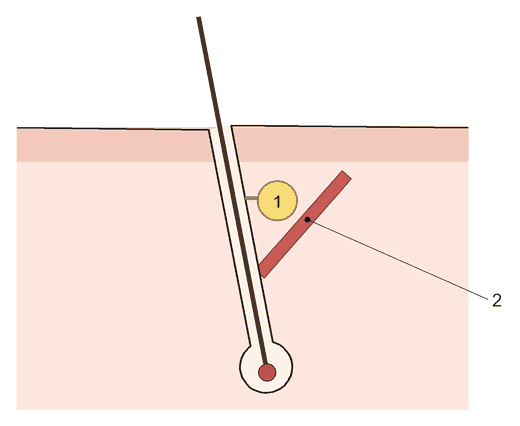
(i) Name the parts marked 1 and 2.
(ii) What happens to the hair when part 2 contracts on a cold day ? What is this condition called ?
- 382 marks
Question 38
(i) Name the pigment that gives colour to the skin and name the layer of the epidermis in which it is found.
(ii) Explain how this pigment protects the inner parts of the body.
- 393 marks
Question 39
Below the dermis, the skin has a layer of fat cells.
(i) State two ways in which this layer is useful to the body.
(ii) Name the vitamin that the skin synthesises when it is exposed to sunshine.
(iii) Name the main protein that makes the outer layer of the skin tough, and say what the toughness protects against.
- 404 marks
Question 40
(i) Draw a neat, labelled diagram showing the three layers of the epidermis. Label the layers in order from the surface to the inside.
(ii) In which of these layers are new cells produced ? Why must new cells keep being produced ?
(iii) Name the layer that forms an almost impermeable barrier to bacteria and say what is done to the germs lying on it.
- 413 marks
Question 41
On a hot day, a man who has been working in the sun has a flushed face and is sweating freely.
(i) Name the changes in the blood vessels of his skin, and say what these changes do to the loss of heat from the body.
(ii) How does sweating cool his body ?
(iii) Name the region of the brain that controls these heat-regulating responses.