Solution:
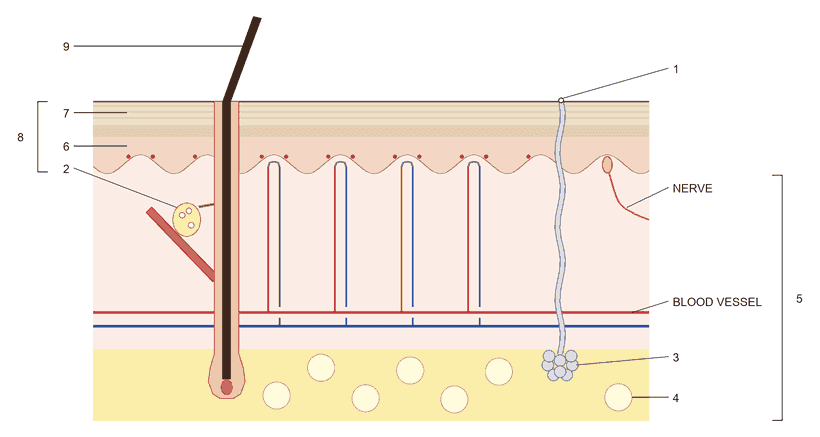
Concept: Read the figure from the surface downwards: the epidermis layers first, then the glands and the fat layer, and the brackets last.
Step 1 — (a) Label the numbered parts.
Each number is matched with the part its guideline or bracket marks.
| Number | Part |
|---|
| 1 | Sweat pore |
| 2 | Sebaceous gland |
| 3 | Sweat gland |
| 4 | Fat cells (adipose tissue) |
| 5 | Dermis |
| 6 | Malpighian layer (germinative layer) |
| 7 | Cornified layer (stratum corneum) |
| 8 | Epidermis |
| 9 | Hair (hair shaft) |
In this book the fat layer is counted as the lowest part of the dermis, which is why bracket 5 reaches down to the bottom of the section.
Step 2 — (b) One main function of parts 2, 3, 4 and 9.
Each part's main function is given below.
- Part 2 (sebaceous gland): secretes sebum, which makes the hair and skin oily and waterproof.
- Part 3 (sweat gland): secretes sweat, whose evaporation cools the body.
- Part 4 (fat cells): store fat as a food reserve.
- Part 9 (hair): gives the sensation of touch through the nerve endings at its root, and head hair shields the scalp from the sun.
Step 3 — (c) A part with at least three functions.
Part 4, the fat cells. The fat layer serves as a food reserve, a heat-insulating layer and a shock-absorber for the parts beneath.
Step 4 — (d) Fat and good appearance.
The layer of fat under the skin gives smooth, rounded contours to the body; for example, it fills out the cheeks and face and rounds the arms and limbs instead of a bony look, in both men and women.
Watch out: 8 marks the whole epidermis, while 6 and 7 are only two of its layers.
Therefore, (a) 1 sweat pore, 2 sebaceous gland, 3 sweat gland, 4 fat cells, 5 dermis, 6 malpighian layer, 7 cornified layer, 8 epidermis, 9 hair; (b) sebum, sweat, fat storage, touch; (c) part 4; (d) the fat rounds the face and limbs.