Solution:
Concept: Skin vessels narrow (vasoconstriction) to save heat and widen (vasodilation) to lose heat. How much blood fills the skin vessels also changes the colour of the face.
Step 1 — (a) Name the processes.
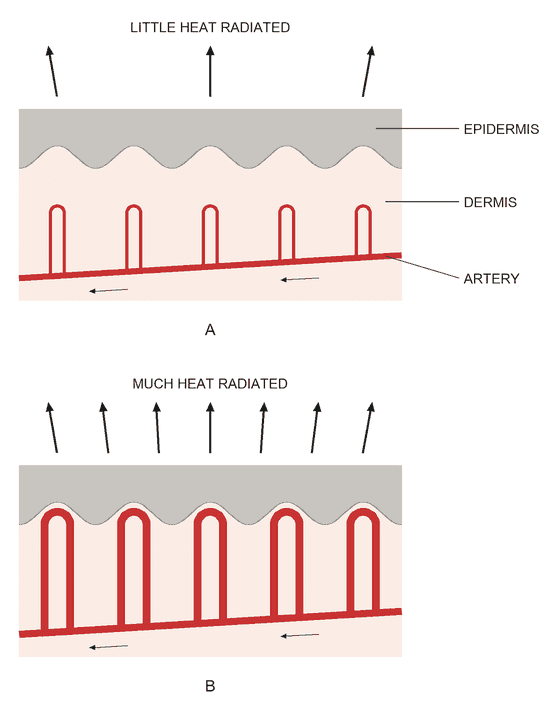
In A the capillary loops are thin and short, and little heat is radiated: this is vasoconstriction. In B the loops are wide and reach up to the epidermis, and much heat is radiated: this is vasodilation.
Step 2 — (b) The climate for each.
A happens in cold weather, to save heat. B happens in hot weather and during strenuous work, to lose heat.
Step 3 — (c) Colour of the face.
In A less blood is in the skin, so the face looks pale (even bluish). In B more blood is in the skin, so the face looks flushed or red.
Step 4 — (d) Emotional causes.
Yes. Fear or fright can cause vasoconstriction, so the face turns pale; shame, embarrassment or anger can cause vasodilation, so the face turns red (blushing).
Watch out: Match the figures by the heat arrows: few arrows (A) = constriction, many arrows (B) = dilation.
Therefore, (a) A vasoconstriction, B vasodilation; (b) A in cold, B in heat; (c) A pale, B red; (d) yes: fear (pale) and shame or anger (blushing).