
Opening your dashboard
Class 9 Biology Chapter 13 Skin – "The Jack of All Trades": Competency-Based Questions (CBQ)
40 questions on Chapter 13, each worked through on its own page with the AI tutor. Class 9 Biology, ICSE 2026-27.
40 questions
1–5 marks · Mixed difficulty
- 11 mark
Question 1
Cognitive domain: Application
Sana is blind and reads Braille with the tip of her right forefinger. For some weeks she has been practising the sitar every day, and the skin of that fingertip has become thick and hard. She now finds it harder to make out the raised Braille dots with that finger. Which statement best explains this ?
- 21 mark
Question 2
Cognitive domain: Analysis
Riya put a small dot of ink on her thumb nail, just above the whitish half-moon marked X. She did not cut the nail. The figure shows the same nail on day 1, after 4 weeks and after 8 weeks.
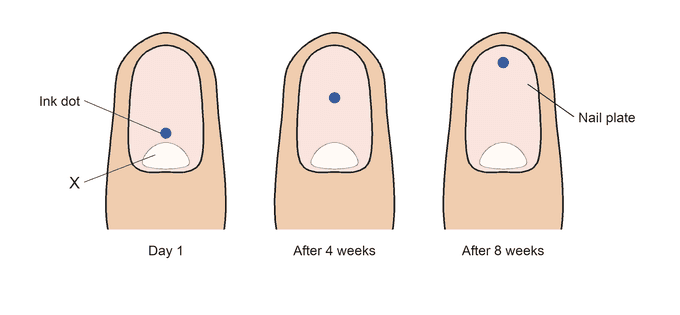
What is the best explanation for the change in the position of the ink dot ?
- 31 mark
Question 3
Cognitive domain: Analysis
For a project, Kabir, a healthy boy, measured his body temperature in the mouth four times on the same day. He did not exercise or eat just before any reading.
Time Temperature in the mouth 5 a.m. 11 a.m. 4 p.m. 10 p.m. Which conclusion is best supported by these readings ?
- 41 mark
Question 4
Cognitive domain: Application
Mr Rao visits an eye doctor. He is not crying and there is no dust in his eyes, yet tears keep spilling over the edges of his eyelids on to his cheeks. The doctor finds that the tiny glands opening along the margins of his eyelids are blocked. Which glands are these, and what do they normally do ?
- 51 mark
Question 5
Cognitive domain: Understanding
Assertion (A): People who grew up in hot countries usually have more working (active) sweat glands than people who grew up in cold countries.
Reason (R): On the human body, sweat pores are far more numerous on the palms than on the back.
- 61 mark
Question 6
Cognitive domain: Application
Assertion (A): The skin of a person with albinism is harmed by strong sunlight more easily than normally pigmented skin.
Reason (R): The pigment melanin acts like an umbrella that protects the inner parts of the body from the harmful ultraviolet rays of sunlight.
- 71 mark
Question 7
Cognitive domain: Understanding
While the class is dusting an old bookshelf, the science teacher remarks that a part of house dust is made of tiny flakes that people shed from the surface of their skin all the time. Yet our skin never gets used up.
Complete the sentence :
The flakes are dead cells of the ______ layer of the epidermis, and the skin does not get used up because new cells keep coming from the actively dividing cells of the ______ layer beneath.
- 81 mark
Question 8
Cognitive domain: Application
On a very hot day, a worker at a brick kiln loses about 2 kg (2000 g) of sweat.
Complete the sentence :
Taking the highest percentage of salts that sweat normally contains, the worker has lost about ______ g of salts in this sweat, and the main salt lost is ______.
- 91 mark
Question 9
Cognitive domain: Understanding
While helping in the kitchen, Asha's fingers brush against a hot tawa by mistake. She feels the heat at once and pulls her hand away before the skin is badly burnt.
Complete the sentence :
Here the skin has worked as a ______ organ, and it could do so because the receptors for heat and pain lie in its inner layer, the ______.
- 102 marks
Question 10
Cognitive domain: Evaluation
It is a hot, humid afternoon. The school kabaddi team has just finished practice and all the players are sweating. Their coach asks them to sit under the ceiling fan in the hall. Dev says, "A fan only pushes the same warm air around. It does not cool the air of the room, so sitting under it is of no use."
Is Dev's conclusion correct ? Justify your answer.
- 112 marks
Question 11
Cognitive domain: Analysis
A forensic laboratory receives three tiny samples picked up from a floor. The technician describes them as follows.
Sample Description P A thin flake of flattened dead cells containing keratin. It has no blood vessels. Q A bit of tough, flexible tissue with elastic fibres, blood vessels and nerve fibres. R A piece of a hard, flat plate of dead, keratinised cells that had been growing out from a root. It is not a strand or a thread. Which two samples come from the skin proper, and from which layer of it does each come ? Which sample is a derivative of the skin ? Name it.
- 122 marks
Question 12
Cognitive domain: Evaluation
Meena's grandmother says, "A glass of chilled lassi in May takes some heat out of the body, and a bowl of hot soup in January puts some heat into it." Her brother Arnav laughs and says, "That is not science. Body heat comes from our muscles. The food we swallow has nothing to do with it."
Who is right ? Judge both statements, using what you know about heat production and heat loss in the body.
- 135 marks
Question 13
Cognitive domain: Analysis
Case: In a study at a sports institute, a healthy volunteer wearing light clothes sat still for one hour in each of three rooms. Each room was kept at a different air temperature. At the end of each hour, the observations given in the table were recorded.
Room Air temperature Colour of the face Sweat lost in 1 hour Temperature in the mouth P Pale 40 g Q Normal 80 g R Flushed red 600 g (a) In which room were the blood vessels of the skin narrowed ? Name this process and give the evidence from the table.
(b) In room R the face was flushed red and a large amount of sweat was produced. Explain how each of these two changes helps the body to lose heat.
(c) From room P to room R, by how much did the air temperature change, and by how much did the temperature in the mouth change ? Name the part of the brain responsible for this result and state how it works.
(d) How many times the sweat lost in room P is the sweat lost in room R ? The volunteer felt cold in room P, yet some sweat was lost. Explain why.
- 144 marks
Question 14
Cognitive domain: Application
Case: In the last week of May, a heat wave with very hot winds was blowing over Nagpur. Two men, Raju and Imran, loaded bricks side by side in the open through the afternoon. Imran kept drinking water and twice had a glass of salted buttermilk. Raju drank almost nothing. By evening Raju felt very ill and was taken to a hospital, where his body temperature was found to be . Imran remained well.
(a) Name the condition Raju was most likely suffering from. What had gone wrong with the cooling of his body ?
(b) Why is a body temperature of dangerous for the normal activities of the body ?
(c) Explain how each of Imran's two habits — drinking water and taking salted buttermilk — helped to protect him.
- 155 marks
Question 15
Cognitive domain: Creativity
Case: The Class 9 science club reads that the sharp sense of touch in the skin of the fingertips enables the blind to read Braille. Tanvi wonders whether the skin of the fingertip really senses touch more sharply than the skin on the back of the hand. She has a blindfold, a ruler, and two unsharpened pencils whose flat ends can be held close together or far apart.
(a) Plan a simple test that Tanvi can carry out on a classmate to compare the two areas of skin. State the one thing she changes and two things she must keep the same.
(b) Draw a table in which she can record her observations.
(c) What result do you expect ? Explain it using the structure of the skin.
- 161 mark
Question 16
Cognitive domain: Analysis
The bar chart shows the thickness of the epidermis at four places on the skin of an adult. (Hypothetical data.)
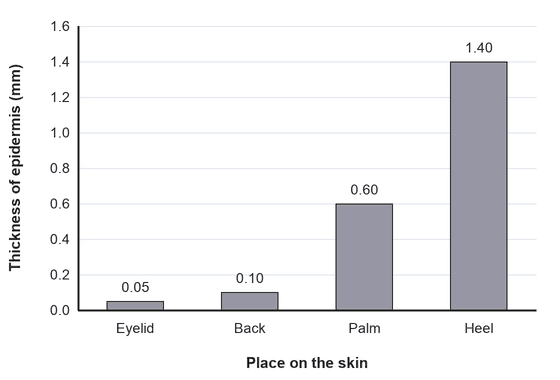
Which conclusion is best supported by the chart and by what you have learnt about the epidermis ?
- 171 mark
Question 17
Cognitive domain: Analysis
The graph shows how the body temperature of a frog and of a man changed when the temperature of the air around them was raised from to . (Hypothetical data.) The readings at the two ends of each line are marked on the graph.
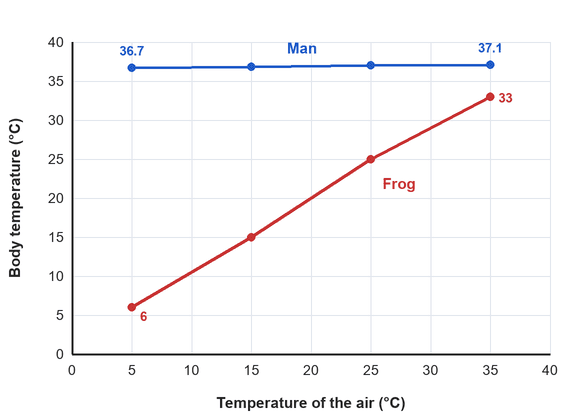
Which statement is correct ?
- 181 mark
Question 18
Cognitive domain: Application
On a cool morning Kavya wears a clean, dry plastic glove on one hand for minutes while she sorts seeds. She has not been running and she does not feel hot. When she takes the glove off, the inside of the glove and her palm are damp. Which is the best explanation ?
- 191 mark
Question 19
Cognitive domain: Understanding
Ishaan notices that a day after a hair wash his scalp and the sides of his nose feel oily, but the palms of his hands never feel oily, even in hot and humid weather. Which is the best explanation ?
- 201 mark
Question 20
Cognitive domain: Analysis
Assertion (A): Seals and whales, which live in icy seas, have a very thick layer of fat beneath the skin.
Reason (R): The layer of fat beneath the dermis serves only as a food reserve for the body.
- 211 mark
Question 21
Cognitive domain: Application
Rafiq's father makes leather bags. He explains that in the tannery the hair and the thin outer layer of the hide are scraped off, and the thick layer that is left is made into leather. Which layer of the skin of the animal becomes leather, and why is leather tough and yet flexible ?
- 221 mark
Question 22
Cognitive domain: Understanding
A student matches four everyday observations with the function of the skin that is at work. Which match is correct ?
- 231 mark
Question 23
Cognitive domain: Understanding
In a family photograph the skin of the grandfather is very light brown and that of his grandson is much darker. Both of them have a normal skin and normal health. Which statement best describes the cause of the difference ?
- 241 mark
Question 24
Cognitive domain: Application
A student at rest loses a total of units of heat from the body in one hour. Taking the share given in the textbook for the skin, how much of this is lost through the skin, and by which other channels is the rest lost ? (Hypothetical data.)
- 251 mark
Question 25
Cognitive domain: Evaluation
Assertion (A): On a hot and humid day a person sweats a great deal but may still feel hot and sticky.
Reason (R): In very humid air sweat evaporates slowly from the skin, so less heat is taken away from the body.
- 262 marks
Question 26
Cognitive domain: Evaluation
On a cold winter morning Sahil gets goose flesh. His cousin says, "The lifted hairs trap warm air, as a cat's fur does when it puffs up, so goose flesh keeps us a little warm." His sister replies, "Then Sahil should feel as warm as a cat does. He does not, so the claim is nonsense." A cat has a thick coat of fur, but the human body has only fine, widely spaced hairs.
Evaluate the statements of the cousin and of the sister.
- 272 marks
Question 27
Cognitive domain: Application
Neha's thumbnail was crushed in a door. After some weeks the whole hard plate came off, but the whitish half-moon at the base of the nail and the skin around it were not damaged. A few weeks later a new nail was seen growing from the base.
(a) Explain why a new nail could grow.
(b) What would have happened if the half-moon region had been destroyed together with the plate ?
- 282 marks
Question 28
Cognitive domain: Application
A nurse in a school clinic holds a thermometer in the armpit of a healthy student for five minutes and reads . The student asks what the thermometer would have shown in the mouth and in the rectum. (Hypothetical data.)
(a) Using the textbook's rule for the differences between these body parts, find the two readings.
(b) Later the same day, another student's armpit reading is . Find the matching mouth reading by the same rule, and say whether this student has fever.
- 292 marks
Question 29
Cognitive domain: Analysis
Before her first speech on the stage, Ananya finds that her forehead and palms are wet with sweat, though the hall is quite cool. In the casualty room of a hospital, a man in severe pain also breaks into a sweat at the same time.
(a) What name is given to this kind of sweating ?
(b) Is the sweat of Ananya helping to keep her body temperature steady ? Give a reason.
- 302 marks
Question 30
Cognitive domain: Application
A trekker is pulled out of an icy stream, and his temperature in the mouth is found to be . (Hypothetical data.)
(a) Why is such a fall in body temperature dangerous ?
(b) Name one thing the rescuers can do to reduce the loss of heat from his body, and one thing they can give him as a source of heat.
- 312 marks
Question 31
Cognitive domain: Understanding
Karan has a habit of pulling out the hairs from the inside of his nostrils and of plucking his eyelashes, saying that they look untidy. During a dusty summer in his town he has frequent sneezing and sore, watering eyes.
(a) Which function of the hairs of these two places has Karan been removing ?
(b) State one other use of hair in the human body.
- 323 marks
Question 32
Cognitive domain: Analysis
A science club measured the thickness of the two layers of the skin proper at three places on the body of an adult. (Hypothetical data.)
Place Epidermis (mm) Dermis (mm) Eyelid Forearm Sole (a) Find the percentage of the whole thickness of the skin that is epidermis at the eyelid and at the sole.
(b) Which layer is the thicker one at every place ? Name two structures found in it that are not found in the epidermis.
(c) A lancet that goes mm into the skin is used to draw a drop of blood. Would it draw blood at the forearm ? Would it draw blood at the sole ? Give a reason for each, using the table.
- 333 marks
Question 33
Cognitive domain: Analysis
On a very cold morning, a girl walks to school without a sweater. The flow chart shows how her body keeps its temperature steady. Four boxes are blank.
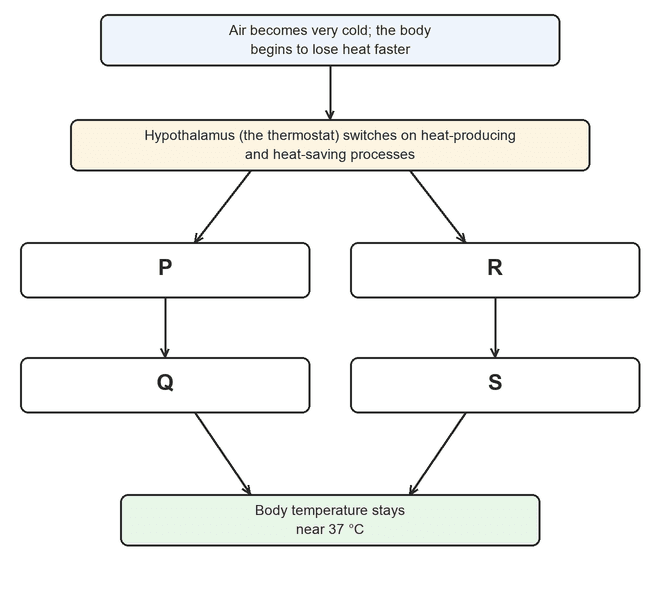
(a) Write what should be in the boxes P, Q, R and S.
(b) Why does the face of the girl look pale ? Link your answer to one of the boxes.
- 343 marks
Question 34
Cognitive domain: Understanding
The figure shows a vertical section of human skin. Three parts of one structure are marked P, Q and R.
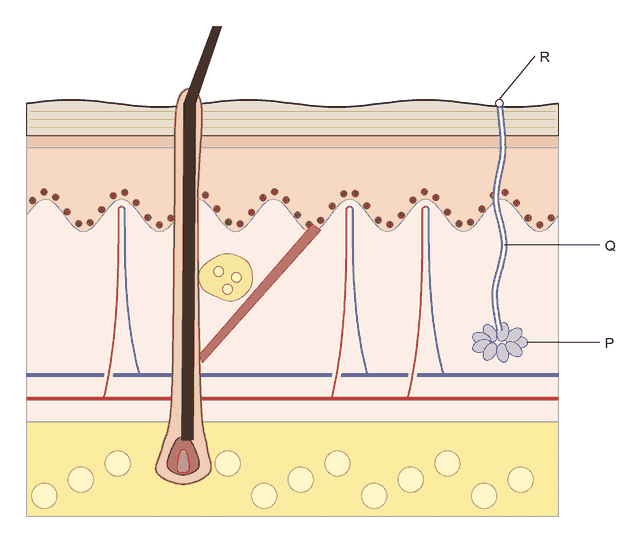
(a) Name the parts P, Q and R.
(b) Describe how a fluid from the blood capillaries of the dermis reaches the surface of the skin with the help of these parts.
(c) State the major function of the sweat that reaches the surface.
- 353 marks
Question 35
Cognitive domain: Evaluation
A face-cream advertisement says, "Our cream opens the pores of your skin so that your skin can breathe in fresh air and breathe out waste gases." Rina's teacher asks the class to examine this claim.
(a) What do the pores of the skin actually give out, and what is that for ?
(b) Give two reasons from the structure of the skin for doubting that the skin breathes air in and out through its pores.
(c) Is the claim of the advertisement acceptable ? Give your judgement.
- 363 marks
Question 36
Cognitive domain: Understanding
Aarav asks his biology teacher three questions about the mammary glands.
(a) "Boys also have these glands, so why do they not look like a girl's breasts ?"
(b) "How many milk ducts open on the nipple, and what is the activity of these glands related to ?"
(c) "Why are they called modified sweat glands ?"
Write the answers the teacher should give.
- 375 marks
Question 37
Cognitive domain: Analysis
Case: The health club of a school studies how long hairs can grow before they fall. From the textbook the members learn that scalp hair grows for to years, while the hairs of the eyebrows and the eyelashes grow for only to months. For the calculation they assume the following growth rates. (Hypothetical data.)
Kind of hair Period of growth before it is lost Assumed growth in one month Scalp hair to years cm Eyelash to months cm (a) What are the shortest and the longest lengths that a scalp hair can reach before it is lost ?
(b) What are the shortest and the longest lengths for an eyelash ?
(c) A hair lengthens by the addition of cells at its base. Explain why the part of the hair that you see is dead, and give two reasons from the table why an eyelash stays much shorter than a scalp hair.
- 384 marks
Question 38
Cognitive domain: Evaluation
Case: Four-year-old Veer has a fever, and the temperature in his mouth is . His grandmother wraps him in two thick blankets, closes all the windows and says, "Let the fever sweat out of him." When the family doctor arrives, she asks the family to take off the blankets, dress Veer in light cotton clothes, keep the room airy, give him plenty of water to drink and give him the medicine she prescribes. (Hypothetical data.)
(a) How do the thick blankets and the closed windows reduce the loss of heat from his skin ?
(b) Explain how light clothes and an airy room help his body to lose heat, and why he must be given plenty of water.
(c) Is the grandmother's advice a good one ? Give two reasons, using what you know about body temperature.
- 395 marks
Question 39
Cognitive domain: Analysis
Case: A volunteer in light clothes cycled steadily on a fixed cycle in a closed room kept at . Every ten minutes the temperature in her mouth was noted, together with the sweat lost in the last ten minutes and the colour of her face. (Hypothetical data.)
Time (minutes) Temperature in the mouth Sweat lost in the last 10 minutes Colour of the face none Normal g Flushed g Red g Red g Red (a) How much sweat did she lose in the first minutes, and by how much did her mouth temperature rise in that time ?
(b) Her temperature did not rise between and minutes, although she kept cycling. Explain this.
(c) At minutes she stops cycling and sits still in the same room. Predict how her mouth temperature, her sweating and the colour of her face will change during the next minutes. Give a reason for each prediction.
- 404 marks
Question 40
Cognitive domain: Creativity
Case: The textbook says that the oily secretion of the sebaceous glands, called sebum, makes the hair and the outer surface of the skin oily and waterproof. The science club of Class 9 wants to make a simple model to show this. They have two identical strips of blotting paper (which soaks up water at once), a little cooking oil, a dropper, a beaker of water, a stopwatch and a pencil.
(a) Describe how the club should set up the model. Say what stands for the skin and what stands for the sebum, and state one thing that is changed and two things that must be kept the same.
(b) Draw a table in which the observations can be recorded.
(c) State the result you expect and link it to the skin. Give one way in which the model is different from real skin.