
Opening your dashboard
Class 8 Physics Chapter 7: Sound Solutions
59 textbook questions with step-by-step answers, free to read, for ICSE 2026-27.
Get talked through Ch 7, not just shown the answer
Reading a finished solution is not the same as being able to do it. The AI tutor takes one question at a time and works it with you, in your own words, until you can.
- Ask it out loud, in your own words
- It gives you the next step, not the answer
- Stuck on part (ii)? Start there
59 questions with solutions
1–4 marks · Mixed difficulty
- 11 mark
Question 1
Sound cannot travel in :
Solve with AIAnswer
(A) solid
(B) liquid
(C) gas
- Correct
(D) vacuum
Answer: (D) vacuum
Concept: Sound is produced by a vibrating body and travels through a medium (solid, liquid or gas) as a wave. The particles of the medium only vibrate about their own mean positions and pass the disturbance on to the next particles; it is the energy that travels, not the particles.
Step 1 — Recall what carries sound.
Sound is passed on by the particles of a medium, which vibrate and push the particles next to them.
Step 2 — Look at a vacuum.
A vacuum has no particles at all, so there is nothing to vibrate and pass the sound on. Hence sound cannot travel through a vacuum. (This is why astronauts on a spacewalk talk by radio.)
Watch out: Light can travel through a vacuum, but sound cannot; do not mix up the two.
Why the other options are wrong:
- (A) solid: Sound does travel through solids; with an ear pressed to a table we hear a light tap at the other end.
- (B) liquid: Sound does travel through liquids; swimmers under water hear sounds.
- (C) gas: Sound travels through gases such as air; this is how we normally hear.
Therefore, sound cannot travel in a vacuum, option (D).
- 21 mark
Question 2
When sound travels in form of a wave :
Solve with AIAnswer
(A) the particles of medium move from the source to the listener
(B) the particles of medium remain stationary
(C) the particles of medium start vibrating up and down
- Correct
(D) the particles of medium transfer energy without leaving their mean positions.
Answer: (D) particles pass on energy without leaving their mean positions
Concept: Sound is produced by a vibrating body and travels through a medium (solid, liquid or gas) as a wave. The particles of the medium only vibrate about their own mean positions and pass the disturbance on to the next particles; it is the energy that travels, not the particles.
Step 1 — See what each particle does.
When a sound wave passes, each particle of the medium vibrates to and fro about its own mean (rest) position and passes the push on to the next particle.
Step 2 — See what travels.
The disturbance, and with it the energy, moves from the source to the listener, while every particle stays near its own mean position.
Watch out: The wave moves forward, but the medium does not flow forward with it.
Why the other options are wrong:
- (A) particles move from source to listener: The particles do not travel from the source to the listener; only the energy does.
- (B) particles remain stationary: The particles are not stationary; they vibrate about their mean positions.
- (C) particles vibrate up and down: In air, sound is a longitudinal wave: the particles vibrate to and fro along the direction of travel, not up and down across it.
Therefore, the particles of the medium transfer energy without leaving their mean positions, option (D).
- 31 mark
Question 3
The safe limit of loudness of audible sound is :
Solve with AIAnswer
- Correct
(A) 0 to 80 dB
(B) above 80 dB
(C) 0 to 120 dB
(D) above 120 dB.
Answer: (A) 0 to 80 dB
Concept: Loudness is the characteristic that tells a loud sound from a soft one. It depends on the amplitude of the wave: in this chapter loudness is taken as proportional to the square of the amplitude, . (Strictly, it is the sound's intensity, the energy it carries, that follows this rule; the loudness we sense rises with the intensity.) Loudness is expressed in decibel (dB).
Step 1 — Recall the safe range.
The chapter gives the safe range of sound level for our ears as 0 to 80 dB. Sounds within this range can be heard for long periods without harm.
Step 2 — See what happens above it.
Sound above 80 dB, heard for a long time, is harmful, and very loud sound (about 120 dB and more) can cause pain and permanent damage to hearing.
Watch out: The safe limit is a range that starts from 0 dB; 'above 80 dB' is the unsafe region.
Why the other options are wrong:
- (B) above 80 dB: Sound above 80 dB is the harmful region, not the safe one.
- (C) 0 to 120 dB: The range up to 120 dB includes very loud sounds, such as a siren close by, which harm the ears.
- (D) above 120 dB: Sound above 120 dB is painful and can damage the ears permanently.
Therefore, the safe limit of loudness is 0 to 80 dB, option (A).
- 41 mark
Question 4
The unit of loudness is :
Solve with AIAnswer
(A) cm
(B) second
(C) hertz
- Correct
(D) decibel.
Answer: (D) decibel
Concept: Loudness is the characteristic that tells a loud sound from a soft one. It depends on the amplitude of the wave: in this chapter loudness is taken as proportional to the square of the amplitude, . (Strictly, it is the sound's intensity, the energy it carries, that follows this rule; the loudness we sense rises with the intensity.) Loudness is expressed in decibel (dB).
Step 1 — Recall how loudness is measured.
The loudness (level) of a sound is measured on the decibel scale.
Step 2 — Name the unit.
So the unit of loudness is the decibel (dB), one-tenth of a bel. The bel is named after Alexander Graham Bell.
Why the other options are wrong:
- (A) cm: The centimetre is a unit of length (amplitude can be given in it), not of loudness.
- (B) second: The second is the unit of time, used for the time period.
- (C) hertz: The hertz is the unit of frequency, which decides the pitch.
Therefore, the unit of loudness is the decibel, option (D).
- 51 mark
Question 5
In a piano, pitch is decreased by :
Solve with AIAnswer
- Correct
(A) using thicker string
(B) increasing tension
(C) reducing length of string
(D) striking it hard.
Answer: (A) using thicker string
Concept: A stretched string vibrates faster (higher frequency, higher pitch) when it is shorter, thinner or under more tension, and slower (lower pitch) when it is longer, thicker or looser.
Step 1 — Decide what lowers the pitch.
To decrease the pitch we must make the string vibrate with a lower frequency.
Step 2 — Check each change.
A thicker (heavier) string vibrates more slowly, so it gives a lower frequency and a lower pitch. This is why the bass strings of a piano are thick.
Watch out: Striking harder changes the loudness, not the pitch.
Why the other options are wrong:
- (B) increasing tension: Increasing the tension makes the string vibrate faster, so the pitch rises.
- (C) reducing length of string: Reducing the length makes the string vibrate faster, so the pitch rises.
- (D) striking it hard: Striking hard increases the amplitude, so the sound is louder; the pitch stays the same.
Therefore, the pitch of a piano note is decreased by using a thicker string, option (A).
- 61 mark
Question 6
By reducing the amplitude of a sound wave, its:
Solve with AIAnswer
(A) pitch decreases
- Correct
(B) loudness decreases
(C) loudness increases
(D) pitch increases
Answer: (B) loudness decreases
Concept: Loudness is the characteristic that tells a loud sound from a soft one. It depends on the amplitude of the wave: in this chapter loudness is taken as proportional to the square of the amplitude, . (Strictly, it is the sound's intensity, the energy it carries, that follows this rule; the loudness we sense rises with the intensity.) Loudness is expressed in decibel (dB).
Step 1 — Link amplitude with a characteristic.
Amplitude decides the loudness: the larger the amplitude, the louder the sound.
Step 2 — Apply it.
A smaller amplitude means the wave carries less energy, so the sound becomes softer: its loudness decreases. The frequency is unchanged, so the pitch is unchanged.
Watch out: Amplitude and pitch are not linked; a soft note and a loud note can have the same pitch.
Why the other options are wrong:
- (A) pitch decreases: Pitch depends on frequency, not on amplitude, so it does not decrease.
- (C) loudness increases: Loudness increases only when the amplitude is increased.
- (D) pitch increases: Pitch depends on frequency, not on amplitude, so it does not increase.
Therefore, reducing the amplitude decreases the loudness, option (B).
- 71 mark
Question 7
Pitch of a note depends on :
Solve with AIAnswer
(A) amplitude
(B) loudness
- Correct
(C) frequency
(D) waveform
Answer: (C) frequency
Concept: Pitch is the characteristic that tells a shrill (high) sound from a flat or grave (low) sound. It depends on the frequency: the higher the frequency, the higher the pitch.
Step 1 — Recall the definition.
Pitch tells a shrill sound from a flat (grave) one.
Step 2 — Name what it depends on.
Pitch depends on the frequency of the note: the higher the frequency, the higher (shriller) the pitch.
Why the other options are wrong:
- (A) amplitude: Amplitude decides the loudness, not the pitch.
- (B) loudness: Loudness is a separate characteristic of sound; it does not decide the pitch.
- (D) waveform: Wave form decides the quality (timbre) of a sound.
Therefore, the pitch of a note depends on its frequency, option (C).
- 81 mark
Question 8
The following question is Assertion-Reason based. Choose the answer based on the codes given below.
Assertion (A) : To make a shrill sound in a flute, holes are opened.
Reason (R) : The holes are opened to increase the length of the vibrating air column.
Solve with AIAnswer
(A) Both A and R are true and R is the correct explanation of A
(B) Both A and R are true and R is not the correct explanation of A
- Correct
(C) Assertion is true but reason is false
(D) Assertion is false but reason is true
Answer: (C) A is true but R is false
Concept: In a wind instrument (or any air column), the vibrating air column gives a higher frequency, and so a higher pitch, when it is shorter, and a lower pitch when it is longer. In an assertion-reason item, judge the Assertion (A) and the Reason (R) separately as true or false, and only if both are true decide whether R explains A.
Step 1 — Judge the Assertion.
A shrill sound means a high pitch. Opening the holes of a flute raises its pitch, so the Assertion is true.
Step 2 — Judge the Reason.
When a hole is opened, the air column vibrates only up to that hole, so the vibrating air column becomes shorter, not longer. A shorter column gives a higher frequency. The Reason says the holes increase the length, so the Reason is false.
Step 3 — Pick the code.
The Assertion is true and the Reason is false, so the answer is (C).
Watch out: Closing the holes lengthens the air column and gives a lower (grave) note; opening them does the opposite.
Note: The printed key gives 'Assertion is false but reason is true'. That contradicts the chapter's own text, which says the holes are opened to reduce the length of the vibrating air column; the correct choice is 'Assertion true, Reason false'.
Why the other options are wrong:
- (A) both true, and R explains A: The Reason is false, so it cannot explain the Assertion.
- (B) both true, but R does not explain A: The Reason is false, so 'both true' is wrong.
- (D) A is false but R is true: The Assertion is true: opening the holes does make the flute sound shriller.
Therefore, the Assertion is true but the Reason is false, option (C).
- 91 mark
Question 9
The following question is Assertion-Reason based. Choose the answer based on the codes given below.
Assertion (A) : Loudness and quality of sound are independent of each other.
Reason (R) : Loudness depends on amplitude while quality of sound depends on the waveform of sound.
Solve with AIAnswer
- Correct
(A) Both A and R are true and R is the correct explanation of A
(B) Both A and R are true and R is not the correct explanation of A
(C) Assertion is true but reason is false
(D) Assertion is false but reason is true
Answer: (A) both true, and R explains A
Concept: A musical sound has three characteristics. Loudness depends on the amplitude, pitch depends on the frequency, and quality (timbre) depends on the wave form. In an assertion-reason item, judge the Assertion (A) and the Reason (R) separately as true or false, and only if both are true decide whether R explains A.
Step 1 — Judge the Assertion.
A violin and a piano can play equally loudly and still sound different, and one instrument can play softly or loudly without changing its quality. So loudness and quality are independent, and the Assertion is true.
Step 2 — Judge the Reason.
Loudness depends on the amplitude and quality depends on the wave form. The Reason is true.
Step 3 — Decide whether R explains A.
Because the two characteristics depend on different properties of the wave, one can change while the other stays the same. So the Reason correctly explains the Assertion.
Why the other options are wrong:
- (B) both true, but R does not explain A: The Reason does explain the Assertion, as Step 3 shows.
- (C) A is true but R is false: The Reason is true: loudness depends on amplitude and quality on wave form.
- (D) A is false but R is true: The Assertion is true, as Step 1 shows.
Therefore, both are true and the Reason is the correct explanation of the Assertion, option (A).
- 101 mark
Question 10
Fill in the blank :
The time period of a wave is 2 s. Its frequency is ................
Solve with AIWritten solution
Solution:
Concept: Frequency and time period are reciprocals of each other: , with in hertz and in seconds.
Given: Time period s.
Step 1 — Write the relation.
Frequency is the reciprocal of the time period, so we divide 1 by the time period.
Step 2 — Put in the value.
Here the time period is 2 s.
Step 3 — Write the unit.
One vibration per second is one hertz, so the frequency is 0.5 Hz.
Watch out: A time period of 2 s gives a frequency of 0.5 Hz, not 2 Hz.
Therefore, the time period of a wave is 2 s, so its frequency is 0.5 Hz (0.5 s⁻¹).
- 111 mark
Question 11
Fill in the blank :
The pitch of a stringed instrument is increased by ................ tension in string.
Solve with AIWritten solution
Solution:
Concept: A stretched string vibrates faster (higher frequency, higher pitch) when it is shorter, thinner or under more tension, and slower (lower pitch) when it is longer, thicker or looser.
Step 1 — Decide what raises the pitch.
A higher pitch needs a higher frequency of vibration.
Step 2 — Link it with tension.
A string under more tension vibrates faster, so increasing the tension raises the frequency and the pitch. Musicians tune a guitar or sitar up by tightening its pegs.
Therefore, the pitch of a stringed instrument is increased by increasing the tension in the string.
- 121 mark
Question 12
Fill in the blank :
The pitch of a flute is decreased by ................ length of air column.
Solve with AIWritten solution
Solution:
Concept: In a wind instrument (or any air column), the vibrating air column gives a higher frequency, and so a higher pitch, when it is shorter, and a lower pitch when it is longer.
Step 1 — Decide what lowers the pitch.
A lower pitch needs a lower frequency of vibration.
Step 2 — Link it with the air column.
A longer air column vibrates more slowly, so increasing its length lowers the pitch. In a flute this is done by closing more of the holes.
Therefore, the pitch of a flute is decreased by increasing the length of the air column.
- 131 mark
Question 13
Fill in the blank :
Smaller the membrane, ................ is the pitch.
Solve with AIWritten solution
Solution:
Concept: In a membrane instrument (drum, tabla), a smaller and tighter membrane vibrates with a higher frequency, so it gives a higher pitch.
Step 1 — Compare the membranes.
For the same material and tension, a smaller membrane vibrates faster than a larger one.
Step 2 — Link frequency with pitch.
Faster vibration means a higher frequency, and so a higher pitch. That is why a small tabla sounds shriller than a big drum.
Therefore, the smaller the membrane, the higher is the pitch.
- 141 mark
Question 14
Fill in the blank :
If a drum is beaten hard, its loudness ................
Solve with AIWritten solution
Solution:
Concept: Loudness is the characteristic that tells a loud sound from a soft one. It depends on the amplitude of the wave: in this chapter loudness is taken as proportional to the square of the amplitude, . (Strictly, it is the sound's intensity, the energy it carries, that follows this rule; the loudness we sense rises with the intensity.) Loudness is expressed in decibel (dB).
Step 1 — See what beating hard does.
Beating the drum hard makes its membrane vibrate with a larger amplitude.
Step 2 — Link amplitude with loudness.
A larger amplitude sends more energy to the ear, so the sound is louder.
Therefore, if a drum is beaten hard, its loudness increases.
- 151 mark
Question 15
Fill in the blank :
A tuning fork produces sound of ................ frequency.
Solve with AIWritten solution
Solution:
Concept: A sound of only one frequency is called a pure note (monotone). A tuning fork is the common laboratory source of such a note, and its frequency is marked on it.
Step 1 — See how a tuning fork vibrates.
When a tuning fork is struck, its prongs vibrate at one fixed natural frequency; the faint extra tones die away almost at once.
Step 2 — Fill the blank.
So the sound of a tuning fork has a single frequency. This is why it is used to tune instruments and in laboratory experiments.
Therefore, a tuning fork produces sound of a single frequency.
- 161 mark
Question 16
Write true or false :
When sound propagates in air, it does not carry energy with it.
Solve with AIWritten solution
Solution:
Concept: Sound is produced by a vibrating body and travels through a medium (solid, liquid or gas) as a wave. The particles of the medium only vibrate about their own mean positions and pass the disturbance on to the next particles; it is the energy that travels, not the particles.
Step 1 — Recall what a wave does.
A wave is a way of carrying energy from one place to another without carrying the medium along.
Step 2 — Check the statement.
In a sound wave, the vibrating air layers pass energy on from layer to layer, and this energy makes our ear drum vibrate. So sound does carry energy, and the statement is false.
Therefore, the statement is false: when sound propagates in air, it carries energy with it.
- 171 mark
Question 17
Write true or false :
In a longitudinal wave, compression and rarefaction are formed.
Solve with AIWritten solution
Solution:
Concept: In air, sound travels as a longitudinal wave: the air particles vibrate to and fro along the direction in which the sound travels, forming compressions (layers pressed close together, higher pressure) and rarefactions (layers spread apart, lower pressure).
Step 1 — Recall how the particles move.
In a longitudinal wave the particles vibrate along the direction in which the wave travels.
Step 2 — Check the statement.
Where the layers are pushed together a compression forms, and where they are spread apart a rarefaction forms. So the statement is true.
Therefore, the statement is true: compressions and rarefactions are formed in a longitudinal wave.
- 181 mark
Question 18
Write true or false :
The distance from one compression to nearest rarefaction is called wavelength.
Solve with AIWritten solution
Solution:
Concept: For a wave: the amplitude () is the maximum displacement of a particle on either side of its mean position; the time period () is the time for one complete vibration; the frequency () is the number of vibrations in one second, measured in hertz (Hz); and the wavelength () is the distance between two consecutive compressions (or rarefactions).
Step 1 — Recall the definition of wavelength.
The wavelength is the distance between two consecutive compressions (or two consecutive rarefactions). One wavelength holds one compression and one rarefaction.
Step 2 — Check the statement.
The distance from a compression to the nearest rarefaction is only half a wavelength, so the statement is false.
Watch out: Count from a compression to the NEXT compression, not to the rarefaction in between.
Therefore, the statement is false: the distance from a compression to the next compression is the wavelength; compression to the nearest rarefaction is half a wavelength.
- 191 mark
Question 19
Write true or false :
The frequency is measured in second.
Solve with AIWritten solution
Solution:
Concept: For a wave: the amplitude () is the maximum displacement of a particle on either side of its mean position; the time period () is the time for one complete vibration; the frequency () is the number of vibrations in one second, measured in hertz (Hz); and the wavelength () is the distance between two consecutive compressions (or rarefactions).
Step 1 — Recall the unit of frequency.
Frequency is the number of vibrations in one second, so its unit is per second (s⁻¹), called the hertz (Hz).
Step 2 — Check the statement.
The second is the unit of the time period, not of frequency, so the statement is false.
Therefore, the statement is false: frequency is measured in hertz (s⁻¹), not in second.
- 201 mark
Question 20
Write true or false :
The quality of a sound depends on the amplitude of wave.
Solve with AIWritten solution
Solution:
Concept: A musical sound has three characteristics. Loudness depends on the amplitude, pitch depends on the frequency, and quality (timbre) depends on the wave form.
Step 1 — Recall what quality depends on.
Quality depends on the wave form of the sound.
Step 2 — Check the statement.
The amplitude decides the loudness, not the quality, so the statement is false.
Therefore, the statement is false: the quality of a sound depends on its wave form, not on the amplitude.
- 211 mark
Question 21
Write true or false :
The pitch of sound depends on frequency.
Solve with AIWritten solution
Solution:
Concept: Pitch is the characteristic that tells a shrill (high) sound from a flat or grave (low) sound. It depends on the frequency: the higher the frequency, the higher the pitch.
Step 1 — Recall what pitch depends on.
Pitch depends on frequency: a high frequency gives a shrill, high-pitched sound and a low frequency gives a flat (grave) sound.
Step 2 — Check the statement.
The statement says exactly this, so it is true.
Therefore, the statement is true: the pitch of sound depends on its frequency.
- 221 mark
Question 22
Write true or false :
Decibel is the unit of pitch of a sound.
Solve with AIWritten solution
Solution:
Concept: Loudness is the characteristic that tells a loud sound from a soft one. It depends on the amplitude of the wave: in this chapter loudness is taken as proportional to the square of the amplitude, . (Strictly, it is the sound's intensity, the energy it carries, that follows this rule; the loudness we sense rises with the intensity.) Loudness is expressed in decibel (dB).
Step 1 — Recall what the decibel measures.
The decibel is the unit on the scale that measures how loud a sound is.
Step 2 — Check the statement.
Pitch depends on frequency, which is measured in hertz, so the statement is false.
Therefore, the statement is false: decibel is the unit of loudness, not of pitch.
- 231 mark
Question 23
Match with the correct option from Column B :
Column A : Amplitude
Choose from Column B :
Column B (i) frequency (ii) amplitude (iii) maximum displacement on either side (iv) presence of other frequencies (v) 1/Time period Solve with AIWritten solution
Solution:
Concept: Match each quantity with the property or unit that defines it. For a wave: the amplitude () is the maximum displacement of a particle on either side of its mean position; the time period () is the time for one complete vibration; the frequency () is the number of vibrations in one second, measured in hertz (Hz); and the wavelength () is the distance between two consecutive compressions (or rarefactions).
Step 1 — Recall the meaning of amplitude.
Amplitude is the maximum displacement of a particle of the medium on either side of its mean position.
Step 2 — Find it in Column B.
Item (iii), 'maximum displacement on either side', states exactly this.
Therefore, amplitude matches (iii) maximum displacement on either side.
- 241 mark
Question 24
Match with the correct option from Column B :
Column A : Frequency
Choose from Column B :
Column B (i) frequency (ii) amplitude (iii) maximum displacement on either side (iv) presence of other frequencies (v) 1/Time period Solve with AIWritten solution
Solution:
Concept: Match each quantity with the property or unit that defines it. Frequency and time period are reciprocals of each other: , with in hertz and in seconds.
Step 1 — Recall how frequency is linked with time period.
Frequency is the reciprocal of the time period.
Step 2 — Find it in Column B.
Item (v), '1/Time period', states this relation.
Watch out: Column B also lists the word 'frequency' as item (i); a quantity is matched with its definition, not with its own name.
Therefore, frequency matches (v) 1/Time period.
- 251 mark
Question 25
Match with the correct option from Column B :
Column A : Loudness
Choose from Column B :
Column B (i) frequency (ii) amplitude (iii) maximum displacement on either side (iv) presence of other frequencies (v) 1/Time period Solve with AIWritten solution
Solution:
Concept: Match each quantity with the property or unit that defines it. Loudness is the characteristic that tells a loud sound from a soft one. It depends on the amplitude of the wave: in this chapter loudness is taken as proportional to the square of the amplitude, . (Strictly, it is the sound's intensity, the energy it carries, that follows this rule; the loudness we sense rises with the intensity.) Loudness is expressed in decibel (dB).
Step 1 — Recall what loudness depends on.
Loudness depends on the amplitude of the wave.
Step 2 — Find it in Column B.
Item (ii) is 'amplitude'.
Therefore, loudness matches (ii) amplitude.
- 261 mark
Question 26
Match with the correct option from Column B :
Column A : Pitch
Choose from Column B :
Column B (i) frequency (ii) amplitude (iii) maximum displacement on either side (iv) presence of other frequencies (v) 1/Time period Solve with AIWritten solution
Solution:
Concept: Match each quantity with the property or unit that defines it. Pitch is the characteristic that tells a shrill (high) sound from a flat or grave (low) sound. It depends on the frequency: the higher the frequency, the higher the pitch.
Step 1 — Recall what pitch depends on.
Pitch depends on the frequency of the wave.
Step 2 — Find it in Column B.
Item (i) is 'frequency'.
Therefore, pitch matches (i) frequency.
- 271 mark
Question 27
Match with the correct option from Column B :
Column A : Wave form
Choose from Column B :
Column B (i) frequency (ii) amplitude (iii) maximum displacement on either side (iv) presence of other frequencies (v) 1/Time period Solve with AIWritten solution
Solution:
Concept: Match each quantity with the property or unit that defines it. Quality (timbre) is the characteristic that tells apart two sounds of the same loudness and the same pitch. It depends on the wave form, which is set by the other frequencies (overtones) that the source produces, in small amplitudes, along with its main frequency.
Step 1 — Recall what changes the wave form.
A musical sound contains, besides its main frequency, other frequencies in small amplitudes. These extra frequencies change the shape of the wave.
Step 2 — Find it in Column B.
Item (iv), 'presence of other frequencies', is what sets the wave form.
Therefore, wave form matches (iv) presence of other frequencies.
- 282 marks
Question 28
How does sound travel in air ?
Solve with AIWritten solution
Solution:
Concept: In air, sound travels as a longitudinal wave: the air particles vibrate to and fro along the direction in which the sound travels, forming compressions (layers pressed close together, higher pressure) and rarefactions (layers spread apart, lower pressure).
Step 1 — Form a compression.
A vibrating body (the source) pushes the layer of air next to it forward. That layer presses on the next one, so the layers crowd together and form a region of higher pressure, a compression.
Step 2 — Form a rarefaction.
When the source moves back, the layers next to it spread out into the space it leaves, forming a region of lower pressure, a rarefaction.
Step 3 — Pass the disturbance on.
Air is elastic, so each layer passes the push on to the next layer and then returns to its mean position. Compressions and rarefactions are therefore formed one after another and move forward through the air.
Step 4 — Say what travels.
The air particles only vibrate to and fro about their mean positions, along the direction in which the sound travels. What moves from the source to the listener is the energy; when the compressions and rarefactions reach the ear, the ear drum vibrates and we hear the sound.
Watch out: The air itself does not flow from the source to the ear; only the disturbance and its energy travel.
Therefore, sound travels in air as a longitudinal wave of compressions and rarefactions.
- 292 marks
Question 29
What is a longitudinal wave ?
Solve with AIWritten solution
Solution:
Concept: In air, sound travels as a longitudinal wave: the air particles vibrate to and fro along the direction in which the sound travels, forming compressions (layers pressed close together, higher pressure) and rarefactions (layers spread apart, lower pressure).
Step 1 — State the definition.
A longitudinal wave is a wave in which the particles of the medium vibrate about their mean positions in the direction of propagation of the wave. ('Longitudinal' means 'along the length'.)
Step 2 — Describe its parts.
Such a wave travels as a series of compressions (layers close together, higher pressure) and rarefactions (layers far apart, lower pressure). One compression and one rarefaction together make one wave.
Step 3 — Give where it occurs.
Longitudinal waves can travel through solids, liquids and gases. Sound travels in air as a longitudinal wave.
Therefore, a longitudinal wave is one in which the particles of the medium vibrate along the direction in which the wave travels, forming compressions and rarefactions.
- 303 marks
Question 30
Define the following terms :
(a) Amplitude (b) Frequency (c) Time period.
Solve with AIWritten solution
Solution:
Concept: These three terms describe how a particle of the medium vibrates when a wave passes through it.
Step 1 — Define amplitude.
(a) The maximum displacement of a particle of the medium on either side of its mean position is called the amplitude of the wave. It is written , and its S.I. unit is the metre (m).
Step 2 — Define frequency.
(b) The number of vibrations made by a particle of the medium in one second is called the frequency of the wave. It is also the number of waves passing a point in one second. It is written , and its S.I. unit is the hertz (Hz), that is, s⁻¹.
Step 3 — Define time period.
(c) The time taken by a particle of the medium to complete one vibration is called the time period of the wave. It is written , and its S.I. unit is the second (s).
Therefore, amplitude is the maximum displacement from the mean position (in m), frequency is the number of vibrations per second (in Hz), and time period is the time for one vibration (in s).
- 312 marks
Question 31
Obtain relationship between the time period and frequency.
Solve with AIWritten solution
Solution:
Concept: In one time period exactly one vibration (one wave) is completed; frequency is the number of vibrations completed in one second.
Step 1 — Start from one time period.
Let the time period of the wave be seconds. So one vibration is completed in seconds.
Step 2 — Count the vibrations in one second.
If one vibration takes seconds, the number of vibrations in one second is 1 divided by :
Step 3 — Recognise the frequency.
The number of vibrations in one second is the frequency , so
Step 4 — Check with an example.
For a time period of 0.5 s, the frequency comes out as 2 Hz:
A shorter time period means a higher frequency.
Therefore, frequency = 1 / time period, that is, (equally, ).
- 322 marks
Question 32
Name the three characteristics of a musical sound.
Solve with AIWritten solution
Solution:
Concept: A musical sound has three characteristics. Loudness depends on the amplitude, pitch depends on the frequency, and quality (timbre) depends on the wave form.
Step 1 — Name the first characteristic.
The first is loudness, which depends on the amplitude of the wave.
Step 2 — Name the second characteristic.
The second is pitch, which depends on the frequency of the wave.
Step 3 — Name the third characteristic.
The third is quality (timbre), which depends on the wave form.
Therefore, the three characteristics of a musical sound are loudness, pitch and quality (timbre).
- 332 marks
Question 33
Which of the following determines the loudness of a sound wave ?
(a) Wavelength (b) Frequency, or (c) Amplitude.
Solve with AIWritten solution
Solution:
Concept: Loudness is the characteristic that tells a loud sound from a soft one. It depends on the amplitude of the wave: in this chapter loudness is taken as proportional to the square of the amplitude, . (Strictly, it is the sound's intensity, the energy it carries, that follows this rule; the loudness we sense rises with the intensity.) Loudness is expressed in decibel (dB).
Step 1 — Recall what loudness depends on.
Loudness depends on how much energy the wave brings to the ear, and this is set by the amplitude of vibration.
Step 2 — Rule out the others.
Frequency decides the pitch, and the wavelength is tied to the frequency, so neither of them decides the loudness.
Therefore, (c) amplitude determines the loudness of a sound wave.
- 342 marks
Question 34
How is loudness related to the amplitude of a wave ?
Solve with AIWritten solution
Solution:
Concept: Loudness is the characteristic that tells a loud sound from a soft one. It depends on the amplitude of the wave: in this chapter loudness is taken as proportional to the square of the amplitude, . (Strictly, it is the sound's intensity, the energy it carries, that follows this rule; the loudness we sense rises with the intensity.) Loudness is expressed in decibel (dB).
Step 1 — State the relation.
The loudness of a sound is directly proportional to the square of the amplitude of the wave:
Step 2 — See what it means.
A larger amplitude gives a louder sound, and the loudness grows faster than the amplitude. If the amplitude is doubled, the loudness becomes 4 times:
If the amplitude is tripled, the loudness becomes 9 times:
Watch out: Loudness is not simply proportional to the amplitude; it goes as the amplitude squared.
Therefore, loudness is directly proportional to the square of the amplitude ().
- 352 marks
Question 35
If the amplitude of a wave is doubled, what will be the effect on its loudness ?
Solve with AIWritten solution
Solution:
Concept: Loudness is the characteristic that tells a loud sound from a soft one. It depends on the amplitude of the wave: in this chapter loudness is taken as proportional to the square of the amplitude, . (Strictly, it is the sound's intensity, the energy it carries, that follows this rule; the loudness we sense rises with the intensity.) Loudness is expressed in decibel (dB).
Step 1 — Write the ratio of loudness.
Since loudness is proportional to the square of the amplitude, the ratio of the new loudness to the old loudness is the ratio of the squares of the amplitudes:
Step 2 — Put in the doubled amplitude.
The new amplitude is and the old one is :
Watch out: Doubling the amplitude does not just double the loudness; it makes it four times.
Therefore, if the amplitude is doubled, the loudness becomes four times.
- 362 marks
Question 36
Name the unit in which the loudness of sound is expressed.
Solve with AIWritten solution
Solution:
Concept: Loudness is the characteristic that tells a loud sound from a soft one. It depends on the amplitude of the wave: in this chapter loudness is taken as proportional to the square of the amplitude, . (Strictly, it is the sound's intensity, the energy it carries, that follows this rule; the loudness we sense rises with the intensity.) Loudness is expressed in decibel (dB).
Step 1 — Name the scale.
Loudness is measured on a special scale called the decibel scale.
Step 2 — Describe the unit.
One decibel is one-tenth of a bel. The bel is named after Alexander Graham Bell, the inventor of the telephone. On this scale the safe range for our ears is 0 to 80 dB.
Therefore, the loudness of sound is expressed in decibel (dB).
- 372 marks
Question 37
Why is the loudness of sound heard by a plucked wire increased when mounted on a sound board ?
[Hint : The surface area of vibrating air increases]
Solve with AIWritten solution
Solution:
Concept: The loudness heard depends on how much air is set vibrating: the larger the vibrating surface, the larger the mass of air it moves and the louder the sound.
Step 1 — Look at the wire alone.
A plucked wire is very thin, so it pushes only a small amount of air. The sound it makes on its own is feeble.
Step 2 — Add the sound board.
When the wire is mounted on a sound board, its vibrations pass into the board, and the board's large surface vibrates too (forced vibration).
Step 3 — See the effect.
The large vibrating surface sets a much larger area (mass) of air vibrating, so more sound energy reaches the ear and the sound heard is louder. This is why the sitar, guitar and violin have a hollow wooden sound box under their strings.
Therefore, the sound is louder because the sound board vibrates with the wire and makes a much larger area of air vibrate.
- 382 marks
Question 38
State three factors on which loudness of sound heard by a listener depends.
Solve with AIWritten solution
Solution:
Concept: Loudness depends on the source, on the distance it travels and on the listener.
Step 1 — Give the first factor.
The first factor is the amplitude of vibration of the source: the greater the amplitude, the louder the sound.
Step 2 — Give the second factor.
The second factor is the distance of the listener from the source: the sound grows feebler as the listener moves away.
Step 3 — Give the third factor.
The third factor is the surface area of the vibrating body: a larger vibrating area moves more air, so a big drum is louder than a small one.
Step 4 — Note a further factor.
The loudness also depends on the sensitivity of the listener's ears: a sound that is loud to one person may seem feeble to a partially deaf person.
Therefore, the loudness heard depends on the amplitude of vibration, the distance from the source and the surface area of the vibrating body (and also on the listener's ears).
- 392 marks
Question 39
What determines the pitch of a sound ?
Solve with AIWritten solution
Solution:
Concept: Pitch is the characteristic that tells a shrill (high) sound from a flat or grave (low) sound. It depends on the frequency: the higher the frequency, the higher the pitch.
Step 1 — Name the factor.
The pitch of a sound is decided by its frequency, the number of vibrations per second of the vibrating body.
Step 2 — Describe the effect.
A higher frequency gives a higher pitch, and the sound is shrill. A lower frequency gives a lower pitch, and the sound is flat (grave). For example, the voice of a woman or a child usually has a higher frequency, and so a higher pitch, than the voice of a man.
Therefore, the pitch of a sound is determined by its frequency.
- 402 marks
Question 40
Name the characteristic of sound related to its frequency.
Solve with AIWritten solution
Solution:
Concept: A musical sound has three characteristics. Loudness depends on the amplitude, pitch depends on the frequency, and quality (timbre) depends on the wave form.
Step 1 — Link frequency with a characteristic.
Of the three characteristics, loudness goes with amplitude, quality with wave form, and pitch with frequency.
Step 2 — Describe the link.
The higher the frequency, the higher (shriller) the pitch.
Therefore, the characteristic of sound related to its frequency is pitch.
- 412 marks
Question 41
Which characteristic of sound makes it possible to recognize a person by his voice without seeing him ?
Solve with AIWritten solution
Solution:
Concept: Quality (timbre) is the characteristic that tells apart two sounds of the same loudness and the same pitch. It depends on the wave form, which is set by the other frequencies (overtones) that the source produces, in small amplitudes, along with its main frequency.
Step 1 — See what is the same and what differs.
Two people may speak with the same loudness and the same pitch, yet their voices sound different.
Step 2 — Name the cause.
Each voice contains, along with its main frequency, other frequencies in small amplitudes. These differ from person to person, so every voice has its own wave form.
Step 3 — Name the characteristic.
The characteristic that depends on wave form is quality (timbre), so it is the quality that lets us recognise a friend by voice alone.
Therefore, the quality (timbre) of sound makes it possible to recognise a person by his voice without seeing him.
- 423 marks
Question 42
State the factors that determine
(a) the pitch of a note.
(b) the loudness of the sound heard.
(c) the quality of the note.
Solve with AIWritten solution
Solution:
Concept: A musical sound has three characteristics. Loudness depends on the amplitude, pitch depends on the frequency, and quality (timbre) depends on the wave form.
Step 1 — Give the factor for pitch.
(a) The pitch of a note is determined by its frequency: the higher the frequency, the higher the pitch.
Step 2 — Give the factors for loudness.
(b) The loudness of the sound heard depends mainly on the amplitude of the wave. It also depends on the distance of the listener from the source, the surface area of the vibrating body and the sensitivity of the listener's ears.
Step 3 — Give the factor for quality.
(c) The quality of a note is determined by its wave form, which is set by the other frequencies present, in small amplitudes, along with the main frequency.
Therefore, (a) pitch depends on frequency, (b) loudness depends on amplitude (and distance, vibrating area and the ear), and (c) quality depends on wave form.
- 433 marks
Question 43
Name the characteristic of the sound affected due to a change in its (a) amplitude (b) wave form (c) frequency.
Solve with AIWritten solution
Solution:
Concept: A musical sound has three characteristics. Loudness depends on the amplitude, pitch depends on the frequency, and quality (timbre) depends on the wave form.
Step 1 — Change in amplitude.
(a) Amplitude decides loudness, so a change in amplitude changes the loudness.
Step 2 — Change in wave form.
(b) Wave form decides quality, so a change in wave form changes the quality (timbre).
Step 3 — Change in frequency.
(c) Frequency decides pitch, so a change in frequency changes the pitch.
Therefore, (a) amplitude affects loudness, (b) wave form affects quality and (c) frequency affects pitch.
- 443 marks
Question 44
How is the pitch of sound in a guitar changed if (a) a thin wire is used, (b) a wire under less tension is used ?
Solve with AIWritten solution
Solution:
Concept: A stretched string vibrates faster (higher frequency, higher pitch) when it is shorter, thinner or under more tension, and slower (lower pitch) when it is longer, thicker or looser.
Step 1 — Thin wire.
(a) A thinner wire is lighter, so it vibrates faster. Its frequency is higher, so the pitch increases and the sound becomes shriller.
Step 2 — Less tension.
(b) A wire under less tension vibrates more slowly. Its frequency is lower, so the pitch decreases and the sound becomes flatter (grave).
Therefore, (a) using a thin wire raises the pitch, and (b) using a wire under less tension lowers the pitch.
- 453 marks
Question 45
Explain the mechanism of formation of a longitudinal wave when a source of sound vibrates in air.
Solve with AIWritten solution
Solution:
Concept: In air, sound travels as a longitudinal wave: the air particles vibrate to and fro along the direction in which the sound travels, forming compressions (layers pressed close together, higher pressure) and rarefactions (layers spread apart, lower pressure).
Step 1 — Set up the source.
Take a thin metal strip clamped at its lower end. Pull it to one side and release it, so that it vibrates to the right and left about its mean position.
Step 2 — Form a compression.
When the strip moves to the right, it pushes the layer of air next to it. This layer presses against the next layer, so the air layers on the right come closer together. This region of higher pressure (and higher density) is a compression C.
Step 3 — Move the compression forward.
As the strip comes back to its mean position, the compression C passes on to the next layers. Because air is elastic, the layers near the strip return to their normal positions; the air particles do not travel with the compression.
Step 4 — Form a rarefaction.
When the strip moves to the left, it leaves a space of lower pressure on its right. The air layers there spread out. This region of lower pressure (and lower density) is a rarefaction R.
Step 5 — Move the rarefaction forward.
As the strip returns to its mean position again, the rarefaction R moves forward and the layers near the strip return to their normal positions.
Step 6 — Build a continuous wave.
As the strip keeps vibrating, compressions and rarefactions are produced one after another and travel forward with a definite speed. One complete to-and-fro motion of the strip makes one compression and one rarefaction, which together make one wave.
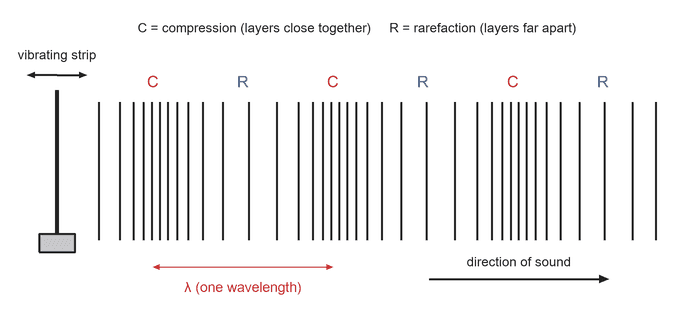
The air particles vibrate about their mean positions along the direction in which the sound travels, so the wave is a longitudinal wave. The distance between two consecutive compressions (or rarefactions) is one wavelength .
Watch out: The air layers only vibrate about their mean positions; the compressions and rarefactions are what move forward.
Therefore, a vibrating source sends out alternate compressions and rarefactions, and these travel through the air as a longitudinal wave.
- 464 marks
Question 46
How does the wave pattern of a loud note differ from a soft note ? Draw a diagram.
Solve with AIWritten solution
Solution:
Concept: Loudness is the characteristic that tells a loud sound from a soft one. It depends on the amplitude of the wave: in this chapter loudness is taken as proportional to the square of the amplitude, . (Strictly, it is the sound's intensity, the energy it carries, that follows this rule; the loudness we sense rises with the intensity.) Loudness is expressed in decibel (dB).
Step 1 — State the difference.
The wave of a loud note has a large amplitude, while the wave of a soft (feeble) note has a small amplitude.
Step 2 — Keep the pitch the same.
If the two notes have the same pitch, their waves have the same frequency: the same number of waves in the same time. Only the height of the crests and the depth of the troughs differ.
Step 3 — Draw the two waves.
The diagram shows both waves with the same frequency; the loud note's amplitude is larger than the soft note's amplitude .
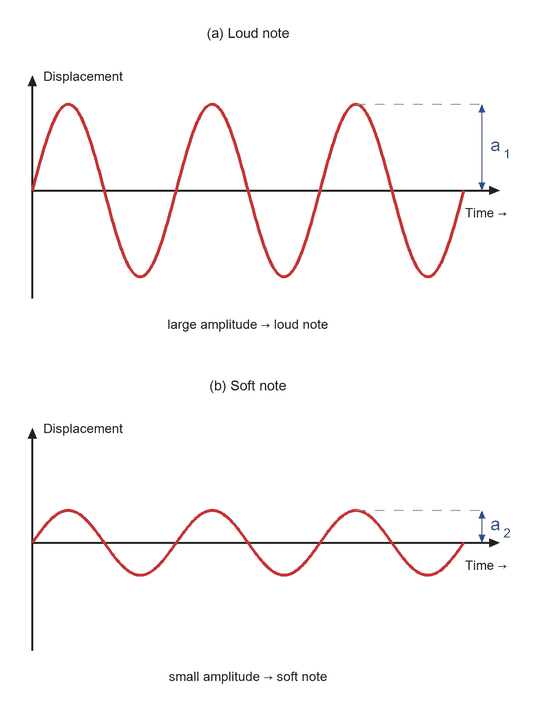
Loud note Soft note Amplitude large () small () Energy carried more less Frequency (same pitch) same same Watch out: A loud note is not 'more waves'; the number of waves (frequency) sets the pitch, the height (amplitude) sets the loudness.
Therefore, a loud note has a wave of larger amplitude than a soft note; the frequency can be the same.
- 473 marks
Question 47
Name and define the characteristic which enables one to distinguish two sounds of same loudness, but of different frequencies, given by the same instrument.
Solve with AIWritten solution
Solution:
Concept: Pitch is the characteristic that tells a shrill (high) sound from a flat or grave (low) sound. It depends on the frequency: the higher the frequency, the higher the pitch.
Step 1 — Name the characteristic.
Two sounds of the same loudness from the same instrument but of different frequencies differ in pitch.
Step 2 — Define it.
Pitch is the characteristic of sound which distinguishes a shrill (acute) sound from a flat (grave) sound of the same loudness. It depends on the frequency of the vibrating body.
Step 3 — Give the effect of frequency.
A sound of high frequency has a high pitch and is shrill; a sound of low frequency has a low pitch and is flat. On the same guitar, a thin string under high tension gives a note of higher pitch than a thick, loose string, even when both are played equally loudly.
Therefore, the characteristic is pitch: the property that tells a shrill sound from a flat one, and it depends on frequency.
- 484 marks
Question 48
Draw a diagram to show the wave pattern of a high pitch note and a low pitch note, but of the same loudness.
Solve with AIWritten solution
Solution:
Concept: Same loudness means the same amplitude; a higher pitch means a higher frequency, that is, more waves in the same time.
Step 1 — Fix the amplitude.
Both notes are equally loud, so both waves are drawn with the same amplitude (the same height of crests and depth of troughs).
Step 2 — Fix the number of waves.
In the same time interval, the high-pitch note is drawn with more waves (shorter time period, higher frequency) and the low-pitch note with fewer waves (longer time period, lower frequency).
Step 3 — Draw the diagram.
The diagram shows the two waves on the same time scale.
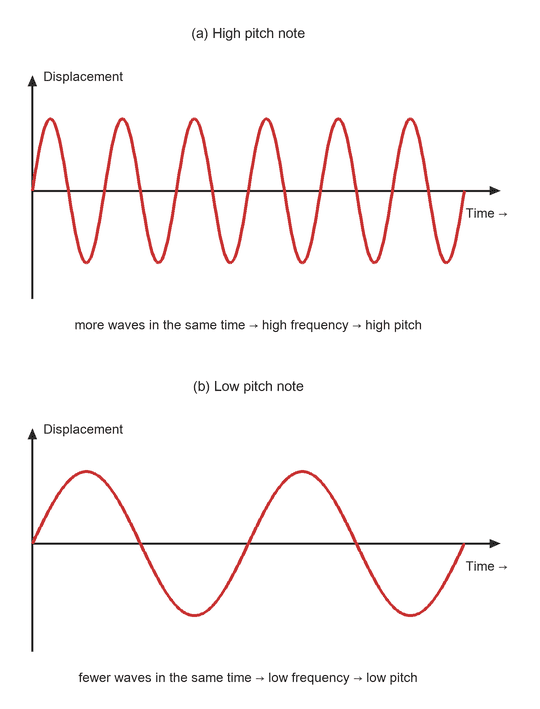
Watch out: For the same loudness, do not change the heights of the two waves; only their spacing changes.
Therefore, the high-pitch note shows more waves and the low-pitch note fewer waves in the same time, both with the same amplitude.
- 492 marks
Question 49
Standing at a distance, how is it possible to detect the filling of a bucket under a water tap by hearing the sound ?
Solve with AIWritten solution
Solution:
Concept: In a wind instrument (or any air column), the vibrating air column gives a higher frequency, and so a higher pitch, when it is shorter, and a lower pitch when it is longer.
Step 1 — Find what makes the sound.
When water falls into the bucket, the air column above the water in the bucket vibrates and gives out a sound.
Step 2 — See how the air column changes.
As the bucket fills, the water level rises, so the length of the air column above it decreases.
Step 3 — See how the pitch changes.
A shorter air column vibrates with a higher frequency, so the pitch rises: the sound gets shriller and shriller as the bucket fills.
Therefore, by listening to the rising pitch of the sound, one can tell from a distance how far the bucket has filled; a very shrill sound means it is nearly full.
- 502 marks
Question 50
The frequencies of notes given by flute, guitar and trumpet are respectively 400 Hz, 200 Hz and 500 Hz. Which one of these has the highest pitch ?
Solve with AIWritten solution
Solution:
Concept: Pitch is the characteristic that tells a shrill (high) sound from a flat or grave (low) sound. It depends on the frequency: the higher the frequency, the higher the pitch.
Step 1 — List the frequencies.
The flute note is 400 Hz, the guitar note 200 Hz and the trumpet note 500 Hz.
Step 2 — Pick the highest frequency.
Pitch rises with frequency, so the note with the highest frequency, 500 Hz, has the highest pitch. That is the trumpet's note. (The guitar's 200 Hz note has the lowest pitch.)
Therefore, the trumpet has the highest pitch.
- 512 marks
Question 51
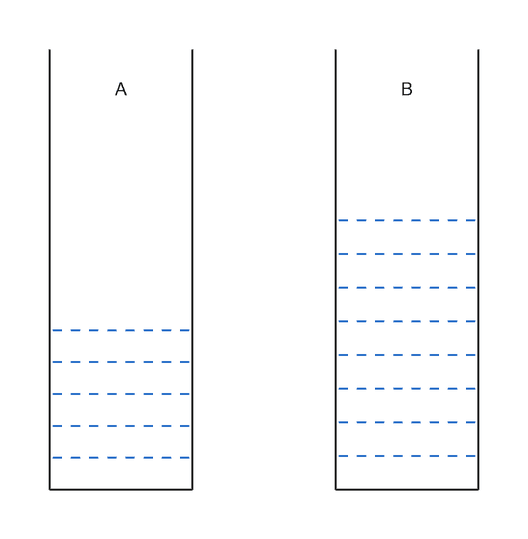
Fig. 7.20 shows two jars A and B containing water up to different heights. Which will produce sound of higher pitch when air is blown in them?
 Solve with AI
Written solution
Solution:
Concept: When air is blown into a jar, the air column above the water vibrates. In a wind instrument (or any air column), the vibrating air column gives a higher frequency, and so a higher pitch, when it is shorter, and a lower pitch when it is longer.
Step 1 — Look at jar A.
In jar A the water level is low, so the air column above the water is long. It vibrates with a lower frequency and gives a lower pitch.
Step 2 — Look at jar B.
In jar B the water level is high, so the air column above the water is short. It vibrates with a higher frequency and gives a higher pitch.
Watch out: It is the air column, not the water, that vibrates and decides the pitch here.
Therefore, jar B will produce the sound of higher pitch.
- 522 marks
Question 52
Two identical guitars are played by two persons to produce notes of the same pitch. Will they differ in quality ? Give reason for your answer.
Solve with AIWritten solution
Solution:
Concept: Quality (timbre) is the characteristic that tells apart two sounds of the same loudness and the same pitch. It depends on the wave form, which is set by the other frequencies (overtones) that the source produces, in small amplitudes, along with its main frequency.
Step 1 — See what decides quality.
Quality depends on the wave form, which is set by the extra frequencies that the instrument produces along with the main frequency.
Step 2 — Compare the two guitars.
The guitars are identical and play notes of the same pitch, so they produce the same set of frequencies and hence the same wave form.
Step 3 — Conclude.
The two notes therefore have the same quality. They may differ only in loudness if one person plucks harder than the other.
Therefore, no, the notes will not differ in quality, because identical guitars give the same wave form for the same pitch.
- 533 marks
Question 53
Two musical notes of the same pitch and same loudness are played on two different instruments. Their wave patterns are as shown in Fig. 7.21.

How do they differ in
(a) loudness, (b) pitch and (c) quality ?
Solve with AIWritten solution
Solution:
Concept: A musical sound has three characteristics. Loudness depends on the amplitude, pitch depends on the frequency, and quality (timbre) depends on the wave form.
Step 1 — Compare loudness.
(a) The two waves have the same amplitude (equal heights of crest and trough), so the notes have the same loudness.
Step 2 — Compare pitch.
(b) The two waves take the same time for one complete wave, so they have the same frequency and the same pitch.
Step 3 — Compare quality.
(c) The shapes (wave forms) are different: the violin gives a saw-tooth shaped wave and the piano an irregular wavy one. So their quality is different. This is how we tell a violin from a piano even when both play the same note equally loudly.
Therefore, the two notes are the same in (a) loudness and (b) pitch, but differ in (c) quality.
- 543 marks
Question 54
Fig. 7.22 shows four waves A, B, C, and D.
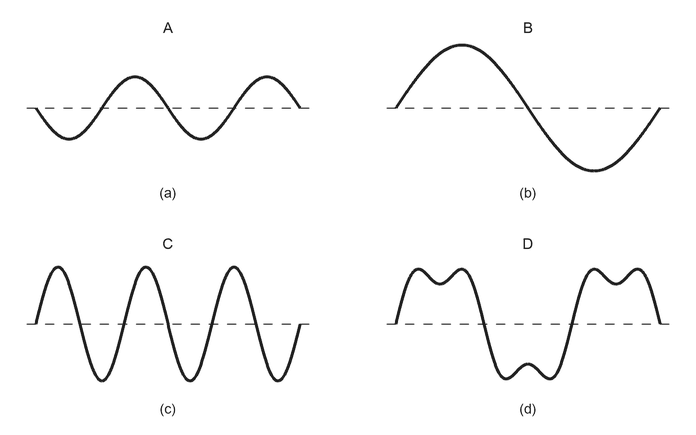
Name the wave which shows
(a) a note from a musical instrument, (b) a soft note, (c) a shrill note.
Solve with AIWritten solution
Solution:
Concept: A musical instrument gives a complex wave form (not a simple sine curve); a soft note has a small amplitude; a shrill note has a high frequency.
Step 1 — Find the note from a musical instrument.
(a) Waves A, B and C are smooth sine curves of a single frequency, like the sound of a tuning fork. Wave D has extra bumps on its crests and trough because other frequencies are mixed with the main one, as in the note of a musical instrument. So wave D shows a note from a musical instrument.
Step 2 — Find the soft note.
(b) Wave A has the smallest amplitude (the lowest crests), so wave A shows a soft note.
Step 3 — Find the shrill note.
(c) Wave C has the most waves in the same width (three, against two for A and one for B), so it has the highest frequency and the highest pitch. Wave C shows a shrill note.
Watch out: The parts of the question are (a), (b), (c), but the waves are A, B, C, D; part (a) is not wave A.
Therefore, (a) wave D is the note from a musical instrument, (b) wave A is a soft note, and (c) wave C is a shrill note.
- 552 marks
Question 55
What happens when a lighted candle is placed in front of a loudspeaker making a loud and steady noise. Give reason.
Solve with AIWritten solution
Solution:
Concept: In air, sound travels as a longitudinal wave: the air particles vibrate to and fro along the direction in which the sound travels, forming compressions (layers pressed close together, higher pressure) and rarefactions (layers spread apart, lower pressure).
Step 1 — Say what happens.
The flame of the candle flickers: it moves to and fro.
Step 2 — Explain why.
The vibrating cone of the loudspeaker sends out compressions and rarefactions. When a compression reaches the flame, the air pushes it slightly away from the loudspeaker; when a rarefaction reaches it, the flame moves back towards the loudspeaker.
Step 3 — See why it is visible.
Because the noise is loud, the air vibrations have a large amplitude, so the flame's to-and-fro movement can be seen. This shows that sound carries energy and that air particles vibrate along the direction in which the sound travels.
Therefore, the candle flame flickers, because the compressions and rarefactions of the sound make the air around it vibrate to and fro.
- 564 marks
Question 56
Two waves of the same pitch have amplitudes in the ratio 1 : 3. What will be the ratio of their (i) loudness, (ii) pitch ?
Solve with AIWritten solution
Solution:
Concept: Loudness is the characteristic that tells a loud sound from a soft one. It depends on the amplitude of the wave: in this chapter loudness is taken as proportional to the square of the amplitude, . (Strictly, it is the sound's intensity, the energy it carries, that follows this rule; the loudness we sense rises with the intensity.) Loudness is expressed in decibel (dB). Pitch depends only on frequency.
Given: ; the two waves have the same pitch.
Step 1 — Write the loudness ratio.
Loudness is proportional to the square of the amplitude, so the ratio of the loudness values is the ratio of the squares of the amplitudes:
Step 2 — Put in the amplitudes.
The amplitudes are in the ratio 1 : 3.
So the ratio of loudness is 1 : 9.
Step 3 — Compare the pitch.
The two waves have the same pitch (the same frequency); a change in amplitude does not change the pitch. So the ratio of pitch is 1 : 1.
Watch out: Square the amplitude ratio for loudness: 1 : 3 in amplitude is 1 : 9 in loudness, not 1 : 3.
Therefore, (i) the ratio of loudness is 1 : 9 and (ii) the ratio of pitch is 1 : 1.
- 574 marks
Question 57
Two waves have frequencies 256 Hz and 512 Hz, but same amplitude. Compare their (i) loudness, and (ii) pitch.
Solve with AIWritten solution
Solution:
Concept: Loudness is the characteristic that tells a loud sound from a soft one. It depends on the amplitude of the wave: in this chapter loudness is taken as proportional to the square of the amplitude, . (Strictly, it is the sound's intensity, the energy it carries, that follows this rule; the loudness we sense rises with the intensity.) Loudness is expressed in decibel (dB). Pitch is the characteristic that tells a shrill (high) sound from a flat or grave (low) sound. It depends on the frequency: the higher the frequency, the higher the pitch.
Given: Hz, Hz, .
Step 1 — Compare the loudness.
The two waves have the same amplitude, so their loudness is the same:
The ratio of loudness is 1 : 1.
Step 2 — Compare the pitch.
Pitch is compared through frequency, so the ratio of pitch is the ratio of the frequencies:
The ratio of pitch is 1 : 2, so the 512 Hz wave has the higher pitch (it is shriller). A note of double the frequency is one octave higher.
Watch out: A different frequency does not make a wave louder; with equal amplitudes the loudness is equal.
Therefore, (i) the ratio of loudness is 1 : 1 and (ii) the ratio of pitch is 1 : 2 (the 512 Hz wave is shriller).
- 583 marks
Question 58
Two waves have the same pitch but their amplitudes are in the ratio of 1 : 2. Draw a figure to show the two waves.
Solve with AIWritten solution
Solution:
Concept: Same pitch means the same frequency, that is, the same time period ; only the amplitudes differ.
Given: Same pitch; amplitudes in the ratio 1 : 2.
Step 1 — Fix the amplitudes.
The amplitudes are in the ratio 1 : 2, so if the first wave has amplitude , the second has amplitude .
Step 2 — Fix the time period.
Both waves have the same pitch, so both are drawn with the same time period : they cross the time axis at the same points.
Step 3 — Draw the figure.
The figure shows the two waves on the same time scale.

The crest of the second wave is twice as high as that of the first. Since loudness is proportional to the square of the amplitude, the second wave is 4 times as loud:
Watch out: Keep the spacing of the waves the same; only the heights differ.
Therefore, the two waves have the same time period T, and the second wave's amplitude (2a) is twice the first wave's amplitude (a).
- 593 marks
Question 59
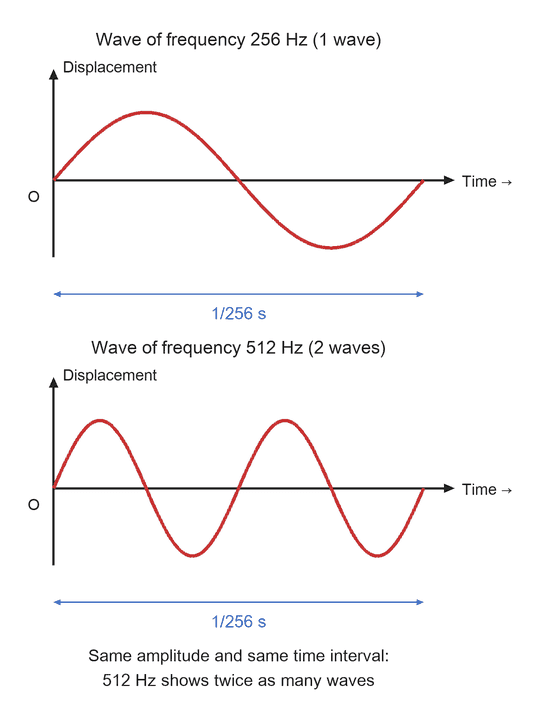
Two waves of the same amplitude have frequencies 256 Hz and 512 Hz respectively. Represent the two waves in the graphical form.
(Hint : 1 wave represents 256 Hz of frequency)
Solve with AIWritten solution
Solution:
Concept: A wave of frequency completes waves in 1 second, so in the same time interval a wave of double the frequency shows double the number of waves.
Given: Hz, Hz, same amplitude.
Step 1 — Choose the time interval.
Following the hint, take the time interval equal to one time period of the 256 Hz wave, so that it shows exactly 1 wave:
Step 2 — Count the waves of the 512 Hz wave.
In the same time, the number of waves of the 512 Hz wave is its frequency multiplied by the time:
Step 3 — Draw the graph.
The 256 Hz wave is drawn as 1 complete wave and the 512 Hz wave as 2 complete waves in the same time s, with the same height for both.
Watch out: Draw both waves to the same time scale; otherwise the comparison of the number of waves means nothing.
Therefore, in the same time of 1/256 s the 256 Hz wave shows 1 wave and the 512 Hz wave shows 2 waves, both of the same amplitude.
What Class 8 Physics Ch 7 covers
The sections of the chapter, in the order the book takes them. Every question above comes from one of these.
- 01Propagation of Sound in Air
- 02Terms Related to a Wave
- 03Representation of a Wave
- 04Characteristics of Sound
- 05Monotone
- 06Making a Musical Toy
More ways to study this chapter
The same chapter asked three other ways. Practise it, revise it, and see what the board has set on Ch 7 before.
Class 8 Physics Ch 7 questions students ask
How many questions are there in Class 8 Physics Ch 7?
59 questions. Every one is solved step by step on this page.
Are these Class 8 Physics solutions free?
Yes. Every question and its full working is free to read, with no account needed.
Can I download the Class 8 Physics Ch 7 solutions as a PDF?
There is no PDF to download. Every solution is on this page instead, which means it is searchable, always the current syllabus, and readable on a phone. Use your browser's print option if you want it on paper.