
Opening your dashboard
Class 8 Physics Chapter 7 Sound: Practice Questions
40 questions on Chapter 7, each worked through on its own page with the AI tutor. Class 8 Physics, ICSE 2026-27.
40 questions
1–5 marks · Mixed difficulty
- 11 mark
Question 1
Bloom's level: Remember
The speed of sound in water is nearly :
- 21 mark
Question 2
Bloom's level: Remember
When a vibrating metal strip moves forward, it pushes the layer of air in front of it so that the particles of air come closer together. Such a region of high pressure in a sound wave is called a :
- 31 mark
Question 3
Bloom's level: Remember
The distance travelled by a wave in one time period of vibration of a particle of the medium is called its :
- 41 mark
Question 4
Bloom's level: Apply
A tuning fork is marked 320 Hz. The time period of its vibration is :
- 51 mark
Question 5
Bloom's level: Apply
A drum is first struck hard and then gently. The loudness of the second sound is one-fourth of the first. The amplitude of vibration of the membrane has become :
- 61 mark
Question 6
Bloom's level: Apply
A sitar player wants the same string to give a note of higher pitch. She should :
- 71 mark
Question 7
Bloom's level: Analyse
The displacement-distance graph of a sound wave at an instant is shown.
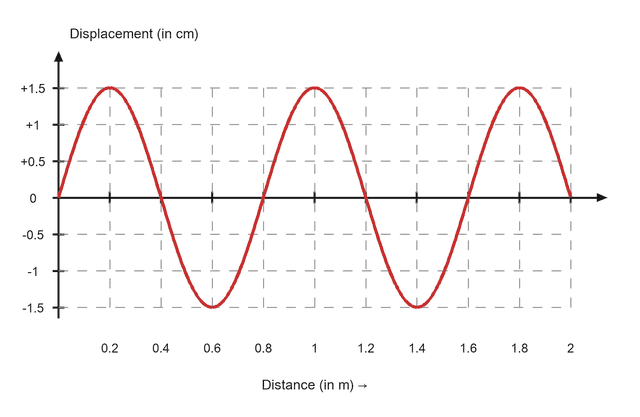
The amplitude and the wavelength of the wave are :
- 81 mark
Question 8
Bloom's level: Understand
A tuning fork is called a source of monotone because it :
- 91 mark
Question 9
Bloom's level: Evaluate
Meena says, "If a flute and a piano play a note of the same pitch with the same loudness, their sound waves must look exactly the same." Which is the correct judgement ?
- 101 mark
Question 10
Bloom's level: Understand
Read the Assertion (A) and the Reason (R) and choose the correct option.
Assertion (A): Two astronauts standing on the moon cannot hear each other speak directly, even when standing close together.
Reason (R): Sound needs a material medium to travel; it cannot travel through vacuum.
- 111 mark
Question 11
Bloom's level: Understand
Read the Assertion (A) and the Reason (R) and choose the correct option.
Assertion (A): The frequency of the sound of a bell remains the same when the sound passes from air into water.
Reason (R): The frequency of a wave depends on the nature of the medium through which it travels.
- 121 mark
Question 12
Bloom's level: Analyse
Read the Assertion (A) and the Reason (R) and choose the correct option.
Assertion (A): The cry of a baby is shriller than the cry of an adult.
Reason (R): The loudness of a sound depends on the amplitude of vibration.
- 132 marks
Question 13
Bloom's level: Remember
How is sound produced ? Why is sound said to be a form of energy ?
- 142 marks
Question 14
Bloom's level: Understand
A loudspeaker is playing music 10 m away from you. Do the particles of air near the loudspeaker travel to your ear ? Explain what actually travels from the loudspeaker to you.
- 152 marks
Question 15
Bloom's level: Apply
A particle of air completes 1200 vibrations in 4 s. Find (a) the frequency and (b) the time period of the wave.
- 162 marks
Question 16
Bloom's level: Apply
In a sound wave in air, the distance between the first compression and the fifth compression is 4.4 m.
(a) Find the wavelength.
(b) What is the distance between a compression and the nearest rarefaction ?
- 172 marks
Question 17
Bloom's level: Understand
The safe limit of the level of sound for hearing is 0 to 80 dB. Classify each sound as safe or harmful (noise) and give a reason.
(a) Normal conversation, 50 dB
(b) Heavy hammering machine, 110 dB
(c) Leaves rustling, 10 dB
(d) Rocket take-off, 140 dB
- 182 marks
Question 18
Bloom's level: Apply
The level of a sound rises from 30 dB (a whisper) to 50 dB (normal conversation). A rise of 10 dB means that the sound is 10 times as intense (10 times as much sound energy reaches the ear each second). How many times has the intensity of the sound increased ?
- 192 marks
Question 19
Bloom's level: Analyse
The displacement-time graph of a particle of air, as a sound wave passes, is shown.
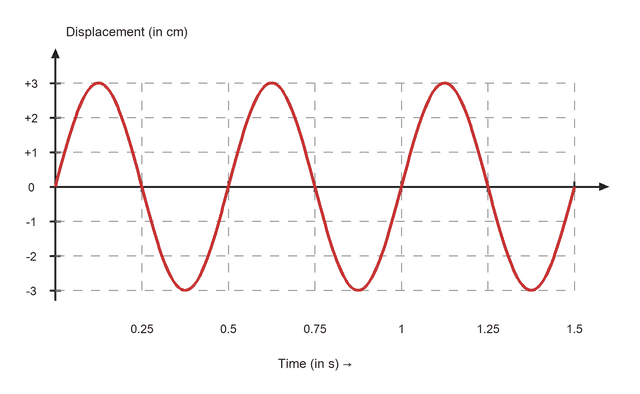
From the graph, find (a) the amplitude, (b) the time period, (c) the frequency, and (d) the number of vibrations the particle makes in 10 s.
- 202 marks
Question 20
Bloom's level: Understand
A tuning fork and a guitar both give a note of frequency 256 Hz. Explain why the wave form of the tuning fork is a smooth, simple wave while that of the guitar is not.
- 212 marks
Question 21
Bloom's level: Apply
In a shoe-box guitar, three rubber bands P, Q and R are stretched across the box. P is thick, Q is of medium thickness and R is thin, and all are under the same tension.
(a) Which band gives the note of highest pitch ?
(b) Suggest one way to raise the pitch of band P without changing it for another band.
- 222 marks
Question 22
Bloom's level: Evaluate
Rahul wrote these notes for revision. Check each one; write Correct or Wrong and correct the wrong ones.
(a) Doubling the amplitude of a sound makes it twice as loud.
(b) A note of higher frequency has a higher pitch.
(c) The frequency of a sound changes when it passes from air into iron.
(d) Two sounds of the same pitch and loudness can be told apart by their wave forms.
- 234 marks
Question 23
Bloom's level: Analyse
The figure shows the displacement-time graphs of two sound waves P and Q, drawn to the same scales.

(a) Find the amplitude and the frequency of each wave.
(b) Which sound is louder ? Find the ratio of the loudness of P to that of Q.
(c) Which sound is shriller ? Give a reason.
(d) Which characteristic of sound, other than loudness and pitch, cannot be compared from these graphs alone if both are simple waves ? Why ?
- 244 marks
Question 24
Bloom's level: Apply
A school band has a flute, a guitar and a tabla. Explain what each player should do, and why, in each case below.
(a) The flute player wants to play a lower (graver) note.
(b) The guitarist wants a higher note from the same string. Give two ways.
(c) The tabla player wants the tabla to sound shriller.
(d) The guitarist wants the same note to sound louder.
- 254 marks
Question 25
Bloom's level: Understand
Case study: In a science show, an electric bell is kept ringing inside a glass jar. As the air is slowly pumped out of the jar, the sound becomes fainter and fainter, until nothing can be heard, although the hammer can still be seen striking the gong. Later, Ravi puts his ear to one end of a long iron railing while his friend taps the far end with a coin. Ravi hears two taps: one through the railing and, a moment later, one through the air.
(a) Why does the sound of the bell fade away as the air is removed ?
(b) What does this show about sound and light ?
(c) Why does Ravi hear the tap through the iron railing first ?
- 264 marks
Question 26
Bloom's level: Apply
A tuning fork of frequency 256 Hz is sounded in air, where sound travels 330 m in one second.
(a) Find the time period of the vibrations.
(b) Using the definition of wavelength (distance travelled by the wave in one time period), find the wavelength in air.
(c) The same fork is now sounded under water, where sound travels 1500 m in one second. Does its frequency change ? Find the new wavelength.
(Give answers correct to two decimal places where needed.)
- 274 marks
Question 27
Bloom's level: Evaluate
Case study: Using a sound-recording app, students record the wave forms of (i) a tuning fork of 512 Hz struck gently on a rubber pad, (ii) the same fork struck harder, and (iii) a flute playing a note of 512 Hz. Three students make these claims.
(a) Asha: "In (ii) the waves are taller, so the fork's pitch has gone up."
(b) Bilal: "The flute and the fork have the same pitch, so their wave forms must be the same."
(c) Chitra: "Musicians use a tuning fork to tune their instruments because it gives one pure, fixed frequency."
Judge each claim as right or wrong, with a reason.
- 283 marks
Question 28
Bloom's level: Analyse
Four sounds W, X, Y and Z are produced. Their amplitudes and frequencies are :
Sound W X Y Z Amplitude 1 cm 3 cm 1 cm 2 cm Frequency 200 Hz 200 Hz 800 Hz 400 Hz (a) Which sound is the loudest and which is the shrillest ?
(b) Find the ratio of the loudness of X to that of W, and of X to that of Z.
(c) Which two sounds differ only in pitch, and which two differ only in loudness ?
- 295 marks
Question 29
Bloom's level: Create
Plan a shoe-box guitar that can play four notes, from the lowest to the highest, using a shoe box, a cardboard tube, rubber bands of different thickness, cellotape and scissors.
(a) List the steps to make the guitar.
(b) Decide how you will arrange the four rubber bands so that the notes go from lowest to highest pitch, and give the reason.
(c) Suggest how a player can make a note louder, and how the player can get a still higher note from the thinnest band.
(d) Suggest one change to make the whole guitar sound louder, and explain it.
- 305 marks
Question 30
Bloom's level: Create
Case study: For a class music corner, you are asked to make pan pipes from eight drinking straws, each closed at one end with clay, taped side by side, to play the eight notes of a scale from low to high.
(a) Plan how you will cut the straws. Explain your plan using the length of the vibrating air column.
(b) While testing, one pipe sounds slightly too low. How will you correct it ? Another pipe sounds too faint. What will the player do ?
(c) Design a simple chart for the music corner with three rows - Loudness, Pitch, Quality - showing for each the factor it depends on and one example from your pan pipes or from other instruments.
- 311 mark
Question 31
Which of the following statements is correct for the particles of air when a sound wave passes through air ?
- 321 mark
Question 32
In the displacement-time graph of a particle of a medium through which a wave is passing, the maximum height of the curve above the time axis gives the :
- 331 mark
Question 33
The sound of a crying baby is shriller than the sound of a crying adult because the sound of the baby has a higher :
- 341 mark
Question 34
Fill in the blank :
A sound of a single frequency is called a ..............
- 351 mark
Question 35
Write true or false :
The frequency of a sound wave changes when the wave passes from air into water.
- 362 marks
Question 36
Differentiate between the loudness and the pitch of a sound. Give two points of difference.
- 372 marks
Question 37
A metal strip clamped at one end is set into vibration. It takes 0.004 s to complete one vibration.
(a) Calculate the frequency of vibration of the strip.
(b) How many vibrations does the strip complete in 3 s ?
- 384 marks
Question 38
The figure shows the displacement-time graph of a particle of air when a sound wave passes through the air.
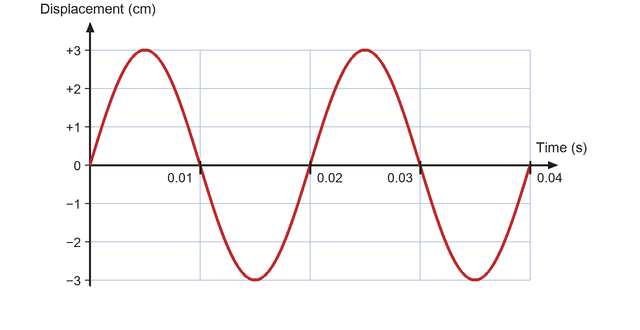
(a) From the graph, write the amplitude and the time period of the wave.
(b) Calculate the frequency of the wave.
(c) Copy the graph. On the same axes, draw the displacement-time graph of another sound of the same pitch whose loudness is one-fourth of the loudness of the given sound. Give a reason for the amplitude and the time period you have chosen.
- 394 marks
Question 39
(a) How is the loudness of a sound related to the amplitude of the wave ?
(b) The membrane of a drum vibrates with an amplitude of 0.5 mm when it is beaten gently and with an amplitude of 2.5 mm when it is beaten hard. How many times louder is the second sound than the first ?
(c) The level of sound of normal conversation is 50 dB and that of a diesel engine is 90 dB.
(i) A rise of 10 dB means that the sound is 10 times as intense. How many times is the intensity of the sound of the diesel engine as compared to that of normal conversation ?
(ii) Which of the two sounds is beyond the safe limit of the level of sound for hearing ? Give a reason.
- 404 marks
Question 40
Rohan makes a toy guitar by stretching rubber bands across the open side of a shoe box in which a cardboard tube has been fixed.
(a) Which part of this toy vibrates to produce the sound when Rohan plays it ?
(b) How does the pitch of the sound change if Rohan (i) stretches the same rubber band more tightly, (ii) replaces it by a thicker rubber band under the same tension ? Give a reason in each case.
(c) Rohan now plucks the same rubber band harder than before. Name the characteristic of the sound that changes and the one that does not change. Give a reason.