
Opening your dashboard
Class 8 Physics Chapter 7 Sound: Competency-Based Questions (CBQ)
40 questions on Chapter 7, each worked through on its own page with the AI tutor. Class 8 Physics, ICSE 2026-27.
40 questions
1–5 marks · Mixed difficulty
- 11 mark
Question 1
Competency: Application
A very light thermocol ball hangs on a long thread just in front of a large loudspeaker. The loudspeaker is switched on and gives a loud, steady, low hum for one minute.
What is seen during this minute, and what does it show ?
- 21 mark
Question 2
Competency: Analysis
A loudspeaker gives a steady note. The figure shows the layers of air in front of it at one instant, drawn as lines above a scale. K, L, M and N are four places in the air.

Which statement about this sound wave is correct ?
- 31 mark
Question 3
Competency: Application
A slow-motion video shows that the wing of a mosquito makes 125 complete beats in 0.25 s. The hum of the mosquito has the same frequency as its wing beats.
What are the frequency and the time period of the hum ?
- 41 mark
Question 4
Competency: Application & Analysis
A tabla player first taps the tabla lightly and then strikes it harder at the same place. A sensor shows that the amplitude of vibration of the membrane rises from 0.4 mm to 1.0 mm. Nothing else about the tabla is changed.
How does the second sound compare with the first ?
- 51 mark
Question 5
Competency: Understanding
Assertion (A): When a singer slides from a low note to a higher note, the waves on the displacement-time graph of her sound come closer together.
Reason (R): The pitch of a sound becomes higher when the amplitude of its wave becomes larger.
- 61 mark
Question 6
Competency: Understanding & Application
Assertion (A): A tuning fork marked 512 Hz gives a note of higher pitch when it is struck harder with the rubber pad.
Reason (R): A tuning fork vibrates with its own frequency, which is marked on it.
- 72 marks
Question 7
Competency: Application & Evaluation
An iron post stands in a lake. A worker hits it once with a hammer. A diver under the water and a girl standing on the bank are each 330 m from the post. Sound travels about 330 m in air and about 1500 m in water in one second.
Ravi says, "The two are at the same distance from the post, so they hear the blow at the same moment."
Is Ravi right ? Support your answer by finding the time the sound takes to reach each of them.
- 82 marks
Question 8
Competency: Application & Analysis
One end of a steel ruler is clamped to a table and the free end is flicked. A slow-motion video of the free end shows that
- its highest point and its lowest point are 6 cm apart, and
- it takes 0.02 s to move from the highest point to the lowest point.
(a) Find the amplitude of vibration of the free end.
(b) Find its time period and its frequency.
- 92 marks
Question 9
Competency: Application
Before a concert, a music teacher strikes a tuning fork marked 384 Hz with a rubber pad and then plucks one string of a sitar, to check the note of the string.
(a) Why does she use a tuning fork as the standard, and not the note of another instrument ?
(b) The note of the string sounds flatter (lower) than that of the fork. What should she do to the string, and how will she know when to stop ?
- 102 marks
Question 10
Competency: Analysis
Meera makes a guitar from a shoe box and rubber bands. She tries four things with one of the bands and writes down what she hears.
Trial What Meera does What she hears 1 Plucks the band gently at its middle A low twang 2 Presses the band down on a pencil laid across the middle of the box and plucks one half of the band gently A shriller twang than in trial 1 3 Pulls the band tighter, tapes it, and plucks it gently at its middle A shriller twang than in trial 1 4 Loosens the band back as in trial 1 and plucks it hard at its middle The twang of trial 1, but louder (a) In which trials has the frequency of vibration of the band changed from that in trial 1 ? What caused the change in each ?
(b) Which quantity of the vibration has changed in trial 4 ? Why is the pitch the same as in trial 1 ?
- 114 marks
Question 11
Competency: Analysis
Case study: In a physics laboratory a loudspeaker gives a steady note. A computer draws two graphs of the sound wave: graph (i) shows how the displacement of one particle of the medium changes with time, and graph (ii) shows the displacement of the particles at different distances at one instant.
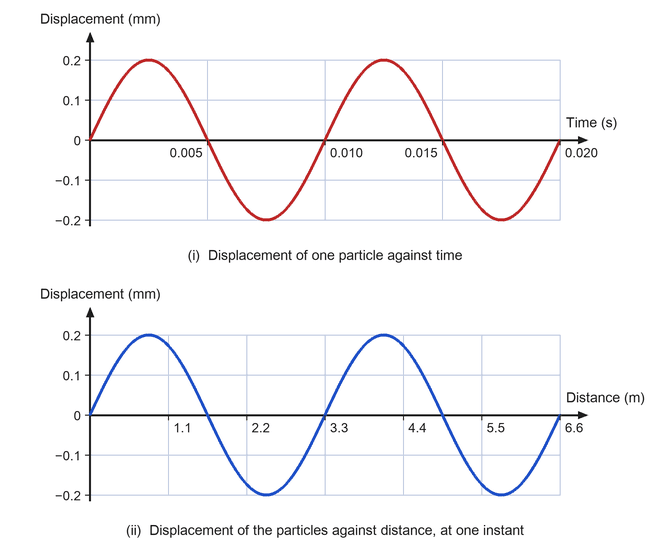
Sound travels about 330 m in air, 1500 m in water and 5000 m in iron in one second.
(a) From graph (i), read the amplitude and the time period of the wave.
(b) Find the frequency of the note, and read the wavelength of the wave from graph (ii).
(c) A wave travels a distance equal to one wavelength in one time period. Use your answers to find how far this sound travels in one second, and decide whether the medium is air, water or iron.
- 124 marks
Question 12
Competency: Analysis & Evaluation
Case study: For a project on noise, students measure the level of sound at five places in their school with a sound level meter.
Place Level of sound (dB) Library 30 Classroom during a lesson 50 Corridor during the break 70 Wood workshop with the saw running 100 Generator room 110 A rise of 10 dB means that the sound is 10 times as intense: 10 times as much sound energy reaches the ear each second.
(a) Which of these places are within the safe limit of the level of sound for hearing ? State the limit you have used.
(b) A student says, "The workshop is only twice as loud as the classroom, because 100 is twice 50." Judge this statement and find how many times as intense the sound in the workshop really is (how many times as much sound energy reaches the ear each second).
(c) The school plans to give ear protectors, which lower the level of sound reaching the ear by 30 dB, to everyone who works in the workshop and in the generator room. By how many times do they cut the intensity of the sound reaching the ear ? Judge whether the plan makes each of the two places safe.
- 133 marks
Question 13
Competency: Analysis
Case study: A science club makes a set of musical tubes. Four identical long glass tubes, closed at the bottom, are filled with water to different heights. A student blows across the mouth of each tube, and a phone app shows the frequency of the note.
Tube Length of the air column (cm) Frequency of the note (Hz) P 20 425 Q 17 500 R 10 850 S 8.5 1000 (a) Which tube gives the note of lowest pitch ? Which tube contains the most water ?
(b) Compare tubes P and R, and then tubes Q and S. What happens to the frequency when the length of the air column is halved ? Show that (frequency × length of air column) is the same for all four tubes.
(c) The club needs one more tube for a note of 680 Hz. Find the length of air column it should have. If this tube is made by pouring more water into a tube like P, by how much must the water level rise ?
- 144 marks
Question 14
Competency: Application & Analysis
A loudspeaker gives a steady note. A particle of air near it vibrates with an amplitude of 0.2 mm and a frequency of 250 Hz.
(a) Find the time period of the particle, and the number of complete waves its displacement-time graph shows between 0 and 0.02 s.
(b) Describe this graph for the first wave: state the time at which the particle first reaches its greatest displacement on one side, the time at which it reaches its greatest displacement on the other side, and the times at which the graph meets the time axis. Take the particle to be at its mean position at time 0.
(c) The volume is now turned up until the sound is four times as loud, at the same pitch. State what changes on the graph and what stays the same, and give the new value of the quantity that changes.
- 154 marks
Question 15
Competency: Creation
You have a shoe-box guitar: a shoe box without its lid, with a rubber band stretched across the open side. You want to find out how the tension of a band changes the pitch of its note. You may also use a second rubber band exactly like the first, a small paper cup, thread, some identical marbles, cellotape and a phone app that shows the frequency of a note.
(a) Describe, in steps, how you would set up and carry out the investigation so that the tension can be changed by a known amount each time.
(b) State two things you must keep the same every time so that the test is fair, and why.
(c) Draw the table you would use for your readings, and state the result you expect, with the reason.
- 161 mark
Question 16
Competency: Understanding
In a school canteen a helper strikes a steel plate with a spoon, and the plate rings loudly. He then presses the palm of his hand flat on the plate, and the ringing stops at once. What does this show ?
- 171 mark
Question 17
Competency: Understanding
A loudspeaker cone is at rest. It is pushed forward quickly by a small distance, then pulled back past its rest position, and then brought back to rest, so that it makes one complete vibration. A pressure sensor far in front of the loudspeaker records the air pressure as the disturbance passes it.
Which statement correctly describes what reaches the sensor ?
- 181 mark
Question 18
Competency: Analysis
The figure shows a bamboo flute. Air is blown across the mouth hole at the left end. Four finger holes P, Q, R and S are marked with their distances from the mouth hole. All four holes are first covered and the flute is played. Then the player plays it again with just one finger lifted, the other three holes staying covered. When a hole is open, the vibrating air column runs from the mouth hole to the first open hole.
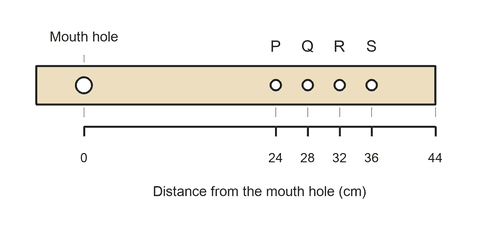
Which statement is correct ?
- 191 mark
Question 19
Competency: Application
A sound level meter beside a lane shows that the sound of a passing scooter is times as intense as the faintest sound that the human ear can hear at a frequency of . (Here ‘times as intense’ means ‘times as much sound energy reaches the ear each second’.) Every time the intensity becomes 10 times, the level of sound rises by , starting from for the faintest audible sound. (Hypothetical data.)
What is the level of the sound of the scooter, and what does it mean for hearing ?
- 201 mark
Question 20
Competency: Application
A laboratory assistant finds a tuning fork whose label has worn off. She knows that it is one of the forks marked 256, 288, 320, 384, 480 and 512 Hz. A sensor shows that the fork makes 7680 complete vibrations in 15 s. (Hypothetical data.)
Which fork is it ?
- 211 mark
Question 21
Competency: Analysis
A microphone records three sounds X, Y and Z. The displacement-time graphs of the three sounds are drawn on the same scales in the figure.

Which statement is correct ?
- 221 mark
Question 22
Competency: Application
Four sounds are described in four different ways. P is a tuning fork marked 450 Hz. Q is a harmonium reed whose vibrations have a time period of . R is a sitar string that makes 1500 vibrations in 3 s. S is a mosquito whose wings beat with a time period of . (Hypothetical data.)
Which sound has the highest pitch ?
- 231 mark
Question 23
Competency: Analysis
Assertion (A): A person with weak hearing sitting beside a friend may find a sound feeble that the friend finds loud, although the intensity of the sound is the same at the two places.
Reason (R): The loudness of a sound heard depends on the sensitivity of the listener's ears, while the intensity of the sound, the sound energy reaching a unit area each second, does not.
- 241 mark
Question 24
Competency: Understanding
Assertion (A): The wavelength of a sound wave can be read directly from the displacement-time graph of one particle of the medium.
Reason (R): The horizontal axis of a displacement-time graph shows time, and not distance.
- 251 mark
Question 25
Competency: Application
A music app lets a student change a recorded violin note, whose waves it draws against time. Edit 1 stretches the waves upwards so that every wave becomes twice as tall, without changing the spacing of the waves. Edit 2 squeezes the waves from side to side so that twice as many waves fit into every second, without changing their height or their shape. Edit 3 flattens the small extra waves so that each wave becomes a smooth, simple curve, with the main waves unchanged.
Which statement is correct ?
- 262 marks
Question 26
Competency: Application
Tara and Uma make a ‘string telephone’ from two paper cups joined by a thin cotton thread 8 m long, stretched straight between the cups. Tara speaks softly into cup A, and Uma, holding cup B to her ear at the other end, hears her clearly.
(a) Name the medium that carries the sound from cup A to cup B, and say what its particles do as the sound passes.
(b) Uma's friend now pinches the thread between two fingers in the middle, while Tara speaks. Uma hears almost nothing. Explain why.
- 272 marks
Question 27
Competency: Application
On sports day, the announcer speaks into a microphone joined to one small loudspeaker placed beside the stage. Students near the stage hear the announcements clearly, but students in the stand at the far end of the ground, about 150 m away, hear them only faintly, although the ground is otherwise quiet.
(a) Name the factor of loudness that explains why the far students hear a feeble sound, and explain it using the sound energy that reaches their ears in each second.
(b) The students cannot be moved. Suggest one change, using a different factor of loudness from the one in (a), that will help the far students hear better, and explain how it helps.
- 282 marks
Question 28
Competency: Analysis
A science-fair model has a cardboard disc with a ring of 30 equally spaced holes near its edge. A small motor turns the disc at 12 rotations per second. A thin jet of air from a pump is aimed at the ring, and each hole that passes the jet lets one puff of air through, so a steady note is heard. (Hypothetical data.)
(a) Find the frequency of the note.
(b) The jet is now moved to an inner ring of the same disc, which has 20 equally spaced holes. The motor speed is not changed. Find the new frequency, and say how the pitch changes.
- 292 marks
Question 29
Competency: Application
A glass fish tank stands on a wooden table. Imran taps the table top with a spoon close to the tank, and the fish dart away, although nobody touches the water.
(a) Name, in order, the media through which the vibrations pass from the tapped spot on the table top to the fish.
(b) In which of these media does the sound travel faster, the glass of the tank or the water in it ? State the general rule about the speed of sound that you have used.
- 302 marks
Question 30
Competency: Evaluation
From a displacement-time graph Zoya counts 5 complete waves between and . She divides by and writes, ‘frequency ’. (Hypothetical data.)
(a) Which quantity has Zoya actually found ?
(b) Find the correct frequency.
- 312 marks
Question 31
Competency: Understanding
Rina strikes a tuning fork marked 512 Hz on a rubber pad and holds it in the air; the sound is very faint. She then presses the stem of the vibrating fork on the top of a wooden table, and the sound becomes much louder.
(a) Why does the sound become louder when the stem touches the table ?
(b) Compare the pitch of the louder sound with the pitch of the faint sound, and give a reason.
- 323 marks
Question 32
Competency: Understanding
A school music room has these instruments: a sarangi, a tabla, a flute, a piano, a dholak and a shehnai.
(a) Group the six instruments as stringed, wind or membrane instruments.
(b) For each kind of instrument, state what is changed to change the pitch of its note.
(c) A young student says, ‘On the sarangi, the piano, the tabla and the dholak, the pitch goes up when we pluck, bow or strike harder.’ Judge this statement.
- 333 marks
Question 33
Competency: Analysis
The figure shows the displacement-distance graphs of two sound waves P and Q travelling in air. Each graph shows the displacement of the particles of air at different distances at one instant, and both are drawn to the same scales. (Hypothetical data.)
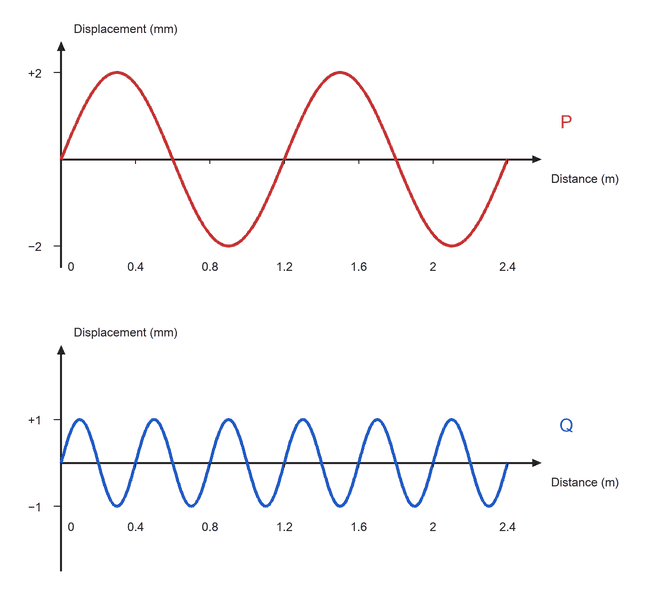
(a) Read the amplitude and the wavelength of each wave.
(b) Which sound is louder and which is shriller ? Give a reason for each.
(c) Find the ratio .
- 343 marks
Question 34
Competency: Application
Arjun stretches a sheet of cling film tightly over a wide bowl and sprinkles a little fine salt on it. He holds a small loudspeaker, playing a steady loud note, about 5 cm above the film. The grains of salt jump about. When he moves the loudspeaker 1 m away, with the volume unchanged, the grains hardly move.
(a) What makes the grains of salt jump ? Name the form of energy that is used.
(b) Why do the grains hardly move when the loudspeaker is 1 m away ?
(c) Suppose all the air between the loudspeaker and the film could be removed, with nothing else joining the two. Would the grains jump ? Give a reason.
- 353 marks
Question 35
Competency: Analysis
A sound-analysis program lists the frequencies present in three sounds, all of which are played at the same loudness. (Hypothetical data.)
Sound Source Frequencies present (Hz) and their relative amplitudes 1 Tuning fork 480 (10) 2 Flute 480 (10), 960 (3), 1440 (1.5) 3 Violin 480 (10), 960 (6), 1440 (4), 1920 (2) (a) Which of the three sounds is a monotone ? Give a reason.
(b) What is the pitch of sounds 2 and 3 compared with sound 1 ? What do you notice about the extra frequencies ?
(c) Why do sounds 2 and 3 sound different to a listener ?
- 363 marks
Question 36
Competency: Analysis
A loudspeaker gives a steady note of frequency in air. A particle of air near it vibrates to and fro along a straight line with an amplitude of . The speed of sound in air is . (Hypothetical data.)
(a) Find the total distance covered by the particle in one complete vibration.
(b) Find the total distance covered by the particle in one second.
(c) Find the distance travelled by the sound in the same second, and say what this shows about the particles of air and the sound.
- 374 marks
Question 37
Competency: Evaluation
Kabir makes four toy drums from tins covered with the rubber of a balloon, and records the frequency of the note of each drum with a phone app. (Hypothetical data.)
Drum Diameter of the tin (cm) How tightly the rubber is stretched Frequency of the note (Hz) A 10 Loose 300 B 10 Tight 420 C 16 Loose 190 D 16 Tight 270 Kabir says, ‘Drum A is smaller than drum D and gives a higher note, so only the size of the drum decides the pitch, and the tightness of the rubber makes no difference.’
(a) Explain why comparing drums A and D is not a fair test of the effect of size.
(b) Name the pairs of drums that give a fair test of the effect of size and of the effect of tightness, and state what each pair shows.
(c) Kabir now makes a drum of diameter 13 cm with loose rubber. Between which two values do you expect its frequency to lie ?
- 384 marks
Question 38
Competency: Analysis
The figure shows the displacement-distance graph of a sound wave in air at the instant (solid line) and at later (dashed line). In this time the whole wave has moved forward, to the right, by less than one wavelength, so that the crest A has moved to the position B. (Hypothetical data.)

(a) Read the wavelength of the wave from the figure, and state how many complete waves the solid graph shows between and .
(b) Find the distance moved by the crest from A to B, and use it to find the speed of the wave.
(c) The wave travels a distance of one wavelength in one time period. Use this to find the time period and the frequency of the wave.
- 394 marks
Question 39
Competency: Creation
Your school is holding a ‘Sound Safety Week’. You have to prepare a display on the level of sound, using the table below.
Source of sound Level of sound (dB) Leaves rustling 10 Whisper 30 Normal conversation 50 Vacuum cleaner 60 Vehicle 80 Diesel engine 90 Police car siren 120 Rocket take-off 140 The safe limit of the level of sound for hearing is 0 to 80 dB. Hearing sound above 120 dB constantly can cause headache and permanent damage to the ears.
(a) Design a ‘sound ladder’: choose any five sources from the table, arrange them from the faintest to the loudest, and show where the safe limit ends.
(b) Write a short safety message, with a reason, for visitors who listen to sources above the safe limit.
(c) Suggest two steps that students can take to reduce the harm of loud sound to their ears, and give the idea from the chapter behind each step.
- 405 marks
Question 40
Competency: Evaluation
At the annual day, the sound engineer of a school uses a music system with three knobs. Turning up the Bass knob makes the low-pitched sounds in the music stronger, turning up the Treble knob makes the high-pitched sounds stronger, and the Volume knob changes the loudness. The note that each of four instruments plays is given below. (Hypothetical data.)
Instrument Frequency of its note (Hz) Dholak 100 Tabla 250 Flute 600 Ghungroo (ankle bells) 3000 (a) Arrange the four instruments from the most grave to the most shrill, and find the time period of the note of the dholak and of the ghungroo.
(b) Which knob should the engineer turn up (i) to bring out the dholak, and (ii) to bring out the ghungroo and the flute ? Give a reason.
(c) After turning the Treble knob fully up, the engineer says, ‘Now the whole music is louder.’ Judge this statement.