
Question 464 marksMedium
How does the wave pattern of a loud note differ from a soft note ? Draw a diagram.
Confirming your payment
Sign up now and get 250 free tokens.
Sound · Question 46 of 59
How does the wave pattern of a loud note differ from a soft note ? Draw a diagram.
Solution:
Concept: Loudness is the characteristic that tells a loud sound from a soft one. It depends on the amplitude of the wave: in this chapter loudness is taken as proportional to the square of the amplitude, . (Strictly, it is the sound's intensity, the energy it carries, that follows this rule; the loudness we sense rises with the intensity.) Loudness is expressed in decibel (dB).
Step 1 — State the difference.
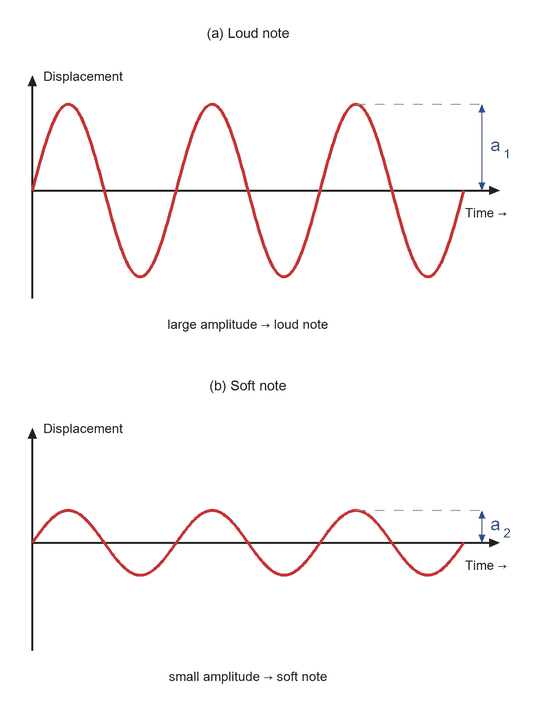
The wave of a loud note has a large amplitude, while the wave of a soft (feeble) note has a small amplitude.
Step 2 — Keep the pitch the same.
If the two notes have the same pitch, their waves have the same frequency: the same number of waves in the same time. Only the height of the crests and the depth of the troughs differ.
Step 3 — Draw the two waves.
The diagram shows both waves with the same frequency; the loud note's amplitude is larger than the soft note's amplitude .
| Loud note | Soft note | |
|---|---|---|
| Amplitude | large () | small () |
| Energy carried | more | less |
| Frequency (same pitch) | same | same |
Watch out: A loud note is not 'more waves'; the number of waves (frequency) sets the pitch, the height (amplitude) sets the loudness.
Therefore, a loud note has a wave of larger amplitude than a soft note; the frequency can be the same.