
Question 453 marksMedium
Explain the mechanism of formation of a longitudinal wave when a source of sound vibrates in air.
Confirming your payment
Sign up now and get 250 free tokens.
Sound · Question 45 of 59
Explain the mechanism of formation of a longitudinal wave when a source of sound vibrates in air.
Solution:
Concept: In air, sound travels as a longitudinal wave: the air particles vibrate to and fro along the direction in which the sound travels, forming compressions (layers pressed close together, higher pressure) and rarefactions (layers spread apart, lower pressure).
Step 1 — Set up the source.
Take a thin metal strip clamped at its lower end. Pull it to one side and release it, so that it vibrates to the right and left about its mean position.
Step 2 — Form a compression.
When the strip moves to the right, it pushes the layer of air next to it. This layer presses against the next layer, so the air layers on the right come closer together. This region of higher pressure (and higher density) is a compression C.
Step 3 — Move the compression forward.
As the strip comes back to its mean position, the compression C passes on to the next layers. Because air is elastic, the layers near the strip return to their normal positions; the air particles do not travel with the compression.
Step 4 — Form a rarefaction.
When the strip moves to the left, it leaves a space of lower pressure on its right. The air layers there spread out. This region of lower pressure (and lower density) is a rarefaction R.
Step 5 — Move the rarefaction forward.
As the strip returns to its mean position again, the rarefaction R moves forward and the layers near the strip return to their normal positions.
Step 6 — Build a continuous wave.
As the strip keeps vibrating, compressions and rarefactions are produced one after another and travel forward with a definite speed. One complete to-and-fro motion of the strip makes one compression and one rarefaction, which together make one wave.
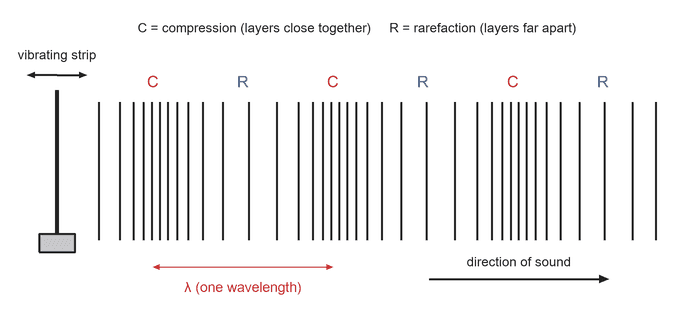
The air particles vibrate about their mean positions along the direction in which the sound travels, so the wave is a longitudinal wave. The distance between two consecutive compressions (or rarefactions) is one wavelength .
Watch out: The air layers only vibrate about their mean positions; the compressions and rarefactions are what move forward.
Therefore, a vibrating source sends out alternate compressions and rarefactions, and these travel through the air as a longitudinal wave.