
Opening your dashboard
Class 8 Physics Chapter 2: Physical Quantities and Measurement Solutions
75 textbook questions with step-by-step answers, free to read, for ICSE 2026-27.
Get talked through Ch 2, not just shown the answer
Reading a finished solution is not the same as being able to do it. The AI tutor takes one question at a time and works it with you, in your own words, until you can.
- Ask it out loud, in your own words
- It gives you the next step, not the answer
- Stuck on part (ii)? Start there
75 questions with solutions
1–4 marks · Mixed difficulty
The first 66 solutions are on this page. This chapter is a long one, so the rest open on their own page to keep this one quick to load.
- 11 mark
Question 1
Choose the correct answer from the multiple choices given below :
The correct relation is :
Solve with AIAnswer
(A) Density = Mass × Volume
- Correct
(B) Mass = Density × Volume
(C) Volume = Density × Mass
(D) Density = Mass + Volume
Answer: (B) Mass as density × volume
Concept: The density of a substance is its mass per unit volume. In symbols, , where M is the mass and V the volume. Its S.I. unit is kg m and its C.G.S. unit is g cm.
Step 1 — Write the definition as an equation.
Density is mass divided by volume, so we start from this equation.
Step 2 — Make mass the subject.
Multiplying both sides by the volume V removes V from the bottom of the fraction.
Step 3 — Read the result in words.
The equation says that mass = density × volume, which is option (B).
Watch out: Density is mass divided by volume; multiplying or adding mass and volume never gives density.
Why the other options are wrong:
- (A) Density as mass × volume: Density is mass ÷ volume, not mass × volume; multiplying them gives a quantity with unit g cm, which is not a density.
- (C) Volume as density × mass: From , volume is mass ÷ density, not density × mass.
- (D) Density as mass + volume: Mass and volume are different kinds of quantity (g and cm), so they cannot be added at all.
Therefore, the correct relation is Mass = Density × Volume, option (B).
- 21 mark
Question 2
Choose the correct answer from the multiple choices given below :
The relative density of alcohol is 0.8. Its density is :
Solve with AIAnswer
(A) 0.8
- Correct
(B) 800 kg m
(C) 800 g cm
(D) 0.8 kg m
Answer: (B) 800 kg m
Concept: The relative density (R.D.) of a substance is the ratio of its density to the density of water: R.D. is density of the substance ÷ density of water. It is a ratio of two densities, so it has no unit, and it equals the density written in g cm without the unit. Since water has density 1000 kg m, the density in kg m is 1000 × R.D.
Step 1 — Write what R.D. means.
A relative density of 0.8 means alcohol is 0.8 times as dense as water.
Step 2 — Put in the density of water in S.I. units.
The density of water is 1000 kg m, so we multiply 0.8 by 1000.
Step 3 — Match with the options.
800 kg m is option (B). In C.G.S. units the same density is 0.8 g cm.
Watch out: R.D. has no unit, but density always has one; the number changes with the unit used.
Why the other options are wrong:
- (A) 0.8: 0.8 is the relative density itself; a density must carry a unit.
- (C) 800 g cm: 800 g cm is 1000 times too large; in C.G.S. units the density of alcohol is 0.8 g cm.
- (D) 0.8 kg m: 0.8 kg m is 1000 times too small; that would be lighter than air.
Therefore, the density of alcohol is 800 kg m, option (B).
- 31 mark
Question 3
Choose the correct answer from the multiple choices given below :
A block of wood of density 0.8 g cm has a volume of 60 cm. The mass of block is :
Solve with AIAnswer
(A) 60.8 g
(B) 75 g
- Correct
(C) 48 g
(D) 0.013 g
Answer: (C) 48 g
Concept: From the definition we get two other forms of the same rule. Mass is density × volume, and volume is mass ÷ density.
Step 1 — Note the given values.
The density is g cm and the volume is cm; we need the mass M.
Step 2 — Use mass = density × volume.
Both values are already in C.G.S. units, so they can be multiplied directly and the mass comes out in grams.
Watch out: Do not divide the volume by the density; that gives 75, which is a volume-like number, not a mass.
Why the other options are wrong:
- (A) 60.8 g: 60.8 g comes from adding the density and the volume, which is not allowed.
- (B) 75 g: 75 g comes from dividing the volume by the density (); the mass is density × volume.
- (D) 0.013 g: 0.013 g comes from dividing the density by the volume (), which has no meaning here.
Therefore, the mass of the block is 48 g, option (C).
- 41 mark
Question 4
Choose the correct answer from the multiple choices given below :
The density of aluminium is 2.7 g cm and that of brass 8.4 g cm. The correct statement is :
Solve with AIAnswer
(A) Equal masses of aluminium and brass have equal volumes.
- Correct
(B) The mass of a certain volume of brass is more than the mass of equal volume of aluminium.
(C) The volume of a certain mass of brass is more than the volume of equal mass of aluminium.
(D) Equal volumes of aluminium and brass have equal masses.
Answer: (B) Brass has more mass for equal volume
Concept: From the definition we get two other forms of the same rule. Mass is density × volume, and volume is mass ÷ density.
Step 1 — Compare the densities.
Brass (8.4 g cm) is denser than aluminium (2.7 g cm).
Step 2 — Take equal volumes.
For the same volume V, mass = density × volume, so the denser metal has the greater mass. For example, 1 cm of brass has a mass of 8.4 g, while 1 cm of aluminium has a mass of only 2.7 g.
Step 3 — Take equal masses.
For the same mass M, volume = mass ÷ density, so the denser metal has the smaller volume. This rules out the statements about equal or larger volumes.
Watch out: A denser substance has more mass in the same volume, but less volume for the same mass.
Why the other options are wrong:
- (A) Equal masses have equal volumes: Equal masses of two metals of different densities have different volumes; the aluminium piece is larger.
- (C) Brass has more volume for equal mass: For equal masses the denser brass has the smaller volume, not the larger one.
- (D) Equal volumes have equal masses: Equal volumes of different metals have different masses; 1 cm of brass is 8.4 g but 1 cm of aluminium is 2.7 g.
Therefore, a given volume of brass has more mass than an equal volume of aluminium, option (B).
- 51 mark
Question 5
Choose the correct answer from the multiple choices given below :
A density bottle has a marking 25 mL on it. It means that :
Solve with AIAnswer
(A) the mass of density bottle is 25 g
- Correct
(B) the density bottle will store 25 mL of any liquid in it
(C) the density bottle will store 25 mL of water, but more volume of liquid denser than water
(D) the density bottle will store 25 mL of water, but more volume of a liquid lighter than water.
Answer: (B) stores 25 mL of any liquid
Concept: A density bottle is a small glass bottle with a ground-glass stopper that has a narrow hole through it. When the bottle is filled and stoppered, the extra liquid escapes through the hole, so it always holds the same volume (marked on it, e.g. 25 mL or 50 mL). Weighing it empty, full of water and full of a liquid gives the mass of equal volumes of water and liquid.
Step 1 — Read the marking.
The mark 25 mL is a volume, so it tells the capacity of the bottle, not a mass.
Step 2 — See why the volume is fixed.
When the full bottle is stoppered, any extra liquid is pushed out through the hole in the stopper. So the bottle always holds exactly 25 mL, whatever the liquid.
Step 3 — What changes with the liquid.
Only the mass of liquid in the bottle depends on its density; the volume does not.
Watch out: A denser liquid makes the full bottle heavier, not fuller.
Why the other options are wrong:
- (A) mass of bottle is 25 g: 25 mL is a unit of volume, so it cannot be the mass of the bottle.
- (C) more volume of a denser liquid: A denser liquid fills the same 25 mL; it only has a greater mass, not a greater volume.
- (D) more volume of a lighter liquid: A lighter liquid also fills exactly 25 mL; only its mass is smaller.
Therefore, the bottle holds 25 mL of any liquid, option (B).
- 61 mark
Question 6
Choose the correct answer from the multiple choices given below :
The correct statement is :
Solve with AIAnswer
(A) The buoyant force on a body is equal to the volume of the liquid displaced by it.
(B) The buoyant force on a body is equal to the volume of the body.
- Correct
(C) The buoyant force on a body is equal to the weight of the liquid displaced by it.
(D) The buoyant force on a body is always equal to the weight of the body.
Answer: (C) equal to weight of liquid displaced
Concept: A liquid pushes up on any body placed in it. This upward push is the buoyant force (upthrust), and it is equal to the weight of the liquid displaced by the immersed part of the body (Archimedes' principle).
Step 1 — Note what kind of quantity it is.
The buoyant force is a force, measured in newtons, so it can only equal another force, never a volume.
Step 2 — Recall Archimedes' principle.
The upward force of the liquid equals the weight of the liquid that the body pushes aside (displaces).
Step 3 — Pick the option.
Only option (C) states this.
Watch out: Volume of liquid displaced and weight of liquid displaced are different; the force equals the weight.
Why the other options are wrong:
- (A) equal to volume of liquid displaced: A force cannot be equal to a volume; they are different kinds of quantity.
- (B) equal to volume of the body: The buoyant force is not a volume, and it does not equal the body's volume.
- (D) always equal to weight of the body: The buoyant force equals the body's weight only when the body floats; for a sinking body it is less than the weight.
Therefore, the buoyant force equals the weight of the liquid displaced, option (C).
- 71 mark
Question 7
Choose the correct answer from the multiple choices given below :
A piece of wood floats on water. The buoyant force on wood will be :
Solve with AIAnswer
(A) zero
(B) more than the weight of the wood piece
- Correct
(C) equal to the weight of the wood piece
(D) less than the weight of the wood piece.
Answer: (C) equal to the weight of the wood piece
Concept: Law of floatation: a body floats when the weight of the liquid displaced by its immersed part is equal to the whole weight of the body. For a floating body, buoyant force equals weight, so its apparent weight is zero.
Step 1 — See what floating means.
The wood is at rest on the water, so the forces on it balance.
Step 2 — Name the two forces.
Its weight acts downwards and the buoyant force of the water acts upwards.
Step 3 — Balance them.
For the wood to stay at rest, the upward buoyant force must be equal to its weight.
Why the other options are wrong:
- (A) zero: If the buoyant force were zero, nothing would hold the wood up and it would sink.
- (B) more than the weight of the wood piece: If the buoyant force were more than the weight, the wood would keep rising out of the water.
- (D) less than the weight of the wood piece: If the buoyant force were less than the weight, the wood would sink.
Therefore, the buoyant force on the floating wood is equal to its weight, option (C).
- 81 mark
Question 8
Choose the correct answer from the multiple choices given below :
The weight of a body is more than the buoyant force experienced by it, due to a liquid. The body will :
Solve with AIAnswer
- Correct
(A) sink
(B) float with its some part outside the liquid
(C) float just below the surface of liquid
(D) float with whole of its volume above the surface of liquid.
Answer: (A) sink
Concept: A liquid pushes up on any body placed in it. This upward push is the buoyant force (upthrust), and it is equal to the weight of the liquid displaced by the immersed part of the body (Archimedes' principle).
Step 1 — Compare the two forces.
The weight W acts downwards and the buoyant force acts upwards. Here W is more than .
Step 2 — Find the net force.
The net force is the difference of the two, and it acts in the direction of the larger force, which is downwards.
Step 3 — Decide the motion.
A net downward force pulls the body down, so it sinks to the bottom.
Why the other options are wrong:
- (B) float with its some part outside the liquid: A body floats with part outside only when the buoyant force can balance its weight before it is fully immersed; here the weight is more.
- (C) float just below the surface of liquid: A body floats just below the surface only when its weight equals the buoyant force on it when fully immersed.
- (D) float with whole of its volume above the surface of liquid: No floating body can have its whole volume above the surface; some part must be immersed to give any buoyant force.
Therefore, the body sinks, option (A).
- 91 mark
Question 9
Choose the correct answer from the multiple choices given below :
Assertion (A) : In order to come to surface of water, whales fill their swim bladder with water.
Reason (R) : A body floats when the density of the body is less than the density of the liquid.
Solve with AIAnswer
(A) Both A and R are true and R is the correct explanation of A
(B) Both A and R are true and R is not the correct explanation of A
(C) Assertion is true but reason is false
- Correct
(D) Assertion is false but reason is true
Answer: (D) A false, R true
Concept: Whether a body floats or sinks depends on densities. If the density of the body is more than that of the liquid, it sinks. If it is less, it floats with part of it above the surface. If the two are equal, it floats fully immersed, just below the surface.
Step 1 — Judge the Assertion.
To rise, an animal must make its average density less than that of sea water. Filling a space inside the body with water would not lower its density, so the Assertion cannot be true. Fish that have a swim bladder fill it with gas to rise, never with water.
Step 2 — Judge the Reason.
A body whose density is less than that of the liquid floats on it. This is the correct rule for floating, so the Reason is true.
Step 3 — Combine the two judgements.
The Assertion is false and the Reason is true, so the answer is (D).
Watch out: A swim bladder is filled with gas, not water; gas lowers the average density.
Note: whales are mammals and have no swim bladder at all; they breathe with lungs. The swim bladder belongs to bony fish, and it holds gas. The Assertion is false either way, so the key stays (D).
Why the other options are wrong:
- (A) Both true, R explains A: The Assertion is false, so “both A and R are true” cannot be right.
- (B) Both true, R does not explain A: This also needs the Assertion to be true, and it is false; whether R explains A does not arise.
- (C) A true, R false: It is the other way round: the Assertion is false and the Reason is true.
Therefore, the Assertion is false but the Reason is true, option (D).
- 101 mark
Question 10
Fill in the blank :
1 kg is the mass of .............. mL of water at 4°C.
Solve with AIWritten solution
Solution:
Concept: Pure water has its greatest density at 4 °C: 1 g cm, or 1000 kg m. So at 4 °C, 1 g of water fills 1 cm (1 mL), and 1 kg of water fills 1000 cm (1 litre).
Step 1 — Change kilograms to grams.
The density of water is in grams per cm, so first write 1 kg in grams.
Step 2 — Use the density of water.
At 4 °C each gram of water fills 1 mL, so 1000 g fills 1000 mL.
Watch out: 1 cm and 1 mL are the same volume, and 1000 mL is 1 litre.
Therefore, 1 kg is the mass of 1000 mL of water at 4 °C.
- 111 mark
Question 11
Fill in the blank :
Mass = density × ..............
Solve with AIWritten solution
Solution:
Concept: The density of a substance is its mass per unit volume. In symbols, , where M is the mass and V the volume. Its S.I. unit is kg m and its C.G.S. unit is g cm.
Step 1 — Start from the definition.
Density is mass ÷ volume.
Step 2 — Make mass the subject.
Multiplying both sides by V gives the mass.
Therefore, mass = density × volume.
- 121 mark
Question 12
Fill in the blank :
The S.I. unit of density is ..............
Solve with AIWritten solution
Solution:
Concept: The density of a substance is its mass per unit volume. In symbols, , where M is the mass and V the volume. Its S.I. unit is kg m and its C.G.S. unit is g cm.
Step 1 — Use the units of mass and volume.
The unit of density is the unit of mass divided by the unit of volume.
Step 2 — Put in the S.I. units.
In the S.I. system mass is in kilograms (kg) and volume in cubic metres (m), so density is in kilograms per cubic metre.
Watch out: G cm is the C.G.S. unit, not the S.I. unit.
Therefore, the S.I. unit of density is kg m (kilogram per cubic metre).
- 131 mark
Question 13
Fill in the blank :
Density of water is .............. kg m.
Solve with AIWritten solution
Solution:
Concept: Pure water has its greatest density at 4 °C: 1 g cm, or 1000 kg m. So at 4 °C, 1 g of water fills 1 cm (1 mL), and 1 kg of water fills 1000 cm (1 litre).
Step 1 — Recall the density of water in C.G.S. units.
1 cm of water has a mass of 1 g, so its density is 1 g cm.
Step 2 — Change to S.I. units.
1 g cm is the same as 1000 kg m, so 1 m of water has a mass of 1000 kg.
Therefore, the density of water is 1000 kg m (its value at 4 °C).
- 141 mark
Question 14
Fill in the blank :
1 g cm = .............. kg m.
Solve with AIWritten solution
Solution:
Concept: The density of a substance is its mass per unit volume. In symbols, , where M is the mass and V the volume. Its S.I. unit is kg m and its C.G.S. unit is g cm.
Step 1 — Write grams and cubic centimetres in S.I. units.
One gram is a thousandth of a kilogram, and one cubic centimetre is a millionth of a cubic metre (since 1 cm is m).
Step 2 — Divide.
Put these into 1 g ÷ 1 cm and simplify the powers of ten.
Watch out: 1 cm is m, not m; cube the factor .
Therefore, 1 g cm = 1000 kg m.
- 151 mark
Question 15
Fill in the blank :
The density of a body which sinks in water is .............. than 1000 kg m.
Solve with AIWritten solution
Solution:
Concept: Whether a body floats or sinks depends on densities. If the density of the body is more than that of the liquid, it sinks. If it is less, it floats with part of it above the surface. If the two are equal, it floats fully immersed, just below the surface.
Step 1 — Use the sinking rule.
A body sinks in water when its density is more than the density of water.
Step 2 — Put in the density of water.
The density of water is 1000 kg m, so the body's density must be greater than this.
Therefore, the density of a body which sinks in water is more than 1000 kg m.
- 161 mark
Question 16
Fill in the blank :
A body sinks in a liquid A, but floats in a liquid B. The density of liquid A is .............. than the density of liquid B.
Solve with AIWritten solution
Solution:
Concept: Whether a body floats or sinks depends on densities. If the density of the body is more than that of the liquid, it sinks. If it is less, it floats with part of it above the surface. If the two are equal, it floats fully immersed, just below the surface.
Step 1 — Use the result in liquid A.
The body sinks in A, so the body is denser than liquid A.
Step 2 — Use the result in liquid B.
The body floats in B, so liquid B is denser than the body.
Step 3 — Put the two together.
In order of density: liquid A < body < liquid B. So A is less dense than B.
Therefore, the density of liquid A is less than the density of liquid B.
- 171 mark
Question 17
Fill in the blank :
A body X sinks in water, but a body Y floats on water. The density of the body X is .............. than the density of body Y.
Solve with AIWritten solution
Solution:
Concept: Whether a body floats or sinks depends on densities. If the density of the body is more than that of the liquid, it sinks. If it is less, it floats with part of it above the surface. If the two are equal, it floats fully immersed, just below the surface.
Step 1 — Compare X with water.
X sinks in water, so X is denser than water.
Step 2 — Compare Y with water.
Y floats on water, so Y is less dense than water.
Step 3 — Put the two together.
In order of density: Y < water < X. So X is denser than Y.
Therefore, the density of body X is more than the density of body Y.
- 181 mark
Question 18
Fill in the blank :
The buoyant force experienced by a body when floating in salt-water is .............. than when floating in pure water.
Solve with AIWritten solution
Solution:
Concept: Law of floatation: a body floats when the weight of the liquid displaced by its immersed part is equal to the whole weight of the body. For a floating body, buoyant force equals weight, so its apparent weight is zero.
Step 1 — Apply the law of floatation in salt water.
The body floats, so the buoyant force equals its weight W.
Step 2 — Apply it in pure water.
The body floats here too, so the buoyant force again equals the same weight W.
Step 3 — Compare.
Both buoyant forces equal W, so they are equal. The body only floats higher in the denser salt water, because a smaller immersed volume is enough.
Watch out: A denser liquid does not give a bigger buoyant force to a floating body; it only makes it sink less deep.
Therefore, the buoyant force in salt water is equal to that in pure water.
- 191 mark
Question 19
Fill in the blank :
The apparent weight of a body floating in a liquid is .............. .
Solve with AIWritten solution
Solution:
Concept: Law of floatation: a body floats when the weight of the liquid displaced by its immersed part is equal to the whole weight of the body. For a floating body, buoyant force equals weight, so its apparent weight is zero.
Step 1 — Write apparent weight.
Apparent weight is the weight minus the buoyant force.
Step 2 — Use the law of floatation.
For a floating body the buoyant force equals the weight, so the two cancel.
Therefore, the apparent weight of a floating body is zero.
- 201 mark
Question 20
Write true or false :
Equal volumes of two different substances have equal masses.
Solve with AIWritten solution
Solution:
Concept: From the definition we get two other forms of the same rule. Mass is density × volume, and volume is mass ÷ density.
Step 1 — Write mass for an equal volume.
For the same volume V, mass = density × V, so the mass depends on the density of each substance.
Step 2 — Test with an example.
1 cm of iron has a mass of about 7.8 g, but 1 cm of water has a mass of 1 g. Different substances have different densities, so equal volumes have different masses.
Therefore, the statement is false: equal volumes of two different substances have different masses.
- 211 mark
Question 21
Write true or false :
The density of a piece of brass will change by changing its size or shape.
Solve with AIWritten solution
Solution:
Concept: The density of a substance is its mass per unit volume. In symbols, , where M is the mass and V the volume. Its S.I. unit is kg m and its C.G.S. unit is g cm.
Step 1 — See what happens when the size changes.
If a piece of brass is made twice as big, both its mass and its volume double.
Step 2 — Find the effect on density.
Density is mass ÷ volume, and doubling both leaves the ratio the same: 16.8 g in 2 cm is still 8.4 g cm. Changing the shape changes neither the mass nor the volume.
Step 3 — Conclude.
Density is a property of the material, not of the size or shape of the piece.
Therefore, the statement is false: the density of brass does not change with its size or shape.
- 221 mark
Question 22
Write true or false :
The density of a liquid decreases with increase in its temperature.
Solve with AIWritten solution
Solution:
Concept: On heating, a substance expands: its volume increases but its mass stays the same, so its density (mass ÷ volume) decreases. Water between 0 °C and 4 °C is the exception: it contracts on warming there.
Step 1 — See what heating does.
When a liquid is heated it expands, so its volume increases, while its mass stays the same.
Step 2 — Find the effect on density.
The same mass now fills a larger volume, so mass ÷ volume becomes smaller.
Watch out: Water is an exception between 0 °C and 4 °C, where its density increases on heating.
Therefore, the statement is true: the density of a liquid decreases as its temperature increases.
- 231 mark
Question 23
Write true or false :
Relative density of water is 1.0.
Solve with AIWritten solution
Solution:
Concept: The relative density (R.D.) of a substance is the ratio of its density to the density of water: R.D. is density of the substance ÷ density of water. It is a ratio of two densities, so it has no unit, and it equals the density written in g cm without the unit.
Step 1 — Apply the definition to water.
For water, the substance and the reference liquid are the same.
Therefore, the statement is true: the relative density of water is 1.0.
- 241 mark
Question 24
Write true or false :
Relative density of a substance is expressed in g cm.
Solve with AIWritten solution
Solution:
Concept: The relative density (R.D.) of a substance is the ratio of its density to the density of water: R.D. is density of the substance ÷ density of water. It is a ratio of two densities, so it has no unit, and it equals the density written in g cm without the unit.
Step 1 — Look at the units in the ratio.
R.D. is one density divided by another, so the units g cm on the top and on the bottom cancel.
Step 2 — Conclude.
R.D. is a pure number with no unit, so it is not expressed in g cm.
Watch out: R.D. has the same number as the density in g cm, but no unit.
Therefore, the statement is false: relative density has no unit.
- 251 mark
Question 25
Write true or false :
When a body is immersed in a liquid, the buoyant force experienced by the body is equal to the volume of the liquid displaced by it.
Solve with AIWritten solution
Solution:
Concept: A liquid pushes up on any body placed in it. This upward push is the buoyant force (upthrust), and it is equal to the weight of the liquid displaced by the immersed part of the body (Archimedes' principle).
Step 1 — Check the kind of quantity.
Buoyant force is a force, so it can only equal another force, not a volume.
Step 2 — State the correct rule.
The buoyant force equals the weight of the liquid displaced.
Therefore, the statement is false: the buoyant force equals the weight, not the volume, of the liquid displaced.
- 261 mark
Question 26
Write true or false :
If a body floats in different liquids, different volumes of the body get submerged in different liquids, but in each liquid the weight of the liquid displaced by the submerged part of body remain the same.
Solve with AIWritten solution
Solution:
Concept: Law of floatation: a body floats when the weight of the liquid displaced by its immersed part is equal to the whole weight of the body. For a floating body, buoyant force equals weight, so its apparent weight is zero.
Step 1 — Apply the law of floatation in each liquid.
In every liquid it floats in, the body displaces liquid whose weight equals its own weight W.
Step 2 — See why the volumes differ.
The weight of liquid displaced depends on both the immersed volume and the density of the liquid. To keep this weight equal to W, a less dense liquid needs a larger immersed volume, and a denser liquid a smaller one.
Step 3 — Conclude.
So the immersed volume changes from liquid to liquid, but the weight of liquid displaced stays equal to W.
Therefore, the statement is true.
- 271 mark
Question 27
Write true or false :
A body experiences the same buoyant force when it floats or sinks in water.
Solve with AIWritten solution
Solution:
Concept: A liquid pushes up on any body placed in it. This upward push is the buoyant force (upthrust), and it is equal to the weight of the liquid displaced by the immersed part of the body (Archimedes' principle).
Step 1 — Floating body.
When the body floats, the buoyant force equals its weight.
Step 2 — Sinking body.
When a body sinks, the buoyant force on it (the weight of water equal to its whole volume) is less than its weight.
Step 3 — Compare.
A body that floats and one that sinks do not get the same buoyant force in general: one equals its weight, the other is less than its weight.
Therefore, the statement is false.
- 281 mark
Question 28
Write true or false :
A body floats in a liquid when its weight becomes equal to the weight of the liquid displaced by its submerged part.
Solve with AIWritten solution
Solution:
Concept: Law of floatation: a body floats when the weight of the liquid displaced by its immersed part is equal to the whole weight of the body. For a floating body, buoyant force equals weight, so its apparent weight is zero.
Step 1 — Recognise the law.
The statement is the law of floatation.
Step 2 — Check it with forces.
When the weight of the liquid displaced (the buoyant force) equals the weight of the body, the upward and downward forces balance, so the body stays at rest on the liquid.
Therefore, the statement is true.
- 291 mark
Question 29
Write true or false :
A body while floating, sinks deeper in a liquid of low density than in a liquid of high density.
Solve with AIWritten solution
Solution:
Concept: Law of floatation: a body floats when the weight of the liquid displaced by its immersed part is equal to the whole weight of the body. For a floating body, buoyant force equals weight, so its apparent weight is zero.
Step 1 — Use the law of floatation.
In both liquids the body must displace liquid whose weight equals its own weight.
Step 2 — Compare the two liquids.
A litre of a low-density liquid weighs less, so more of it must be displaced to make up the same weight. That needs a larger immersed volume, so the body sinks deeper.
Step 3 — Example.
A ship floats lower in river water than in the denser sea water.
Therefore, the statement is true.
- 301 mark
Question 30
Match with the correct option from Column B :
Column A : kg m
Column B : (i) relative density, (ii) sinks in alcohol, (iii) floats on water, (iv) density, (v) density bottle
Solve with AIWritten solution
Solution:
Concept: The density of a substance is its mass per unit volume. In symbols, , where M is the mass and V the volume. Its S.I. unit is kg m and its C.G.S. unit is g cm.
Step 1 — Read the unit.
kg m is kilograms per cubic metre, a mass divided by a volume.
Step 2 — Match.
Mass per unit volume is density. Column B gives (i) relative density, (ii) sinks in alcohol, (iii) floats on water, (iv) density, (v) density bottle.
Therefore, kg m matches (iv) density.
- 311 mark
Question 31
Match with the correct option from Column B :
Column A : No unit
Column B : (i) relative density, (ii) sinks in alcohol, (iii) floats on water, (iv) density, (v) density bottle
Solve with AIWritten solution
Solution:
Concept: The relative density (R.D.) of a substance is the ratio of its density to the density of water: R.D. is density of the substance ÷ density of water. It is a ratio of two densities, so it has no unit, and it equals the density written in g cm without the unit.
Step 1 — Find a quantity with no unit.
Of the items in Column B, only relative density is a ratio of two quantities of the same kind (two densities).
Step 2 — Match.
So it has no unit. Column B gives (i) relative density, (ii) sinks in alcohol, (iii) floats on water, (iv) density, (v) density bottle.
Therefore, “No unit” matches (i) relative density.
- 321 mark
Question 32
Match with the correct option from Column B :
Column A : Relative density
Column B : (i) relative density, (ii) sinks in alcohol, (iii) floats on water, (iv) density, (v) density bottle
Solve with AIWritten solution
Solution:
Concept: A density bottle is a small glass bottle with a ground-glass stopper that has a narrow hole through it. When the bottle is filled and stoppered, the extra liquid escapes through the hole, so it always holds the same volume (marked on it, e.g. 25 mL or 50 mL). Weighing it empty, full of water and full of a liquid gives the mass of equal volumes of water and liquid.
Step 1 — Think of how it is measured.
The relative density of a liquid is found by weighing equal volumes of the liquid and of water.
Step 2 — Match.
A density bottle holds exactly equal volumes of each, so it is the apparatus used. Column B gives (i) relative density, (ii) sinks in alcohol, (iii) floats on water, (iv) density, (v) density bottle.
Therefore, relative density matches (v) density bottle.
- 331 mark
Question 33
Match with the correct option from Column B :
Column A : Iron
Column B : (i) relative density, (ii) sinks in alcohol, (iii) floats on water, (iv) density, (v) density bottle
Solve with AIWritten solution
Solution:
Concept: Whether a body floats or sinks depends on densities. If the density of the body is more than that of the liquid, it sinks. If it is less, it floats with part of it above the surface. If the two are equal, it floats fully immersed, just below the surface.
Step 1 — Compare densities.
Iron has a density of about 7.8 g cm, and alcohol about 0.8 g cm.
Step 2 — Apply the rule and match.
Iron is denser than alcohol, so it sinks in it. Column B gives (i) relative density, (ii) sinks in alcohol, (iii) floats on water, (iv) density, (v) density bottle.
Therefore, iron matches (ii) sinks in alcohol.
- 341 mark
Question 34
Match with the correct option from Column B :
Column A : Wood
Column B : (i) relative density, (ii) sinks in alcohol, (iii) floats on water, (iv) density, (v) density bottle
Solve with AIWritten solution
Solution:
Concept: Whether a body floats or sinks depends on densities. If the density of the body is more than that of the liquid, it sinks. If it is less, it floats with part of it above the surface. If the two are equal, it floats fully immersed, just below the surface.
Step 1 — Compare densities.
Most wood has a density of about 0.5–0.8 g cm, less than that of water (1 g cm).
Step 2 — Apply the rule and match.
Wood is less dense than water, so it floats on water. Column B gives (i) relative density, (ii) sinks in alcohol, (iii) floats on water, (iv) density, (v) density bottle.
Therefore, wood matches (iii) floats on water.
- 352 marks
Question 35
Define the term density of a substance.
Solve with AIWritten solution
Solution:
Concept: Density tells us how much mass is packed into each unit of volume of a substance.
Step 1 — State the definition.
The density of a substance is its mass per unit volume, that is, the mass of one unit of its volume (1 m or 1 cm).
Step 2 — Write it as a formula.
Dividing the mass of a piece of the substance by its volume gives the density.
Step 3 — See an example.
An iron cube of volume 10 cm has a mass of 78 g, so the mass of each cm is
Step 4 — What a large or small density means.
A substance whose particles are closely packed, such as iron or lead, has a high density; a loosely packed one, such as cork or cotton, has a low density.
Therefore, density is the mass per unit volume of a substance.
- 362 marks
Question 36
Name the S.I. unit of density. How is it related to g cm ?
Solve with AIWritten solution
Solution:
Concept: The density of a substance is its mass per unit volume. In symbols, , where M is the mass and V the volume. Its S.I. unit is kg m and its C.G.S. unit is g cm.
Step 1 — Find the S.I. unit.
The unit of density is the unit of mass divided by the unit of volume. In the S.I. system these are the kilogram and the cubic metre, so the S.I. unit of density is the kilogram per cubic metre (kg m).
Step 2 — Change kg m into g cm.
Write 1 kg as 1000 g and 1 m as 100 cm, then simplify.
Step 3 — State the relation both ways.
So 1 kg m is g cm; turning this round, 1 g cm is 1000 kg m.
Watch out: (100 cm) is 10,00,000 cm, not 100 cm.
Therefore, the S.I. unit of density is kg m, and 1 g cm = 1000 kg m.
- 372 marks
Question 37
The density of brass is 8.4 g cm. What do you mean by this statement ?
Solve with AIWritten solution
Solution:
Concept: The density of a substance is its mass per unit volume. In symbols, , where M is the mass and V the volume. Its S.I. unit is kg m and its C.G.S. unit is g cm.
Step 1 — Read the unit.
g cm means grams in each cubic centimetre, so the number 8.4 is the mass of 1 cm.
Step 2 — State the meaning.
So 1 cm of brass has a mass of 8.4 g.
Step 3 — Give the same fact in S.I. units.
Multiplying by 1000 changes g cm into kg m.
Step 4 — Say it in S.I. words.
So 1 m of brass has a mass of 8400 kg.
Therefore, the statement means that 1 cm of brass has a mass of 8.4 g.
- 382 marks
Question 38
Arrange the following substances in order of their increasing density :
Iron, Cork, Brass, Water, Mercury.
Solve with AIWritten solution
Solution:
Concept: The density of a substance is its mass per unit volume. In symbols, , where M is the mass and V the volume. Its S.I. unit is kg m and its C.G.S. unit is g cm.
Step 1 — Write the density of each substance.
Take the usual values (in g cm) from the table of densities.
Substance Density (g cm) Cork about 0.25 Water 1.0 Iron 7.8 Brass 8.4 Mercury 13.6 Step 2 — Arrange from the smallest to the largest.
Cork has the least density and mercury the greatest; iron is a little less dense than brass.
Watch out: Iron (7.8) and brass (8.4) are close; check the numbers rather than guessing.
Therefore, the increasing order of density is Cork < Water < Iron < Brass < Mercury.
- 392 marks
Question 39
How does the density of a liquid (or gas) vary with temperature ?
Solve with AIWritten solution
Solution:
Concept: On heating, a substance expands: its volume increases but its mass stays the same, so its density (mass ÷ volume) decreases. Water between 0 °C and 4 °C is the exception: it contracts on warming there.
Step 1 — See what heating does to volume and mass.
When a liquid or a gas is heated, it expands, so its volume increases. No matter is added or removed, so its mass stays the same.
Step 2 — Find the effect on density.
The same mass now fills a larger volume, so mass ÷ volume becomes smaller. On cooling the volume decreases, so the density increases. The change is much larger for a gas, because a gas expands much more than a liquid.
Step 3 — Note the exception.
Water contracts when it is warmed from 0 °C to 4 °C, so its density increases in this range. Above 4 °C it expands and its density falls. So water has its greatest density, 1000 kg m, at 4 °C.
Therefore, the density of a liquid (or gas) decreases when its temperature rises and increases when it cools (water between 0 °C and 4 °C is the exception).
- 403 marks
Question 40
A given quantity of a liquid is heated. Which of the following quantity will vary and how ?
(a) mass, (b) volume or (c) density.
Solve with AIWritten solution
Solution:
Concept: On heating, a substance expands: its volume increases but its mass stays the same, so its density (mass ÷ volume) decreases. Water between 0 °C and 4 °C is the exception: it contracts on warming there.
Step 1 — Mass.
Heating does not add or remove any matter, so the mass does not change.
Step 2 — Volume.
The liquid expands on heating, so its volume increases.
Step 3 — Density.
The same mass now fills a larger volume, so its density, , decreases.
Watch out: Only volume and density change; mass never changes on heating.
Therefore, (a) mass stays the same, (b) volume increases and (c) density decreases (for water between 0 °C and 4 °C the volume decreases and the density increases).
- 412 marks
Question 41
Define the term relative density of a substance.
Solve with AIWritten solution
Solution:
Concept: Relative density compares the density of a substance with the density of water.
Step 1 — State the definition.
The relative density (R.D.) of a substance is the ratio of the density of the substance to the density of water.
Step 2 — Give the second form.
For equal volumes, densities are in the same ratio as masses, so R.D. is also the ratio of the mass of any volume of the substance to the mass of an equal volume of water.
Step 3 — See an example.
Iron has density 7.8 g cm and water 1 g cm, so the R.D. of iron is
Therefore, relative density is the ratio of the density of a substance to the density of water.
- 422 marks
Question 42
What is the unit of relative density ?
Solve with AIWritten solution
Solution:
Concept: The relative density (R.D.) of a substance is the ratio of its density to the density of water: R.D. is density of the substance ÷ density of water. It is a ratio of two densities, so it has no unit, and it equals the density written in g cm without the unit.
Step 1 — Write R.D. with units.
Put the units into the ratio of the two densities.
Step 2 — Cancel the units.
The same unit, g cm, appears on the top and the bottom, so it cancels and leaves a pure number.
Therefore, relative density has no unit; it is a pure number.
- 432 marks
Question 43
Explain the meaning of the statement 'Relative density of aluminium is 2.7'.
Solve with AIWritten solution
Solution:
Concept: The relative density (R.D.) of a substance is the ratio of its density to the density of water: R.D. is density of the substance ÷ density of water. It is a ratio of two densities, so it has no unit, and it equals the density written in g cm without the unit.
Step 1 — Use the density form.
R.D. of 2.7 means the density of aluminium is 2.7 times the density of water.
Step 2 — Use the mass form.
So any piece of aluminium has a mass 2.7 times the mass of an equal volume of water. For example, 1 cm of aluminium has a mass of 2.7 g, while 1 cm of water has a mass of 1 g.
Step 3 — Find the density in both units.
Multiplying by the density of water gives 2.7 g cm, or 2700 kg m in S.I. units.
Therefore, aluminium is 2.7 times as dense as water: any volume of it has 2.7 times the mass of an equal volume of water.
- 442 marks
Question 44
State the law of floatation.
Solve with AIWritten solution
Solution:
Concept: A liquid pushes up on any body placed in it. This upward push is the buoyant force (upthrust), and it is equal to the weight of the liquid displaced by the immersed part of the body (Archimedes' principle).
Step 1 — State the law.
Law of floatation: when a body floats in a liquid, the weight of the liquid displaced by its immersed part is equal to the total weight of the body.
Step 2 — See what it means.
The right-hand side is the buoyant force, so for a floating body the upward buoyant force exactly balances its weight. That is why its apparent weight is zero.
Therefore, a floating body displaces liquid equal to its own weight.
- 452 marks
Question 45
For a floating body, how is its weight related to the buoyant force ?
Solve with AIWritten solution
Solution:
Concept: Law of floatation: a body floats when the weight of the liquid displaced by its immersed part is equal to the whole weight of the body. For a floating body, buoyant force equals weight, so its apparent weight is zero.
Step 1 — Note that the body is at rest.
A floating body neither sinks nor rises, so the forces on it balance.
Step 2 — Name the two forces.
Its weight W acts vertically downwards; the buoyant force acts vertically upwards.
Step 3 — Balance them.
For the forces to balance, the two must be equal.
Therefore, for a floating body its weight is equal to the buoyant force on it.
- 464 marks
Question 46
Describe an experiment to determine the density of the material of a coin.
Solve with AIWritten solution
Solution:
Concept: A coin is a small solid of irregular shape. Its mass is found with a beam balance and its volume by the displacement method: a solid sunk in water pushes aside a volume of water equal to its own volume. Then density = mass ÷ volume.
Apparatus: a number of identical coins, a beam balance, a measuring cylinder, water and a thread.
Step 1 — Find the mass.
One coin displaces too little water to read, so take a number of identical coins, say 10 coins. Find their total mass M (in g) with a beam balance.
Step 2 — Note the first water level.
Pour water into a measuring cylinder up to a convenient level. Read the level at the bottom of the meniscus, with the eye level with it. Call it (in mL).
Step 3 — Note the second water level.
Lower the coins gently into the water one by one (or tied with a thread), so that no water splashes out, until all of them are fully under water. Read the new level .
Step 4 — Find the volume.
The rise in level is the volume of water pushed aside, which equals the volume of the coins (1 mL is 1 cm).
Step 5 — Find the density.
Divide the mass by the volume.
Step 6 — Sample readings.
Suppose 10 coins have a mass of 63.2 g and the level rises from 50 mL to 58 mL.
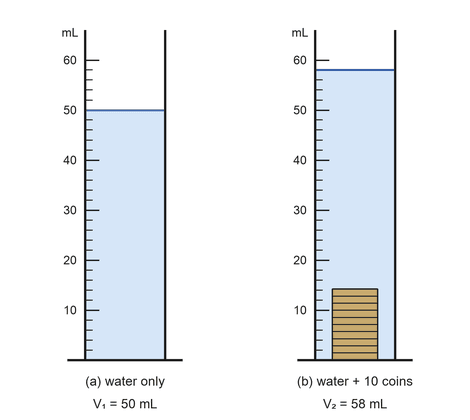
Precautions: read the level at the bottom of the meniscus with the eye at the same height; let no water splash out; make sure every coin is fully under water and no air bubble sticks to it.
Watch out: Using a single coin gives a rise too small to read on the cylinder; many coins make the reading accurate.
Therefore, the density of the material of the coin is the mass of the coins divided by the rise in the water level, .
- 474 marks
Question 47
Describe an experiment to determine the density of a liquid.
Solve with AIWritten solution
Solution:
Concept: To find the density of a liquid, find the mass of a known volume of it; density = mass ÷ volume.
Apparatus: a beaker, a beam balance, a measuring cylinder and the given liquid (say milk).
Step 1 — Weigh the empty beaker.
Find the mass of a clean, dry, empty beaker with the beam balance. Call it (in g).
Step 2 — Measure a volume of the liquid.
Pour the liquid into a measuring cylinder up to a mark, say 50 mL. So the volume of the liquid is V = 50 cm.
Step 3 — Weigh the beaker with the liquid.
Pour all of this liquid into the beaker and find the mass of the beaker with the liquid. Call it .
Step 4 — Find the mass of the liquid.
The difference of the two readings is the mass of the liquid alone.
Step 5 — Find the density.
Divide the mass of the liquid by its volume.
Step 6 — Sample readings.
If the milk has a mass of 51.5 g and a volume of 50 cm, its density is
Watch out: A few drops stay behind in the cylinder, so the mass found is slightly low; a density bottle (next question) gives a more accurate value.
Therefore, the density of the liquid is its mass divided by its volume, .
- 484 marks
Question 48
What is a density bottle ? How is it used to find the density of a liquid ?
Solve with AIWritten solution
Solution:
Concept: A density bottle always holds the same volume of liquid. Weighing it full of water gives that volume (1 g of water fills 1 cm), and weighing it full of the liquid gives the mass of the same volume of liquid; density is mass ÷ volume.
Step 1 — Describe the density bottle.
A density bottle is a small glass bottle with a ground-glass stopper that has a narrow hole through it. When the bottle is filled and the stopper is put in, the extra liquid rises through the hole and runs out. So the bottle always holds the same fixed volume of liquid, marked on it (usually 25 mL or 50 mL).
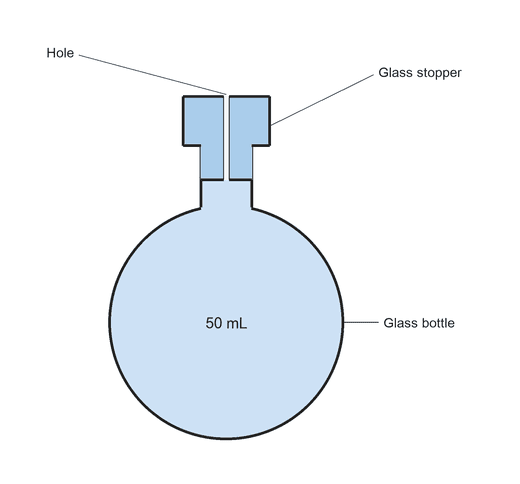
Step 2 — Weigh the empty bottle.
Wash and dry the bottle. Find the mass of the empty bottle with its stopper. Call it (in g).
Step 3 — Weigh it full of water.
Fill the bottle completely with water, put in the stopper, wipe the outside dry and find its mass .
Step 4 — Weigh it full of the liquid.
Empty and dry the bottle, fill it completely with the given liquid, put in the stopper, wipe it dry and find its mass .
Step 5 — Find the volume of the bottle.
The mass of water is grams. Since 1 g of water fills 1 cm, the volume of the bottle, and so of the liquid, is cubic centimetres.
Step 6 — Find the density of the liquid.
The mass of the liquid is grams; divide it by the volume.
Step 7 — Sample readings.
Suppose is 30 g, is 80 g and is 70 g.
Watch out: Fill the bottle to the top of the hole each time and wipe off all liquid outside before weighing.
Therefore, a density bottle holds a fixed volume, and the density of a liquid is g cm.
- 493 marks
Question 49
Distinguish between density and relative density.
Solve with AIWritten solution
Solution:
Concept: Density is mass per unit volume; relative density compares that density with the density of water.
Step 1 — Compare the definitions, formulae and units.
The table puts the two quantities side by side.
Density Relative density It is the mass per unit volume of a substance. It is the ratio of the density of a substance to the density of water. Formula: density is mass ÷ volume. Formula: R.D. is density of substance ÷ density of water. It has a unit: kg m (S.I.) or g cm (C.G.S.). It has no unit; it is a pure number. Its number depends on the unit used: water is 1 g cm or 1000 kg m. Its number is the same in every system: water has R.D. 1. It is found by measuring mass and volume. It is found by comparing the masses of equal volumes of the substance and water (for example with a density bottle). Step 2 — Link the two.
The R.D. of a substance has the same number as its density in g cm; for iron both are 7.8, but only the density carries the unit.
Therefore, density has a unit and depends on the system of units, while relative density is a unitless ratio that does not.
- 503 marks
Question 50
How does the density of a body and that of a liquid determine whether the body will float or sink into that liquid ?
Solve with AIWritten solution
Solution:
Concept: A liquid pushes up on any body placed in it. This upward push is the buoyant force (upthrust), and it is equal to the weight of the liquid displaced by the immersed part of the body (Archimedes' principle).
Step 1 — Name the two forces.
A body in a liquid has its weight W acting downwards and the buoyant force acting upwards.
Step 2 — Compare them when the body is fully immersed.
A fully immersed body displaces its own volume V of liquid. Its weight depends on the body's density and the buoyant force on the liquid's density, for the same V. So comparing W with is the same as comparing the two densities.
Density comparison Forces when fully immersed Result body denser than liquid W more than The body sinks. body as dense as liquid W equal to The body floats fully immersed, just below the surface. body less dense than liquid W less than The body rises and floats with part of it above the surface; only enough of it stays under to make the buoyant force equal to W. Step 3 — Example.
An iron ball (density about 7.9 g cm) sinks in water (1 g cm) but floats on mercury (13.6 g cm).
Therefore, a body sinks in a liquid if its density is more than that of the liquid, and floats if its density is equal to or less than that of the liquid.
- 513 marks
Question 51
Explain why an iron needle sinks in water, but a ship made of iron floats on water.
Solve with AIWritten solution
Solution:
Concept: For a hollow object, or one with air or water inside, what decides floating is its average density: total mass ÷ total volume (including the space inside).
Step 1 — The needle.
A needle is solid iron. Iron (about 7.8 g cm) is denser than water (1 g cm), so the weight of the needle is more than the buoyant force of the small amount of water it displaces. The needle sinks.
Step 2 — The ship.
A ship is made of iron too, but it is hollow: its hull encloses a very large space filled with air. Its total volume is so large for its mass that its average density is less than that of water.
Step 3 — Why the ship floats.
As the ship settles into the water, the hull displaces a large volume of water. Before the hull is fully under water, the weight of water displaced becomes equal to the weight of the ship, so it floats.
Watch out: It is not that iron floats; it is the average density of the hollow ship that is less than that of water.
Therefore, the needle sinks because iron is denser than water, while the hollow ship floats because its average density is less than that of water.
- 523 marks
Question 52
It is easier to swim in sea water than in river water. Explain the reason.
Solve with AIWritten solution
Solution:
Concept: Law of floatation: a body floats when the weight of the liquid displaced by its immersed part is equal to the whole weight of the body. For a floating body, buoyant force equals weight, so its apparent weight is zero.
Step 1 — Compare the two waters.
Sea water has salt dissolved in it, so it is denser than river water.
Step 2 — Apply the law of floatation.
A swimmer is held up when the weight of water displaced by the immersed part of the body equals the body's weight.
Step 3 — Compare the immersed parts.
Each litre of sea water weighs more, so a smaller part of the body needs to be under water to displace this weight. In other words, the same immersed volume gets a larger buoyant force in sea water.
Step 4 — Conclude.
The swimmer floats higher with less effort, so swimming is easier in sea water.
Therefore, it is easier to swim in sea water because its greater density gives more buoyant force for the same immersed volume.
- 533 marks
Question 53
Icebergs floating on sea water are dangerous for ships. Explain the reason.
Solve with AIWritten solution
Solution:
Concept: Law of floatation: a body floats when the weight of the liquid displaced by its immersed part is equal to the whole weight of the body. For a floating body, buoyant force equals weight, so its apparent weight is zero.
Step 1 — Compare the densities.
Ice has a density of about 0.92 g cm, a little less than that of sea water (about 1.03 g cm). So an iceberg floats, but only just.
Step 2 — Find how much is under water.
For a floating body, the fraction under the surface is the ratio of the two densities.
Step 3 — See the danger.
So about nine-tenths of an iceberg lies below the surface and only about one-tenth shows. The hidden part is huge and spreads out wider than the visible tip, so a ship can strike it even while keeping clear of the part it can see.
Watch out: The visible part is only a small fraction; most of the iceberg is under water.
Therefore, icebergs are dangerous because about nine-tenths of each lies hidden under the sea, where ships can collide with it.
- 543 marks
Question 54
Explain why it is easier to lift a stone under water than in air.
Solve with AIWritten solution
Solution:
Concept: A liquid pushes up on any body placed in it. This upward push is the buoyant force (upthrust), and it is equal to the weight of the liquid displaced by the immersed part of the body (Archimedes' principle).
Step 1 — Name the forces in water.
In water the stone's weight acts downwards and the buoyant force of the water acts upwards. The buoyant force equals the weight of water displaced by the stone.
Step 2 — Find the force needed to lift it.
The upward push of the water does part of the lifting, so the force we must apply is the apparent weight.
Step 3 — Compare with air.
Air is about 800 times less dense than water, so the buoyant force of air on the stone is tiny and we must lift almost its full weight.
Watch out: The stone's real weight is the same in both; only the upward push of the water makes it feel lighter.
Therefore, a stone is easier to lift under water because the buoyant force of the water reduces its apparent weight.
- 554 marks
Question 55
What is a submarine ? How can it be made to dive in water and come to the surface of water ?
Solve with AIWritten solution
Solution:
Concept: For a hollow object, or one with air or water inside, what decides floating is its average density: total mass ÷ total volume (including the space inside).
Step 1 — What a submarine is.
A submarine is a water-tight ship that can travel under water and can dive or rise to the surface when needed. It has large ballast tanks that can be filled with sea water or with air.
Step 2 — To dive.
The ballast tanks are opened and filled with sea water. This adds mass without adding volume, so the average density of the submarine becomes more than that of sea water. Its weight is then more than the buoyant force, and it sinks.
Step 3 — To come to the surface.
Compressed air is blown into the tanks and forces the water out. The mass falls while the volume stays the same, so the average density becomes less than that of sea water. The buoyant force is now more than its weight, and the submarine rises.
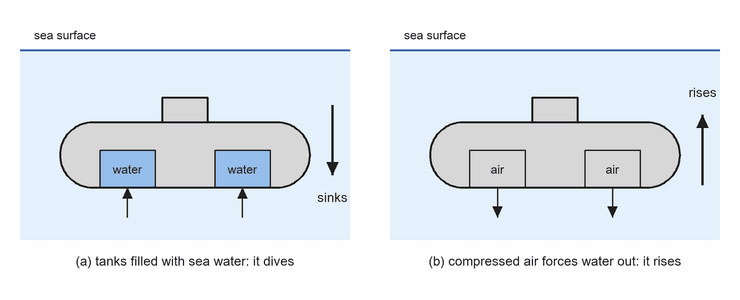
Watch out: The submarine's volume hardly changes; it is the mass of water in the tanks that changes its average density.
Therefore, a submarine dives by filling its tanks with water and surfaces by forcing the water out with compressed air.
- 563 marks
Question 56
A balloon filled with hydrogen rises in air. Explain the reason.
Solve with AIWritten solution
Solution:
Concept: A liquid pushes up on any body placed in it. This upward push is the buoyant force (upthrust), and it is equal to the weight of the liquid displaced by the immersed part of the body (Archimedes' principle). Air is a fluid too, so it also gives a buoyant force: the weight of the air displaced.
Step 1 — Compare the densities.
Hydrogen (about 0.09 kg m) is about 14 times lighter than air (about 1.29 kg m).
Step 2 — Compare the forces.
The balloon displaces its own volume of air. The weight of this air (the buoyant force) is more than the total weight of the balloon, that is the hydrogen plus the fabric.
Step 3 — Find the motion.
The net force on the balloon is upwards, so it rises.
Watch out: The balloon rises only while the weight of air displaced is more than its total weight; higher up the air is thinner, so it stops rising at some height.
Therefore, a hydrogen balloon rises because the buoyant force of the air it displaces is more than its total weight.
- 572 marks
Question 57
A cork piece floats on water surface while an iron nail sinks in it. Explain the reason.
Solve with AIWritten solution
Solution:
Concept: Whether a body floats or sinks depends on densities. If the density of the body is more than that of the liquid, it sinks. If it is less, it floats with part of it above the surface. If the two are equal, it floats fully immersed, just below the surface.
Step 1 — The cork.
Cork has a density of about 0.25 g cm, much less than that of water (1 g cm). Only a small part of the cork needs to be under water to displace water equal to its weight, so the cork floats on the surface.
Step 2 — The iron nail.
Iron has a density of about 7.8 g cm, more than that of water. Even when the nail is fully under water, the weight of water it displaces (the buoyant force) is less than its weight, so the nail sinks.
Therefore, the cork floats because it is less dense than water, and the iron nail sinks because it is denser than water.
- 583 marks
Question 58
Which of the following will sink or float on water ? (Density of water = 1 g cm)
(a) Body A having density 500 kg m
(b) Body B having density 2520 kg m
(c) Body C having density 1100 kg m
(d) Body D having density 0.85 g cm.
Solve with AIWritten solution
Solution:
Concept: Whether a body floats or sinks depends on densities. If the density of the body is more than that of the liquid, it sinks. If it is less, it floats with part of it above the surface. If the two are equal, it floats fully immersed, just below the surface.
Step 1 — Write the density of water in both units.
The density of water is 1 g cm, or 1000 kg m in S.I. units.
Step 2 — Change body D into kg m.
Body D is given in g cm, so multiply by 1000 to compare it with the others.
Step 3 — Compare each body with water.
A body denser than 1000 kg m sinks; a less dense one floats.
Body Density (kg m) Compared with water Result A 500 less than 1000 Floats B 2520 more than 1000 Sinks C 1100 more than 1000 Sinks D 850 less than 1000 Floats Watch out: Compare in the same unit; 0.85 g cm is 850 kg m, not 0.85 kg m.
Therefore, bodies B and C sink, while bodies A and D float on water.
- 593 marks
Question 59
The density of water is 1.0 g cm. The density of iron is 7.8 g cm. The density of mercury is 13.6 g cm. Answer the following :
(a) Will a piece of iron float or sink in water ?
(b) Will a piece of iron float or sink in mercury ?
Solve with AIWritten solution
Solution:
Concept: Whether a body floats or sinks depends on densities. If the density of the body is more than that of the liquid, it sinks. If it is less, it floats with part of it above the surface. If the two are equal, it floats fully immersed, just below the surface.
Step 1 — Iron in water.
Iron (7.8 g cm) is denser than water (1.0 g cm), so its weight is more than the buoyant force even when fully immersed, and it sinks.
Step 2 — Iron in mercury.
Iron (7.8 g cm) is less dense than mercury (13.6 g cm), so mercury pushes it up with a force equal to its weight before it is fully immersed, and it floats.
Watch out: The same piece of iron can sink in one liquid and float in another; it depends on the liquid's density.
Therefore, (a) a piece of iron sinks in water, and (b) it floats on mercury.
- 603 marks
Question 60
The diagram given below shows a body floating in three different liquids A, B and C at different levels.
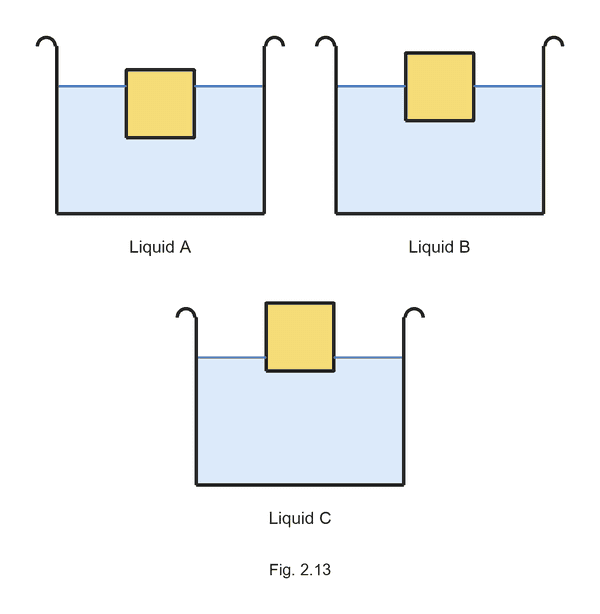
(a) In which liquid does the body experience the greatest buoyant force ?
(b) Which liquid has the least density ?
(c) Which liquid has the highest density ?
Solve with AIWritten solution
Solution:
Concept: Law of floatation: a body floats when the weight of the liquid displaced by its immersed part is equal to the whole weight of the body. For a floating body, buoyant force equals weight, so its apparent weight is zero.
Step 1 — Buoyant force in each liquid.
The same body floats in all three liquids. By the law of floatation, the buoyant force on a floating body equals its weight, so in every liquid the buoyant force equals the same weight. It is not greatest in any one liquid.
Step 2 — Least dense liquid.
To displace liquid equal to its own weight, the body must dip deeper in a less dense liquid. The body is immersed the most in liquid A, so A has the least density.
Step 3 — Most dense liquid.
The body is immersed the least in liquid C, so C has the highest density.
Watch out: A deeper-floating body does not get more buoyant force; it only shows that the liquid is less dense.
Therefore, (a) the buoyant force is the same in all three liquids, (b) liquid A has the least density and (c) liquid C has the highest density (order of density: A < B < C).
- 612 marks
Question 61
Why does a piece of ice float on water ?
Solve with AIWritten solution
Solution:
Concept: Whether a body floats or sinks depends on densities. If the density of the body is more than that of the liquid, it sinks. If it is less, it floats with part of it above the surface. If the two are equal, it floats fully immersed, just below the surface.
Step 1 — Compare the densities.
Ice has a density of about 0.92 g cm (920 kg m), which is less than the density of water, 1 g cm (1000 kg m).
Step 2 — Apply the floating rule.
A body less dense than a liquid floats on it, so ice floats on water.
Step 3 — How much stays under water.
The ice sinks only until the water it displaces weighs as much as the ice. The fraction under water is the ratio of the densities.
Step 4 — Read the result.
So about nine-tenths of a piece of ice floats under the surface, and only about one-tenth shows above.
Therefore, ice floats on water because its density is less than that of water.
- 622 marks
Question 62
An egg sinks in fresh water, but floats in a strong salt solution. Give reason.
Solve with AIWritten solution
Solution:
Concept: Whether a body floats or sinks depends on densities. If the density of the body is more than that of the liquid, it sinks. If it is less, it floats with part of it above the surface. If the two are equal, it floats fully immersed, just below the surface.
Step 1 — In fresh water.
An egg is slightly denser than fresh water, so its weight is more than the buoyant force of the water it displaces, and it sinks.
Step 2 — In a strong salt solution.
Dissolving a lot of salt raises the density of the water until it is more than the density of the egg. The buoyant force can now equal the egg's weight before the egg is fully under, so the egg floats.
Therefore, the egg sinks in fresh water, which is less dense than the egg, and floats in a strong salt solution, which is denser than the egg.
- 632 marks
Question 63
A ship submerges more as it sails from sea water to river water. Give reason.
Solve with AIWritten solution
Solution:
Concept: Law of floatation: a body floats when the weight of the liquid displaced by its immersed part is equal to the whole weight of the body. For a floating body, buoyant force equals weight, so its apparent weight is zero.
Step 1 — Apply the law of floatation.
A floating ship always displaces water whose weight equals its own weight, in sea water and in river water alike.
Step 2 — Compare the two waters.
River water has no dissolved salt, so it is less dense than sea water. Each cubic metre of it weighs less.
Step 3 — Conclude.
To displace the same weight of the less dense river water, the ship must displace a larger volume, so more of its hull goes under water.
Watch out: The buoyant force does not change between the two waters; only the immersed volume does.
Therefore, a ship sinks deeper on sailing from sea water into river water, because river water is less dense.
- 642 marks
Question 64
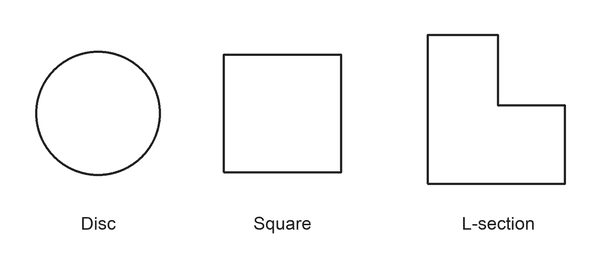
Three different shapes of the same mass are cut from a sheet of iron as shown in the figure given below. Identify the shape with the highest density. Give reason
 Solve with AI
Written solution
Solution:
Concept: Density is a property of the material (at a given temperature), not of the shape or size of the piece.
Step 1 — See what the shapes have in common.
The disc, the square and the L-section are all cut from the same sheet of iron, so they are made of the same material.
Step 2 — Compare mass and volume.
They have the same mass, and being cut from a sheet of the same thickness, they also have the same volume (the same area). So mass ÷ volume is the same for all three.
Step 3 — Answer the question.
No shape has a higher density than the others; each has the density of iron, about 7.8 g cm.
Watch out: Changing the shape of a piece changes neither its mass nor its volume, so its density cannot change.
Therefore, no shape has the highest density: all three have the same density, because they are made of the same material.
- 654 marks
Question 65
The density of air is 1.28 g litre. Express it in : (a) g cm (b) kg m.
Solve with AIWritten solution
Solution:
Concept: Since 1 g is kg and 1 cm is m, a density of 1 g cm is the same as 1000 kg m. To change g cm into kg m multiply by 1000; to change kg m into g cm divide by 1000.
Given: Density of air = 1.28 g litre.
Step 1 — Change litres into cubic centimetres.
1 litre is 1000 cm, so 1.28 g of air fills 1000 cm.
Step 2 — Find the density in g cm.
Divide the mass by the volume in cm.
Step 3 — Change into kg m.
Multiply the value in g cm by 1000.
Watch out: 1 g per litre is the same as 1 kg per cubic metre, so the number 1.28 comes back in part (b).
Therefore, the density of air is (a) 0.00128 g cm and (b) 1.28 kg m.
- 663 marks
Question 66
The dimensions of a hall are 10 m × 7 m × 5 m. If the density of air is 1.11 kg m, find the mass of air in the hall.
Solve with AIWritten solution
Solution:
Concept: From the definition we get two other forms of the same rule. Mass is density × volume, and volume is mass ÷ density.
Given: Hall 10 m × 7 m × 5 m; density of air d = 1.11 kg m.
Step 1 — Find the volume of the hall.
The air fills the whole hall, so its volume is length × breadth × height.
Step 2 — Find the mass of the air.
Multiply the density by the volume; both are in S.I. units, so the mass comes out in kg.
Watch out: Air has mass: a large room holds hundreds of kilograms of it.
Note: at room temperature the density of air is nearer 1.2 kg m; the question's value is used here.
Therefore, the mass of air in the hall is 388.5 kg.
- 673 marks
Question 67
The density of aluminium is 2.7 g cm. Express it in kg m.
- 683 marks
Question 68
The density of alcohol is 600 kg m. Express it in g cm.
- 693 marks
Question 69
A piece of zinc of mass 438.6 g has a volume of 86 cm. Calculate the density of zinc.
- 704 marks
Question 70
A piece of wood of mass 150 g has a volume of 200 cm. Find the density of wood in
(a) C.G.S. unit, (b) S.I. unit.
- 713 marks
Question 71
Calculate the volume of wood of mass 6000 kg if the density of wood is 0.8 g cm.
- 723 marks
Question 72
Calculate the density of a solid from the following data :
(a) Mass of solid = 72 g
(b) Initial volume of water in measuring cylinder = 24 mL
(c) Final volume of water when solid is completely immersed in water = 42 mL
- 734 marks
Question 73
The mass of an empty density bottle is 21.8 g, when filled completely with water it is 41.8 g and when filled completely with liquid it is 40.6 g. Find:
(a) the volume of density bottle
(b) the relative density of liquid.
- 744 marks
Question 74
From the following observations, calculate the density and relative density of a brine solution.
Mass of empty density bottle = 22 g
Mass of bottle + water = 50 g
Mass of bottle + brine solution = 54 g
- 754 marks
Question 75
The mass of an empty density bottle is 30 g, it is 75 g when filled completely with water and 65 g when filled completely with a liquid. Find :
(a) volume of density bottle,
(b) density of liquid, and
(c) relative density of liquid.
What Class 8 Physics Ch 2 covers
The sections of the chapter, in the order the book takes them. Every question above comes from one of these.
- 01Density
- 02Determination of Density of a Regular Solid
- 03Determination of Density of an Irregular Solid
- 04Determination of Density of a Liquid
- 05Relative Density
- 06Density of a Substance in Its Different States
More ways to study this chapter
The same chapter asked three other ways. Practise it, revise it, and see what the board has set on Ch 2 before.
Class 8 Physics Ch 2 questions students ask
How many questions are there in Class 8 Physics Ch 2?
75 questions. Every one is solved step by step on this page.
Are these Class 8 Physics solutions free?
Yes. Every question and its full working is free to read, with no account needed.
Can I download the Class 8 Physics Ch 2 solutions as a PDF?
There is no PDF to download. Every solution is on this page instead, which means it is searchable, always the current syllabus, and readable on a phone. Use your browser's print option if you want it on paper.