
Question 464 marksMedium
Describe an experiment to determine the density of the material of a coin.
Confirming your payment
Sign up now and get 250 free tokens.
Physical Quantities and Measurement · Question 46 of 75
Describe an experiment to determine the density of the material of a coin.
Solution:
Concept: A coin is a small solid of irregular shape. Its mass is found with a beam balance and its volume by the displacement method: a solid sunk in water pushes aside a volume of water equal to its own volume. Then density = mass ÷ volume.
Apparatus: a number of identical coins, a beam balance, a measuring cylinder, water and a thread.
Step 1 — Find the mass.
One coin displaces too little water to read, so take a number of identical coins, say 10 coins. Find their total mass M (in g) with a beam balance.
Step 2 — Note the first water level.
Pour water into a measuring cylinder up to a convenient level. Read the level at the bottom of the meniscus, with the eye level with it. Call it (in mL).
Step 3 — Note the second water level.
Lower the coins gently into the water one by one (or tied with a thread), so that no water splashes out, until all of them are fully under water. Read the new level .
Step 4 — Find the volume.
The rise in level is the volume of water pushed aside, which equals the volume of the coins (1 mL is 1 cm).
Step 5 — Find the density.
Divide the mass by the volume.
Step 6 — Sample readings.
Suppose 10 coins have a mass of 63.2 g and the level rises from 50 mL to 58 mL.
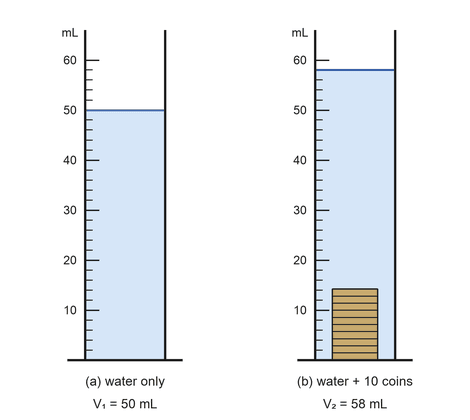
Precautions: read the level at the bottom of the meniscus with the eye at the same height; let no water splash out; make sure every coin is fully under water and no air bubble sticks to it.
Watch out: Using a single coin gives a rise too small to read on the cylinder; many coins make the reading accurate.
Therefore, the density of the material of the coin is the mass of the coins divided by the rise in the water level, .