Solution:
Concept: Law of floatation: a body floats when the weight of the liquid displaced by its immersed part is equal to the whole weight of the body. For a floating body, buoyant force equals weight, so its apparent weight is zero.
Step 1 — Buoyant force in each liquid.
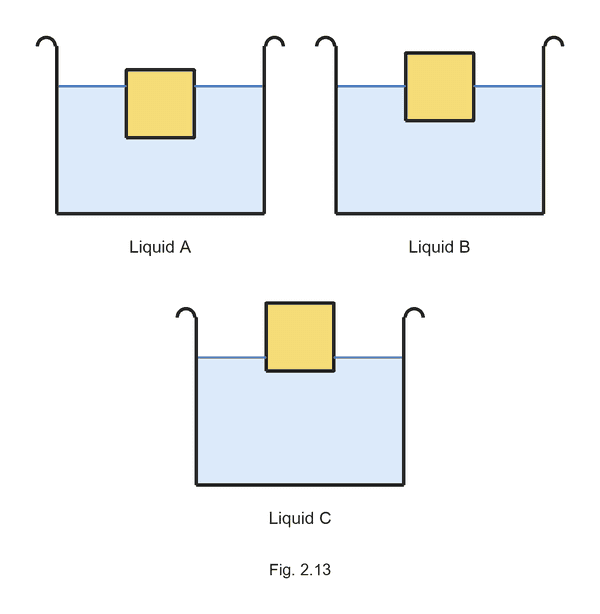
The same body floats in all three liquids. By the law of floatation, the buoyant force on a floating body equals its weight, so in every liquid the buoyant force equals the same weight. It is not greatest in any one liquid.
Step 2 — Least dense liquid.
To displace liquid equal to its own weight, the body must dip deeper in a less dense liquid. The body is immersed the most in liquid A, so A has the least density.
Step 3 — Most dense liquid.
The body is immersed the least in liquid C, so C has the highest density.
Watch out: A deeper-floating body does not get more buoyant force; it only shows that the liquid is less dense.
Therefore, (a) the buoyant force is the same in all three liquids, (b) liquid A has the least density and (c) liquid C has the highest density (order of density: A < B < C).