
Question 484 marksMedium
What is a density bottle ? How is it used to find the density of a liquid ?
Confirming your payment
Sign up now and get 250 free tokens.
Physical Quantities and Measurement · Question 48 of 75
What is a density bottle ? How is it used to find the density of a liquid ?
Solution:
Concept: A density bottle always holds the same volume of liquid. Weighing it full of water gives that volume (1 g of water fills 1 cm), and weighing it full of the liquid gives the mass of the same volume of liquid; density is mass ÷ volume.
Step 1 — Describe the density bottle.
A density bottle is a small glass bottle with a ground-glass stopper that has a narrow hole through it. When the bottle is filled and the stopper is put in, the extra liquid rises through the hole and runs out. So the bottle always holds the same fixed volume of liquid, marked on it (usually 25 mL or 50 mL).
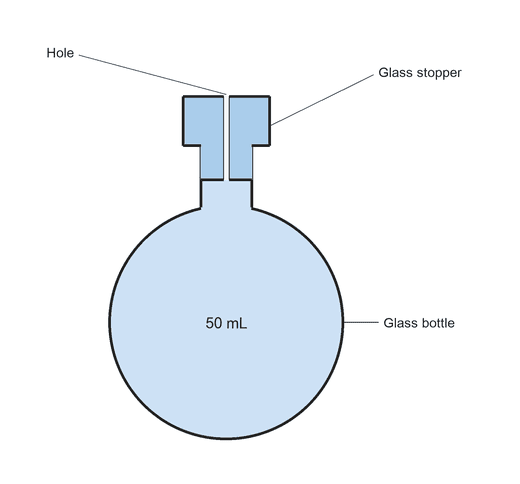
Step 2 — Weigh the empty bottle.
Wash and dry the bottle. Find the mass of the empty bottle with its stopper. Call it (in g).
Step 3 — Weigh it full of water.
Fill the bottle completely with water, put in the stopper, wipe the outside dry and find its mass .
Step 4 — Weigh it full of the liquid.
Empty and dry the bottle, fill it completely with the given liquid, put in the stopper, wipe it dry and find its mass .
Step 5 — Find the volume of the bottle.
The mass of water is grams. Since 1 g of water fills 1 cm, the volume of the bottle, and so of the liquid, is cubic centimetres.
Step 6 — Find the density of the liquid.
The mass of the liquid is grams; divide it by the volume.
Step 7 — Sample readings.
Suppose is 30 g, is 80 g and is 70 g.
Watch out: Fill the bottle to the top of the hole each time and wipe off all liquid outside before weighing.
Therefore, a density bottle holds a fixed volume, and the density of a liquid is g cm.