
Opening your dashboard
Class 8 Physics Chapter 2 Physical Quantities and Measurement: Competency-Based Questions (CBQ)
40 questions on Chapter 2, each worked through on its own page with the AI tutor. Class 8 Physics, ICSE 2026-27.
40 questions
1–5 marks · Mixed difficulty
- 11 mark
Question 1
Competency: Application
A glass bottle is filled completely with water, capped tightly and left in a freezer. Next morning the water has turned into ice and the bottle has cracked.
Which is the best explanation ?
- 21 mark
Question 2
Competency: Analysis
Asha finds the density of a stone of mass 75 g. She fills a measuring cylinder with water up to the 40 mL mark and lowers the stone gently into it with a thread. The level rises to 70 mL.
Bina uses the same stone and starts with water at the same 40 mL mark, but she drops the stone in. Some water splashes out of the cylinder, and the level reads 65 mL.
What value does Bina get for the density of the stone, and how does it compare with the true value ?
- 31 mark
Question 3
Competency: Analysis
The graph shows how the mass of a piece of each of two solid materials X and Y depends on its volume.
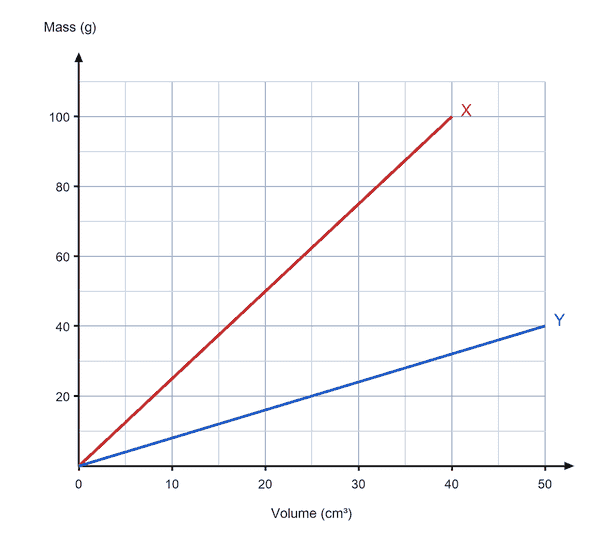
A solid piece of X and a solid piece of Y are put into water (density 1 g cm). Which statement is correct ?
- 41 mark
Question 4
Competency: Application
A ferry of mass 12 000 kg floats on a river. Six cars, each of mass 1000 kg, are driven on to it, and the ferry still floats. The density of river water is 1000 kg m.
By how much does the volume of water displaced by the ferry increase ?
- 51 mark
Question 5
Competency: Understanding
Assertion (A): A loaded ship floats with more of its hull under water in a river than in the sea.
Reason (R): The buoyant force on the floating ship is less in river water than in sea water.
- 61 mark
Question 6
Competency: Understanding
Assertion (A): A density bottle that holds 50 g of water when it is full holds 63 g of glycerine, of relative density 1.26, when it is full.
Reason (R): Relative density is a pure number and has no unit.
- 72 marks
Question 7
Competency: Application
A builder measures one brick. It is 20 cm long, 10 cm wide and 7.5 cm high, and its mass is 2.7 kg.
(a) Find the density of the brick in kg m.
(b) A wall needs 2 m of such bricks. A truck may carry a load of up to 4000 kg. Can it bring all the bricks in one trip ? Show your working.
- 82 marks
Question 8
Competency: Evaluation
Kabir finds the density of a thick cooking oil in this way. He finds the mass of an empty, dry beaker : 52 g. He measures exactly 50 mL of the oil in a measuring cylinder and pours it into the beaker. The beaker with the oil has a mass of 96 g. He then notices that a layer of oil is still sticking to the inside of the measuring cylinder.
(a) Calculate the density of the oil from Kabir's readings.
(b) Is his value more or less than the true density of the oil ? Give a reason, and suggest one change in the method that removes this error.
- 92 marks
Question 9
Competency: Analysis
A solid body of weight 8 N is pushed completely under the surface of each of three liquids A, B and C in turn, and then let go. The buoyant force on the completely immersed body is given below.
Liquid A B C Buoyant force on the completely immersed body (in N) 6 8 10 (a) State what the body does in each liquid after it is let go.
(b) Arrange the three liquids in the order of increasing density. Give a reason.
- 102 marks
Question 10
Competency: Application
A small research submarine has a total volume of 2000 m. With its water tanks empty its mass is 1 800 000 kg. The density of sea water is 1020 kg m.
(a) Show by a calculation that the submarine floats on the sea when its tanks are empty.
(b) Find the least mass of sea water that must be let into the tanks for the submarine to stay completely under water.
- 114 marks
Question 11
Competency: Analysis & Evaluation
Case study: For a science exhibition, Dev slowly pours honey, water and cooking oil into a tall jar. The three liquids settle in separate layers. He then drops four small solid objects into the jar : a cork, a piece of candle wax, a grape and a steel ball. They come to rest at the places marked P, Q, R and S in the figure (not drawn to scale).

Object Cork Candle wax Grape Steel ball Density (in g cm) 0.25 0.93 1.1 7.8 Mass (in g) 8 5 6 2 (a) Use the figure to state what you can say about the density of each of the objects P, Q, R and S.
(b) Use the table to identify P, Q, R and S.
(c) Dev tells a visitor, "The heavier an object is, the lower it settles in the jar." Use the data to judge his statement, and write a correct statement in its place.
- 124 marks
Question 12
Competency: Analysis
Case study: A factory makes solid aluminium balls for a machine. Some balls may have a hidden hollow (an air space) inside. An inspector tests three balls. She finds the mass of each ball and then lowers it into a large measuring cylinder containing water. The density of aluminium is 2.7 g cm.
Ball Mass (in g) Water level before (in mL) Water level after (in mL) 1 135 40 90 2 135 40 100 3 108 40 80 (a) Find the volume of each ball and the value of mass ÷ volume for each.
(b) Which ball has a hollow inside ? Give a reason. Could the inspector have found it by weighing the balls alone ?
(c) Calculate the volume of the hollow.
- 134 marks
Question 13
Competency: Application & Evaluation
Case study: A flat-bottomed raft carries people across a lake. Its base is a rectangle 3 m long and 2 m wide, its sides are vertical and 30 cm high, and its mass is 300 kg. The density of the lake water is 1000 kg m. For safety, the top edge of the raft must stay at least 10 cm above the water.
(a) How deep does the empty raft float in the water ?
(b) Find the greatest number of passengers, each of mass 60 kg, that the raft can carry safely on the lake.
(c) The boatman says, "Sea water is denser, so on the sea my raft can safely carry at least one more passenger." Judge his statement with a calculation. (Density of sea water = 1020 kg m.)
- 143 marks
Question 14
Competency: Application & Analysis
Case study: A delivery van has a cargo space of 6 m, and it must not carry a load of more than 1200 kg. On Monday it has to carry thermocol sheets, and on Tuesday dry sand.
Material Density (in kg m) Thermocol 20 Dry sand 1600 (a) Find the mass of thermocol that fills the whole cargo space. Is the van then overloaded ?
(b) Find the greatest volume of sand the van may carry. What fraction of the cargo space does this sand fill ?
(c) What must be the density of a material for the van to be completely full and carrying exactly its greatest load at the same time ? Use your answer to explain the results of (a) and (b).
- 154 marks
Question 15
Competency: Creation
You are given a plastic drinking straw, some modelling clay, a marker pen, a ruler and three tall jars that contain water, a strong salt solution and cooking oil. You have no balance.
Design a simple floating device with which the three liquids can be arranged in the order of their densities. Write :
(a) how you will make the device and use it,
(b) two precautions that make the comparison fair,
(c) a table for your readings, the result you expect and the reason for it.
- 161 mark
Question 16
Competency: Application
A narrow-necked glass flask is filled with pure water at 0 C so that the water reaches a mark on the neck. The flask is then warmed slowly to 4 C. Ignore any change in the size of the glass.
What happens to the level of the water in the neck, and why ?
- 171 mark
Question 17
Competency: Analysis
A student measures the mass of of each of three liquids P, Q and R, and of water, in the same bottle. The liquids do not mix with water.
Liquid Water P Q R Mass of of the liquid (in g) 40.0 32.0 34.8 41.2 Which statement is correct ?
- 181 mark
Question 18
Competency: Understanding
Assertion (A): A closed hollow iron ball of mass 900 g and total (outer) volume floats on water.
Reason (R): A body floats on a liquid if its average density is less than the density of the liquid.
- 191 mark
Question 19
Competency: Application
A solid cube of aluminium has a mass of 21.6 kg. The density of aluminium is .
What is the length of one edge of the cube ?
- 201 mark
Question 20
Competency: Analysis
Arun finds the density of a liquid with a density bottle. He first finds the volume of the bottle with water in the usual way. When he fills the bottle with the liquid and fits the stopper, a small air bubble stays trapped under the stopper and he does not notice it. His balance readings are all correct.
Compared with the true density, what is his value of the density of the liquid ?
- 211 mark
Question 21
Competency: Application
A rectangular block with a uniform cross-section floats upright in water. Its height is 8 cm, and 2 cm of this height is below the surface of the water, as shown.
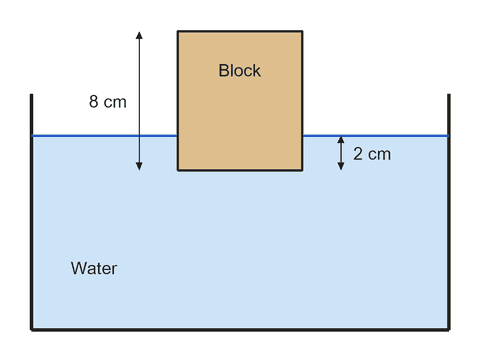
The densities of some solids are: cork , wood , ice and glass . Which material is the block most likely made of ?
- 221 mark
Question 22
Competency: Analysis
Asma fills a Eureka can with water until the water just stops dripping from the spout. She puts a dry measuring cylinder under the spout and gently places a wooden block in the can. The block has a mass of 120 g and a volume of . It floats.

What volume of water collects in the measuring cylinder ?
- 231 mark
Question 23
Competency: Understanding
Assertion (A): A liquid of relative density 0.9 floats on water, if the two do not mix.
Reason (R): A liquid floats on water if the mass of the liquid is less than the mass of the water.
- 241 mark
Question 24
Competency: Evaluation
Nikhil has a few small pebbles, each small enough to slip easily into either cylinder below. Together they have a mass of 11 g and a volume of about . To find their volume by the displacement method, he may use one of two measuring cylinders.
- Cylinder X: range , smallest division .
- Cylinder Y: range , smallest division .
Which advice is the best, and why ?
- 251 mark
Question 25
Competency: Analysis
A small metal piece is hung from a spring balance. The balance shows 7.8 N in air. When the piece is completely dipped in water, the reading falls to 6.8 N; the fall in the reading equals the buoyant force. Take the weight of 1 kg as 10 N and the density of water as .
The densities of four metals are: aluminium , iron , brass and silver . Which metal is the piece made of ?
- 262 marks
Question 26
Competency: Analysis
Meena cuts a long brass rod into three pieces P, Q and R. She finds the mass and volume of each piece, but one of her readings is wrongly written down.
Piece P Q R Mass (in g) 84 168 252 Volume (in cm) 10 20 40 (a) Find the density from the readings of P and of Q.
(b) Which piece has a wrong reading ? Use the idea of density to explain, and say what the mass of this piece should be if its volume is correct.
- 272 marks
Question 27
Competency: Analysis
A student wants to find the volume of each of these solids by dipping it in water in a measuring cylinder and noting the rise in the water level.
A. an iron nail B. a lump of sugar C. a piece of cork D. a dry sponge
For each solid, say whether this simple method gives its volume correctly. Where it does not, give the reason in one line, and say how the volume of C can be found.
- 282 marks
Question 28
Competency: Evaluation
A wooden block of volume floats in water with exactly half of its volume under water. Rina presses the block down with her finger until it is completely under water, and says, 'The buoyant force on the block stays the same, because it is the same block in the same water.' Take the weight of 100 g of water as 1 N.
(a) Find the buoyant force on the block when it floats, and when it is completely under water. Is Rina right ?
(b) Find the weight of the block and the downward force of Rina's finger when the block is held completely under water.
- 292 marks
Question 29
Competency: Application
A helium-filled balloon of volume is used to lift a small camera into the air. The density of air is and the density of helium is . The rubber of the balloon has a mass of 0.5 kg. (Hypothetical data.)
(a) Find the mass of the air displaced by the balloon.
(b) Find the greatest mass of the camera that the balloon can just lift.
- 302 marks
Question 30
Competency: Analysis
A tumbler is filled to the brim with water, and a piece of ice floats in it, with the water level exactly at the brim. Sara waits for the ice to melt. Nothing evaporates.
Will the water overflow, will its level fall, or will it stay at the brim ? Use the law of floatation to explain.
- 312 marks
Question 31
Competency: Application
A rectangular brass plate is 25 cm long and 12 cm wide. Its mass is 1.26 kg. The density of brass is .
(a) Find the volume of the plate.
(b) Find the thickness of the plate in mm.
- 323 marks
Question 32
Competency: Application
An iceberg floats in sea water. The density of ice is and the density of sea water is . Surveyors estimate that the part of the iceberg above water has a volume of .
(a) What fraction of the volume of the iceberg is under water ?
(b) Find the total volume of the iceberg.
(c) Find the mass of the iceberg, using the density of ice in kg m.
- 333 marks
Question 33
Competency: Analysis
Different volumes of one liquid are poured into the same beaker and the total mass of the beaker and the liquid is found each time. The graph shows the total mass against the volume of the liquid.

(a) Read from the graph the mass of the empty beaker.
(b) Find the density of the liquid, and name the liquid, using the densities in this chapter: water , alcohol , turpentine oil , glycerine (all in g cm).
(c) Find the total mass of the beaker with of the liquid.
- 343 marks
Question 34
Competency: Analysis
A shopkeeper has a stock of mustard oil. A 500 g sample of the oil is heated, and its volume is measured at three temperatures. (Hypothetical data.)
Temperature (in C) 20 40 60 Volume of the 500 g sample (in cm) 545 553 561 (a) Find the density of the oil at each temperature, to three decimal places.
(b) State how the density changes with temperature and give the reason.
(c) A buyer takes 1 litre () of the oil, measured out at 60 C on a hot day, rather than at 20 C. How much less mass of oil does she get ?
- 353 marks
Question 35
Competency: Creativity
A fresh egg sinks in a tall glass of plain water, but it floats in a glass of very salty water. You have a tall glass, water, table salt, a spoon and a fresh egg.
Design a way to make the egg stay at rest in the middle of the water, neither floating on the surface nor resting on the bottom.
(a) Describe the steps of your plan.
(b) State the condition, in terms of density, for the egg to stay in the middle, and say what you do if the egg is found to float or to sink.
- 363 marks
Question 36
Competency: Evaluation
A life jacket is made of foam. A swimming instructor says, 'A life jacket works because it is lighter than the person who wears it.' (Hypothetical data.)
A person has a mass of 50 kg and a volume of 49 litres. The jacket has a mass of 0.5 kg and a volume of 6 litres. Take the density of water as .
(a) Find the average density of the person alone. Will the person float ?
(b) Find the average density of the person and the jacket together. Will they float ?
(c) Evaluate the instructor's statement, by finding the average density when the person wears a iron block (density ) in place of the jacket.
- 374 marks
Question 37
Competency: Analysis
Case study: In the science club, Neha's group has four small solid objects A, B, C and D of unknown materials, and three liquids from the lab: alcohol, water and glycerine. The group finds the mass and volume of each object, so that they can predict which objects float and which sink in each liquid before trying them. The densities of the liquids are: alcohol , water and glycerine (all in g cm). (Hypothetical data.)
Object A B C D Mass (in g) 36 28 135 22 Volume (in cm) 30 40 15 25 (a) Find the density of each object.
(b) For each object, state in which of the three liquids it floats and in which it sinks.
(c) The group mixes equal volumes of water and glycerine. Assume that the volume of the mixture is the sum of the two volumes. Find the density of the mixture, and say which of A, B, C and D float in it.
- 384 marks
Question 38
Competency: Evaluation
Case study: Arjun, a swimmer, floats at rest on his back. His mass is 49 kg and his total volume is 50 litres, which gives him an average density of . He floats in three waters in turn: a river (density ), the sea () and a very salty lake (). Take the weight of 1 kg as 10 N. (Hypothetical data.)
Water River Sea Salty lake Density (in kg per litre) 1.00 1.02 1.24 (a) Find the volume of Arjun's body under water in each, and hence the volume that stays above the surface.
(b) Explain why he floats higher in the lake than in the river.
(c) Arjun says, 'The buoyant force on me must be larger in the lake, so that I float higher.' Evaluate this statement with a calculation.
- 395 marks
Question 39
Competency: Creativity
Case study: A lump of candle wax has a mass of 18 g. Meera wants to find its density, but the wax floats on water. She has a measuring cylinder with water, a beam balance, a thread and an iron nail. She uses the nail as a sinker. She handles everything gently so that no water splashes out, and she makes sure that the water covers the nail and the wax completely. Her three readings are shown in the figure. (Hypothetical data.)
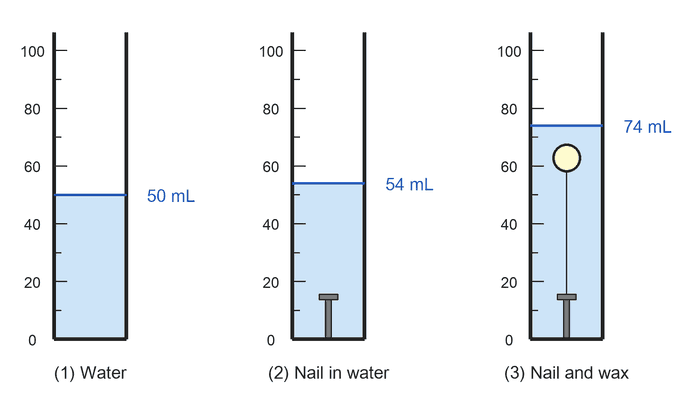
(a) Why can Meera not find the volume of the wax in the usual way, and what does the nail do ?
(b) Write the steps of the method, in the right order.
(c) Use the readings to find the volume and the density of the wax. Will the wax float in water ? Will it float in alcohol of density ?
- 404 marks
Question 40
Competency: Analysis
Case study: In cold countries, the top of a pond freezes in winter, but the fish live on in the water below. Ice is less dense than water, so it stays on top of the pond. The water at the very bottom of the pond stays at about 4 C, even when the air above is much colder. The table gives the density of pure water at different temperatures. (Values are rounded.)
Temperature (in C) 0 2 4 6 8 10 Density (in kg m) 999.8 999.9 1000.0 999.9 999.8 999.7 (a) At which temperature is the density of water the greatest ? Is this the temperature at which a given mass of water has the greatest or the least volume ?
(b) A layer of water at 2 C lies next to a layer of water at 8 C. Which layer is denser, and which would sink below the other ?
(c) On a cold night the surface water cools from 10 C to 4 C and sinks. Use the table to explain why the water at the bottom of the pond ends up at 4 C when the surface is cooled further.