
Opening your dashboard
Class 8 Maths Chapter 19: Representing 3-D in 2-D Solutions
33 textbook questions with step-by-step answers, free to read, for ICSE 2026-27.
Get talked through Ch 19, not just shown the answer
Reading a finished solution is not the same as being able to do it. The AI tutor takes one question at a time and works it with you, in your own words, until you can.
- Ask it out loud, in your own words
- It gives you the next step, not the answer
- Stuck on part (ii)? Start there
33 questions with solutions
1–3 marks · Mixed difficulty
- 11 mark
Question 1
Number of faces in a tetrahedron is :
Solve with AIAnswer
(A) 3
- Correct
(B) 4
(C) 5
(D) 6
Answer: (B) 4
Concept: A pyramid on an n-sided base has the base and n triangular side faces (n + 1 faces), the n corners of the base and one apex (n + 1 vertices), and n base edges plus n slant edges (2n edges).
Step 1 — Recall what a tetrahedron is.
A tetrahedron is a triangular pyramid: one triangular base and three triangular side faces that meet at the apex.
Step 2 — Count the faces.
Add the base to the side faces.
Watch out: Do not forget the base; the base is a face too.
Why the other options are wrong:
- (A) 3: 3 counts only the side faces and leaves out the base.
- (C) 5: 5 is the number of faces of a square pyramid (or of a triangular prism).
- (D) 6: 6 is the number of faces of a cube.
Therefore, a tetrahedron has 4 faces, option (B).
- 21 mark
Question 2
In an octahedron; number of faces is :
Solve with AIAnswer
(A) half of the number of edges
- Correct
(B) 8
(C) 12
(D) more than the number of edges
Answer: (B) 8
Concept: An octahedron has 8 faces. Euler's formula: for every polyhedron, the number of faces F, vertices V and edges E satisfy .
Step 1 — Recall the octahedron.
“Octa” means eight. An octahedron looks like two square pyramids joined at their square bases, so it has 4 + 4 = 8 triangular faces, 4 + 2 = 6 vertices and 4 + 4 + 4 = 12 edges.
Step 2 — Check with Euler's formula.
Put these counts into F + V − E.
Watch out: Do not mix up faces (8) with edges (12) or vertices (6).
Why the other options are wrong:
- (A) half of the number of edges: Half of the 12 edges is 6, which is the number of vertices, not faces.
- (C) 12: 12 is the number of edges.
- (D) more than the number of edges: 8 faces is fewer than 12 edges, not more.
Therefore, an octahedron has 8 faces, option (B).
- 31 mark
Question 3
A rectangular pyramid has :
Solve with AIAnswer
(A) 4 vertices and 4 faces
(B) 6 vertices and 6 faces
(C) 7 vertices and 4 faces
- Correct
(D) 5 vertices and 5 faces
Answer: (D) 5 vertices and 5 faces
Concept: A pyramid on an n-sided base has the base and n triangular side faces (n + 1 faces), the n corners of the base and one apex (n + 1 vertices), and n base edges plus n slant edges (2n edges). A rectangular pyramid has n = 4.
Step 1 — Count the vertices.
The base is a rectangle with 4 corners, and there is one apex on top.
Step 2 — Count the faces.
There is 1 rectangular base and 4 triangular side faces.
Watch out: Count the apex as a vertex and the base as a face.
Why the other options are wrong:
- (A) 4 vertices and 4 faces: 4 vertices and 4 faces belong to a tetrahedron (triangular pyramid).
- (B) 6 vertices and 6 faces: 6 vertices and 6 faces belong to a pentagonal pyramid.
- (C) 7 vertices and 4 faces: A solid with only 4 faces is a tetrahedron, which has 4 vertices, so 7 vertices with 4 faces is impossible.
Therefore, a rectangular pyramid has 5 vertices and 5 faces, option (D).
- 41 mark
Question 4
If V stands for number of vertices, F stands for number of faces and E stands for number of edges, then :
Solve with AIAnswer
(A) V + F + E = 2
(B) F + E − V − 2 = 0
- Correct
(C) F + V − E = 2
(D) F − E + V + 2 = 0
Answer: (C) F + V − E = 2
Concept: Euler's formula: for every polyhedron, the number of faces F, vertices V and edges E satisfy .
Step 1 — State Euler's formula.
For every polyhedron, faces plus vertices minus edges equals 2.
Step 2 — Test it on a cube.
A cube has F = 6, V = 8 and E = 12.
Watch out: The edges are SUBTRACTED; faces and vertices are added.
Why the other options are wrong:
- (A): For a cube, V + F + E comes to 26 (8 + 6 + 12), not 2.
- (B): For a cube, F + E − V − 2 comes to 8 (6 + 12 − 8 − 2), not 0.
- (D): For a cube, F − E + V + 2 comes to 4 (6 − 12 + 8 + 2), not 0.
Therefore, the correct relation is F + V − E = 2, option (C).
- 51 mark
Question 5
If in a polyhedron, number of faces = 12 and number of vertices is 20, then the number of edges is :
Solve with AIAnswer
(A) 10
(B) 20
- Correct
(C) 30
(D) 40
Answer: (C) 30
Concept: Euler's formula: for every polyhedron, the number of faces F, vertices V and edges E satisfy .
Step 1 — Write Euler's formula for E.
Make E the subject of Euler's formula, then put in F = 12 and V = 20.
Watch out: Move E to the other side correctly: E = F + V − 2, not F + V + 2.
Why the other options are wrong:
- (A) 10: With E = 10, F + V − E comes to 22 (12 + 20 − 10), not 2.
- (B) 20: With E = 20, F + V − E comes to 12 (12 + 20 − 20), not 2.
- (D) 40: With E = 40, F + V − E comes to −8 (12 + 20 − 40), not 2.
Therefore, the polyhedron has 30 edges, option (C).
- 63 marks
Question 6
If a polyhedron, has 10 vertices and 7 faces, find the number of edges in it.
Solve with AIWritten solution
Solution:
Concept: Euler's formula: for every polyhedron, the number of faces F, vertices V and edges E satisfy .
Given: V = 10 and F = 7.
Step 1 — Write Euler's formula for E.
Make E the subject of Euler's formula, then put in F = 7 and V = 10.
Watch out: E = F + V − 2, so subtract 2 at the end; do not add it.
Check: A pentagonal prism has exactly these numbers (7 faces, 10 vertices, 15 edges).
Therefore, the polyhedron has 15 edges.
- 73 marks
Question 7
State the number of faces, number of vertices and the number of edges of :
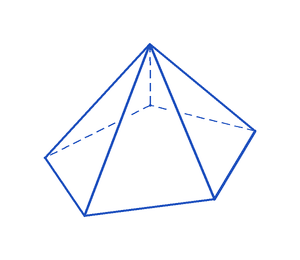
(i) a pentagonal pyramid
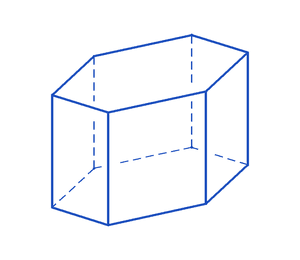
(ii) a hexagonal prism
 Solve with AI
Written solution
Solution:
Concept: A pyramid on an n-sided base has the base and n triangular side faces (n + 1 faces), the n corners of the base and one apex (n + 1 vertices), and n base edges plus n slant edges (2n edges). A prism on an n-sided base has two equal end faces and n rectangular side faces (n + 2 faces), n corners at each end (2n vertices), and n edges round each end plus n side edges (3n edges).
Step 1 — Part (i): count for the pentagonal pyramid.
Here n = 5. The faces are 1 pentagon and 5 triangles, the vertices are 5 base corners and 1 apex, and the edges are 5 base edges and 5 slant edges.
Step 2 — Part (i): check with Euler's formula.
Put the counts into F + V − E.
Step 3 — Part (ii): count for the hexagonal prism.
Here n = 6. The faces are 2 hexagons and 6 rectangles, the vertices are 6 at each end, and the edges are 6 round each end and 6 side edges.
Step 4 — Part (ii): check with Euler's formula.
Put the counts into F + V − E.
Watch out: A pyramid has ONE base, a prism has TWO ends; count them separately.
Therefore, (i) a pentagonal pyramid has 6 faces, 6 vertices and 10 edges; (ii) a hexagonal prism has 8 faces, 12 vertices and 18 edges.
- 83 marks
Question 8
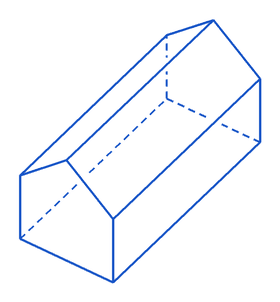
Verify Euler's formula for the following three dimensional figures :
(i)
(ii)
(iii)
 Solve with AI
Written solution
Solution:
Concept: Euler's formula: for every polyhedron, the number of faces F, vertices V and edges E satisfy . Count hidden faces, edges and vertices too (dashed lines show hidden edges).
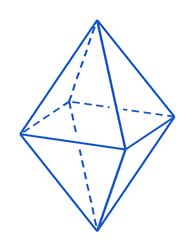
Step 1 — Part (i): count for the octahedron.
Solid (i) is two square pyramids joined at the square. It has 4 upper and 4 lower triangles, the 4 corners of the square and 2 apexes, and 4 square edges with 4 upper and 4 lower slant edges.
Step 2 — Part (i): verify.
Put the counts into F + V − E.
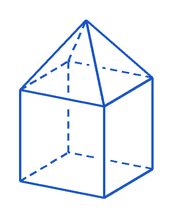
Step 3 — Part (ii): count for the cube with a pyramid on top.
The top face of the cube is covered by the pyramid, so it is not a face of the solid. There are 5 cube faces and 4 triangles, 8 cube corners and 1 apex, and 12 cube edges with 4 slant edges to the apex.
Step 4 — Part (ii): verify.
Put the counts into F + V − E.
Step 5 — Part (iii): count for the pentagonal prism.
Solid (iii) has two pentagonal ends and 5 rectangles, 5 corners at each end, and 5 edges round each end with 5 side edges.
Step 6 — Part (iii): verify.
Put the counts into F + V − E.
Watch out: In (ii) the top of the cube is hidden inside the solid, so it is not a face; but its four edges are still edges.
Therefore, F + V − E = 2 for all three solids, so Euler's formula is verified.
- 93 marks
Question 9
Can a polyhedron have 8 faces, 26 edges and 16 vertices ?
Solve with AIWritten solution
Solution:
Concept: Euler's formula: for every polyhedron, the number of faces F, vertices V and edges E satisfy .
Given: F = 8, E = 26 and V = 16.
Step 1 — Test Euler's formula.
Every polyhedron must satisfy F + V − E = 2; put in F = 8, V = 16 and E = 26.
Step 2 — Decide.
The result is −2, not 2, so the numbers break Euler's formula.
Watch out: Take E with a minus sign: F + V − E, not F + V + E.
Therefore, no, a polyhedron cannot have 8 faces, 26 edges and 16 vertices.
- 103 marks
Question 10
Can a polyhedron have :
(i) 3 triangles only ?
(ii) 4 triangles only ?
(iii) a square and four triangles?
Solve with AIWritten solution
Solution:
Concept: A polyhedron is a solid bounded by flat polygon faces; at least four faces are needed to enclose a space.
Step 1 — Recall the least number of faces.
A polyhedron must enclose a space completely. Two flat faces meet in one line, and three faces meet at a corner but leave the fourth side open, so at least four faces are needed.
Step 2 — Part (i): 3 triangles.
Three triangles cannot close up a solid, so they cannot form a polyhedron.
Step 3 — Part (ii): 4 triangles.
Four triangles can close up into a tetrahedron (triangular pyramid), so they can form a polyhedron.
Step 4 — Part (iii): a square and four triangles.
A square base with a triangle on each of its four sides folds up into a square pyramid, so they can form a polyhedron.
Watch out: A polyhedron with 4 faces is always a tetrahedron, so its faces are triangles.
Therefore, (i) no; (ii) yes, a tetrahedron; (iii) yes, a square pyramid.
- 113 marks
Question 11
Using Euler's formula, find the values of x, y and z
Faces Vertices Edges (i) x 15 20 (ii) 6 y 8 (iii) 14 26 z Solve with AIWritten solution
Solution:
Concept: Euler's formula: for every polyhedron, the number of faces F, vertices V and edges E satisfy .
Given: The table of faces, vertices and edges.
Step 1 — Part (i): find x.
Here F = x, V = 15 and E = 20. Make F the subject of Euler's formula.
Step 2 — Part (ii): find y.
Here F = 6, V = y and E = 8. Make V the subject of Euler's formula.
Step 3 — Part (iii): find z.
Here F = 14, V = 26 and E = z. Make E the subject of Euler's formula.
Watch out: Rearrange the formula before substituting, and keep the minus sign on E.
Note: These numbers satisfy Euler's formula, which is what the question asks. Euler's formula alone does not prove that such a solid exists. Every vertex meets at least 3 edges and every face has at least 3 edges, so 2E must be at least 3V and at least 3F. Row (i) fails the first test (2 × 20 is 40, less than 3 × 15), row (ii) fails the second (2 × 8 is 16, less than 3 × 6) and row (iii) fails the first (2 × 38 is 76, less than 3 × 26). So no real polyhedron has these numbers.
Therefore, x = 7, y = 4 and z = 38.
- 123 marks
Question 12
What is the least number of planes that can enclose a solid ? What is the name of the solid ?
Solve with AIWritten solution
Solution:
Concept: A solid is enclosed only when its flat faces close up on every side.
Step 1 — Try fewer than four planes.
Two planes meet in a line and three planes meet at a point like the corner of a room; in both cases the space is open on at least one side.
Step 2 — Use four planes.
Four planes, none parallel and not all through one point, cut off a closed solid with 4 triangular faces.
Watch out: The solid formed has 4 triangular faces, so it is a triangular pyramid.
Therefore, the least number of planes is 4, and the solid is a tetrahedron (triangular pyramid).
- 133 marks
Question 13
Is a square prism same as a cube ?
Solve with AIWritten solution
Solution:
Concept: A prism is named by its end faces; a cube is a prism whose every face is a square.
Step 1 — Describe a square prism.
A square prism has two square ends; its side faces are rectangles whose length is the height of the prism.
Step 2 — Compare with a cube.
A cube has all six faces square. So a square prism is a cube only when its height equals the side of its square ends; then the rectangles become squares.
Step 3 — Give the answer.
Every cube is a square prism, but a square prism with a different height (a cuboid with square ends) is not a cube.
Watch out: The name “square prism” only fixes the END faces; the height can be anything.
Note: The book's printed answer “yes” holds only in that special case (height = side of the base).
Therefore, not always: a square prism is the same as a cube only when its height equals the side of its square base.
- 143 marks
Question 14
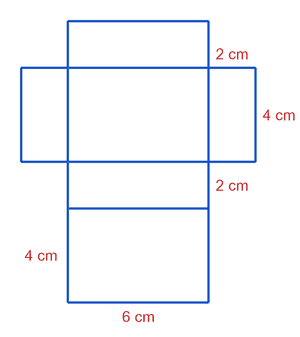
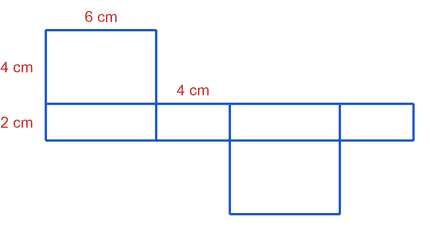
The dimensions of a cuboid are 6 cm × 4 cm × 2 cm. Draw two different nets of it.
Solve with AIWritten solution
Solution:
Concept: A net is a flat shape that folds into the solid; it must contain every face once, joined along edges of equal length.
Given: A cuboid 6 cm × 4 cm × 2 cm.
Step 1 — List the faces.
A cuboid 6 cm × 4 cm × 2 cm has six rectangular faces in three equal pairs: two of 6 cm × 4 cm, two of 6 cm × 2 cm and two of 4 cm × 2 cm.
Step 2 — Net 1.
Put four faces in a column (6 × 2, 6 × 4, 6 × 2, 6 × 4) and attach the two 4 × 2 end faces on either side of the first 6 × 4 face.
Step 3 — Net 2.
Put the four faces round the middle in a row (6 × 2, 4 × 2, 6 × 2, 4 × 2), with one 6 × 4 face above the first and the other below the third.
Step 4 — Check that each net folds.
In each net every edge that meets another face when folded has the same length as that face's edge, and opposite faces are equal, so both fold into the cuboid.
Watch out: Two faces that are opposite on the cuboid must never share an edge in the net.
Therefore, the two figures above are two different nets of the cuboid.
- 153 marks
Question 15
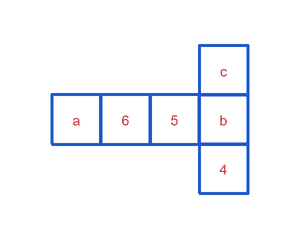
Dice are cubes where the sum of the numbers on the opposite faces is 7. Find the missing numbers a, b and c.
 Solve with AI
Written solution
Solution:
Concept: On a die the numbers on opposite faces add up to 7.
Given: The net in the figure.
Step 1 — Use the folding rule.
In a row of four squares of a cube net, the 1st and 3rd squares become opposite faces, and so do the 2nd and 4th. The two squares attached above and below the row become the top and bottom, which are opposite each other.
Step 2 — Find a.
The squares a and 5 are the 1st and 3rd of the row, so they are opposite.
Step 3 — Find b.
The squares 6 and b are the 2nd and 4th of the row, so they are opposite.
Step 4 — Find c.
The squares c and 4 are attached above and below b, so they are opposite.
Watch out: Squares that touch in the net are NEIGHBOURS on the cube, never opposite faces.
Therefore, a = 2, b = 1 and c = 3 (and the six faces show 1 to 6 once each).
- 163 marks
Question 16
Draw two nets for each of the following polyhedrons :
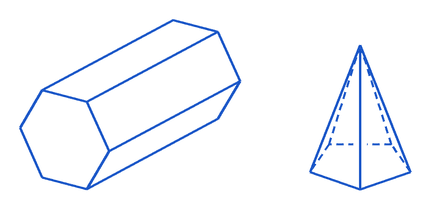 Solve with AI
Written solution
Solution:
Concept: A net is a flat shape that folds into the solid; it contains every face once, joined along equal edges.
Given: A hexagonal prism and a pentagonal pyramid.
Step 1 — Name the solids and list their faces.
The first solid is a hexagonal prism: 2 hexagons and 6 rectangles (8 faces). The second is a pentagonal pyramid: 1 pentagon and 5 triangles (6 faces).
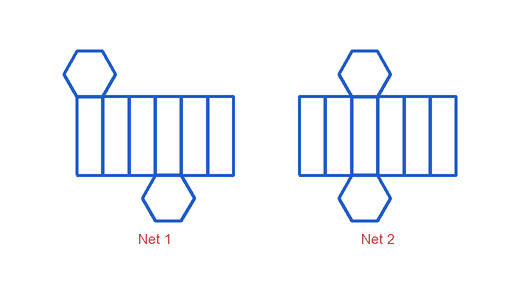
Step 2 — Hexagonal prism: two nets.
Put the six equal rectangles in a row. Attach one hexagon above and one below the row: on different rectangles (Net 1) or on the same rectangle (Net 2). Each hexagon side equals the rectangle's width.
Step 3 — Pentagonal pyramid: two nets.
Net 1: a pentagon with a triangle on each of its five sides. Net 2: the five triangles side by side round the apex, with the pentagon attached to the base of the middle triangle.
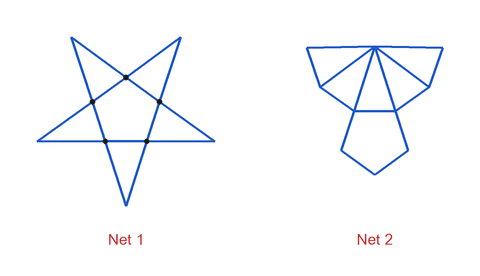
Watch out: For the pyramid, the five triangles must be equal isosceles triangles whose bases equal the pentagon's sides.
Therefore, the figures above give two nets of each solid.
- 171 mark
Question 17
If in a polyhedron, number of faces = 20 and number edges = 30; the number of vertices is :
Solve with AIAnswer
- Correct
(A) 12
(B) 6
(C) 8
(D) 20
Answer: (A) 12
Concept: Euler's formula: for every polyhedron, the number of faces F, vertices V and edges E satisfy .
Step 1 — Write Euler's formula for V.
Make V the subject of Euler's formula, then put in F = 20 and E = 30.
Watch out: Rearrange carefully: V = 2 − F + E.
Why the other options are wrong:
- (B) 6: With V = 6, F + V − E comes to −4 (20 + 6 − 30), not 2.
- (C) 8: With V = 8, F + V − E comes to −2 (20 + 8 − 30), not 2.
- (D) 20: With V = 20, F + V − E comes to 10 (20 + 20 − 30), not 2.
Therefore, the polyhedron has 12 vertices, option (A).
- 181 mark
Question 18
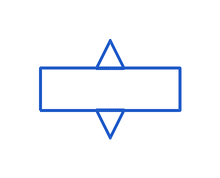
is the net of :
Solve with AIAnswer
(A) square pyramid
- Correct
(B) triangular prism
(C) hexagonal pyramid
(D) none of these
Answer: (B) triangular prism
Concept: A prism has two equal end faces joined by rectangles; a pyramid has one base and triangles meeting at an apex.
Step 1 — Look at the faces in the net.
The net has a rectangular part with one triangle at each end of it.
Step 2 — Fold it.
The two triangles become the two ends, and the rectangular part wraps round the three sides of the triangles. Its fold lines (not drawn in this sketch) split it into three rectangles, the three side faces.
Watch out: Two triangles at the ENDS of rectangles mean a prism, not a pyramid.
Why the other options are wrong:
- (A) square pyramid: A square pyramid's net is a square with four triangles, and this net has no square.
- (C) hexagonal pyramid: A hexagonal pyramid's net is a hexagon with six triangles, and this net has neither.
- (D) none of these: The net does fold into a triangular prism, so “none of these” is wrong.
Therefore, it is the net of a triangular prism, option (B).
- 191 mark
Question 19
Joseph is making a pentagonal prism using identical straws.

How many straws does he need ?
Solve with AIAnswer
(A) 20
(B) 18
- Correct
(C) 15
(D) 10
Answer: (C) 15
Concept: A prism on an n-sided base has two equal end faces and n rectangular side faces (n + 2 faces), n corners at each end (2n vertices), and n edges round each end plus n side edges (3n edges).
Step 1 — Link straws to edges.
Each straw makes one edge, so count the edges of a pentagonal prism (n = 5).
Watch out: Count edges, not vertices: the 10 corners are where the straws meet.
Why the other options are wrong:
- (A) 20: 20 is 5 more than the 15 edges a pentagonal prism has.
- (B) 18: 18 is the number of edges of a hexagonal prism.
- (D) 10: 10 is the number of vertices of a pentagonal prism.
Therefore, Joseph needs 15 straws, option (C).
- 201 mark
Question 20
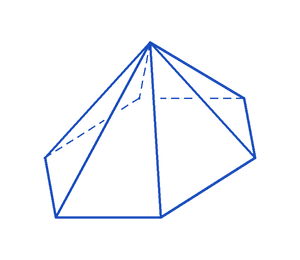
In case of a hexagonal pyramid, F = no. of faces and V = no. of vertices, then F + V is :
 Solve with AI
Answer
(A) 10
(B) 12
- Correct
(C) 14
(D) 16
Answer: (C) 14
Concept: A pyramid on an n-sided base has the base and n triangular side faces (n + 1 faces), the n corners of the base and one apex (n + 1 vertices), and n base edges plus n slant edges (2n edges).
Step 1 — Count faces and vertices.
A hexagonal pyramid (n = 6) has 1 hexagon and 6 triangles, and 6 base corners and 1 apex.
Step 2 — Add them.
Now add the two counts.
Watch out: Include the base as a face and the apex as a vertex.
Why the other options are wrong:
- (A) 10: 10 is too small; it would need F and V to total only 10, but each of them is 7.
- (B) 12: 12 is the number of edges of a hexagonal pyramid, not F + V.
- (D) 16: 16 is 2 more than 7 + 7; it would mean an extra face and an extra vertex.
Therefore, F + V = 14, option (C).
- 211 mark
Question 21
The number of faces in a triangular pyramid is :
Solve with AIAnswer
(A) 3
- Correct
(B) 4
(C) 5
(D) none of these
Answer: (B) 4
Concept: A pyramid on an n-sided base has the base and n triangular side faces (n + 1 faces), the n corners of the base and one apex (n + 1 vertices), and n base edges plus n slant edges (2n edges).
Step 1 — Count the faces.
A triangular pyramid has one triangular base and three triangular side faces.
Watch out: The base is also a face.
Why the other options are wrong:
- (A) 3: 3 leaves out the base.
- (C) 5: 5 is the number of faces of a square pyramid or of a triangular prism.
- (D) none of these: The correct number 4 is given in option (B).
Therefore, a triangular pyramid has 4 faces, option (B).
- 221 mark
Question 22
Statement 1 : The number of vertices in a pyramid is one more than the number of sides in a polygon.
Statement 2 : A polyhedron may have 10 faces, 20 edges and 15 vertices.
Which of the following options is correct?
Solve with AIAnswer
(A) Both the statements are true.
(B) Both the statements are false.
- Correct
(C) Statement 1 is true, and statement 2 is false.
(D) Statement 1 is false, and statement 2 is true.
Answer: (C) Statement 1 is true, and statement 2 is false.
Concept: A pyramid on an n-sided base has the base and n triangular side faces (n + 1 faces), the n corners of the base and one apex (n + 1 vertices), and n base edges plus n slant edges (2n edges). Euler's formula: for every polyhedron, the number of faces F, vertices V and edges E satisfy .
Step 1 — Judge statement 1.
A pyramid whose base is a polygon with n sides has the n corners of the base and one apex, that is n + 1 vertices. So statement 1, read with “a polygon” as the base polygon, is true.
Step 2 — Judge statement 2.
Test F = 10, E = 20 and V = 15 in Euler's formula.
Step 3 — Decide.
The result is 5, not 2, so statement 2 is false.
Watch out: A polyhedron must satisfy F + V − E = 2 exactly.
Note: The printed answer list gives (b), “both false”. Statement 1 is true by counting for every pyramid, so (b) cannot be right; (C) is used here.
Why the other options are wrong:
- (A): Statement 2 fails Euler's formula, so both cannot be true.
- (B): Statement 1 is true for every pyramid.
- (D): It is the other way round: statement 1 is true and statement 2 is false.
Therefore, statement 1 is true and statement 2 is false, option (C).
- 231 mark
Question 23
The following questions are Assertion-Reason based questions. Choose your answer based on the codes given below.
(1) Both A and R are correct, and R is the correct explanation for A.
(2) Both A and R are correct, and R is not the correct explanation for A.
(3) A is true, but R is false.
(4) A is false, but R is true.
Assertion (A) : In a polyhedron, if there are 6 vertices, 12 edges , then the number of faces are 8.
Reason (R) : In a pentagonal pyramid, there are 6 faces, 6 vertices and 10 edges.
Solve with AIAnswer
(A) (1)
- Correct
(B) (2)
(C) (3)
(D) (4)
Answer: (B) (2)
Concept: In these Assertion–Reason items, code (1) means both true and R explains A; (2) both true but R does not explain A; (3) A true, R false; (4) A false, R true. Euler's formula: for every polyhedron, the number of faces F, vertices V and edges E satisfy .
Step 1 — Judge the assertion.
For V = 6 and E = 12, find F from F = 2 − V + E.
Step 2 — Judge the reason.
A pentagonal pyramid (n = 5) has 6 faces, 6 vertices and 10 edges, so R is true.
Step 3 — Does R explain A?
R is about a different solid (a pentagonal pyramid) and does not give the rule used for A (Euler's formula). So R does not explain A, and the code is (2).
Watch out: Both statements can be true and still be unrelated.
Note: The printed answer list gives code (1). R gives no reason for A (it is about another solid), so code (2) is used here.
Why the other options are wrong:
- (A): Code (1) needs R to explain A, but R only lists the counts of another solid.
- (C): Code (3) says R is false, but a pentagonal pyramid does have 6 faces, 6 vertices and 10 edges.
- (D): Code (4) says A is false, but the working above gives exactly 8 faces from these values.
Therefore, both A and R are true, but R is not the explanation of A, option (B).
- 241 mark
Question 24
The following questions are Assertion-Reason based questions. Choose your answer based on the codes given below.
(1) Both A and R are correct, and R is the correct explanation for A.
(2) Both A and R are correct, and R is not the correct explanation for A.
(3) A is true, but R is false.
(4) A is false, but R is true.
Assertion (A) : If a polyhedron has 7 vertices and 10 faces, the number of edges is 19.
Reason (R) : The relationship between the faces (F), edges (E) and vertices (V) of a polyhedron is F + V − E = 2.
Solve with AIAnswer
(A) (1)
(B) (2)
(C) (3)
- Correct
(D) (4)
Answer: (D) (4)
Concept: In these Assertion–Reason items, code (1) means both true and R explains A; (2) both true but R does not explain A; (3) A true, R false; (4) A false, R true. Euler's formula: for every polyhedron, the number of faces F, vertices V and edges E satisfy .
Step 1 — Judge the reason.
R is Euler's formula, which is true for every polyhedron.
Step 2 — Judge the assertion.
Use R with V = 7 and F = 10.
Step 3 — Decide.
The polyhedron has 15 edges, not 19, so A is false while R is true: code (4).
Watch out: Use the formula to CHECK the assertion's number, not to accept it.
Why the other options are wrong:
- (A): Code (1) needs A to be true, but the edges are 15, not 19.
- (B): Code (2) needs A to be true, but the edges are 15, not 19.
- (C): Code (3) says R is false, but R is Euler's formula, which is true.
Therefore, A is false and R is true, option (D).
- 251 mark
Question 25
The following questions are Assertion-Reason based questions. Choose your answer based on the codes given below.
(1) Both A and R are correct, and R is the correct explanation for A.
(2) Both A and R are correct, and R is not the correct explanation for A.
(3) A is true, but R is false.
(4) A is false, but R is true.
Assertion (A) : The number of edges in a triangular prism = 9.
Reason (R) : In a triangular prism, the number of vertices = 2 × number of sides = 6;
The number of faces = 2 + number of sides = 5.
Solve with AIAnswer
(A) (1)
- Correct
(B) (2)
(C) (3)
(D) (4)
Answer: (B) (2)
Concept: In these Assertion–Reason items, code (1) means both true and R explains A; (2) both true but R does not explain A; (3) A true, R false; (4) A false, R true. A prism on an n-sided base has two equal end faces and n rectangular side faces (n + 2 faces), n corners at each end (2n vertices), and n edges round each end plus n side edges (3n edges).
Step 1 — Judge the assertion.
A triangular prism (n = 3) has 3 edges round each end and 3 side edges.
Step 2 — Judge the reason.
Its vertices are 2 × 3 = 6 and its faces are 2 + 3 = 5, so both parts of R are true.
Step 3 — Does R explain A?
R gives the vertices and faces, not the edges, so it does not explain why there are 9 edges. The code is (2).
Watch out: Check every part of R before calling it true or false.
Note: The printed answer list gives code (3), “R false”. Both counts in R are correct, so code (2) is used here.
Why the other options are wrong:
- (A): Code (1) needs R to explain A, but R says nothing about edges.
- (C): Code (3) says R is false, but 6 vertices and 5 faces are both correct.
- (D): Code (4) says A is false, but a triangular prism does have 9 edges.
Therefore, both A and R are true, but R is not the explanation of A, option (B).
- 261 mark
Question 26
The following questions are Assertion-Reason based questions. Choose your answer based on the codes given below.
(1) Both A and R are correct, and R is the correct explanation for A.
(2) Both A and R are correct, and R is not the correct explanation for A.
(3) A is true, but R is false.
(4) A is false, but R is true.
Assertion (A) : The number of edges in a rectangular pyramid = 8.
Reason (R) : In a triangular prism, the number of vertices is one more than the number of sides and the number of faces is one less than the number of sides.
Solve with AIAnswer
(A) (1)
(B) (2)
- Correct
(C) (3)
(D) (4)
Answer: (C) (3)
Concept: In these Assertion–Reason items, code (1) means both true and R explains A; (2) both true but R does not explain A; (3) A true, R false; (4) A false, R true. A pyramid on an n-sided base has the base and n triangular side faces (n + 1 faces), the n corners of the base and one apex (n + 1 vertices), and n base edges plus n slant edges (2n edges). A prism on an n-sided base has two equal end faces and n rectangular side faces (n + 2 faces), n corners at each end (2n vertices), and n edges round each end plus n side edges (3n edges).
Step 1 — Judge the assertion.
A rectangular pyramid (n = 4) has 4 base edges and 4 slant edges.
Step 2 — Judge the reason.
A triangular prism has 6 vertices, not 3 + 1 = 4, and 5 faces, not 3 − 1 = 2. So R is false.
Step 3 — Decide.
A is true and R is false: code (3).
Watch out: R is about a PRISM, so use the prism counts (2n vertices, n + 2 faces).
Note: The printed answer list gives code (4), “A false”. A rectangular pyramid has 8 edges by counting, so code (3) is used here.
Why the other options are wrong:
- (A): Code (1) needs R to be true.
- (B): Code (2) needs R to be true.
- (D): Code (4) says A is false, but a rectangular pyramid does have 8 edges.
Therefore, A is true and R is false, option (C).
- 273 marks
Question 27
Draw a net of a rectangular box.
Solve with AIWritten solution
Solution:
Concept: A net is a flat shape that folds into the solid, with every face appearing once.
Step 1 — List the faces.
A rectangular box (cuboid) has six rectangular faces in three equal pairs: top and bottom, front and back, and two sides.
Step 2 — Arrange them.
Put four faces in a column (back, top, front, bottom) and attach the two side faces on either side of the top.

Step 3 — Check that it folds.
Folding along every common edge brings the back, front and sides up round the top and closes the box with the bottom.
Watch out: The two side faces must be attached to different edges, so they end up opposite each other.
Therefore, the figure above is a net of a rectangular box.
- 283 marks
Question 28
Can a polyhedron have 15 faces, 30 edges and 20 vertices ?
Solve with AIWritten solution
Solution:
Concept: Euler's formula: for every polyhedron, the number of faces F, vertices V and edges E satisfy .
Given: F = 15, E = 30 and V = 20.
Step 1 — Test Euler's formula.
Put F = 15, V = 20 and E = 30 into F + V − E.
Step 2 — Decide.
The result is 5, not 2, so the numbers break Euler's formula.
Watch out: The test must give exactly 2.
Therefore, no, a polyhedron cannot have 15 faces, 30 edges and 20 vertices.
- 293 marks
Question 29
Draw the net of a square pyramid.
Solve with AIWritten solution
Solution:
Concept: A pyramid on an n-sided base has the base and n triangular side faces (n + 1 faces), the n corners of the base and one apex (n + 1 vertices), and n base edges plus n slant edges (2n edges).
Step 1 — List the faces.
A square pyramid has one square base and four congruent isosceles triangles.
Step 2 — Draw the net.
Draw the square and build a triangle on each of its four sides.
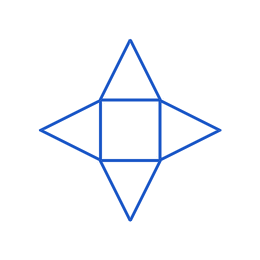
Step 3 — Check that it folds.
Folding the four triangles up makes their tips meet at the apex.
Watch out: All four triangles must have the same slant sides, or the tips will not meet.
Therefore, the figure above is a net of a square pyramid.
- 303 marks
Question 30
Write the number of edges in a hexagonal pyramid.
Solve with AIWritten solution
Solution:
Concept: A pyramid on an n-sided base has the base and n triangular side faces (n + 1 faces), the n corners of the base and one apex (n + 1 vertices), and n base edges plus n slant edges (2n edges).
Step 1 — Count the edges.
A hexagonal pyramid (n = 6) has 6 base edges and 6 slant edges to the apex.
Step 2 — Check with Euler's formula.
It has 7 faces and 7 vertices.
Watch out: Count the slant edges as well as the base edges.
Therefore, a hexagonal pyramid has 12 edges.
- 313 marks
Question 31
Draw the two dimensional representation of a triangular prism.
Solve with AIWritten solution
Solution:
Concept: A 3-D solid is shown on paper by drawing its visible edges as full lines and its hidden edges as dashed lines.
Step 1 — Draw the ends.
Draw the front triangle, then the back triangle shifted up and to the side.
Step 2 — Join and dash.
Join the matching corners. Draw with dashed lines the edges hidden behind the solid.

Step 3 — Check the counts.
The figure shows 2 triangular faces, 3 rectangular faces, 6 vertices and 9 edges.
Watch out: A hidden edge is dashed, and where it passes behind a full line, leave a small gap.
Therefore, the figure above is a two-dimensional representation of a triangular prism.
- 323 marks
Question 32
If a polyhedron has 10 faces and 8 vertices, find the number of edges in it.
Solve with AIWritten solution
Solution:
Concept: Euler's formula: for every polyhedron, the number of faces F, vertices V and edges E satisfy .
Given: F = 10 and V = 8.
Step 1 — Write Euler's formula for E.
Make E the subject of Euler's formula, then put in F = 10 and V = 8.
Watch out: Subtract 2 at the end, do not add it.
Therefore, the polyhedron has 16 edges.
- 333 marks
Question 33
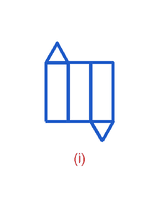
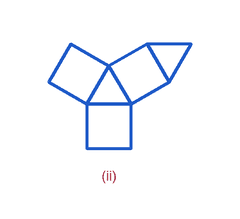
Name the polyhedron that can be made by folding each of the following nets :
(i)
(ii)
(iii)
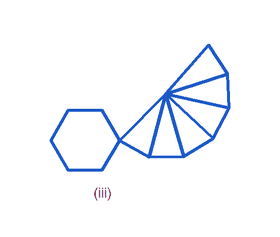 Solve with AI
Written solution
Solution:
Concept: Read a net by its faces: two equal end faces joined by rectangles make a prism; one base with triangles meeting at a point makes a pyramid.
Step 1 — Part (i).
Three rectangles in a row with a triangle at each end: two triangular ends and three rectangular sides make a triangular prism.
Step 2 — Part (ii).
Three squares round a triangle, with a second triangle on the far side of one square: 2 triangles and 3 squares, again a triangular prism (with square side faces).
Step 3 — Part (iii).
One hexagon and six triangles that meet at one point: a hexagonal pyramid.
Watch out: Count the triangles: two triangles are the ends of a prism, many triangles meeting at a point form a pyramid.
Therefore, (i) triangular prism; (ii) triangular prism; (iii) hexagonal pyramid.
What Class 8 Maths Ch 19 covers
The sections of the chapter, in the order the book takes them. Every question above comes from one of these.
- 01Polyhedron
- 02Faces, Edges and Vertices
- 03Euler's Formula
- 04More Polyhedrons (Polyhedra)
- 05Nets of a Solid
More ways to study this chapter
The same chapter asked three other ways. Practise it, revise it, and see what the board has set on Ch 19 before.
Class 8 Maths Ch 19 questions students ask
How many questions are there in Class 8 Maths Ch 19?
33 questions. Every one is solved step by step on this page.
Are these Class 8 Maths solutions free?
Yes. Every question and its full working is free to read, with no account needed.
Can I download the Class 8 Maths Ch 19 solutions as a PDF?
There is no PDF to download. Every solution is on this page instead, which means it is searchable, always the current syllabus, and readable on a phone. Use your browser's print option if you want it on paper.