
Opening your dashboard
Class 8 Maths Chapter 19 Representing 3-D in 2-D: Practice Questions
42 questions on Chapter 19, each worked through on its own page with the AI tutor. Class 8 Maths, ICSE 2026-27.
42 questions
1–5 marks · Mixed difficulty
- 11 mark
Question 1
Bloom's level: Remember
Which of the following solids is a polyhedron?
- 21 mark
Question 2
Bloom's level: Remember
The line segment along which two faces of a polyhedron meet is called :
- 31 mark
Question 3
Bloom's level: Remember
The number of edges of a cuboid is :
- 41 mark
Question 4
Bloom's level: Understand
In a 2-D drawing of a cube, some edges are drawn with dotted lines. This is because those edges :
- 51 mark
Question 5
Bloom's level: Apply
In a certain polyhedron, the edges outnumber the faces by 7. How many vertices does it have?
- 61 mark
Question 6
Bloom's level: Apply
A pyramid has 11 vertices. The number of its edges is :
- 71 mark
Question 7
Bloom's level: Analyse
Which of the following arrangements of six equal squares is not a net of a cube?
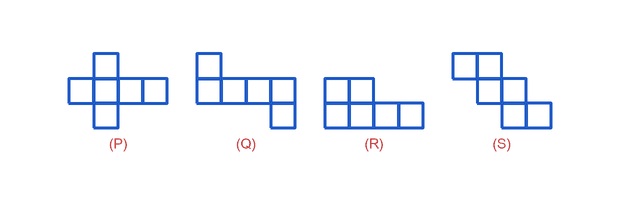
- 81 mark
Question 8
Bloom's level: Apply
A prism has 18 edges. The number of its faces is :
- 91 mark
Question 9
Bloom's level: Understand
For a prism whose base is a polygon with sides, which of the following is correct?
- 101 mark
Question 10
Bloom's level: Understand
Assertion (A) : A cone is not a polyhedron.
Reason (R) : A cone has only one vertex.
- 111 mark
Question 11
Bloom's level: Evaluate
Assertion (A) : No polyhedron can have 6 faces, 10 edges and 7 vertices.
Reason (R) : For every polyhedron, .
- 121 mark
Question 12
Bloom's level: Analyse
Assertion (A) : A square pyramid and a triangular prism have the same number of faces.
Reason (R) : A square pyramid and a triangular prism both have exactly 5 vertices.
- 131 mark
Question 13
Bloom's level: Remember
What is a polyhedron? Write its plural.
- 142 marks
Question 14
Bloom's level: Understand
The figure shows a triangular prism with ends ABC and DEF. Name all its faces and all its edges.

- 152 marks
Question 15
Bloom's level: Apply
A polyhedron has as many faces as vertices, and it has 14 edges. Find the number of its faces. Name a solid that fits.
- 162 marks
Question 16
Bloom's level: Understand
State two differences between a prism and a pyramid.
- 172 marks
Question 17
Bloom's level: Apply
A net of a cuboid 5 cm long, 3 cm wide and 2 cm high is cut out of card.
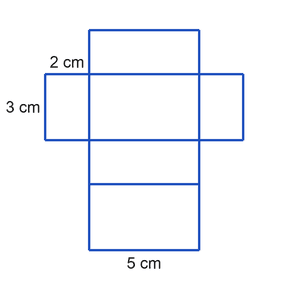
Find the area of card in the net (ignore any flaps).
- 182 marks
Question 18
Bloom's level: Evaluate
For a hexagonal pyramid, a student writes , and . Check the student's answer using Euler's formula. If the faces and vertices are correct, what should the number of edges be?
- 192 marks
Question 19
Bloom's level: Understand
In 2-D drawings of solids, the drawing of a sphere usually shows a dotted ellipse across its middle, and a cylinder lying on its side shows one end as an ellipse. Explain why these curves are drawn as ellipses and not as circles.
- 202 marks
Question 20
Bloom's level: Analyse
A prism and a pyramid have bases with the same number of sides, . Show that the prism always has more edges than the pyramid, and find how many more vertices it has.
- 212 marks
Question 21
Bloom's level: Apply
A net is made of two circles, each of radius 7 cm, and a rectangle 10 cm wide.
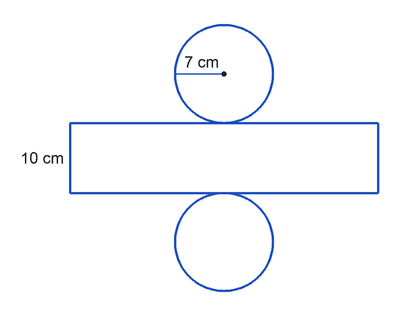
Name the solid it folds into, and find the length of the rectangle so that it fits exactly round the circles.
- 222 marks
Question 22
Bloom's level: Apply
Copy and complete the table, and check that each solid obeys Euler's formula.
Solid F V E Tetrahedron Cube Octahedron - 233 marks
Question 23
Bloom's level: Analyse
The figure shows a net of a cube with its faces lettered P, Q, R, S, T and U. When the net is folded into a cube, which face is opposite to (i) P (ii) Q (iii) R? Give a reason for each.
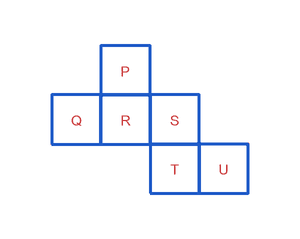
- 244 marks
Question 24
Bloom's level: Apply
A solid is made of 6 square faces and 8 triangular faces. Each edge is shared by exactly two faces.
(a) Find the number of edges.
(b) Use Euler's formula to find the number of vertices.
(c) At each vertex, the same number of faces meet. Using the fact that each face has as many corners as sides, find how many faces meet at each vertex.
- 255 marks
Question 25
Bloom's level: Apply
Case study: A school craft club builds skeleton models of solids, using straws for edges and small clay balls for vertices. Coloured paper is pasted on each face.
(a) How many straws and clay balls are needed for a hexagonal pyramid? How many pieces of paper?
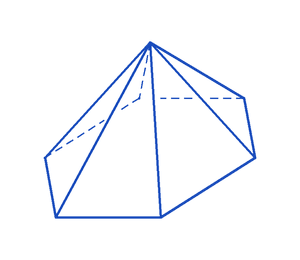
(b) The club has exactly 30 straws and 20 clay balls left. Which prism can be made using all of them?
(c) How many pieces of paper does the prism in (b) need? Verify Euler's formula for it.
- 265 marks
Question 26
Bloom's level: Create
Case study: A sweet shop needs closed boxes 10 cm long, 6 cm wide and 4 cm high, each cut in one piece from a rectangular sheet of card (ignore flaps).
(a) List the sizes of the faces and find the area of card in one net.
(b) Design a net for the box. Sketch it and mark the dimensions of each face.
(c) Find the smallest rectangular sheet your net fits on, and the area of card wasted. Suggest whether a different arrangement of the same faces could waste more card.
- 273 marks
Question 27
Bloom's level: Evaluate
Ria says: "A cylinder has 3 faces, 2 edges and 0 vertices. Then , which is not 2. So Euler's formula is wrong." Evaluate Ria's argument.
- 284 marks
Question 28
Bloom's level: Analyse
One corner of a cube is sliced off by a flat cut through three points on the three edges meeting at that corner, as shown.
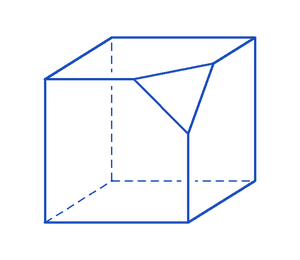
(a) How many faces, vertices and edges does the new solid have?
(b) Verify Euler's formula for it.
(c) Explain how each of , and changed compared with the cube.
- 295 marks
Question 29
Bloom's level: Create
(a) Write general expressions for , and of (i) a prism and (ii) a pyramid whose base has sides.
(b) Use your expressions to show that Euler's formula holds for every prism and every pyramid.
(c) Design a prism with exactly 24 edges and a pyramid with exactly 24 edges. Name each and give its numbers of faces and vertices.
- 303 marks
Question 30
Bloom's level: Understand
The figure is a 2-D drawing of a cuboid.
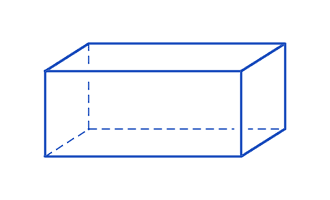
(a) How many edges are drawn with full lines and how many are dotted? What do the dotted edges show?
(b) Every face of a cuboid is a rectangle, yet in the drawing some faces look like parallelograms. Explain why.
(c) Which faces of the cuboid can be seen from the viewpoint of this drawing?
- 313 marks
Question 31
Using Euler's formula, check whether a polyhedron can have :
(i) Faces = 8, Vertices = 18, Edges = 26
(ii) Faces = 10, Vertices = 16, Edges = 24
(iii) Faces = 7, Vertices = 10, Edges = 12
- 323 marks
Question 32
Find the number of edges in a polyhedron, if it has :
(i) Faces = 4, Vertices = 4
(ii) Faces = 6, Vertices = 8
(iii) Faces = 5, Vertices = 6
- 331 mark
Question 33
An octahedron has 8 triangular faces. Its numbers of faces, vertices and edges are, in this order :
- 341 mark
Question 34
Which of the following can be the numbers of faces, vertices and edges, in this order, of a polyhedron ?
- 351 mark
Question 35
A net is made up of two congruent regular pentagons and five congruent rectangles. When folded, it makes a :
- 362 marks
Question 36
Which of these objects have the shape of a polyhedron ? Give a reason for each.
a dice, a soup tin, an ice-cream cone, a tent with a triangular roof (a triangular prism)
- 372 marks
Question 37
Write the number of faces, vertices and edges of a heptagonal pyramid.

Verify that they satisfy Euler's formula.
- 382 marks
Question 38
All the faces of a polyhedron are triangles. It has 12 vertices and 30 edges. Use Euler's formula to find the number of its faces, and check your answer by counting the edges from the faces.
- 392 marks
Question 39
Name the polyhedron which has :
(i) 6 faces, all squares
(ii) 5 faces : one square and four triangles
(iii) 4 faces, all triangles
(iv) 5 faces : two triangles and three rectangles
- 404 marks
Question 40
The figure shows a net of a solid.
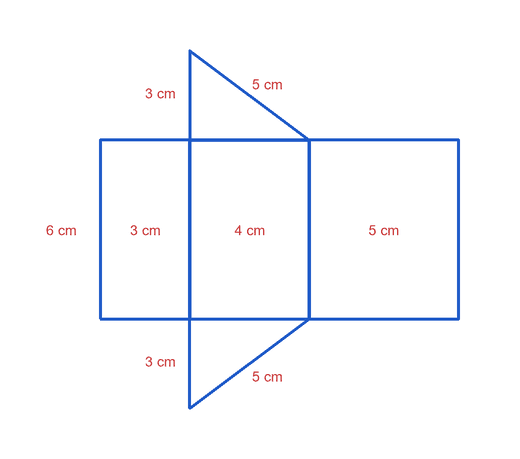
(a) Name the solid that is formed when this net is folded.
(b) Write the number of faces, vertices and edges of the solid and verify Euler's formula.
(c) Find the area of card needed to make the net.
- 414 marks
Question 41
A polyhedron has 10 faces : 2 of them are octagons and the other 8 are rectangles.
(a) Find the number of its edges by counting the sides of all the faces.
(b) Use Euler's formula to find the number of its vertices.
(c) Name the polyhedron.
- 423 marks
Question 42
A toy house is made by fixing a square pyramid on the top of a cube, so that the base of the pyramid exactly covers one face of the cube.
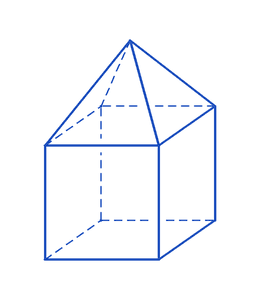
(a) Find the number of faces, vertices and edges of the solid.
(b) Verify Euler's formula for it.