
Question 201 markMCQEasy
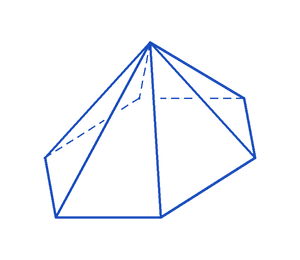
In case of a hexagonal pyramid, F = no. of faces and V = no. of vertices, then F + V is :
Confirming your payment
Sign up now and get 250 free tokens.
Representing 3-D in 2-D · Question 20 of 33
In case of a hexagonal pyramid, F = no. of faces and V = no. of vertices, then F + V is :
(A) 10
(B) 12
(C) 14
(D) 16
Answer: (C) 14
Concept: A pyramid on an n-sided base has the base and n triangular side faces (n + 1 faces), the n corners of the base and one apex (n + 1 vertices), and n base edges plus n slant edges (2n edges).
Step 1 — Count faces and vertices.
A hexagonal pyramid (n = 6) has 1 hexagon and 6 triangles, and 6 base corners and 1 apex.
Step 2 — Add them.
Now add the two counts.
Watch out: Include the base as a face and the apex as a vertex.
Why the other options are wrong:
Therefore, F + V = 14, option (C).