
Question 83 marksEasy
Verify Euler's formula for the following three dimensional figures :
(i)
(ii)
(iii)
Confirming your payment
Sign up now and get 250 free tokens.
Representing 3-D in 2-D · Question 8 of 33
Verify Euler's formula for the following three dimensional figures :
(i)
(ii)
(iii)
Solution:
Concept: Euler's formula: for every polyhedron, the number of faces F, vertices V and edges E satisfy . Count hidden faces, edges and vertices too (dashed lines show hidden edges).
Step 1 — Part (i): count for the octahedron.
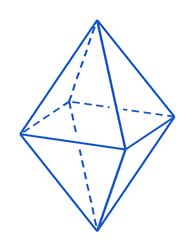
Solid (i) is two square pyramids joined at the square. It has 4 upper and 4 lower triangles, the 4 corners of the square and 2 apexes, and 4 square edges with 4 upper and 4 lower slant edges.
Step 2 — Part (i): verify.
Put the counts into F + V − E.
Step 3 — Part (ii): count for the cube with a pyramid on top.
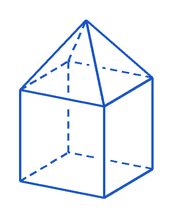
The top face of the cube is covered by the pyramid, so it is not a face of the solid. There are 5 cube faces and 4 triangles, 8 cube corners and 1 apex, and 12 cube edges with 4 slant edges to the apex.
Step 4 — Part (ii): verify.
Put the counts into F + V − E.
Step 5 — Part (iii): count for the pentagonal prism.
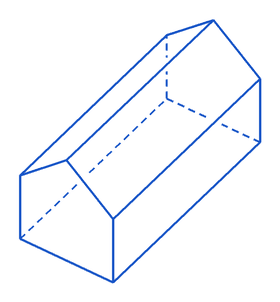
Solid (iii) has two pentagonal ends and 5 rectangles, 5 corners at each end, and 5 edges round each end with 5 side edges.
Step 6 — Part (iii): verify.
Put the counts into F + V − E.
Watch out: In (ii) the top of the cube is hidden inside the solid, so it is not a face; but its four edges are still edges.
Therefore, F + V − E = 2 for all three solids, so Euler's formula is verified.