
Opening your dashboard
Class 8 Maths Chapter 19 Representing 3-D in 2-D: Competency-Based Questions (CBQ)
40 questions on Chapter 19, each worked through on its own page with the AI tutor. Class 8 Maths, ICSE 2026-27.
40 questions
1–5 marks · Mixed difficulty
- 11 mark
Question 1
Competency: Understanding
A camping tent has a rectangular floor, two slanting rectangular sides that meet along the top, and a triangle at the front and at the back.
The shape of the tent is a
- 21 mark
Question 2
Competency: Application
A gift box is a cuboid 8 cm long, 5 cm wide and 3 cm high. Golden tape is pasted along every edge of the box.
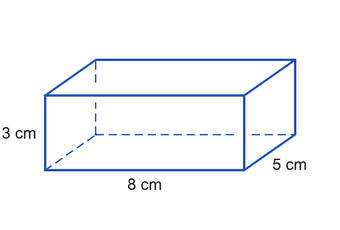
What is the total length of tape needed?
- 31 mark
Question 3
Competency: Application
The pattern on a football is based on a polyhedron. It has 32 faces (12 pentagons and 20 hexagons) and 60 vertices. Each edge of the polyhedron is a seam.
How many seams does it have?
- 41 mark
Question 4
Competency: Analysis
Rehana wants to fold an open box (a cube without a lid) from one piece of card made of five equal squares. Four pieces are shown.

Which piece can not be folded into the open box?
- 51 mark
Question 5
Competency: Application
A jeweller counts 16 edges on a crystal that has the shape of a pyramid.
The base of the crystal is a polygon with
- 61 mark
Question 6
Competency: Understanding
Assertion (A) : An octahedron can be made by joining two equal square pyramids base to base.
Reason (R) : A square pyramid has 5 faces, so an octahedron has faces.
- 72 marks
Question 7
Competency: Application
A room is a cuboid 5 m long, 4 m wide and 3 m high. An electrician fixes a strip of LED lights along every edge where a wall meets the ceiling and along every edge where two walls meet. No strip is fixed along the floor.

Along how many edges does he fix the strip? Find the total length of strip needed.
- 82 marks
Question 8
Competency: Analysis
A cube of paneer is cut into two equal pieces by one straight, upright cut along a diagonal of its top face.

Name the solid that each piece is. Write its number of faces, vertices and edges, and check Euler's formula for it.
- 92 marks
Question 9
Competency: Evaluation
Mona says, "A cube has six square faces. So any six equal squares joined edge to edge make a net of a cube."
Is Mona right? Support your answer with one arrangement of six squares.
- 102 marks
Question 10
Competency: Application
The metal frame of a lampshade is a polyhedron. It is made of 15 rods (its edges) which are joined at 10 joints (its vertices). A glass panel is fitted in every face.
How many glass panels are needed? Name a solid from your book that this frame could be.
- 113 marks
Question 11
Competency: Analysis
On a die, the numbers on opposite faces always add up to 7. Three dice are stacked one on top of another to make a tower. The top face of the top die shows 3.
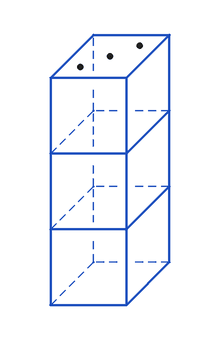
Five faces are hidden: the bottom face of each die and the top faces of the middle and bottom dice. Find the total of the numbers on these five hidden faces. Explain why you do not need to see the middle and bottom dice.
- 123 marks
Question 12
Competency: Creativity
Design a net for an open box (a cuboid without a lid) that is 4 cm long, 3 cm wide and 2 cm high.
(a) Draw your net and mark the measurements on it.
(b) In your net, how many edges of the box are fold lines?
(c) How many edges of the box must be closed with tape after folding?
- 133 marks
Question 13
Competency: Analysis & Evaluation
Neha counts the edges of a hexagonal prism like this:
"It has 2 hexagonal faces and 6 rectangular faces. Each hexagon has 6 edges and each rectangle has 4 edges. So the prism has edges."
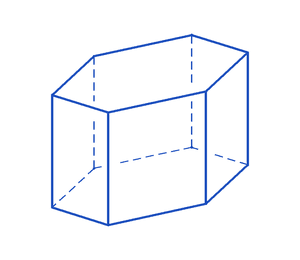
(a) What is wrong with Neha's method?
(b) Correct her answer.
(c) Check the corrected answer with Euler's formula.
- 144 marks
Question 14
Competency: Application & Analysis
Case study — The bamboo gazebo
A gazebo (an open shelter) in a park has the shape shown. Its lower part is a hexagonal prism. Its roof is a hexagonal pyramid that fits exactly on top of the prism.
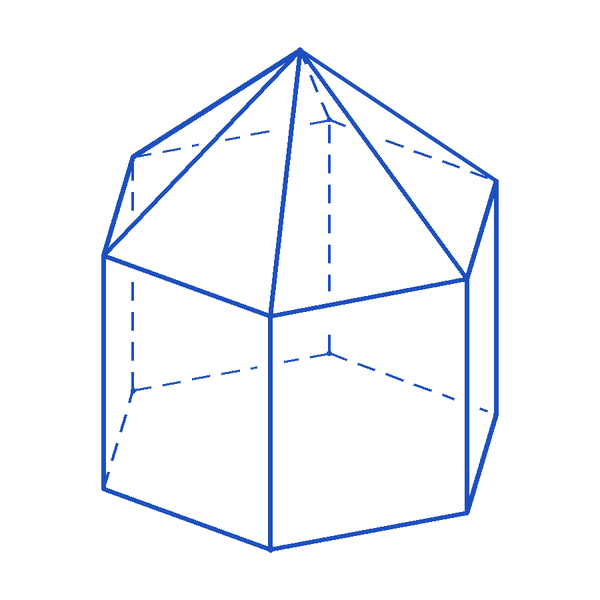
(a) Write the number of faces, vertices and edges of the roof alone (a hexagonal pyramid).
(b) Now take the whole gazebo as one solid. Find its number of faces, vertices and edges. Does it obey Euler's formula?
(c) One bamboo pole is used for every edge of the gazebo, except the edges on the ground. How many poles are used?
- 155 marks
Question 15
Competency: Analysis & Evaluation
Case study — The mixed-up museum labels
A museum shows models of polyhedra. Some numbers on the labels have faded. The curator's notes are given below.
Model Faces Vertices Edges P 7 10 Q 7 12 R 6 12 (a) Find , and .
(b) One of the models P and Q is a prism and the other is a pyramid. Decide which is which, and name the shape of the base of each.
(c) A fourth label, for a pyramid, reads "10 faces, 10 vertices, 20 edges". Show that this label has a mistake. If the faces and vertices are correct, what should the number of edges be?
- 161 mark
Question 16
Competency: Understanding
A new, unsharpened pencil has six flat sides and two flat ends, so it is a hexagonal prism. Ignore the rubber and the metal band.
How many of its edges run along the length of the pencil, from one end to the other?
- 171 mark
Question 17
Competency: Analysis
A glass paperweight is a polyhedron with 10 faces. At every vertex of it, exactly 3 edges meet. (Hypothetical data.)
How many vertices does the paperweight have?
- 181 mark
Question 18
Competency: Evaluation
Assertion (A) : Two different nets of the same cuboid need the same area of card (ignore flaps).
Reason (R) : Every net of a solid shows each face of the solid exactly once, so the area of the net is the sum of the areas of all the faces.
- 191 mark
Question 19
Competency: Analysis
A packing unit wants to fold a closed box, 4 cm long, 3 cm wide and 2 cm high, from one piece of card. Four nets are drawn. The measurements, in cm, are written as width × height inside each rectangle.
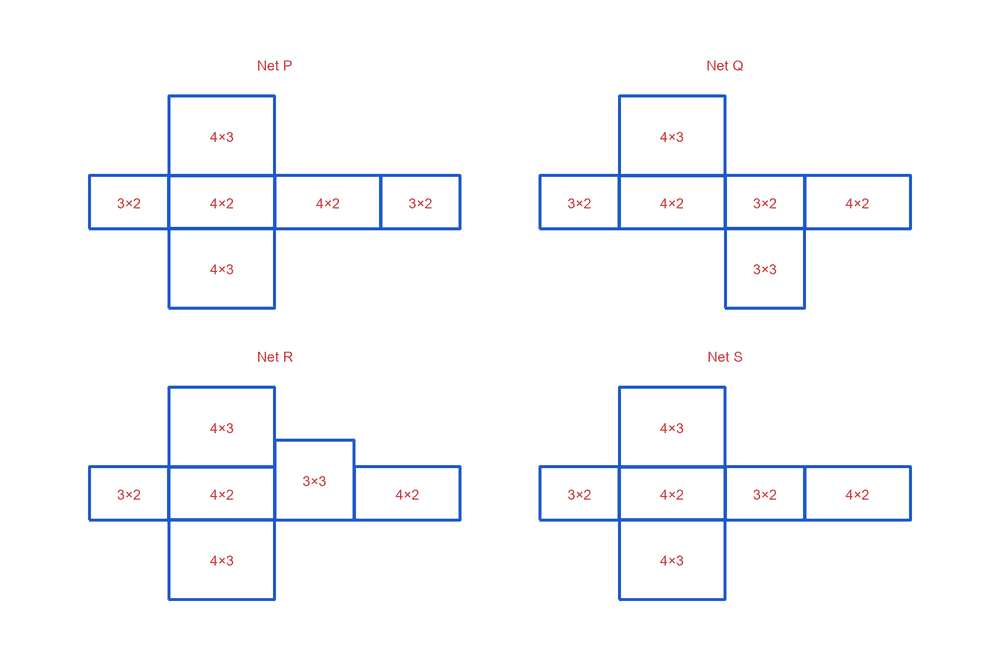
Which net can be folded into this box?
- 201 mark
Question 20
Competency: Application
A birthday cap is shaped like a cone that is open at the bottom. Neha makes it by cutting one flat piece of paper and rolling it up.
Which flat piece should she cut?
- 211 mark
Question 21
Competency: Analysis
The maths lab keeps four solid models in boxes. Each label gives the name of the solid and its numbers of faces (), vertices () and edges ().
Box Name of the solid 1 Cuboid 6 8 12 2 Pentagonal prism 7 10 15 3 Square pyramid 5 6 9 4 Hexagonal pyramid 7 7 12 Priya checks every label with Euler's formula and finds that all four satisfy it. Even so, one label gives a name that does not match its numbers.
Which box has the wrong name?
- 221 mark
Question 22
Competency: Analysis & Evaluation
Assertion (A) : Any solid that has exactly 6 faces must be a cube.
Reason (R) : A cube has exactly 6 faces.
- 231 mark
Question 23
Competency: Analysis
A juice carton with a gable top is shaped like a cuboid with a triangular prism on top of it as a roof. The front wall of the cuboid and the triangular end of the roof lie in one flat surface, so together they form one pentagon, as shown. The back is the same. Ignore the thin sealed strip along the top.
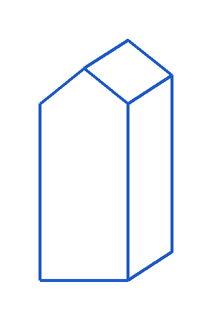
How many faces does the carton have?
- 241 mark
Question 24
Competency: Application
Asha has a glass showpiece shaped like a prism. She counts its faces, its vertices and its edges, and adds the three numbers. The total is 44. (Hypothetical data.)
What shape are the ends of the prism?
- 251 mark
Question 25
Competency: Evaluation
Four students make statements about nets of solids.
Which statement is correct?
- 262 marks
Question 26
Competency: Application
A shop packs sweets in a paper box shaped like a square pyramid. The square base has side 6 cm, and each of the four triangular faces has base 6 cm and height 5 cm. (Hypothetical data.)
Find the area of paper needed to make the net of the box. Ignore any flaps.
- 272 marks
Question 27
Competency: Understanding
A regular tetrahedron is a pyramid whose base and other faces are all equilateral triangles. A paperweight of this shape rests on a table, and the face on the table is its base.
How many of its edges are base edges and how many are slanting edges? Does the answer change if the paperweight is turned over so that a different face rests on the table?
- 282 marks
Question 28
Competency: Evaluation
A glass pillar in a museum leans to one side. Its two ends are equal heptagons (7-sided figures) in parallel planes, and each of its 7 side faces is a parallelogram, not a rectangle.
Ravi says, "Because the pillar leans, it is not a prism, and Euler's formula will not work for it."
A prism is a solid whose two ends are equal polygons in parallel planes and whose side faces are parallelograms. Use this to check both parts of Ravi's statement, and find the numbers of faces, vertices and edges of the pillar.
- 292 marks
Question 29
Competency: Application
A box of tea is a cuboid 12 cm long, 9 cm wide and 4 cm high. A paper label goes once round the four side faces of the box, without covering the top or the bottom, and does not overlap. (Hypothetical data.)
When the label is laid flat it is a rectangle. Find its length and width, and its area.
- 302 marks
Question 30
Competency: Analysis
Priya makes a right square pyramid from clay, so its apex is directly above the centre of the square base. She presses the apex gently to one side, so that it is no longer above the centre. The base does not change.
Do the numbers of faces, vertices and edges change? Are the four triangular faces still all congruent? Give reasons.
- 312 marks
Question 31
Competency: Analysis
The figure shows a net of a closed box. Each piece is marked width × height, in cm.

Find and . Then find the area of card needed for the net.
- 323 marks
Question 32
Competency: Analysis
A carpenter has two identical wooden prisms. The end of each prism is a right-angled triangle with two equal sides of 5 cm, and each prism is 12 cm long. He glues the two prisms together along their largest rectangular faces, with the longest sides of the triangles together, so that the ends of the two pieces fit side by side. (Hypothetical data.)
(a) What shape do the two triangular ends on one side make together?
(b) Name the new solid, and write its number of faces, vertices and edges.
(c) Check Euler's formula for the new solid.
- 333 marks
Question 33
Competency: Analysis & Evaluation
A teacher draws nets of a regular tetrahedron using four equilateral triangles of the same size. The figure shows three arrangements P, Q and R.

(a) Which of the arrangements can be folded into a tetrahedron?
(b) Explain why the other arrangement cannot be, by looking at the corner where its triangles meet.
- 343 marks
Question 34
Competency: Creativity
Design a riddle. Write three clues about the numbers of faces, vertices and edges of a solid, so that a hexagonal prism is the only one of these solids that fits all three clues: cube, cuboid, triangular prism, pentagonal prism, hexagonal prism, tetrahedron, square pyramid, pentagonal pyramid, hexagonal pyramid and octahedron.
Then show that a hexagonal prism fits your clues and that the other solids do not.
- 353 marks
Question 35
Competency: Application
A tent is a triangular prism. Its floor is a rectangle 3 m long and 2.4 m wide. Its two slanting sides are rectangles 3 m by 1.5 m. Its two ends are triangles with base 2.4 m and height 0.9 m. Canvas is used for the floor, the two slanting sides and the two ends. (Hypothetical data.)
Find the area of canvas needed. If canvas costs ₹ 150 per square metre, find the cost.
- 363 marks
Question 36
Competency: Evaluation
Rashid works out for a cube and for a triangular prism, and each time he gets the number of edges. He says, "For every polyhedron, ."
Test his rule on (i) a pentagonal prism and (ii) a square pyramid. Is Rashid right?
- 374 marks
Question 37
Competency: Application & Analysis
Case study — The chocolate pack
A company packs chocolate in a box shaped like a triangular prism. The ends are right-angled triangles with sides 3 cm, 4 cm and 5 cm, and the box is 10 cm long. The box is made from one piece of card, shown as a net. The pieces are joined along the lines where they touch, and the other edges are closed with tape. (Hypothetical data.)
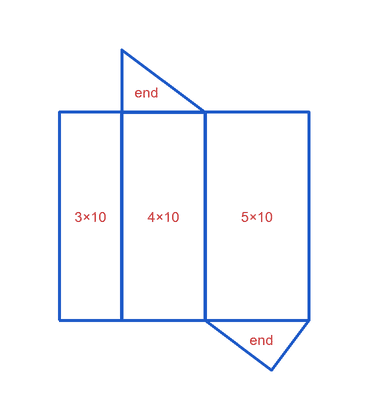
(a) How many fold lines does the net have, and how many edges of the box must be closed with tape?
(b) Find the total length of tape needed.
(c) Find the area of card in the net.
- 385 marks
Question 38
Competency: Analysis & Evaluation
Case study — Protecting cartons
A courier company fixes a plastic corner protector at every vertex of its cartons and sticks an edge guard along every edge. A corner protector costs ₹ 3, and the edge guard costs ₹ 0.50 per cm. It uses three cartons. (Hypothetical data.)
Carton Shape Size P Cuboid 40 cm × 30 cm × 20 cm Q Triangular prism ends are triangles with sides 15 cm, 20 cm, 25 cm; length 40 cm R Hexagonal prism ends are regular hexagons of side 12 cm; length 30 cm (a) Write the number of faces, vertices and edges of each carton, and check Euler's formula.
(b) Find the cost of the corner protectors and edge guards for each carton.
(c) Salim says, "The carton with the most corners always costs the most to protect." Use your answers to decide whether he is right.
- 395 marks
Question 39
Competency: Analysis
Case study — The ant and the sugar
An ant lives at the corner A of a wooden block shaped like a cuboid, 4 cm long, 3 cm wide and 2 cm high. A grain of sugar lies at the corner G, which is the corner farthest from A. The ant can walk only along the edges of the block. (Hypothetical data.)
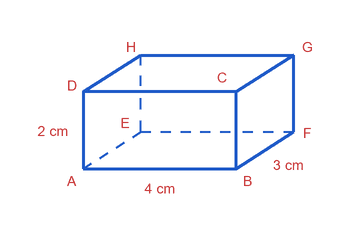
(a) How many edges meet at A? Name them.
(b) Find the shortest distance the ant must walk along the edges to reach G, and explain why it cannot do better.
(c) The ant takes 3 edges, one in each direction. List all the routes of this kind from A to G, and say how many there are.
- 404 marks
Question 40
Competency: Application & Evaluation
Case study — The card tray
Sana makes a tray without a lid from a square sheet of card, 12 cm by 12 cm. She cuts a small square of side cm from each corner, as shown (here ), and folds up the four flaps.
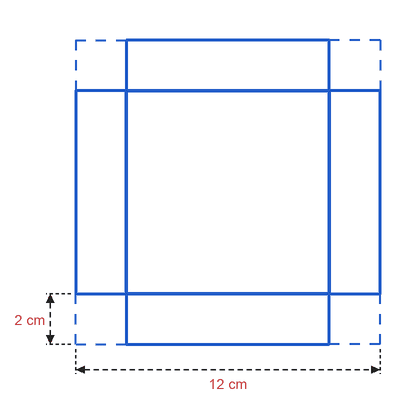
(a) For , find the side of the square base and the height of the tray. How many fold lines does the net have?
(b) Copy and complete the table.
(cm) Side of the base (cm) Height (cm) Area of the base (cm²) 1 10 1 100 2 3 4 (c) Sana wants the area of the base to be at least 50 cm², and the tray to be as high as possible. Which whole number value of should she use? Give a reason.