
Opening your dashboard
Class 7 Maths Chapter 20: Recognition of Solids Solutions
29 textbook questions with step-by-step answers, free to read, for ICSE 2026-27.
Get talked through Ch 20, not just shown the answer
Reading a finished solution is not the same as being able to do it. The AI tutor takes one question at a time and works it with you, in your own words, until you can.
- Ask it out loud, in your own words
- It gives you the next step, not the answer
- Stuck on part (ii)? Start there
29 questions with solutions
1–3 marks · Mixed difficulty
- 13 marks
Question 1
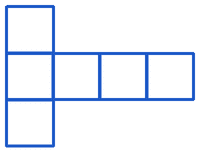
Identify the nets which can be used to form cubes :
(i)
 Solve with AI
Written solution
Solution:
Concept: A net is a flat shape that can be folded up into a solid. A cube has 6 equal square faces, so a net of a cube is made of 6 equal squares joined edge to edge. It works only if, after folding, every face of the cube is covered exactly once: no two squares may land on the same face, and no face may be left open. When a net has a straight row of four squares, that row wraps round the cube as its four side faces. The other two squares must then become the top and the bottom, so one of them has to be above the row and the other below it. Which square of the row they are joined to does not matter.
Step 1 — Look at the shape of the net.
Net (i) has a row of four squares in the middle, one square above the first square of the row and one square below that same square.
Step 2 — Fold the net.
The row of four wraps round as the four side faces. The square above folds over the top, and the square below folds under the bottom.
Step 3 — Check every face.
Each of the six squares lands on a different face of the cube, with no overlap and no gap.
Watch out: Two extra squares on the same side of the row of four (both above or both below) fold onto the same face, and the opposite face is left open.
Therefore, net (i) can be folded into a cube.
- 23 marks
Question 2
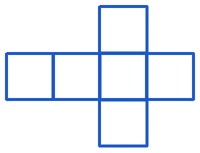
Identify the nets which can be used to form cubes :
(ii)
 Solve with AI
Written solution
Solution:
Concept: A net is a flat shape that can be folded up into a solid. A cube has 6 equal square faces, so a net of a cube is made of 6 equal squares joined edge to edge. It works only if, after folding, every face of the cube is covered exactly once: no two squares may land on the same face, and no face may be left open. When a net has a straight row of four squares, that row wraps round the cube as its four side faces. The other two squares must then become the top and the bottom, so one of them has to be above the row and the other below it. Which square of the row they are joined to does not matter.
Step 1 — Look at the shape of the net.
Net (ii) has a row of four squares, with one square above and one square below the third square of the row (a cross shape).
Step 2 — Fold the net.
The row of four wraps round as the four side faces. The square above becomes the top and the square below becomes the bottom.
Step 3 — Check every face.
All six squares land on different faces, so the cube closes completely.
Watch out: Two extra squares on the same side of the row of four (both above or both below) fold onto the same face, and the opposite face is left open.
Therefore, net (ii) can be folded into a cube.
- 33 marks
Question 3
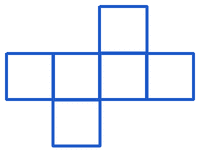
Identify the nets which can be used to form cubes :
(iii)
 Solve with AI
Written solution
Solution:
Concept: A net is a flat shape that can be folded up into a solid. A cube has 6 equal square faces, so a net of a cube is made of 6 equal squares joined edge to edge. It works only if, after folding, every face of the cube is covered exactly once: no two squares may land on the same face, and no face may be left open. When a net has a straight row of four squares, that row wraps round the cube as its four side faces. The other two squares must then become the top and the bottom, so one of them has to be above the row and the other below it. Which square of the row they are joined to does not matter.
Step 1 — Look at the shape of the net.
Net (iii) has a row of four squares, with one square above the third square of the row and one square below the second square.
Step 2 — Fold the net.
The row of four wraps round as the four side faces. The square above folds over as the top and the square below folds under as the bottom; they may hang from different squares of the row.
Step 3 — Check every face.
The six squares land on six different faces, with no overlap, so the net closes into a cube.
Watch out: The top and bottom squares need not be in line with each other; one above and one below the row is enough.
Note: The printed answer lists only nets (i), (ii) and (v). Folding net (iii) square by square shows that it also closes into a cube, so (iii) is included here.
Therefore, net (iii) can be folded into a cube.
- 43 marks
Question 4
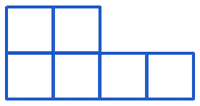
Identify the nets which can be used to form cubes :
(iv)
 Solve with AI
Written solution
Solution:
Concept: A net is a flat shape that can be folded up into a solid. A cube has 6 equal square faces, so a net of a cube is made of 6 equal squares joined edge to edge. It works only if, after folding, every face of the cube is covered exactly once: no two squares may land on the same face, and no face may be left open. When a net has a straight row of four squares, that row wraps round the cube as its four side faces. The other two squares must then become the top and the bottom, so one of them has to be above the row and the other below it. Which square of the row they are joined to does not matter.
Step 1 — Look at the shape of the net.
Net (iv) has a row of four squares along the bottom, and both remaining squares are above the row, side by side over its first two squares.
Step 2 — Fold the net.
The row of four wraps round as the four side faces. Each of the two upper squares folds over the top, so both of them try to cover the top face.
Step 3 — Check every face.
Two squares overlap on the top face, and nothing covers the bottom face, so the cube cannot close.
Watch out: Two extra squares on the same side of the row of four (both above or both below) fold onto the same face, and the opposite face is left open.
Therefore, net (iv) cannot be folded into a cube.
- 53 marks
Question 5
Identify the nets which can be used to form cubes :
(v)
 Solve with AI
Written solution
Solution:
Concept: A net is a flat shape that can be folded up into a solid. A cube has 6 equal square faces, so a net of a cube is made of 6 equal squares joined edge to edge. It works only if, after folding, every face of the cube is covered exactly once: no two squares may land on the same face, and no face may be left open.
Step 1 — Look at the shape of the net.
Net (v) is two rows of three squares. The bottom row starts under the last square of the top row, so the two rows overlap by one square.
Step 2 — Fold the net.
Take the first square of the top row as the base. The second square folds up as a side face, and the third folds over as the top. The square below the third square hangs down from the top as another side face, and the last two squares of the bottom row wrap round as the remaining two side faces.
Step 3 — Check every face.
Every square lands on a different face, with no gap and no overlap.
Watch out: A net need not contain a row of four; fold it one square at a time and see where each square lands.
Therefore, net (v) can be folded into a cube.
- 63 marks
Question 6
Draw at least three different nets for making a cube.
Solve with AIWritten solution
Solution:
Concept: A net is a flat shape that can be folded up into a solid. A cube has 6 equal square faces, so a net of a cube is made of 6 equal squares joined edge to edge. It works only if, after folding, every face of the cube is covered exactly once: no two squares may land on the same face, and no face may be left open.
Step 1 — Decide what each net needs.
Each net must have 6 equal squares joined edge to edge, and must fold without any overlap. We draw three nets of different shapes.

Step 2 — Net 1: the cross.
Net 1 is a row of four squares with one square above and one below the second square. The row wraps round as the side faces, and the other two squares become the top and the bottom.
Step 3 — Net 2: the T shape.
Net 2 is a column of four squares with one square on each side of the top square. The column wraps round as four faces, and the two side squares close the two open ends.
Step 4 — Net 3: the staircase.
Net 3 is a staircase of three steps, each step two squares wide. Folding along each step wraps two faces at a time, and all six faces are covered once.
Watch out: A 2 × 3 block of squares, or any net with four squares meeting at one corner, does not fold into a cube.
Therefore, three different nets of a cube are the cross (Net 1), the T shape (Net 2) and the staircase (Net 3); a cube has 11 different nets in all.
- 73 marks
Question 7
The figure, given below, shows shadows of some 3D objects, when seen under the lamp of an overhead projector :

In each case, name the object
Solve with AIWritten solution
Solution:
Concept: A shadow on the screen of an overhead projector shows the outline of the object seen from one direction, so we look for a solid with a face of that shape. We name a solid from its faces: a cube has 6 equal squares; a cuboid has 6 rectangles in 3 equal opposite pairs; a prism has two equal end faces joined by rectangles; a pyramid has one base and triangular faces meeting at a point (the apex).
Step 1 — Part (i): a square shadow.
A square shadow comes from a face that is a square. Every face of a cube is a square, so the object is a cube.
Step 2 — Part (ii): a rectangular shadow.
A rectangular shadow comes from a rectangular face, as on a box or a brick. So the object is a cuboid.
Step 3 — Part (iii): a triangular shadow.
A triangular shadow comes from a triangular face, such as the end of a triangular prism (a tent shape) held end-on under the lamp. So the object is a triangular prism.
Watch out: One shadow shows only one view; a cone or a pyramid seen from the side can also give a triangle.
Therefore, the objects are (i) a cube, (ii) a cuboid and (iii) a triangular prism.
- 83 marks
Question 8
Using Euler's formula, find the values of , , and .
Faces a 5 20 6 Vertices 6 b 12 d Edges 12 9 c 12 Solve with AIWritten solution
Solution:
Concept: For every polyhedron (a solid with flat faces, straight edges and sharp corners), Euler's formula links the number of faces , vertices and edges : .
Step 1 — Find a.
In the first column , and . We put these in Euler's formula.
A solid with 8 faces, 6 vertices and 12 edges is an octahedron.
Step 2 — Find b.
In the second column , and .
A triangular prism has 5 faces, 6 vertices and 9 edges.
Step 3 — Find c.
In the third column , and .
These are the counts of a regular icosahedron.
Step 4 — Find d.
In the last column , and .
A cube (or any cuboid) has 6 faces, 8 vertices and 12 edges.
Watch out: Keep the signs right: it is faces plus vertices minus edges; mixing up V and E gives wrong values.
Therefore, a = 8, b = 6, c = 30 and d = 8.
- 93 marks
Question 9
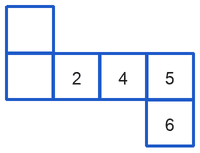
Dice are cubes with dot or dots on each face. Opposite faces of a die always have a total of seven on them.

Below are given two nets to make a die (cube), the numbers inserted in each square indicate the number of dots in it.
(i)
(ii)

Insert suitable numbers in each blank so that numbers in opposite faces of the die have a total of seven dots.
Solve with AIWritten solution
Solution:
Concept: On a cube net, two squares that share an edge are never opposite faces. In a straight row of squares, two squares with exactly one square between them are opposite. On a die, the numbers on opposite faces add up to 7, so each blank gets 7 minus the number opposite it.
Step 1 — Find the opposite faces in net (i).
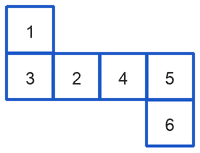
Net (i) has a row of four squares: blank, 2, 4, 5. In a row of four, the 1st and 3rd squares are opposite, and so are the 2nd and 4th. So the blank square in the row is opposite 4, and 2 is opposite 5. The square on top (above the blank) and the square 6 (below 5) become the top and the bottom, so they are opposite each other.
Step 2 — Fill in net (i).
Each blank gets 7 minus the number on its opposite face.
As a check, for the pair already filled.
Step 3 — Find the opposite faces in net (ii).
Net (ii) is a staircase. Folding it square by square shows three opposite pairs: 1 and the bottom-right square, 2 and the blank square to the left of 3, and 3 and the bottom-left square.
Step 4 — Fill in net (ii).
Again each blank gets 7 minus the number on its opposite face.

Watch out: Squares that touch along an edge are neighbours on the die, never opposite faces; fold the net in your mind before pairing two squares.
Therefore, in net (i) the blanks are 3 (in the row) and 1 (on top); in net (ii) they are 5 (left of 3), 4 (bottom left) and 6 (bottom right).
- 103 marks
Question 10
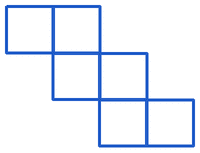
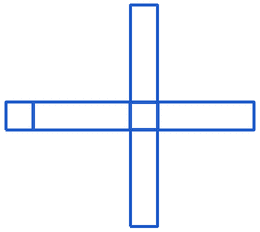
The following figures represent nets of some solids. Name the solids.
(i)
 Solve with AI
Written solution
Solution:
Concept: We name a solid from its faces: a cube has 6 equal squares; a cuboid has 6 rectangles in 3 equal opposite pairs; a prism has two equal end faces joined by rectangles; a pyramid has one base and triangular faces meeting at a point (the apex).
Step 1 — Look at the faces.
The net has six squares, all of the same size, arranged as a staircase of three steps, each step two squares wide.
Step 2 — Fold the net.
Folding along each step wraps two faces at a time round the solid. The six squares land on six different faces with no overlap.
Step 3 — Name the solid.
A solid with six equal square faces is a cube.
Therefore, the solid is a cube.
- 113 marks
Question 11
The following figures represent nets of some solids. Name the solids.
(ii)
 Solve with AI
Written solution
Solution:
Concept: We name a solid from its faces: a cube has 6 equal squares; a cuboid has 6 rectangles in 3 equal opposite pairs; a prism has two equal end faces joined by rectangles; a pyramid has one base and triangular faces meeting at a point (the apex).
Step 1 — Look at the faces.
The net has two small equal squares and four equal long rectangles. Four rectangles are joined round one square, and the second square is joined to the far end of one rectangle.
Step 2 — Fold the net.
The four rectangles fold up round the first square as the four side faces, and the second square closes the other end.
Step 3 — Name the solid.
Six rectangular faces with opposite faces equal make a cuboid; here its two ends are squares.
Watch out: A square is a special rectangle, so a solid with two square ends and four equal rectangles is still a cuboid, not a cube.
Therefore, the solid is a cuboid (with square ends).
- 123 marks
Question 12
Draw a map of your classroom using proper scale and symbols for different objects.
Solve with AIWritten solution
Solution:
Concept: A map is a drawing of a real place made smaller by a fixed scale, such as 1 cm = 1 m. Every length on the map is the real length divided by the same number, and simple symbols with a key show what each object is.
Step 1 — Measure the room.
We measure the length and breadth of the classroom and the positions of the door, windows, blackboard, teacher's table and desks. Suppose the room is 12 m long and 8 m wide.
Step 2 — Choose a scale.
A scale of 1 cm = 1 m lets the room fit on the page: every length in metres becomes the same number of centimetres. So the room is drawn as a rectangle 12 cm by 8 cm.
Step 3 — Mark the objects.
We draw each object at its scaled position, using a simple symbol for each kind of object (a small rectangle for a desk, a letter T for the teacher's table) and a key that explains the symbols.
Step 4 — Finish the map.
We write the scale and show the north direction with an arrow. A sample map is shown below.

Watch out: Use one scale for every length; changing the scale part-way makes the map wrong.
Therefore, this is only a sample map; each student draws the map of his or her own classroom with a scale, symbols and a key.
- 133 marks
Question 13
Draw a map of your school compound using proper scale and symbols for various features like playground, main building, garden, etc.
Solve with AIWritten solution
Solution:
Concept: A map is a drawing of a real place made smaller by a fixed scale, such as 1 cm = 1 m. Every length on the map is the real length divided by the same number, and simple symbols with a key show what each object is.
Step 1 — Measure the compound.
We find (or pace out) the length and breadth of the school compound and of each feature: the main building, playground, garden, canteen and gate.
Step 2 — Choose a scale.
The distances are much larger than in a classroom, so we need a smaller scale, for example 1 cm = 10 m. Each length in metres is divided by 10 to give centimetres on the map.
Step 3 — Draw the features.
We draw the boundary first, then each feature at its scaled size and position, with a label or a symbol and a key.
Step 4 — Finish the map.
We write the scale and show the north direction. A sample map is shown below.

Watch out: Check that every feature is drawn with the same scale and fits inside the boundary.
Therefore, this is only a sample; the map must be drawn for your own school compound, with a scale, symbols and the north direction.
- 143 marks
Question 14
In the map of India, the distance between two cities is 13·8 cm.
Taking scale : 1 cm = 12 km, find the actual distance between these two cities.
Solve with AIWritten solution
Solution:
Concept: On a map drawn to a scale of 1 cm = km, the actual distance is the map distance in centimetres multiplied by , and it is in kilometres.
Step 1 — Use the scale.
The scale says that 1 cm on the map stands for 12 km on the ground. So 13·8 cm stands for 13·8 times 12 km.
Step 2 — Write the unit.
The number above counts kilometres, because each centimetre on the map stands for 12 km.
Watch out: Multiply, do not divide: the real distance is far larger than the map distance.
Therefore, the actual distance between the two cities is 165·6 km.
- 151 mark
Question 15
For a 3D solid, if V = number of vertices, E = number of edges and F = number of faces, then :
Solve with AIAnswer
- Correct
(A) V + F – E = 2
(B) V + E = 2 + F
(C) V – E = 2 + F
(D) V + F = E – 2
Answer: (A) V + F – E = 2
Concept: For every polyhedron (a solid with flat faces, straight edges and sharp corners), Euler's formula links the number of faces , vertices and edges : .
Step 1 — Recall the formula.
Euler's formula for any polyhedron is .
Step 2 — Test it on a cube.
A cube has , and .
So the formula holds, and it matches option (A).
Why the other options are wrong:
- (B): for a cube is 20 while is only 8, so this is not true.
- (C): for a cube is −4 while is 8, so this is not true.
- (D): for a cube is 14 while is only 10, so this is not true.
Therefore, the formula is V + F − E = 2, option (A).
- 161 mark
Question 16
If a 3D solid figure has 12 edges and 6 faces, the number of vertices in it are:
Solve with AIAnswer
(A) 2
(B) 4
(C) 6
- Correct
(D) 8
Answer: (D) 8
Concept: For every polyhedron (a solid with flat faces, straight edges and sharp corners), Euler's formula links the number of faces , vertices and edges : .
Step 1 — Put the values in Euler's formula.
Here and , and is unknown.
Step 2 — Name the solid.
A solid with 6 faces, 8 vertices and 12 edges is a cuboid (or a cube).
Why the other options are wrong:
- (A) 2: with 2 vertices, , not 2.
- (B) 4: with 4 vertices, , not 2.
- (C) 6: with 6 vertices, , not 2.
Therefore, the solid has 8 vertices, option (D).
- 171 mark
Question 17
The given figure shows a net pattern of :
 Solve with AI
Answer
(A) cuboid
- Correct
(B) cube
(C) cone
(D) none of these
Answer: (B) cube
Concept: A net is a flat shape that can be folded up into a solid. A cube has 6 equal square faces, so a net of a cube is made of 6 equal squares joined edge to edge. It works only if, after folding, every face of the cube is covered exactly once: no two squares may land on the same face, and no face may be left open.
Step 1 — Count and compare the faces.
The net has six equal squares: a row of four, with one square above and one below the second square of the row.
Step 2 — Fold the net.
The row of four wraps round as the four side faces, and the other two squares close the top and the bottom. Six equal squares that close up make a cube.
Why the other options are wrong:
- (A) cuboid: a cuboid that is not a cube has rectangles that are not all equal, but this net has six equal squares.
- (C) cone: a net of a cone is a circle and a sector of a circle, with no squares at all.
- (D) none of these: the net does fold into a solid, the cube in option (B).
Therefore, it is the net of a cube, option (B).
- 181 mark
Question 18
The given figure shows a net pattern of :
 Solve with AI
Answer
(A) cube
(B) cone
(C) a triangular prism
- Correct
(D) triangular pyramid
Answer: (D) triangular pyramid
Concept: We name a solid from its faces: a cube has 6 equal squares; a cuboid has 6 rectangles in 3 equal opposite pairs; a prism has two equal end faces joined by rectangles; a pyramid has one base and triangular faces meeting at a point (the apex).
Step 1 — Count the faces.
The net is a strip of four equal triangles, and it has no squares, rectangles or circles.
Step 2 — Fold the net.
Folding the outer triangles up round the middle ones brings three triangles together over one triangle as the base. A solid with four triangular faces is a triangular pyramid (a tetrahedron).
Why the other options are wrong:
- (A) cube: a cube needs six squares, and this net has none.
- (B) cone: a cone needs a circle and a sector of a circle for its curved surface.
- (C) a triangular prism: a triangular prism needs two triangles and three rectangles, 5 faces in all, not four triangles.
Therefore, it is the net of a triangular pyramid, option (D).
- 191 mark
Question 19
The least number of unit cubes, that should be joined together to get a cuboid of dimensions 4 × 4 × 2, is :
Solve with AIAnswer
(A) 12
(B) 16
(C) 24
- Correct
(D) 32
Answer: (D) 32
Concept: A cuboid of whole-number dimensions can be built from unit cubes (cubes of edge 1). It takes of them: in each layer and layers.
Step 1 — Find the volume of the cuboid.
Each unit cube takes up 1 cubic unit, so the number of cubes equals the volume of the cuboid.
Step 2 — Count the cubes.
The cuboid is 2 layers high, and each layer is a square of 16 cubes. So 32 unit cubes are needed.
Watch out: Count every layer: one layer is only half of the cuboid.
Why the other options are wrong:
- (A) 12: 12 is the number of edges of a cuboid, not the number of cubes in it.
- (B) 16: 16 cubes () make only one layer, but the cuboid is 2 layers high.
- (C) 24: 24 cubes would make a cuboid, one row short in the breadth.
Therefore, 32 unit cubes are needed, option (D).
- 201 mark
Question 20
The given figure shows a/an :
 Solve with AI
Answer
(A) octahedron
- Correct
(B) hexagonal prism
(C) hexahedron
(D) none of these
Answer: (B) hexagonal prism
Concept: We name a solid from its faces: a cube has 6 equal squares; a cuboid has 6 rectangles in 3 equal opposite pairs; a prism has two equal end faces joined by rectangles; a pyramid has one base and triangular faces meeting at a point (the apex).
Step 1 — Look at the faces.
The top and the bottom of the solid are equal hexagons (six-sided figures), and the side faces are rectangles.
Step 2 — Name the solid.
A solid with two equal end faces joined by rectangles is a prism, named after its end face. So this is a hexagonal prism, with faces.
Why the other options are wrong:
- (A) octahedron: an octahedron (the regular solid of that name) has 8 equal triangular faces; this solid has hexagons and rectangles.
- (C) hexahedron: a hexahedron has 6 faces, but this solid has 8.
- (D) none of these: the solid is named in option (B).
Therefore, the figure shows a hexagonal prism, option (B).
- 211 mark
Question 21
A 3D figure, which has six faces, straight edges and a sharp edge, is called :
Solve with AIAnswer
(A) cube
- Correct
(B) hexahedron
(C) hexagonal prism
(D) octagonal pyramid
Answer: (B) hexahedron
Concept: Solids with flat faces are named by their number of faces: a solid with 4 faces is a tetrahedron, with 6 faces a hexahedron, with 8 faces an octahedron.
Step 1 — Use the meaning of the name.
The word part 'hexa' means six and 'hedron' means face. Any solid with six flat faces, straight edges and sharp corners is a hexahedron.
Step 2 — Compare with the options.
The description gives only the number of faces, six. It does not say the faces are squares, so the general name hexahedron fits it.
Note: A cube does have six faces, so it is one example of the solid described; the printed key names the general solid, the hexahedron.
Why the other options are wrong:
- (A) cube: a cube is one particular hexahedron, with six equal square faces. It also fits, but the description does not say the faces are squares, so the general name in (B) is the better answer.
- (C) hexagonal prism: a hexagonal prism has 2 hexagons and 6 rectangles: 8 faces in all, not six.
- (D) octagonal pyramid: an octagonal pyramid has an octagonal base and 8 triangles: 9 faces in all, not six.
Therefore, the solid is called a hexahedron, option (B).
- 221 mark
Question 22
An isometric sheet is made up of dots forming :
Solve with AIAnswer
(A) squares
(B) right angled triangles
- Correct
(C) equilateral triangles
(D) rectangles
Answer: (C) equilateral triangles
Concept: Isometric dot paper is used to draw 3D shapes. Its dots are arranged so that every dot is equally far from its six nearest neighbours.
Step 1 — Look at how the dots are placed.
On an isometric sheet each dot is at the same distance from its six nearest dots, and the lines through the dots meet at 60°.
Step 2 — Join neighbouring dots.
Three neighbouring dots form a triangle with three equal sides and three angles of 60°, which is an equilateral triangle.
Why the other options are wrong:
- (A) squares: squares come from square dot paper, where the lines through the dots meet at 90°.
- (B) right angled triangles: the lines on an isometric sheet meet at 60° and 120°, so they never form right angles.
- (D) rectangles: rectangles also need right angles, which isometric dot paper does not give.
Therefore, the dots form equilateral triangles, option (C).
- 231 mark
Question 23
A square pyramid has :
Solve with AIAnswer
(A) 4 vertices and 4 faces
(B) 4 vertices and 5 faces
(C) 5 vertices and 4 faces
- Correct
(D) 5 vertices and 5 faces
Answer: (D) 5 vertices and 5 faces
Concept: A pyramid has one base and triangular faces that meet at a single point, the apex. For every polyhedron (a solid with flat faces, straight edges and sharp corners), Euler's formula links the number of faces , vertices and edges : .
Step 1 — Count the vertices.
A square pyramid has a square base with 4 corners, and one more corner at the apex. So it has vertices.
Step 2 — Count the faces.
It has the square base and 4 triangular faces, one on each side of the base. So it has faces.
Step 3 — Check with Euler's formula.
It has 8 edges (4 round the base and 4 up to the apex).
Watch out: Forget neither the apex (a vertex) nor the base (a face).
Why the other options are wrong:
- (A) 4 vertices and 4 faces: 4 vertices and 4 faces leave out both the apex and the base.
- (B) 4 vertices and 5 faces: 4 vertices leaves out the apex, the fifth corner.
- (C) 5 vertices and 4 faces: 4 faces leaves out the square base.
Therefore, a square pyramid has 5 vertices and 5 faces, option (D).
- 241 mark
Question 24
A cuboid has:
Solve with AIAnswer
- Correct
(A) 8 vertices, 12 edges and 6 faces
(B) 6 vertices, 12 edges and 8 faces
(C) 8 vertices, 6 edges and 12 faces
(D) 12 vertices, 8 edges and 6 faces
Answer: (A) 8 vertices, 12 edges and 6 faces
Concept: For every polyhedron (a solid with flat faces, straight edges and sharp corners), Euler's formula links the number of faces , vertices and edges : .
Step 1 — Count the vertices.
A cuboid has 4 corners on the top face and 4 on the bottom face: 8 vertices.
Step 2 — Count the edges and faces.
It has 4 edges round the top, 4 round the bottom and 4 upright edges: 12 edges. It has 6 faces: top, bottom, front, back, left and right.
Step 3 — Check with Euler's formula.
The three counts must satisfy Euler's formula.
Why the other options are wrong:
- (B): this swaps the numbers of vertices and faces: a cuboid has 8 vertices and 6 faces.
- (C): a cuboid has 12 edges and 6 faces, not 6 edges and 12 faces.
- (D): a cuboid has 8 vertices and 12 edges, not 12 vertices and 8 edges.
Therefore, a cuboid has 8 vertices, 12 edges and 6 faces, option (A).
- 251 mark
Question 25
Statement 1 : The following diagram is net of a cuboid of dimensions 3 cm × 2 cm× 6 cm.
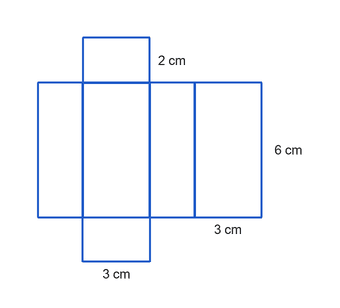
Statement 2 : The cuboid has six rectangular faces. The opposite rectangular plane surfaces are identical.
Which of the following options is correct?
Solve with AIAnswer
- Correct
(A) Both the statements are true.
(B) Both the statements are false.
(C) Statement 1 is true, and statement 2 is false.
(D) Statement 1 is false, and statement 2 is true.
Answer: (A) Both the statements are true.
Concept: We judge each statement separately, true or false, and then choose the option that matches both verdicts. A net of a cuboid has 6 rectangles in 3 equal pairs: two , two and two . A row of four side faces of the same height wraps round the solid, and two flaps close the top and the bottom.
Step 1 — Read the net.
The row has four faces, each 6 cm tall, with widths 2 cm, 3 cm, 2 cm and 3 cm. The two flaps above and below the second face are 3 cm wide and 2 cm tall.
Step 2 — Pair up the faces.
So the net has two faces , two faces and two faces (all in cm). These are exactly the three pairs of faces of a cuboid 3 cm × 2 cm × 6 cm, and the row wraps round with the flaps closing the top and the bottom. So Statement 1 is true.
Step 3 — Judge Statement 2.
A cuboid has six rectangular faces, and opposite faces are identical. So Statement 2 is true.
Why the other options are wrong:
- (B): both statements are true, not false.
- (C): Statement 2 is a correct description of a cuboid, so it is not false.
- (D): Statement 1 is true: the net folds into a 3 cm × 2 cm × 6 cm cuboid.
Therefore, both statements are true, option (A).
- 261 mark
Question 26
Statement 1 : If three cubes of dimensions 2 cm by 2cm by 2 cm are placed side by side then resulting solid willbecome a cube of side 6 cm.
Statement 2 : A cuboid having square base has length and breadth are equal and height may be different.
Which of the following options is correct?
Solve with AIAnswer
(A) Both the statements are true.
(B) Both the statements are false.
(C) Statement 1 is true, and statement 2 is false.
- Correct
(D) Statement 1 is false, and statement 2 is true.
Answer: (D) Statement 1 is false, and statement 2 is true.
Concept: We judge each statement separately, true or false, and then choose the option that matches both verdicts. A cube has all three dimensions equal; a cuboid may have three different dimensions.
Step 1 — Judge Statement 1.
Placing three 2 cm cubes side by side makes the length 6 cm, but the breadth and the height stay 2 cm. The result is a cuboid 6 cm × 2 cm × 2 cm, not a cube. A cube of side 6 cm would need such cubes. So Statement 1 is false.
Step 2 — Judge Statement 2.
A square base means the length and the breadth are equal; the height can be different. So Statement 2 is true.
Why the other options are wrong:
- (A): Statement 1 is false, so 'both true' is wrong.
- (B): Statement 2 is true, so 'both false' is wrong.
- (C): this reverses the verdicts: Statement 1 is false and Statement 2 is true.
Therefore, Statement 1 is false and Statement 2 is true, option (D).
- 271 mark
Question 27
The following questions are Assertion-Reason based questions. Choose your answer based on the codes given below :
(1) A is true, R is false.
(2) A is false, R is true.
(3) Both A and R are true.
(4) Both A and R are false.
Assertion (A) : Dimensions of a carton is 100 cm × 50 cm × 55 cm. Number of cubes of dimension 10 cm × 10 cm × 10 cm can be fitted in the carton is 275.
Reason (R) : Number of cubes
Solve with AIAnswer
(A) (1)
(B) (2)
- Correct
(C) (3)
(D) (4)
Answer: (C) (3)
Concept: In an Assertion–Reason item we judge the Assertion (A) and the Reason (R) separately, true or false, and then choose the code that matches both verdicts.
Step 1 — Use the formula in the Reason.
The Reason divides the volume of the carton by the volume of one cube.
Step 2 — Judge A and R.
By this volume method of the chapter the answer is 275, so A is true, and R is the rule used, so R is true. Code (3).
Watch out: The volume method counts whole cubes only when each edge of the carton is a whole number of cube edges.
Note: Packed in real life, the 55 cm edge holds only 5 whole cubes of 10 cm, so only whole cubes fit, with a 5 cm gap left. On that strict reading A would be false; the question intends the volume method, so code (3) is kept.
Why the other options are wrong:
- (A): code (1) calls R false, but R is the volume rule the question uses.
- (B): code (2) calls A false, but the volume method gives 275.
- (D): code (4) calls both false, but by the volume method both are true.
Therefore, both A and R are true by the volume method, code (3), option (C).
- 281 mark
Question 28
The following questions are Assertion-Reason based questions. Choose your answer based on the codes given below :
(1) A is true, R is false.
(2) A is false, R is true.
(3) Both A and R are true.
(4) Both A and R are false.
Assertion (A) : Two dice are placed side by side as shown in the given figure.

Dots on two faces as shown is the number on the face. The sum of the two numbers on the faces opposite to them is 3.
Reason (R) : In an ordinary die, sum of numbers on the opposite faces is 7.
Solve with AIAnswer
(A) (1)
(B) (2)
- Correct
(C) (3)
(D) (4)
Answer: (C) (3)
Concept: In an Assertion–Reason item we judge the Assertion (A) and the Reason (R) separately, true or false, and then choose the code that matches both verdicts. On an ordinary die the numbers on opposite faces add up to 7.
Step 1 — Find the hidden faces.
On the first die the front face shows 5 dots, so the face opposite it shows . On the second die the front face shows 6 dots, so the face opposite it shows .
Step 2 — Judge A and R.
The sum of the two hidden numbers is , so A is true. R is the rule for an ordinary die, so R is true. Code (3).
Why the other options are wrong:
- (A): code (1) calls R false, but opposite faces of a die do add up to 7.
- (B): code (2) calls A false, but the hidden faces show 2 and 1, which add up to 3.
- (D): code (4) calls both false, but both are true.
Therefore, both A and R are true, code (3), option (C).
- 291 mark
Question 29
The following questions are Assertion-Reason based questions. Choose your answer based on the codes given below :
(1) A is true, R is false.
(2) A is false, R is true.
(3) Both A and R are true.
(4) Both A and R are false.
Assertion (A) : Net of a solid is shown in the diagram.
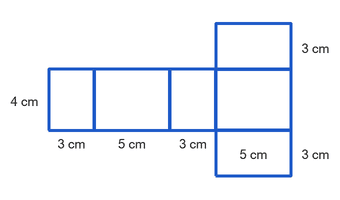
Reason (R) : Space diagonal of a rectangular solid is the line segment that joins the opposite vertices passing through its interior.
Solve with AIAnswer
(A) (1)
(B) (2)
- Correct
(C) (3)
(D) (4)
Answer: (C) (3)
Concept: In an Assertion–Reason item we judge the Assertion (A) and the Reason (R) separately, true or false, and then choose the code that matches both verdicts. A net of a cuboid has 6 rectangles in 3 equal pairs: two , two and two . A row of four side faces of the same height wraps round the solid, and two flaps close the top and the bottom.
Step 1 — Judge the Assertion.
The row has four faces, each 4 cm tall, with widths 3 cm, 5 cm, 3 cm and 5 cm. They wrap round as the four side faces, and the two 5 cm × 3 cm flaps on the fourth face close the top and the bottom. So the diagram is the net of a cuboid 5 cm × 3 cm × 4 cm, and A is true.
Step 2 — Judge the Reason.
A space diagonal of a cuboid joins two opposite corners and runs through the inside of the solid. R says exactly this, so R is true. Code (3).
Why the other options are wrong:
- (A): code (1) calls R false, but R is the correct meaning of a space diagonal.
- (B): code (2) calls A false, but the diagram does fold into a closed cuboid.
- (D): code (4) calls both false, but both are true.
Therefore, both A and R are true, code (3), option (C).
What Class 7 Maths Ch 20 covers
The sections of the chapter, in the order the book takes them. Every question above comes from one of these.
- 01Identification of 3D Shapes
- 02Faces, Edges and Vertices of a Polyhedron
- 03Faces, Edges and Vertices of a Non-Polyhedron
- 04Euler's Formula
- 05Nets of 3D Figures
- 06Mapping Space Around Us
More ways to study this chapter
The same chapter asked three other ways. Practise it, revise it, and see what the board has set on Ch 20 before.
Class 7 Maths Ch 20 questions students ask
How many questions are there in Class 7 Maths Ch 20?
29 questions. Every one is solved step by step on this page.
Are these Class 7 Maths solutions free?
Yes. Every question and its full working is free to read, with no account needed.
Can I download the Class 7 Maths Ch 20 solutions as a PDF?
There is no PDF to download. Every solution is on this page instead, which means it is searchable, always the current syllabus, and readable on a phone. Use your browser's print option if you want it on paper.