Solution:
Concept: On a cube net, two squares that share an edge are never opposite faces. In a straight row of squares, two squares with exactly one square between them are opposite. On a die, the numbers on opposite faces add up to 7, so each blank gets 7 minus the number opposite it.
Step 1 — Find the opposite faces in net (i).
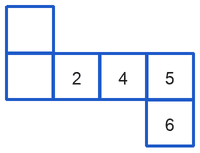
Net (i) has a row of four squares: blank, 2, 4, 5. In a row of four, the 1st and 3rd squares are opposite, and so are the 2nd and 4th. So the blank square in the row is opposite 4, and 2 is opposite 5. The square on top (above the blank) and the square 6 (below 5) become the top and the bottom, so they are opposite each other.
Step 2 — Fill in net (i).
Each blank gets 7 minus the number on its opposite face.
Blank in the row=7−4=3
Square on top=7−6=1
As a check, 2+5=7 for the pair already filled.
Step 3 — Find the opposite faces in net (ii).
Net (ii) is a staircase. Folding it square by square shows three opposite pairs: 1 and the bottom-right square, 2 and the blank square to the left of 3, and 3 and the bottom-left square.
Step 4 — Fill in net (ii).
Again each blank gets 7 minus the number on its opposite face.
Square left of 3=7−2=5
Bottom-left square=7−3=4
Bottom-right square=7−1=6

Watch out: Squares that touch along an edge are neighbours on the die, never opposite faces; fold the net in your mind before pairing two squares.
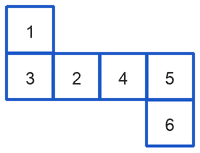
Therefore, in net (i) the blanks are 3 (in the row) and 1 (on top); in net (ii) they are 5 (left of 3), 4 (bottom left) and 6 (bottom right).