Answer: (C) (3)
Concept: In an Assertion–Reason item we judge the Assertion (A) and the Reason (R) separately, true or false, and then choose the code that matches both verdicts. A net of a cuboid l×b×h has 6 rectangles in 3 equal pairs: two l×b, two b×h and two l×h. A row of four side faces of the same height wraps round the solid, and two flaps close the top and the bottom.
Step 1 — Judge the Assertion.
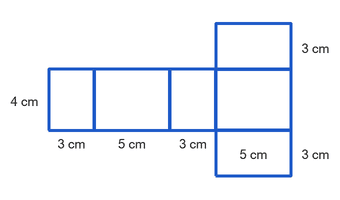
The row has four faces, each 4 cm tall, with widths 3 cm, 5 cm, 3 cm and 5 cm. They wrap round as the four side faces, and the two 5 cm × 3 cm flaps on the fourth face close the top and the bottom. So the diagram is the net of a cuboid 5 cm × 3 cm × 4 cm, and A is true.
Step 2 — Judge the Reason.
A space diagonal of a cuboid joins two opposite corners and runs through the inside of the solid. R says exactly this, so R is true. Code (3).
Why the other options are wrong:
- (A): code (1) calls R false, but R is the correct meaning of a space diagonal.
- (B): code (2) calls A false, but the diagram does fold into a closed cuboid.
- (D): code (4) calls both false, but both are true.
Therefore, both A and R are true, code (3), option (C).