
Opening your dashboard
Class 7 Maths Chapter 20 Recognition of Solids: Competency-Based Questions (CBQ)
40 questions on Chapter 20, each worked through on its own page with the AI tutor. Class 7 Maths, ICSE 2026-27.
40 questions
1–5 marks · Mixed difficulty
- 11 mark
Question 1
Competency: Understanding
A shopkeeper wants oil tins that can be stacked one upon another on a shelf. He also wants to roll a tin along the floor when he has to move it.
Which shape of tin should he choose?
- 21 mark
Question 2
Competency: Analysis
Two identical wooden cubes are glued together, face to face, to make one solid block.
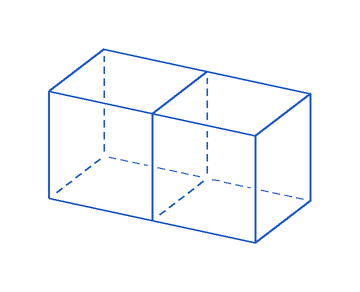
How many faces does the new block have?
- 31 mark
Question 3
Competency: Application
A paper birthday cap has the shape of a cone that is open at the bottom. Neha cuts the cap along a straight line from its rim to its tip and presses it flat on the table.
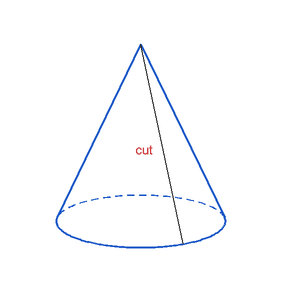
The flat piece of paper she gets is
- 41 mark
Question 4
Competency: Understanding
Mona compares a closed cylindrical tin with a solid cone-shaped candle. She counts faces (flat or curved surfaces), edges and vertices as in her textbook.
Which statement is correct?
- 51 mark
Question 5
Competency: Analysis
On a die, the numbers of dots on opposite faces always add up to 7. Ria looks at a die from one corner and can see three faces at the same time.
Which pair of numbers can she never see together?
- 61 mark
Question 6
Competency: Understanding
Assertion (A): On a map drawn to the scale 1 cm = 20 km, two towns that are 3.5 cm apart are actually 70 km apart.
Reason (R): On a map drawn to scale, the distances shown are proportional to the actual distances on the ground.
- 72 marks
Question 7
Competency: Analysis
A cook slices off one corner of a cube of paneer with a single flat cut. The cut passes through the three edges that meet at that corner, as shown. The new flat face is shaded.
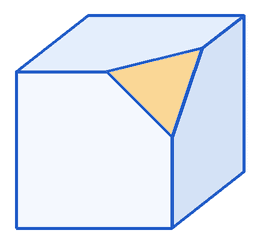
Count the faces, vertices and edges of the piece that is left. Check your counts with Euler's formula.
- 82 marks
Question 8
Competency: Evaluation
Jay says, "A cube has six square faces. So any six equal squares joined edge to edge make a net of a cube. I will use six squares in one straight row."
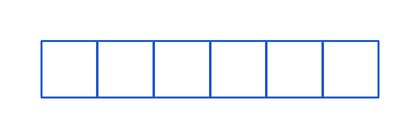
Is Jay right? Explain what happens when his strip of six squares is folded.
- 92 marks
Question 9
Competency: Analysis
A die is resting on a table. The numbers of dots on its opposite faces add up to 7. From where Tanvi sits, she can see three faces of the die, as shown.

How many dots are on each of the three faces she cannot see (bottom, back and left)? Find the total number of dots on these three hidden faces.
- 102 marks
Question 10
Competency: Application
A brick is a cuboid 20 cm long, 10 cm broad and 5 cm thick. A mason can rest it on the ground on any one of its faces.
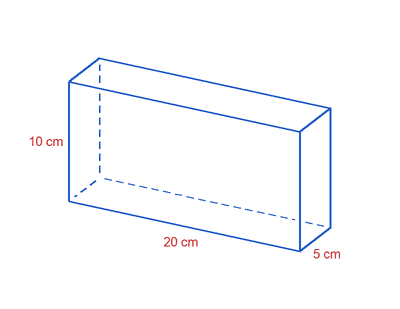
On which face should the brick rest so that it stands tallest? How tall is it then, and how many of its edges are vertical? What is its height when it rests on its largest face?
- 113 marks
Question 11
Competency: Analysis
A craft teacher gives three sets of paper cut-outs. Each set is to be folded or rolled, without cutting, to make a closed solid.
Set Cut-outs P one rectangle 88 cm by 15 cm and two circles of radius 14 cm Q one sector of a circle and one circle R six equal squares joined in the shape of a cross 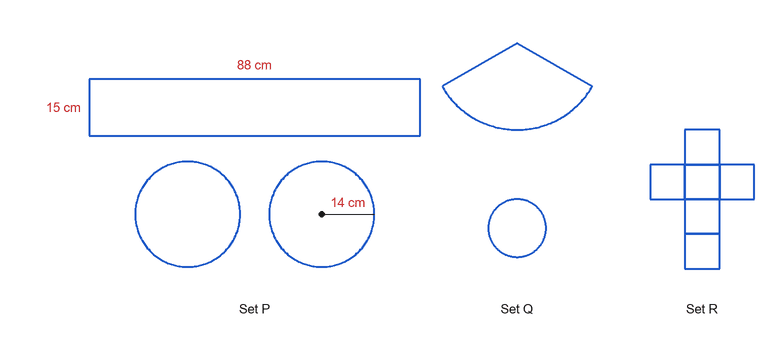
(a) Name the solid that each set is meant to make.
(b) For set P, show by calculation that the circles fit the rectangle exactly. What is the height of the solid?
(c) By mistake, a student gets two circles of radius 21 cm with the same rectangle. Can he make a closed solid of the same kind? Give a reason.
- 123 marks
Question 12
Competency: Creativity & Application
Your school playground is a rectangle 80 m long and 50 m wide. You have to draw a map of it on a page that is 20 cm long and 15 cm wide. A flag pole stands on one long side of the playground, 30 m from a corner.
(a) Choose a suitable scale of your own (1 cm = a whole number of metres). Find the length and the width of the playground on your map and show that the map fits on the page.
(b) How far from the corner should the flag pole be marked on your map?
(c) Which scale of this kind gives the largest map that still fits on the page? Give the size of that map.
- 133 marks
Question 13
Competency: Analysis & Evaluation
A new, unsharpened pencil has the shape of a prism. Its two ends are equal six-sided figures (hexagons), and its sides are flat rectangles.
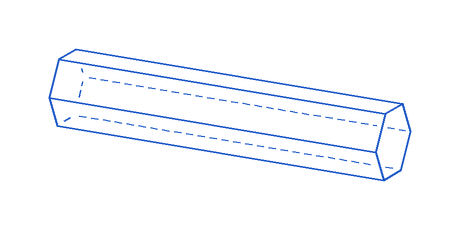
(a) Count the faces, vertices and edges of the pencil. Show how you counted.
(b) Verify Euler's formula for the pencil.
(c) Another prism has 10 faces and 16 vertices. Dev says, "It must have 26 edges, because ." Is Dev right? Correct him if he is wrong. How many sides does each end of this prism have?
- 144 marks
Question 14
Competency: Application & Analysis
Case study — The painted cube
A large wooden cube is painted red on all its six faces. After the paint dries, it is cut into 27 equal small cubes, 3 along each edge, as shown.

(a) Some small cubes have three red faces. Where in the large cube do they come from? How many are there?
(b) How many small cubes have exactly two red faces? How many have exactly one red face? Say where each kind comes from.
(c) How many small cubes have no red face at all? Check that your four answers account for all 27 small cubes. What do you notice about your answers to (a) and (b) and the numbers of vertices, edges and faces of a cube?
- 155 marks
Question 15
Competency: Application & Evaluation
Case study — Planning a school trip
A school bus will go from Amba to Bela, then from Bela to Chandi, and then back from Chandi to Amba. The teacher measures the three roads on a map drawn to the scale 1 cm = 40 km. Take each road to be straight.
Road Length on the map Amba to Bela 5 cm Bela to Chandi 6 cm Chandi to Amba 7 cm (a) Find the actual length of each road.
(b) Find the total distance of the round trip. If the bus travels at an average speed of 60 km/h, how many hours will it be on the road?
(c) Kabir has another map of the same region, drawn to the scale 1 cm = 80 km. He says, "The scale number is double, so every road will be twice as long on my map." Is Kabir right? Find the length of the road from Amba to Bela on his map.
- 161 mark
Question 16
Competency: Understanding
A toy rocket is made by gluing a solid cone on top of a solid cylinder. The flat circular base of the cone has the same radius as the top of the cylinder, and it fits exactly on it.
How many flat faces and how many curved surfaces does the toy rocket have?
- 171 mark
Question 17
Competency: Analysis
A baker has a cuboid-shaped cake. He makes one straight cut, parallel to the top face, and the cake falls into two pieces. Each piece is also a cuboid.
How many faces do the two pieces have in all?
- 181 mark
Question 18
Competency: Analysis
A board game uses an 8-sided die. All 8 faces are triangles. Every edge of the die is shared by exactly two faces.
How many vertices does the die have?
- 191 mark
Question 19
Competency: Understanding
A craft sheet gives the pieces for a solid: one pentagon and five triangles. The pentagon is surrounded by the triangles, each joined to one side of the pentagon.
Which solid is made when the pieces are folded up?
- 201 mark
Question 20
Competency: Analysis
A map has no scale printed on it. Meena knows that the towns P and Q are 60 km apart, and she measures 2.5 cm between them on the map. She now measures 7.5 cm between the towns R and S on the same map.
What is the actual distance between R and S?
- 211 mark
Question 21
Competency: Analysis
Assertion (A): A cube and a cuboid each have 6 faces, 12 edges and 8 vertices.
Reason (R): Every cuboid is a cube.
- 221 mark
Question 22
Competency: Analysis
A solid cone is held in front of a lamp of an overhead projector. The cone is turned into different positions, and the shadow on the screen is observed each time.
Which of the following shadows can the cone never make?
- 231 mark
Question 23
Competency: Understanding
A paper label is wrapped once round a closed cylindrical tin of juice. It covers the curved side exactly, with no gap and no overlap.
Which parts of the tin are not covered by the label?
- 241 mark
Question 24
Competency: Application
A bus leaves a town A at 6 a.m. and goes straight to a town B, reaching it at 8 a.m. It travels at a steady speed of 50 km/h. The towns are shown on a map drawn to the scale 1 cm = 25 km.
How far apart are A and B on the map?
- 251 mark
Question 25
Competency: Evaluation
Assertion (A): A solid with 5 faces, 6 vertices and 10 edges cannot be a polyhedron.
Reason (R): For every polyhedron, the number of vertices plus the number of faces, minus the number of edges, is 2.
- 262 marks
Question 26
Competency: Evaluation
Neha wants to make a closed cylinder from card. She cuts one rectangle 44 cm by 14 cm and two circles of radius 7 cm. She sticks both circles on the top long edge of the rectangle, as shown. She says, "The pieces are the right size, so this net will fold into a closed cylinder."
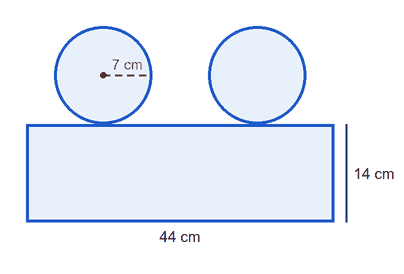
Is Neha right? Give a reason, and say how she should change the net.
- 272 marks
Question 27
Competency: Evaluation & Application
Two maps of the same region are drawn on the same size of paper. Map P has the scale 1 cm = 20 m and map Q has the scale 1 cm = 5 km.
(a) Zoya wants to find the lane from her house to a friend's house, 400 m away. Which map should she use? How long is the lane on that map?
(b) Zoya's uncle plans a drive between two cities 60 km apart. Which map should he use? How long is the drive on that map? Why is the other map not suitable?
- 282 marks
Question 28
Competency: Creativity
Your class plays a riddle game. Each riddle gives clues using the numbers of faces, edges and vertices of a hidden solid, and the other players have to guess the solid.
Write your own riddle with three clues (one about faces, one about edges and one about vertices) whose answer is a cone. Then show that the same three clues do not fit a cylinder.
- 292 marks
Question 29
Competency: Evaluation
On a map drawn to the scale 1 cm = 15 km, the towns A and B are 4 cm apart and the towns B and C are 6 cm apart. Asha says, "So A and C must be 10 cm apart on the map, which is 150 km."
Is Asha always right? Suppose the three towns lie on one straight road. Find all the possible actual distances between A and C.
- 302 marks
Question 30
Competency: Analysis
A model of a polyhedron has 12 faces. At every vertex exactly 3 edges meet.
Find the number of vertices and the number of edges of the model.
- 312 marks
Question 31
Competency: Evaluation
Rohit checks Euler's formula for a cone. Using the counts in his book (1 vertex, 2 faces and 1 edge) he finds . He says, "The cone satisfies Euler's formula, so a cone is a polyhedron."
Is his conclusion correct? Check what happens for a cylinder, and give the reason.
- 323 marks
Question 32
Competency: Evaluation
A toy house is made by gluing a triangular prism (the roof) on top of a cuboid (the walls). The picture shows the house. Hidden edges are dashed. Its front and back are equal pentagons.
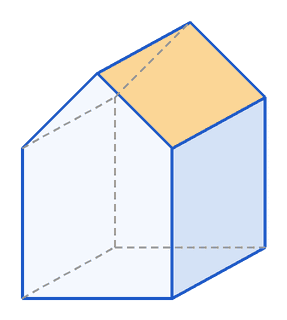
Mira says, "A cuboid has 6 faces and a triangular prism has 5 faces, so the house has faces."
(a) Explain why Mira's count is wrong. (b) Find the true number of faces of the house. (c) Count the vertices and edges from the picture, and check your answer with Euler's formula.
- 333 marks
Question 33
Competency: Analysis & Application
The pattern on a football can be modelled by a polyhedron made of 12 pentagons and 20 hexagons, all flat. Each edge is shared by exactly two of these faces.
(a) Find the number of edges. (b) Use Euler's formula to find the number of vertices. (c) Show that exactly 3 edges meet at each vertex.
- 343 marks
Question 34
Competency: Analysis & Evaluation
A rectangular field is 40 m long and 30 m wide. It is drawn on a map to the scale 1 cm = 10 m.
(a) Find the length and the width of the field on the map. (b) Find the area of the field, and its area on the map. (c) Ritu says, "The scale is 1 cm = 10 m, so the area on the map is also 10 times smaller." Is she right? How many square metres does 1 cm² of the map stand for?
- 353 marks
Question 35
Competency: Application & Evaluation
Dev wants to wrap a cube-shaped gift box of edge 12 cm. He will cut a cross-shaped net of the cube from one sheet of card. In the cross-shaped net, 4 squares are in one straight row, and one more square is joined above and one below the row.
He has three sheets: 50 cm by 40 cm, 60 cm by 30 cm and 45 cm by 36 cm.
(a) Find the length and the width of the smallest rectangle that holds the net. (b) Which sheet can he use? Give a reason for each sheet. (c) How much card is left over from the sheet he uses?
- 363 marks
Question 36
Competency: Analysis
A wooden cube is cut by a straight saw cut that passes through two vertical edges that are diagonally opposite each other, as shown by the red dashed lines. The cube splits into two equal solids.
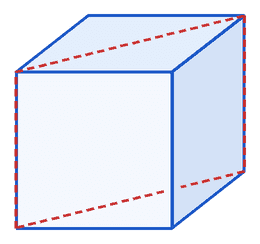
(a) Name the solids made. (b) Find the total number of faces, vertices and edges of the two pieces together. (c) Compare these totals with the cube, and find the total of for the two pieces.
- 374 marks
Question 37
Competency: Analysis & Evaluation
Case study — The solids quiz
Mr Rao's club has four quiz cards. Each card shows the number of faces and edges of a solid model. The solids are a cube, a triangular prism, a square pyramid and a triangular pyramid, in some order. The club members must find the number of vertices from Euler's formula and then name the solid. A member scores a point for each card only if the explanation is also correct, so a lucky guess is not enough.
Card Faces Edges P 4 6 Q 5 8 R 5 9 S 6 12 (a) Find the number of vertices on each card.
(b) Name the solid on each card. Cards Q and R have the same number of faces: how do you tell them apart?
(c) Sia says, "Every solid with 6 faces has 12 edges." Test her claim with the pentagonal pyramid, which has 6 faces and 6 vertices.
- 385 marks
Question 38
Competency: Application & Analysis
Case study — Reaching the library
The map shows the roads of a small town. The scale is 1 cm = 250 m, and each grid square is 1 cm by 1 cm on the map. Zoya lives at Home and wants to go to the Library. She can go through the School, along the roads Home–School, School–J and J–Library, where J is a junction on the School–Library road. Or she can go through the Park, along Home–Park (which bends once), Park–J and J–Library.
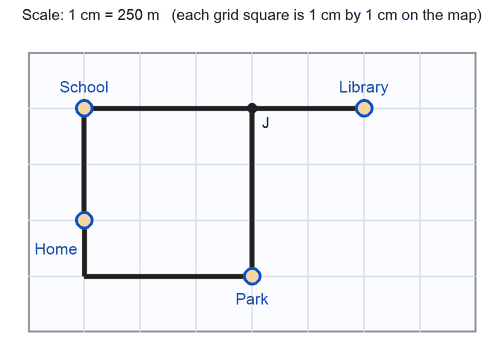
(a) Read the length of each of the five roads from the grid (count both parts of the bent road), and find its actual length in metres.
(b) Find the actual length of each route from Home to the Library.
(c) Zoya walks at a steady speed of 3 km/h. She leaves home at 7:30 a.m., and her reading class at the Library starts at 8:10 a.m. Which route gets her there in time? Find her arrival time on each route.
- 394 marks
Question 39
Competency: Application & Evaluation
Case study — Pen holders for the school fair
Meera is making pen holders for the school fair. She has rectangular sheets of coloured card, each 44 cm long and 22 cm wide. She rolls a sheet into a cylinder without any overlap and glues the edges together. She can do it in two ways. In way 1 she brings the two 22 cm edges together. In way 2 she brings the two 44 cm edges together.
(a) For each way, write the length of the circle round the cylinder and the height of the pen holder.
(b) Find the radius of the circular card needed for the base of each holder.
(c) A 30 cm ruler must stand upright in the pen holder with no part sticking out. Which way should Meera roll the card? Give two reasons.
- 405 marks
Question 40
Competency: Analysis & Application
Case study — Straw and clay models
A school club makes models of solids from drinking straws and balls of clay. Each straw is one edge and each ball is one vertex. The table shows the number of straws and balls for five models. The club has to plan its stock carefully, because straws and clay are shared by many groups, and a model can be built only when both enough straws and enough balls are available.
Solid Straws Balls Faces Cube 12 8 Square pyramid 8 5 Triangular prism 9 6 Pentagonal pyramid 10 6 Hexagonal prism 18 12 Rita has 20 straws and 12 balls of clay.
(a) Use Euler's formula to find the number of faces of each solid.
(b) Rita wants to build two different models at the same time from her 20 straws and 12 balls. List every pair of solids from the table that she can build together.
(c) She wants a prism with 7 faces and 15 straws. How many balls does it need? Has Rita enough? How many sides has its base?