
Opening your dashboard
Class 7 Maths Chapter 20 Recognition of Solids: Practice Questions
40 questions on Chapter 20, each worked through on its own page with the AI tutor. Class 7 Maths, ICSE 2026-27.
40 questions
1–5 marks · Mixed difficulty
- 11 mark
Question 1
Bloom's level: Remember
Every solid has :
- 21 mark
Question 2
Bloom's level: Remember
According to the chapter, the number of vertices of a cylinder is :
- 31 mark
Question 3
Bloom's level: Remember
A polyhedron is a solid which has :
- 41 mark
Question 4
Bloom's level: Understand
Which of the following is a two-dimensional figure?
- 51 mark
Question 5
Bloom's level: Understand
Which of the following solids is a non-polyhedron?
- 61 mark
Question 6
Bloom's level: Understand
A net of a cylinder is made up of :
- 71 mark
Question 7
Bloom's level: Apply
A polyhedron has 8 faces and 12 vertices. Using Euler's formula, the number of its edges is :
- 81 mark
Question 8
Bloom's level: Apply
On a map, the scale is cm km. Two towns are cm apart on the map. The actual distance between them is :
- 91 mark
Question 9
Bloom's level: Analyse
A cuboid measures 6 cm by 4 cm by 3 cm.
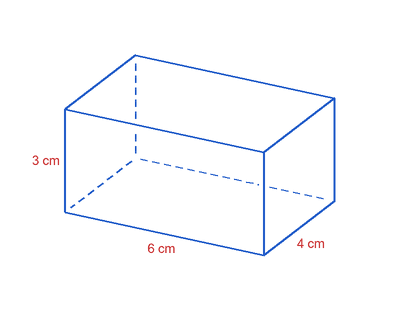
How many of its faces are rectangles measuring 6 cm by 4 cm?
- 101 mark
Question 10
Bloom's level: Understand
Assertion (A) : Euler's formula cannot be used for a cylinder.
Reason (R) : Euler's formula holds only for polyhedra, which have flat faces, straight edges and vertices.
- 111 mark
Question 11
Bloom's level: Analyse
Assertion (A) : A cube is a special cuboid.
Reason (R) : A cube has 8 vertices and 12 edges.
- 121 mark
Question 12
Bloom's level: Evaluate
Assertion (A) : A cone has one vertex, one edge and two faces (surfaces).
Reason (R) : Every solid that has a vertex is a polyhedron.
- 131 mark
Question 13
Bloom's level: Remember
What is a net of a solid?
- 141 mark
Question 14
Bloom's level: Understand
Name the shape (cube, cuboid, cylinder or cone) of each object : a die, a brick, a gas cylinder, a birthday cap.
- 152 marks
Question 15
Bloom's level: Understand
Explain why you cannot find the actual distance between two places just by looking at a photograph of the area. What must a map show so that actual distances can be found from it?
- 162 marks
Question 16
Bloom's level: Apply
A square pyramid has 5 faces, 5 vertices and 8 edges. Verify Euler's formula for it.
- 172 marks
Question 17
Bloom's level: Apply
The distance between a school and a railway station is km. On a map drawn to the scale cm m, how far apart should they be shown?
- 182 marks
Question 18
Bloom's level: Apply
A box in the shape of a cuboid is 10 cm long, 6 cm broad and 4 cm high.
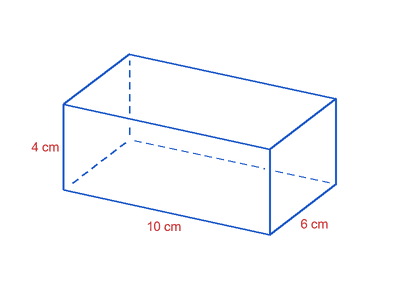
A wire frame is made along all its edges. Find the total length of wire needed.
- 192 marks
Question 19
Bloom's level: Analyse
Solid X looks like a circle when seen from directly above and like a rectangle when seen from the front. Solid Y looks like a circle from above and like a triangle from the front. Identify X and Y, giving a reason for each.
- 202 marks
Question 20
Bloom's level: Apply
A closed cylinder has radius 7 cm and height 10 cm.
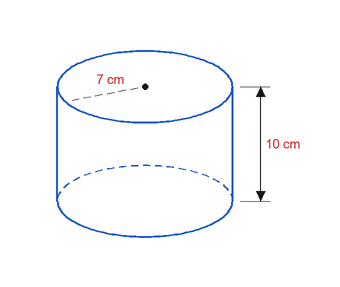
Its net has two circles and one rectangle. Find the length and breadth of the rectangle.
- 212 marks
Question 21
Bloom's level: Evaluate
Riya counts the faces, vertices and edges of a polyhedron and writes , , . Use Euler's formula to decide whether her counts can be correct.
- 221 mark
Question 22
Bloom's level: Understand
What is the difference between a polyhedron and a non-polyhedron? Give one example of each.
- 233 marks
Question 23
Bloom's level: Apply
Use Euler's formula to find , , and for these polyhedra.
Solid 1 Solid 2 Solid 3 Solid 4 Faces () 7 9 10 Vertices () 4 9 Edges () 15 6 24 - 244 marks
Question 24
Bloom's level: Apply
A closed cuboid measuring 5 cm 3 cm 2 cm is cut open along some edges and laid flat to form a net.
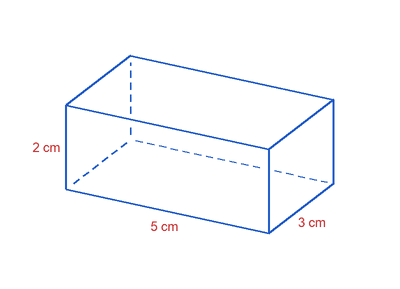
(i) How many rectangles does the net have?
(ii) Write the dimensions of the rectangles, pair by pair.
(iii) Find the total area of the net.
- 254 marks
Question 25
Bloom's level: Analyse
The figure shows a net of a cube.
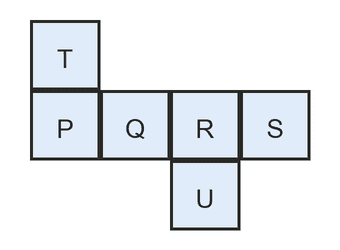
When it is folded to make a cube :
(i) Which face is opposite to face ?
(ii) Which face is opposite to face , and which is opposite to face ?
(iii) If face is at the bottom of the cube, which face is on top?
(iv) Name the four faces that share an edge with face .
- 265 marks
Question 26
Bloom's level: Analyse
Case study: Aman's town map is drawn to the scale cm m. On the map, his home is cm from his school, the school is cm from the library, and his home is cm from the library along a straight road.
(a) Find the actual distance between Aman's home and school.
(b) Aman goes from home to the library via the school. How much farther is this than going straight along the road from home to the library?
(c) A new map of the same town uses the scale cm m. How far apart will the home and the school be on the new map? Which map is bigger and shows more detail? Explain.
- 274 marks
Question 27
Bloom's level: Apply
Case study: A gift box is a cuboid 20 cm long, 15 cm broad and 10 cm high.
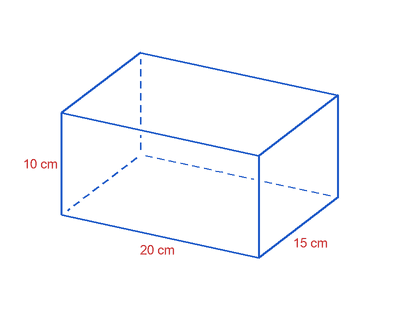
Meena sticks a small star on every corner of the box and fixes a gold ribbon along every edge.
(a) Write the number of faces, edges and vertices of the box, and check Euler's formula for it.
(b) How many stars does she need, and what length of ribbon?
(c) Her friend uses a cube-shaped box of edge 15 cm instead. Find the length of ribbon for this box and compare it with (b).
- 284 marks
Question 28
Bloom's level: Evaluate
Say whether each statement is true or false. Justify each answer using the counts of faces, edges and vertices given in the chapter.
(i) "A cylinder has no vertex, so it has no edges either."
(ii) "A cone has two surfaces: one flat and one curved."
(iii) "For a cylinder, ."
(iv) "A sphere is a polyhedron."
- 294 marks
Question 29
Bloom's level: Create
Design two different nets for a closed cuboid of length 4 cm, breadth 3 cm and height 2 cm.
(i) Draw (or describe) each net, labelling every face with its name and size.
(ii) Explain how you made sure each net folds into the cuboid.
(iii) Which face would you remove from one of your nets to make an open box (without a lid)?
- 305 marks
Question 30
Bloom's level: Create
Plan a short class activity on solids using one polyhedron and one non-polyhedron.
(i) Choose a triangular prism (like a tent). Write its number of faces, vertices and edges, and verify Euler's formula.
(ii) Describe a net for the triangular prism.
(iii) Choose a cylinder and write its counts as given in the chapter. Show that Euler's formula does not hold for it, and explain why.
(iv) Frame one question for your classmates about the map scale of a model town, and give its answer.
- 311 mark
Question 31
A solid has two flat circular faces and one curved surface, and it has no vertex. The solid is a :
- 321 mark
Question 32
A prism has a hexagon as its base.
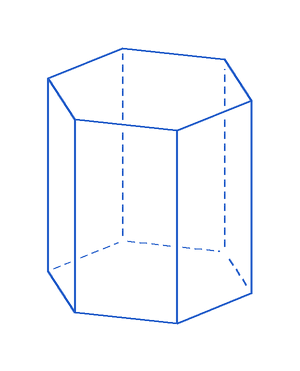
The number of edges of this prism is :
- 331 mark
Question 33
A crystal in the shape of a polyhedron has 14 corners (vertices) and 21 edges. By Euler's formula, the number of faces of the crystal is :
- 342 marks
Question 34
State whether each of the following solids is a polyhedron or a non-polyhedron, with a reason :
(i) a triangular prism
(ii) a cone
(iii) a sphere
(iv) a pentagonal pyramid
- 352 marks
Question 35
A polyhedron has 10 faces and 16 vertices. Find the number of its edges. If the solid is a prism, how many sides has its base ?
- 362 marks
Question 36
A net is made of six rectangles : two of size 8 cm 5 cm, two of size 8 cm 3 cm and two of size 5 cm 3 cm. Name the solid it forms, state its length, breadth and height, and find the total length of all its edges.
- 372 marks
Question 37
On a map the scale is 1 cm = 8 km. Two villages are 6·5 cm apart on the map. Find the actual distance between them. A road is actually 124 km long ; what length represents it on the map ?
- 383 marks
Question 38
Four objects are given : a football, a traffic cone, a cylindrical dustbin and a match box.
(a) Name the solid each object looks like.
(b) Which of these objects is shaped like a polyhedron ?
(c) Which object has no flat face, no edge and no vertex ? Write the number of its faces.
- 394 marks
Question 39
A pyramid has a base with sides.
(a) For a pentagonal pyramid (), write the number of faces, vertices and edges, and verify Euler's formula.
(b) A pyramid has 16 edges. How many sides has its base ? Write its numbers of faces and vertices.
(c) Verify Euler's formula for the pyramid in part (b).
- 404 marks
Question 40
The given figure shows the net of a solid.
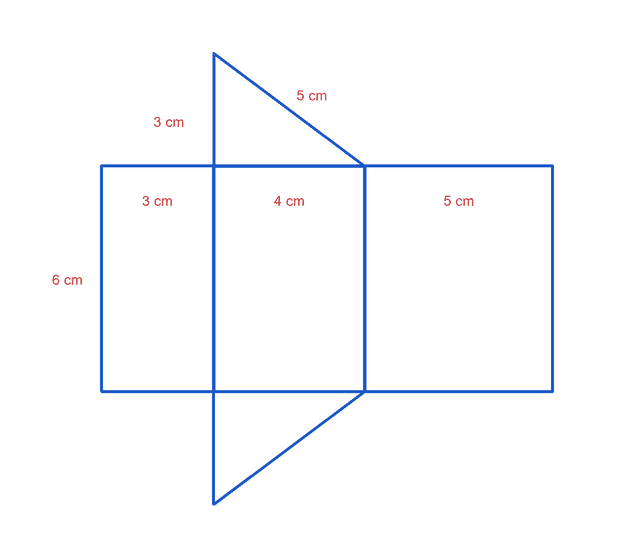
(a) Name the solid that is formed when the net is folded.
(b) Write the numbers of its faces, vertices and edges, and verify Euler's formula.
(c) A thin wire frame is to be made along all the edges of the solid. Find the total length of wire needed.