
Opening your dashboard
Class 6 Biology Chapter 4: Digestive System Solutions
40 textbook questions with step-by-step answers, free to read, for ICSE 2026-27.
Get talked through Ch 4, not just shown the answer
Reading a finished solution is not the same as being able to do it. The AI tutor takes one question at a time and works it with you, in your own words, until you can.
- Ask it out loud, in your own words
- It gives you the next step, not the answer
- Stuck on part (ii)? Start there
40 questions with solutions
1–15 marks · Mixed difficulty
- 11 mark
Question 1
The teeth which help in tearing the food are the :
Solve with AIAnswer
(A) Incisors
- Correct
(B) Canines
(C) Premolars
(D) Molars
Answer: (B) Canines
Concept: Humans have four kinds of teeth: incisors (chisel-shaped, for biting and cutting), canines (pointed, for tearing), premolars (for crushing and grinding) and molars (for finer crushing and grinding).
Step 1 — Match the job with a tooth.
Tearing needs a long, pointed tooth that can grip and pull food apart.
Step 2 — Pick the option.
The pointed teeth, one on each side of the incisors in each jaw, are the canines, so the answer is option (B).
Watch out: Incisors also cut, but they bite with a straight chisel edge; tearing is done by the pointed canines.
Why the other options are wrong:
- (A) Incisors: they are chisel-shaped and are used for biting and cutting.
- (C) Premolars: they have broad tops with cusps for crushing and grinding.
- (D) Molars: they are the broad back teeth for finer crushing and grinding.
Therefore, the teeth that help in tearing food are the canines, option (B).
- 21 mark
Question 2
Last molar tooth in human beings is called :
Solve with AIAnswer
(A) Adult tooth
- Correct
(B) Wisdom tooth
(C) Child tooth
(D) Elder’s tooth
Answer: (B) Wisdom tooth
Concept: Humans have four kinds of teeth: incisors (chisel-shaped, for biting and cutting), canines (pointed, for tearing), premolars (for crushing and grinding) and molars (for finer crushing and grinding).
Step 1 — Find the last molar.
The last molar on each side of each jaw comes up much later than the other teeth, usually between about 17 and 25 years of age.
Step 2 — Name it.
Because it appears when a person is grown up, it is called the wisdom tooth, option (B).
Watch out: The wisdom teeth are the third molars; some people never get all four.
Why the other options are wrong:
- (A) Adult tooth: “adult tooth” is not the name of one particular tooth; all permanent teeth are adult teeth.
- (C) Child tooth: “child tooth” is not a name used for the last molar; a child's first set is called the milk teeth.
- (D) Elder’s tooth: “elder's tooth” is not a name used for any tooth.
Therefore, the last molar tooth in human beings is called the wisdom tooth, option (B).
- 31 mark
Question 3
The hardest substance in your body is :
Solve with AIAnswer
(A) Dentine
(B) Bone
(C) Cement
- Correct
(D) Enamel
Answer: (D) Enamel
Concept: A tooth is built in layers: enamel covers the crown, dentine lies below it, cement covers the root and the soft pulp is in the centre.
Step 1 — Compare the hardness.
Enamel is made almost entirely of hard mineral crystals. It is harder than dentine, cement and bone.
Step 2 — Pick the option.
So the hardest substance in the body is enamel, option (D).
Watch out: Bone is very hard, but enamel is harder still.
Why the other options are wrong:
- (A) Dentine: it is bone-like and lies under the enamel; it is softer than enamel.
- (B) Bone: it is hard, but not as hard as enamel.
- (C) Cement: it covers the root; it is about as hard as bone and softer than enamel.
Therefore, the hardest substance in the body is enamel, option (D).
- 41 mark
Question 4
Saliva converts starch into :
Solve with AIAnswer
(A) Glucose
(B) Sucrose
- Correct
(C) Maltose
(D) Lactose
Answer: (C) Maltose
Concept: Digestion breaks food into the simplest forms the blood can absorb: carbohydrates into glucose (simple sugars), proteins into amino acids, and fats into fatty acids and glycerol.
Step 1 — Recall the enzyme in saliva.
Saliva contains the enzyme salivary amylase, which acts on starch.
Step 2 — Write what it makes.
Salivary amylase breaks starch into maltose, a sugar made of two glucose units.
Step 3 — Pick the option.
So saliva converts starch into maltose, option (C).
Watch out: Glucose is the end product of starch digestion, but it is formed later, in the small intestine, not by saliva.
Why the other options are wrong:
- (A) Glucose: it is formed later, in the small intestine, when maltase splits maltose.
- (B) Sucrose: it is cane sugar from food; saliva does not make it from starch.
- (D) Lactose: it is milk sugar; it is not made from starch.
Therefore, saliva converts starch into maltose, option (C).
- 51 mark
Question 5
Proteins of the milk are converted into curd in human stomach by the enzyme :
Solve with AIAnswer
(A) Trypsin
- Correct
(B) Rennin
(C) Pepsin
(D) Erepsin
Answer: (B) Rennin
Concept: Milk protein (casein) is turned into a solid curd in the stomach; the chapter names the enzyme that does this rennin.
Step 1 — Recall the enzymes of gastric juice.
Gastric juice contains hydrochloric acid and the enzymes pepsin and rennin. Rennin acts on the milk protein casein.
Step 2 — Write the change.
Rennin turns the dissolved casein of milk into solid curd.
Step 3 — Pick the option.
So the enzyme named for curdling milk in the stomach is rennin, option (B).
Watch out: Trypsin and erepsin also act on proteins, but in the small intestine, not in the stomach.
Note: The human stomach makes little or no rennin; in people, pepsin does most of the curdling of milk. Rennin does this job in calves and is used to make cheese, and it is the milk-curdling enzyme named in this chapter.
Why the other options are wrong:
- (A) Trypsin: it is in pancreatic juice; it acts on proteins in the small intestine.
- (C) Pepsin: pepsin's main job is to break proteins into peptones; it can also curdle milk (see the note), but the chapter names rennin for this.
- (D) Erepsin: it is in intestinal juice; it changes peptides into amino acids.
Therefore, the enzyme that converts milk proteins into curd in the stomach is rennin, option (B).
- 61 mark
Question 6
Bile juice is produced by :
Solve with AIAnswer
(A) Stomach
- Correct
(B) Liver
(C) Pancreas
(D) Gall bladder
Answer: (B) Liver
Concept: Digestion uses juices from several glands: saliva (salivary glands, mouth), gastric juice (stomach), bile (made by the liver, stored in the gall bladder) and pancreatic juice (pancreas), both poured into the duodenum, and intestinal juice (small intestine).
Step 1 — Find where bile is made.
Bile is a greenish-yellow juice made by the liver, the largest gland of the body.
Step 2 — Pick the option.
So bile juice is produced by the liver, option (B).
Watch out: The gall bladder only stores bile; the liver makes it.
Why the other options are wrong:
- (A) Stomach: the stomach produces gastric juice, not bile.
- (C) Pancreas: the pancreas produces pancreatic juice, not bile.
- (D) Gall bladder: the gall bladder only stores bile; it does not make it.
Therefore, bile juice is produced by the liver, option (B).
- 71 mark
Question 7
Which of the following enzymes is contained in the saliva ?
Solve with AIAnswer
(A) Sucrase
(B) Maltase
- Correct
(C) Amylase
(D) Erepsin
Answer: (C) Amylase
Concept: Digestion uses juices from several glands: saliva (salivary glands, mouth), gastric juice (stomach), bile (made by the liver, stored in the gall bladder) and pancreatic juice (pancreas), both poured into the duodenum, and intestinal juice (small intestine).
Step 1 — Recall the enzyme in saliva.
Saliva contains the enzyme amylase (salivary amylase), which starts the digestion of starch in the mouth.
Step 2 — Pick the option.
So the enzyme in saliva is amylase, option (C).
Watch out: Maltase and sucrase also act on sugars, but they are found in intestinal juice, not in saliva.
Why the other options are wrong:
- (A) Sucrase: it is found in intestinal juice; it acts on cane sugar.
- (B) Maltase: it is found in intestinal juice; it acts on maltose.
- (D) Erepsin: it is found in intestinal juice; it acts on peptides.
Therefore, the enzyme contained in saliva is amylase, option (C).
- 81 mark
Question 8
Bile juice is stored in :
Solve with AIAnswer
- Correct
(A) Gall bladder
(B) Liver
(C) Duodenum
(D) Stomach
Answer: (A) Gall bladder
Concept: Digestion uses juices from several glands: saliva (salivary glands, mouth), gastric juice (stomach), bile (made by the liver, stored in the gall bladder) and pancreatic juice (pancreas), both poured into the duodenum, and intestinal juice (small intestine).
Step 1 — Find where bile is kept.
Bile made by the liver is stored in a small sac, the gall bladder, which lies just below the liver.
Step 2 — Pick the option.
When food reaches the duodenum, bile flows out of the gall bladder through the bile duct. So the answer is option (A).
Watch out: The liver makes bile, but it does not store it.
Why the other options are wrong:
- (B) Liver: the liver makes bile but passes it on to the gall bladder for storage.
- (C) Duodenum: the duodenum receives bile when food arrives; it does not store it.
- (D) Stomach: the stomach is not connected with bile; its own juice is gastric juice.
Therefore, bile juice is stored in the gall bladder, option (A).
- 91 mark
Question 9
The end product of protein is :
Solve with AIAnswer
(A) Fatty acids
- Correct
(B) Amino acids
(C) Glycerols
(D) Peptones
Answer: (B) Amino acids
Concept: Digestion breaks food into the simplest forms the blood can absorb: carbohydrates into glucose (simple sugars), proteins into amino acids, and fats into fatty acids and glycerol.
Step 1 — Follow protein digestion.
Pepsin in the stomach breaks proteins into peptones. Trypsin and erepsin in the small intestine break them further, into amino acids.
Step 2 — Pick the option.
Amino acids are the end product of protein digestion, option (B).
Watch out: Peptones are formed on the way; they are not the end product.
Why the other options are wrong:
- (A) Fatty acids: they are an end product of fat digestion, not of protein digestion.
- (C) Glycerols: glycerol is the other end product of fat digestion.
- (D) Peptones: they are only a middle stage of protein digestion, made by pepsin in the stomach.
Therefore, the end product of protein digestion is amino acids, option (B).
- 101 mark
Question 10
In which of the following parts of the alimentary canal, does digestion not take place ?
Solve with AIAnswer
(A) Stomach
(B) Duodenum
- Correct
(C) Jejunum
(D) Ileum
Answer: (C) Jejunum
Concept: Digestion happens wherever digestive enzymes act on food. In this chapter, a new digestive juice is added in the stomach (gastric juice), the duodenum (bile and pancreatic juice) and the ileum (intestinal juice). The jejunum is the middle part of the small intestine, between the duodenum and the ileum.
Step 1 — Find where the chapter adds a new juice.
The stomach adds gastric juice, the duodenum receives bile and pancreatic juice, and the ileum adds intestinal juice. The jejunum is the only part in the list where the chapter adds no new juice.
Step 2 — Pick the option the question intends.
The question is looking for the part where no new juice is added, so the intended answer is the jejunum, option (C).
Watch out: Digestion does not stop in the jejunum. The enzymes of the pancreatic juice go on working there, the lining of the jejunum also makes enzymes that help finish digestion, and much of the digested food is absorbed in the jejunum. So, strictly, digestion takes place in all four parts; the question means the part where this chapter adds no new juice.
Why the other options are not intended:
- (A) Stomach: the stomach adds gastric juice, and pepsin in it digests proteins.
- (B) Duodenum: the duodenum receives bile and pancreatic juice, which act on all three kinds of food.
- (D) Ileum: the ileum adds intestinal juice, which completes digestion.
Therefore, the intended answer is (C) Jejunum: it is the only part listed where the chapter adds no new digestive juice, although digestion still goes on there.
- 111 mark
Question 11
Assertion (A): Food provides us with energy to do work and nutrients for the growth and repair of the body.
Reason (R): Food is a complex substance and is broken down into simpler substances with the help of digestive juices or enzymes.
Solve with AIAnswer
(A) (1) Both A and R are true and R is the correct explanation of A.
- Correct
(B) (2) Both A and R are true but R is not the correct explanation of A.
(C) (3) A is true but R is false.
(D) (4) A is false but R is true.
Answer: (B) (2) Both A and R are true but R is not the correct explanation of A.
Concept: In an assertion-reason item, first judge the Assertion (A) and the Reason (R) separately as true or false; only when both are true do we ask whether R correctly explains A.
Step 1 — Judge the Assertion.
A is true. Food gives us energy to do work, and nutrients for growth and for repair of damaged cells and tissues.
Step 2 — Judge the Reason.
R is true. Food is made of complex substances, which digestive juices (enzymes) break into simpler substances.
Step 3 — Check whether R explains A.
R tells us how food is digested, not why food gives energy and nutrients. So R does not explain A, and the answer is option (B).
Why the other options are wrong:
- (A): R does not explain A, so “R is the correct explanation” is wrong.
- (C): R is a true statement.
- (D): A is a true statement.
Therefore, both A and R are true but R is not the correct explanation of A, option (B).
- 121 mark
Question 12
Assertion (A): Digestion is the process by which complex food materials are broken down into simpler, smaller substances that can be readily absorbed and utilized by the body.
Reason (R): The bigger and complex food components cannot be easily passed down the narrow alimentary canal and so digestion is required.
Solve with AIAnswer
(A) (1) Both A and R are true and R is the correct explanation of A.
(B) (2) Both A and R are true but R is not the correct explanation of A.
- Correct
(C) (3) A is true but R is false.
(D) (4) A is false but R is true.
Answer: (C) (3) A is true but R is false.
Concept: In an assertion-reason item, first judge the Assertion (A) and the Reason (R) separately as true or false; only when both are true do we ask whether R correctly explains A.
Step 1 — Judge the Assertion.
A is true. This is the definition of digestion: complex food is broken into simpler, smaller substances that the body can absorb and use.
Step 2 — Judge the Reason.
R is false. Chewed food (the bolus) moves easily down the alimentary canal by waves of muscle contraction (peristalsis). Digestion is needed because large, complex molecules cannot pass through the wall of the intestine into the blood; only simple substances such as glucose and amino acids can.
Step 3 — Pick the option.
A is true and R is false, so the answer is option (C).
Watch out: Digestion is needed for absorption, not for moving food along the canal.
Why the other options are wrong:
- (A): R is false, so it cannot explain A.
- (B): R is false, so “both A and R are true” is wrong.
- (D): A is a true statement.
Therefore, A is true but R is false, option (C).
- 131 mark
Question 13
Assertion (A): Humans have two sets of teeth — milk teeth (20 in number) during childhood and permanent teeth (28/32 in number) in adulthood.
Reason (R): The first set of teeth is smaller and suited for a child’s jaw, while the second set is larger and stronger to fit the adult jaw and support long-term chewing needs.
Solve with AIAnswer
- Correct
(A) (1) Both A and R are true and R is the correct explanation of A.
(B) (2) Both A and R are true but R is not the correct explanation of A.
(C) (3) A is true but R is false.
(D) (4) A is false but R is true.
Answer: (A) (1) Both A and R are true and R is the correct explanation of A.
Concept: In an assertion-reason item, first judge the Assertion (A) and the Reason (R) separately as true or false; only when both are true do we ask whether R correctly explains A.
Step 1 — Judge the Assertion.
A is true. A child has 20 milk teeth. An adult has 32 permanent teeth, or 28 until the four wisdom teeth come up.
Step 2 — Judge the Reason.
R is true. Milk teeth are small and suit the small jaw of a child; permanent teeth are larger and stronger to fit the grown jaw and to last for life.
Step 3 — Check whether R explains A.
R tells us why humans need two sets of teeth: the jaw grows, so a small first set is replaced by a larger second set. So R explains A, and the answer is option (A).
Why the other options are wrong:
- (B): R does explain A, so “R is not the correct explanation” is wrong.
- (C): R is a true statement.
- (D): A is a true statement.
Therefore, both A and R are true and R is the correct explanation of A, option (A).
- 141 mark
Question 14
Assertion (A): Liver is a reddish brown gland in the body which produces bile juice. Bile juice is a greenish yellow fluid which breaks down fats into tiny droplets.
Reason (R): Bile juice is stored in the gall bladder and it does not contain any digestive enzymes.
Solve with AIAnswer
(A) (1) Both A and R are true and R is the correct explanation of A.
- Correct
(B) (2) Both A and R are true but R is not the correct explanation of A.
(C) (3) A is true but R is false.
(D) (4) A is false but R is true.
Answer: (B) (2) Both A and R are true but R is not the correct explanation of A.
Concept: In an assertion-reason item, first judge the Assertion (A) and the Reason (R) separately as true or false; only when both are true do we ask whether R correctly explains A.
Step 1 — Judge the Assertion.
A is true. The reddish-brown liver makes greenish-yellow bile, which breaks fats into tiny droplets (emulsification).
Step 2 — Judge the Reason.
R is true. Bile is stored in the gall bladder, and it contains no digestive enzymes.
Step 3 — Check whether R explains A.
Where bile is stored, and the fact that it has no enzymes, do not explain how bile breaks fats into droplets. So R does not explain A, and the answer is option (B).
Why the other options are wrong:
- (A): R does not explain A, so “R is the correct explanation” is wrong.
- (C): R is a true statement.
- (D): A is a true statement.
Therefore, both A and R are true but R is not the correct explanation of A, option (B).
- 151 mark
Question 15
Assertion (A): The small intestine and large intestine are named based on their overall size when measured along their length.
Reason (R): Small intestine is narrower but its surface area is much larger hence digestion and absorption of digested food happens here, whereas large intestine mainly absorbs water from the undigested food.
Solve with AIAnswer
(A) (1) Both A and R are true and R is the correct explanation of A.
(B) (2) Both A and R are true but R is not the correct explanation of A.
(C) (3) A is true but R is false.
- Correct
(D) (4) A is false but R is true.
Answer: (D) (4) A is false but R is true.
Concept: In an assertion-reason item, first judge the Assertion (A) and the Reason (R) separately as true or false; only when both are true do we ask whether R correctly explains A.
Step 1 — Judge the Assertion.
A is false. The small intestine is about 6–7 m long and the large intestine only about 1.5 m. If they were named by length, the small intestine would be the “large” one. They are named by their width: the small intestine is narrow, the large intestine is wide.
Step 2 — Judge the Reason.
R is true. The small intestine is narrower, but its folded lining with villi gives a very large surface for digestion and absorption; the large intestine mainly absorbs water from the undigested food.
Step 3 — Pick the option.
A is false and R is true, so the answer is option (D).
Watch out: “Small” and “large” describe the width of the tubes, not their length.
Why the other options are wrong:
- (A): A is false, so R cannot explain it.
- (B): A is false, so “both A and R are true” cannot be right.
- (C): this says A is true and R is false; in fact it is the other way round.
Therefore, A is false but R is true, option (D).
- 168 marks
Question 16
Fill in the blanks :
(i) The teeth called .......... are a total of four in number on the sides of incisors.
(ii) .......... is a common opening of food pipe and wind pipe.
(iii) Molars are meant for .......... the food.
(iv) Incisors are used for .......... and .......... the food.
(v) The .......... are used for tearing the food.
(vi) The .......... and .......... are used for crushing and grinding the food.
(vii) In an adult human, there are a total of .......... teeth.
(viii) The human teeth appear in two sets, the first set is called .......... which consists of only .......... teeth.
Solve with AIWritten solution
Solution:
Concept: Humans have four kinds of teeth: incisors (chisel-shaped, for biting and cutting), canines (pointed, for tearing), premolars (for crushing and grinding) and molars (for finer crushing and grinding).
Step 1 — Blanks (i) to (iv).
The four pointed teeth beside the incisors are the canines. The pharynx is the common passage for the food pipe and the windpipe. Molars are meant for crushing and grinding the food, and incisors are used for biting and cutting it.
Step 2 — Blanks (v) and (vi).
The canines are used for tearing the food. The premolars and molars are used for crushing and grinding it.
Step 3 — Blanks (vii) and (viii).
An adult has a total of 32 teeth. The first set of teeth is the milk teeth (temporary teeth), and it has only 20 teeth.
Watch out: Milk teeth number 20, not 32; the 32 belong to the permanent set.
Therefore, (i) canines, (ii) pharynx, (iii) crushing and grinding, (iv) biting, cutting, (v) canines, (vi) premolars, molars, (vii) 32, (viii) milk teeth, 20.
- 177 marks
Question 17
Write True or False in the following statements.
(i) Molars help in cutting and tearing food.
(ii) Carbohydrates are digested into glucose.
(iii) Proteins are digested into fatty acids.
(iv) Wisdom tooth appears at the age of 5-6 years when the child starts going to school.
(v) The temporary set of teeth includes incisors, canines and premolars only.
(vi) The ducts from the salivary glands open into the duodenum.
(vii) Saliva changes starch into maltose.
Solve with AIWritten solution
Solution:
Concept: Check each statement against the chapter; a false statement is corrected by changing its wrong part.
Step 1 — Statements (i) to (iii).
Each statement is checked against the chapter. (i) is False: molars crush and grind food; incisors cut and canines tear. (ii) is True: carbohydrates are digested into glucose (and other simple sugars). (iii) is False: proteins are digested into amino acids; fatty acids come from fats.
Step 2 — Statements (iv) and (v).
Each statement is checked against the chapter. (iv) is False: the wisdom tooth appears at about 17 to 25 years; at 5–6 years the milk teeth begin to fall. (v) is False: the temporary set has incisors, canines and molars (8 incisors, 4 canines and 8 molars); it has no premolars.
Step 3 — Statements (vi) and (vii).
Each statement is checked against the chapter. (vi) is False: the ducts of the salivary glands open into the mouth. (vii) is True: salivary amylase changes starch into maltose.
Watch out: The milk set has molars but no premolars; do not mark (v) false for the wrong reason.
Therefore, (i) False, (ii) True, (iii) False, (iv) False, (v) False, (vi) False, (vii) True.
- 185 marks
Question 18
Fill in the blanks in the table (1-5) by selecting the suitable names of substances from the list given below :
[lipase, peptones, fatty acids, proteoses, protein].
Digestive enzymes acts on to form (i) Pepsin .......... (2) .......... (3) and .......... (4) (ii) .......... (1) fats .......... (5) Solve with AIWritten solution
Solution:
Concept: Pepsin of gastric juice acts on proteins and breaks them into proteoses and peptones; lipase acts on fats and breaks them into fatty acids and glycerol.
Step 1 — The row of pepsin.
Pepsin acts on protein (blank 2) to form proteoses (blank 3) and peptones (blank 4).
Step 2 — The row of fats.
The enzyme that acts on fats is lipase (blank 1), and it forms fatty acids (blank 5), together with glycerol.
Therefore, (1) lipase, (2) protein, (3) proteoses, (4) peptones, (5) fatty acids.
- 195 marks
Question 19
Given below are the set of four terms. Choose the odd one and write the category of the remaining terms :
(i) Maltose, Sucrose, Lipase, Lactose.
(ii) Gall bladder, Pancreas, Salivary Glands, Liver.
(iii) Carbohydrates, Fats, Bile, Proteins.
(iv) Ileum, Colon, Jejunum, Duodenum.
(v) Albumen, Pepsin, Trypsin. Rennin.
Solve with AIWritten solution
Solution:
Concept: In each set, three terms belong to one group; name that group first, and the term outside it is the odd one.
Step 1 — Sets (i) and (ii).
Each set is sorted in turn. (i) Maltose, sucrose and lactose are sugars (carbohydrates); lipase is an enzyme, so it is the odd one. (ii) The salivary glands, pancreas and liver are digestive glands that make juices; the gall bladder only stores bile, so it is the odd one.
Step 2 — Sets (iii) and (iv).
Each set is sorted in turn. (iii) Carbohydrates, fats and proteins are nutrients; bile is a digestive juice, so it is the odd one. (iv) The ileum, jejunum and duodenum are parts of the small intestine; the colon is part of the large intestine.
Step 3 — Set (v).
Pepsin, trypsin and rennin are enzymes that act on proteins; albumen is itself a protein (egg white), so it is the odd one.
Watch out: The gall bladder is linked with digestion, but it makes no juice, so it is not a digestive gland.
Therefore, the odd ones are (i) lipase, (ii) gall bladder, (iii) bile, (iv) colon and (v) albumen.
- 205 marks
Question 20
Match the terms given in column A with those of column B :
Column A Column B (i) Incisors (a) Crushing and grinding (ii) Canines (b) Emulsification (iii) Molars (c) Tearing (iv) Bile (d) Absorption (v) Villus (e) Biting and cutting Solve with AIWritten solution
Solution:
Concept: Match each tooth, juice or structure with the job it does in digestion.
Step 1 — Match the items.
The table pairs each item of Column A with its job from Column B.
Column A Column B (i) Incisors (e) Biting and cutting (ii) Canines (c) Tearing (iii) Molars (a) Crushing and grinding (iv) Bile (b) Emulsification (v) Villus (d) Absorption Step 2 — Reasons for the matches.
Chisel-shaped incisors bite and cut, pointed canines tear, and broad molars crush and grind. Bile breaks fats into tiny droplets (emulsification). Villi are finger-like folds of the small intestine that absorb digested food.
Therefore, (i) matches (e), (ii) matches (c), (iii) matches (a), (iv) matches (b), (v) matches (d).
- 2115 marks
Question 21
Name the following :
(i) End product of starch after digestion.
(ii) The organ where protein digestion begins.
(iii) The organ into which the pancreatic juice and the bile juice are poured.
(iv) The enzyme which digests fat in ileum.
(v) The simplest form of carbohydrates.
(vi) The part of alimentary canal where water from the undigested food is absorbed.
(vii) The end-product of protein digestion
(viii) Five major groups of nutrients.
(ix) Five steps involved in the entire process of nutrition.
(x) Three digestive glands.
(xi) Four kinds of teeth.
(xii) Three parts of the small intestine.
(xiii) Three parts of the large intestine.
(xiv) Three enzymes responsible for the breakdown of carbohydrates.
(xv) Three enzymes responsible for the breakdown of proteins.
Solve with AIWritten solution
Solution:
Concept: Digestion uses juices from several glands: saliva (salivary glands, mouth), gastric juice (stomach), bile (made by the liver, stored in the gall bladder) and pancreatic juice (pancreas), both poured into the duodenum, and intestinal juice (small intestine).
Step 1 — Items (i) to (iv).
Each item is named in turn. (i) Starch is finally digested into glucose. (ii) Protein digestion begins in the stomach (pepsin). (iii) Pancreatic juice and bile are poured into the duodenum. (iv) Fat in the ileum is digested by lipase of the intestinal juice.
Step 2 — Items (v) to (vii).
Each item is named in turn. (v) The simplest form of carbohydrate is a simple sugar such as glucose. (vi) Water from the undigested food is absorbed in the large intestine. (vii) The end product of protein digestion is amino acids.
Step 3 — Items (viii) to (x).
Each item is named in turn. (viii) The five major groups of nutrients are carbohydrates, proteins, fats, minerals and vitamins. (ix) The five steps of nutrition are ingestion, digestion, absorption, assimilation and egestion. (x) Three digestive glands are the salivary glands, liver and pancreas.
Step 4 — Items (xi) to (xiii).
Each item is named in turn. (xi) The four kinds of teeth are incisors, canines, premolars and molars. (xii) The small intestine has the duodenum, jejunum and ileum. (xiii) The large intestine has the caecum, colon and rectum.
Step 5 — Items (xiv) and (xv).
Each item is named in turn. (xiv) Enzymes that break down carbohydrates are amylase (salivary and pancreatic), maltase and sucrase (lactase is another). (xv) Enzymes that break down proteins are pepsin, trypsin and erepsin.
Watch out: The gall bladder is not a digestive gland; it only stores bile made by the liver.
Therefore, (i) glucose, (ii) stomach, (iii) duodenum, (iv) lipase, (v) glucose, (vi) large intestine, (vii) amino acids, (viii) carbohydrates, proteins, fats, minerals, vitamins, (ix) ingestion, digestion, absorption, assimilation, egestion, (x) salivary glands, liver, pancreas, (xi) incisors, canines, premolars, molars, (xii) duodenum, jejunum, ileum, (xiii) caecum, colon, rectum, (xiv) amylase, maltase, sucrase, (xv) pepsin, trypsin, erepsin.
- 222 marks
Question 22
Identify and name the four types of teeth shown below and state their functions.
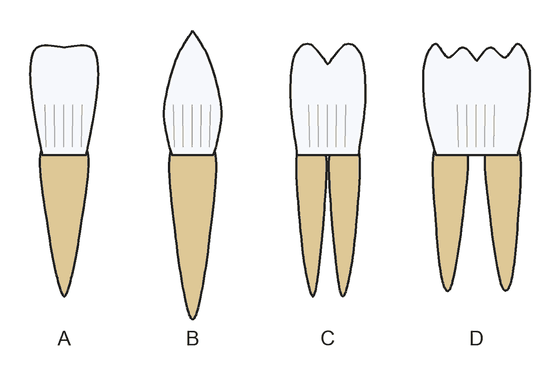 Solve with AI
Written solution
Solution:
Concept: Humans have four kinds of teeth: incisors (chisel-shaped, for biting and cutting), canines (pointed, for tearing), premolars (for crushing and grinding) and molars (for finer crushing and grinding).
Step 1 — Teeth A and B.
A is an incisor: it has a flat, chisel-like edge and one root, and is used for biting and cutting food. B is a canine: it is long and pointed with one long root, and is used for tearing food.
Step 2 — Teeth C and D.
C is a premolar: its top has two cusps, and it is used for crushing and grinding food. D is a molar: it has a broad top with several cusps and more than one root, and is used for finer crushing and grinding.
Watch out: Premolars and molars both grind; the molar is the broader one with more cusps.
Therefore, A is an incisor (biting, cutting), B a canine (tearing), C a premolar (crushing, grinding) and D a molar (finer crushing and grinding).
- 234 marks
Question 23
(i) Name the juice secreted by the liver .......... .
(ii) Name the organ where this juice is temporarily stored .......... .
(iii) What is the main function of this juice ?
Solve with AIWritten solution
Solution:
Concept: The liver makes bile, the gall bladder stores it, and bile acts on fats in the duodenum.
Step 1 — Parts (i) and (ii).
The juice secreted by the liver is bile (bile juice). It is stored for a while in the gall bladder.
Step 2 — Part (iii).
Bile breaks fats into tiny droplets; this is called emulsification. The droplets give lipase a much larger surface to act on, so fats are digested easily. Bile has no enzyme of its own.
Watch out: Bile does not digest fat itself; it only breaks it into droplets for lipase.
Therefore, (i) bile, (ii) the gall bladder, (iii) emulsification of fats.
- 242 marks
Question 24
Name the three enzymes found in the pancreatic juice and mention their functions.
Solve with AIWritten solution
Solution:
Concept: Pancreatic juice has one enzyme for each main kind of food: carbohydrates, proteins and fats.
Step 1 — Name the enzymes and their work.
The three enzymes and the changes they bring about are listed below.
- Amylase changes starch into maltose.
- Trypsin changes proteins and peptones into peptides.
- Lipase changes emulsified fats into fatty acids and glycerol.
Watch out: Pancreatic amylase does the same job as salivary amylase, but in the duodenum.
Therefore, the enzymes are amylase (starch to maltose), trypsin (proteins to peptides) and lipase (fats to fatty acids and glycerol).
- 251 mark
Question 25
Name the three regions of the large intestine.
Solve with AIWritten solution
Solution:
Concept: The large intestine, about 1.5 m long, joins the small intestine and ends at the anus.
Step 1 — Name the regions in order.
The large intestine begins with the pouch-like caecum (with the appendix), continues as the long colon, and ends in the rectum, which opens at the anus.
Watch out: The appendix hangs from the caecum; it is not counted as one of the three regions.
Therefore, the three regions of the large intestine are the caecum, colon and rectum.
- 265 marks
Question 26
Given alongside is the diagram of the human alimentary canal.

(i) Name the parts 1-11 indicated by guidelines.
1.......... 2.......... 3..........
4.......... 5.......... 6..........
7.......... 8.......... 9..........
10.......... 11..........
(ii) State the function of the juice secreted by part 1.
(iii) State the function of the three enzymes found in the juice secreted by part 3.
Solve with AIWritten solution
Solution:
Concept: Digestion uses juices from several glands: saliva (salivary glands, mouth), gastric juice (stomach), bile (made by the liver, stored in the gall bladder) and pancreatic juice (pancreas), both poured into the duodenum, and intestinal juice (small intestine).
Step 1 — (i) Name the parts 1 to 11.
Following each guideline to the part it ends on gives: 1 stomach, 2 duodenum, 3 pancreas, 4 large intestine (colon), 5 small intestine, 6 rectum, 7 appendix, 8 bile duct, 9 gall bladder, 10 liver, 11 anus.
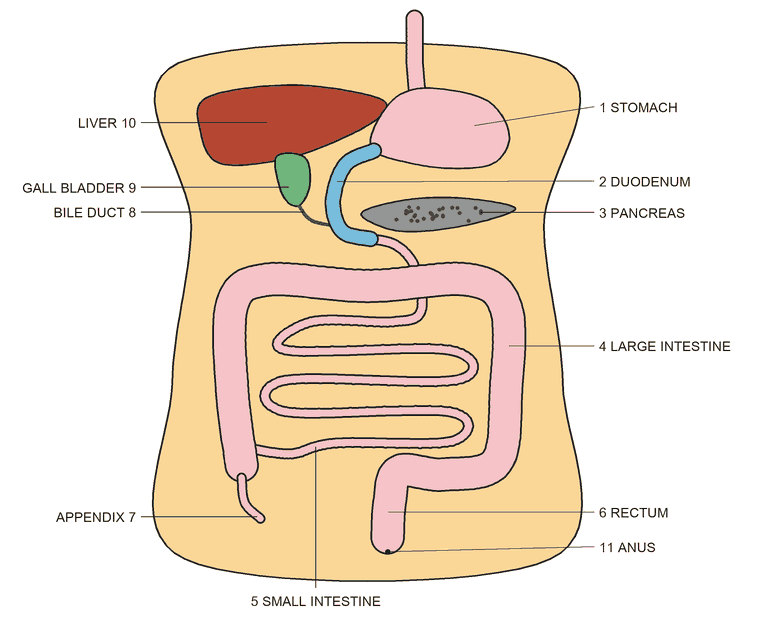
Step 2 — (ii) Juice of part 1.
Part 1, the stomach, secretes gastric juice. Its hydrochloric acid kills germs that come with food and makes the medium acidic so that pepsin can work. Pepsin breaks proteins into peptones, and rennin curdles the milk protein casein (in people, pepsin also does this).
Step 3 — (iii) Juice of part 3.
Part 3, the pancreas, secretes pancreatic juice into the duodenum. Its three enzymes work as listed below.
- Amylase changes starch into maltose.
- Trypsin changes proteins and peptones into peptides.
- Lipase changes emulsified fats into fatty acids and glycerol.
Watch out: The gall bladder (9) only stores bile; the bile is made by the liver (10).
Therefore, (i) 1 stomach, 2 duodenum, 3 pancreas, 4 large intestine, 5 small intestine, 6 rectum, 7 appendix, 8 bile duct, 9 gall bladder, 10 liver, 11 anus; (ii) gastric juice kills germs and digests proteins into peptones; (iii) amylase, trypsin and lipase digest starch, proteins and fats.
- 2710 marks
Question 27
Define the terms given below :
(i) Nutrients
(ii) Nutrition
(iii) Wisdom teeth
(iv) Emulsification
(v) Egestion
Solve with AIWritten solution
Solution:
Concept: A definition gives the exact meaning of a term in one short sentence.
Step 1 — Nutrients and nutrition.
Nutrients are the substances in food that the body needs to work, grow and stay healthy, such as carbohydrates, proteins, fats, minerals and vitamins. Nutrition is the process by which organisms obtain or make food and change it into simpler substances that their cells can absorb and use.
Step 2 — Wisdom teeth.
Wisdom teeth are the last molars, one at the back of each side of each jaw, which usually appear between about 17 and 25 years of age.
Step 3 — Emulsification and egestion.
Emulsification is the breaking of fats into tiny droplets by bile. Egestion is the removal of undigested food (faeces) from the body through the anus.
Watch out: Egestion removes undigested food; it is different from excretion, which removes wastes made by the cells.
Therefore, nutrients are the useful parts of food, nutrition is obtaining and using food, wisdom teeth are the last molars, emulsification is the breaking of fats into droplets by bile, and egestion is the removal of undigested food.
- 282 marks
Question 28
Define the term nutrition.
Solve with AIWritten solution
Solution:
Concept: Nutrition covers both getting food and changing it into a form the body can use.
Step 1 — Give the definition.
Nutrition is the process by which organisms obtain or make their food and change it into simpler substances that can be absorbed and used by the cells of the body. It includes ingestion, digestion, absorption, assimilation and egestion.
Watch out: Nutrition is not the same as eating; eating (ingestion) is only its first step.
Therefore, nutrition is the process of obtaining or making food and converting it into simpler substances that the body cells can absorb and use.
- 293 marks
Question 29
What is the role of liver and pancreas respectively in the digestion of food ?
Solve with AIWritten solution
Solution:
Concept: Digestion uses juices from several glands: saliva (salivary glands, mouth), gastric juice (stomach), bile (made by the liver, stored in the gall bladder) and pancreatic juice (pancreas), both poured into the duodenum, and intestinal juice (small intestine).
Step 1 — Role of the liver.
The liver makes bile, a greenish-yellow juice, which is stored in the gall bladder and poured into the duodenum. Bile breaks fats into tiny droplets (emulsification), so that lipase can digest them easily.
Step 2 — Role of the pancreas.
The pancreas pours pancreatic juice into the duodenum. Its enzymes digest all three main kinds of food, as listed below.
- Amylase changes starch into maltose.
- Trypsin changes proteins and peptones into peptides.
- Lipase changes emulsified fats into fatty acids and glycerol.
Watch out: Bile has no enzymes; the digestion itself is done by the pancreatic enzymes.
Therefore, the liver helps by making bile, which emulsifies fats, and the pancreas by making pancreatic juice, whose enzymes digest starch, proteins and fats.
- 303 marks
Question 30
Name the digestive juice secreted by the stomach and give its function.
Solve with AIWritten solution
Solution:
Concept: The gastric glands in the wall of the stomach secrete gastric juice, which contains hydrochloric acid and the enzymes pepsin and rennin.
Step 1 — Name the juice.
The stomach secretes gastric juice. It is made of water, hydrochloric acid and the enzymes pepsin and rennin.
Step 2 — State its functions.
Each part of the juice has its own job, as listed below.
- Hydrochloric acid kills germs that enter with the food, stops the food from rotting and makes the medium acidic so that pepsin can act.
- Pepsin breaks proteins into peptones.
- Rennin curdles the milk protein casein; in people, pepsin also does this.
Watch out: The acid does not digest food itself; it kills germs and lets pepsin work.
Therefore, the stomach secretes gastric juice, whose acid kills germs and whose enzymes digest proteins and curdle milk.
- 317 marks
Question 31
Answer the following questions :
(i) Name the types of teeth present in humans.
(ii) How is the small intestine best suited for the digestion and absorption of food ?
(iii) What do you mean by absorption of food ?
Solve with AIWritten solution
Solution:
Concept: The small intestine is long, receives several digestive juices and has a huge inner surface of villi.
Step 1 — (i) Types of teeth.
The four types of teeth in humans are incisors, canines, premolars and molars.
Step 2 — (ii) Suited for digestion.
The small intestine is a long, coiled tube, about 6–7 m long, so food stays in it for several hours. Its first part, the duodenum, receives bile and pancreatic juice, and its wall makes intestinal juice with enzymes (erepsin, maltase, sucrase, lactase, lipase) that complete digestion.
Step 3 — (ii) Suited for absorption.
Its inner lining has many finger-like villi, which greatly increase the surface for absorption. Each villus has a network of thin blood capillaries close to its surface, so digested food passes easily into the blood.
Step 4 — (iii) Meaning of absorption.
Absorption is the passing of digested food (glucose, amino acids, fatty acids and glycerol) through the wall of the small intestine (villi) into the blood and lymph.
Therefore, (i) incisors, canines, premolars, molars; (ii) the small intestine is long, receives three juices and has villi with blood capillaries; (iii) absorption is the passage of digested food into the blood.
- 326 marks
Question 32
Define the following terms : Egestion, digestion, assimilation.
Solve with AIWritten solution
Solution:
Concept: Egestion, digestion and assimilation are three of the five steps of nutrition.
Step 1 — Egestion.
Egestion is the removal of the undigested food (faeces) from the body through the anus.
Step 2 — Digestion.
Digestion is the breaking down of the complex substances in food into simpler substances that the body can readily absorb and use.
Step 3 — Assimilation.
Assimilation is the use of the absorbed food by the body cells, to obtain energy and to build and repair the body.
Watch out: Absorption (food entering the blood) comes before assimilation (food used by the cells).
Therefore, egestion removes undigested food, digestion breaks food into simpler substances, and assimilation is the use of absorbed food by the cells.
- 332 marks
Question 33
Rewrite the following parts of the human alimentary canal in their correct sequence :
Stomach, Oesophagus, Large intestine, Small intestine.
Solve with AIWritten solution
Solution:
Concept: Food travels through the alimentary canal from the mouth to the anus.
Step 1 — Arrange the parts.
After swallowing, food passes down the oesophagus into the stomach, then into the small intestine, and what is left goes on into the large intestine.
Therefore, the correct sequence is oesophagus, stomach, small intestine, large intestine.
- 343 marks
Question 34
What is the fate of excess glucose in our body ?
Solve with AIWritten solution
Solution:
Concept: Glucose that the body does not need at once is stored for later use.
Step 1 — Glucose used first.
The cells first use glucose to release energy in respiration.
Step 2 — Glucose stored as glycogen.
Extra glucose is changed into glycogen and stored in the liver and muscles. When the body needs energy, the glycogen is changed back into glucose.
Step 3 — Glucose stored as fat.
When the glycogen stores are full, still more glucose is changed into fat, which is stored under the skin and around organs as a reserve of energy.
Watch out: Excess glucose is not passed out of a healthy body; it is stored.
Therefore, excess glucose is stored as glycogen in the liver and muscles, and the rest as fat under the skin.
- 352 marks
Question 35
Define the term ‘digestion’.
Solve with AIWritten solution
Solution:
Concept: Digestion turns large, complex food molecules into small, simple ones that can pass into the blood.
Step 1 — Give the definition.
Digestion is the process by which the complex substances in food are broken down into simpler substances that are readily absorbed and used by the body. It is done by digestive juices containing enzymes.
Watch out: Chewing breaks food into smaller pieces, but digestion means the chemical breakdown by enzymes.
Therefore, digestion is the breaking down of complex food into simpler substances that the body can absorb and use.
- 363 marks
Question 36
State the four ways in which saliva is useful to us.
Solve with AIWritten solution
Solution:
Concept: Saliva, made by the salivary glands, wets the mouth and food and starts the digestion of starch.
Step 1 — Two uses in the mouth.
First, saliva moistens and lubricates the mouth and tongue, which makes speaking and swallowing easy. Second, it helps to clean the mouth, and it contains substances that kill some germs.
Step 2 — Two uses in digestion.
Third, it binds the chewed food into a soft ball, the bolus, that is easy to swallow. Fourth, it begins digestion: its enzyme amylase changes starch into maltose.
Watch out: Saliva does not kill every germ; regular brushing is still needed.
Therefore, saliva moistens the mouth, cleans it and kills some germs, binds food into a bolus, and starts the digestion of starch.
- 373 marks
Question 37
Foods are classified into three groups on the basis of the functions they perform in our body. Name these three groups, and briefly state their functions. Also give two sources of each.
Solve with AIWritten solution
Solution:
Concept: Foods are grouped by their main job in the body: giving energy, building the body, or protecting it.
Step 1 — List the three groups.
The table gives each group, what it does and two sources.
Group Function Two sources Energy-giving foods (carbohydrates and fats) Give energy for work; fats also store energy and keep the body warm Rice, potato (also sugar, ghee, butter) Body-building foods (proteins) Provide material for growth and repair of cells and tissues Pulses, eggs (also milk, meat, fish) Protective foods (vitamins and minerals) Keep us healthy, protect against deficiency diseases and help body processes work normally Fruits, green leafy vegetables Watch out: Fats give energy too; they are energy-giving foods, not body-building foods.
Therefore, the three groups are energy-giving foods (rice, potato), body-building foods (pulses, eggs) and protective foods (fruits, green leafy vegetables).
- 3810 marks
Question 38
Distinguish between the following pairs on the basis of the words indicated in the brackets [ ]:
(i) Bolus and chyme [occurrence in the part of alimentary canal].
(ii) Saliva and bile [source of secretion]
(iii) Milk teeth and permanent teeth [number]
(iv) Lactose and lipase [substrate on which they act]
(v) Small intestine and large intestine [the absorbed materials]
Solve with AIWritten solution
Solution:
Concept: Compare each pair only on the point given in the brackets.
Step 1 — (i) Bolus and chyme.
They are formed in different parts of the canal.
Bolus Chyme Formed in the mouth: chewed food bound together by saliva. Formed in the stomach: food churned with gastric juice into a thick paste. Step 2 — (ii) Saliva and bile.
They come from different glands.
Saliva Bile Secreted by the salivary glands. Secreted by the liver. Step 3 — (iii) Milk teeth and permanent teeth.
The two sets have different numbers of teeth.
Milk teeth Permanent teeth 20 in number. 32 in number (28 until the wisdom teeth appear). Step 4 — (iv) Lactose and lipase.
Lactose is a sugar and lipase is an enzyme, so only lipase acts on a substrate; lactose is itself the substrate of lactase.
Lactose Lipase Milk sugar; it is acted upon by the enzyme lactase, which splits it into simple sugars. An enzyme that acts on emulsified fats, forming fatty acids and glycerol. Step 5 — (v) Small intestine and large intestine.
They absorb different materials.
Small intestine Large intestine Absorbs the digested food (glucose, amino acids, fatty acids and glycerol, vitamins and minerals) and most of the water. Absorbs the water (and some salts) left in the undigested food. Watch out: Chyme is formed in the stomach, not the small intestine; the small intestine receives it.
Note: Pair (iv) is most likely meant to be lactase and lipase. On that reading, lactase acts on lactose (milk sugar) and lipase acts on fats.
Therefore, (i) bolus forms in the mouth, chyme in the stomach; (ii) saliva comes from the salivary glands, bile from the liver; (iii) milk teeth 20, permanent teeth 32; (iv) lactose is acted on by lactase, lipase acts on fats; (v) the small intestine absorbs digested food, the large intestine mainly water.
- 3912 marks
Question 39
Draw a neat diagram of the “vertical section of a grinding tooth” and label all its important parts. Answer the following questions :
(i) Name the substance which covers the visible portion of the tooth.
(ii) Which of the above labelled parts of the tooth is hard like a bone ?
(iii) Name the substance which covers the embedded part of the tooth.
(iv) What are caries ?
(v) Define plaque.
Solve with AIWritten solution
Solution:
Concept: A tooth has a crown above the gum, a neck at the gum line and a root in the jaw bone; enamel covers the crown, cement covers the root, dentine forms the body and pulp fills the centre.
Step 1 — Draw the diagram.
Draw a vertical section of a molar standing in the jaw bone, with the gum around its neck. Show the enamel cap, the dentine below it, the pulp cavity with its blood vessels and nerves, and the cement around the roots, and label each part.
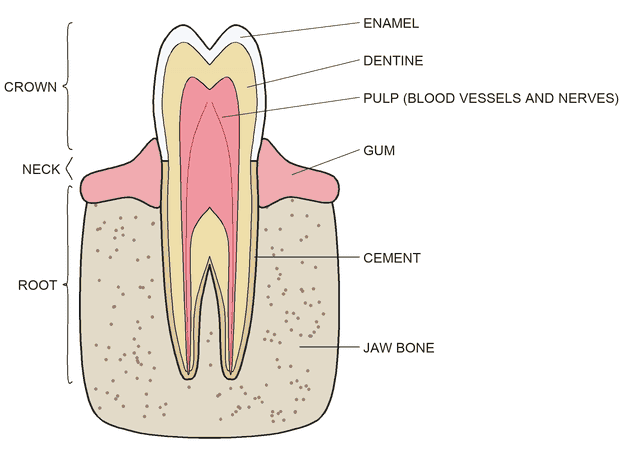
Labels: crown, neck, root, enamel, dentine, pulp (with blood vessels and nerves), cement, gum, jaw bone.
Step 2 — Parts (i) to (iii).
Each part is answered in turn. (i) The visible part (crown) is covered by enamel. (ii) The bone-like layer is the dentine. (iii) The embedded part (root) is covered by cement.
Step 3 — Parts (iv) and (v).
Each part is answered in turn. (iv) Caries are cavities (holes) in the teeth, formed when acids made by bacteria slowly dissolve the enamel and then the dentine. (v) Plaque is a soft, sticky, pale-yellow film of bacteria and food particles (sugary and starchy) that forms on the teeth.
Watch out: Enamel is harder than bone; it is the dentine that is described as bone-like.
Therefore, (i) enamel, (ii) dentine, (iii) cement, (iv) caries are cavities made by bacterial acids, and (v) plaque is a sticky film of bacteria and food on the teeth.
- 407 marks
Question 40
During a school health camp, students examined a model of the human digestive system. They noticed that different glands release specific digestive juices at different stages of digestion. Based on their observations, answer the following:
(i) Which digestive gland starts the process of digestion and what does it release?
(ii) Name one enzyme present in the above secretion answered by you in (i). What role does it play in digestion?
(iii) A piece of bread or boiled rice tastes sweet after being chewed thoroughly. Give a reason.
(iv) Mention the digestive juice secreted by the largest gland in the body. Where is this juice stored in the human body?
(v) In which part of the small intestine is pancreatic juice released?
Solve with AIWritten solution
Solution:
Concept: Digestion uses juices from several glands: saliva (salivary glands, mouth), gastric juice (stomach), bile (made by the liver, stored in the gall bladder) and pancreatic juice (pancreas), both poured into the duodenum, and intestinal juice (small intestine).
Step 1 — (i) and (ii) Digestion begins.
Digestion starts in the mouth, where the salivary glands release saliva. Its enzyme salivary amylase changes starch into maltose, so starch digestion begins in the mouth.
Step 2 — (iii) Why bread tastes sweet.
Bread and rice are mostly starch, which has no sweet taste. When they are chewed for a long time, salivary amylase turns some of the starch into maltose, a sugar, so the food begins to taste sweet.
Step 3 — (iv) Juice of the largest gland.
The largest gland in the body is the liver. It secretes bile juice, which is stored in the gall bladder.
Step 4 — (v) Where pancreatic juice enters.
Pancreatic juice is released into the duodenum, the first part of the small intestine.
Watch out: The gall bladder stores bile; it does not make it.
Therefore, (i) the salivary glands release saliva; (ii) salivary amylase changes starch into maltose; (iii) starch is turned into sweet maltose by chewing with saliva; (iv) the liver makes bile, stored in the gall bladder; (v) the duodenum.
What Class 6 Biology Ch 4 covers
The sections of the chapter, in the order the book takes them. Every question above comes from one of these.
- 01Food for Life
- 02Digestive System in Humans
- 03The Mouth
- 04The Oesophagus (Food Pipe)
- 05The Stomach
- 06The Small Intestine
More ways to study this chapter
The same chapter asked three other ways. Practise it, revise it, and see what the board has set on Ch 4 before.
Class 6 Biology Ch 4 questions students ask
How many questions are there in Class 6 Biology Ch 4?
40 questions. Every one is solved step by step on this page.
Are these Class 6 Biology solutions free?
Yes. Every question and its full working is free to read, with no account needed.
Can I download the Class 6 Biology Ch 4 solutions as a PDF?
There is no PDF to download. Every solution is on this page instead, which means it is searchable, always the current syllabus, and readable on a phone. Use your browser's print option if you want it on paper.