Solution:
Concept: A tooth has a crown above the gum, a neck at the gum line and a root in the jaw bone; enamel covers the crown, cement covers the root, dentine forms the body and pulp fills the centre.
Step 1 — Draw the diagram.
Draw a vertical section of a molar standing in the jaw bone, with the gum around its neck. Show the enamel cap, the dentine below it, the pulp cavity with its blood vessels and nerves, and the cement around the roots, and label each part.
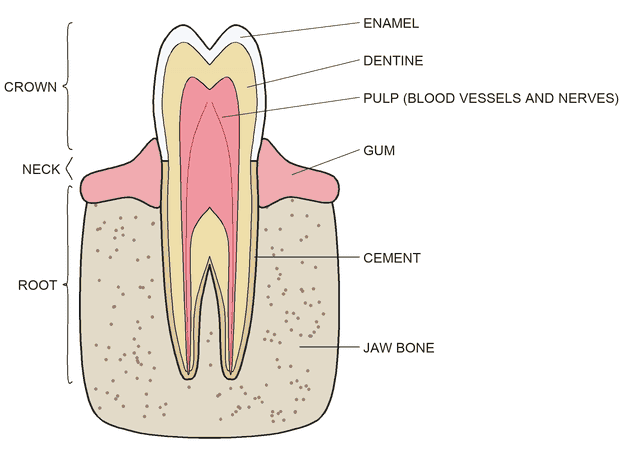
Labels: crown, neck, root, enamel, dentine, pulp (with blood vessels and nerves), cement, gum, jaw bone.
Step 2 — Parts (i) to (iii).
Each part is answered in turn. (i) The visible part (crown) is covered by enamel. (ii) The bone-like layer is the dentine. (iii) The embedded part (root) is covered by cement.
Step 3 — Parts (iv) and (v).
Each part is answered in turn. (iv) Caries are cavities (holes) in the teeth, formed when acids made by bacteria slowly dissolve the enamel and then the dentine. (v) Plaque is a soft, sticky, pale-yellow film of bacteria and food particles (sugary and starchy) that forms on the teeth.
Watch out: Enamel is harder than bone; it is the dentine that is described as bone-like.
Therefore, (i) enamel, (ii) dentine, (iii) cement, (iv) caries are cavities made by bacterial acids, and (v) plaque is a sticky film of bacteria and food on the teeth.
