Solution:
Concept: Digestion uses juices from several glands: saliva (salivary glands, mouth), gastric juice (stomach), bile (made by the liver, stored in the gall bladder) and pancreatic juice (pancreas), both poured into the duodenum, and intestinal juice (small intestine).
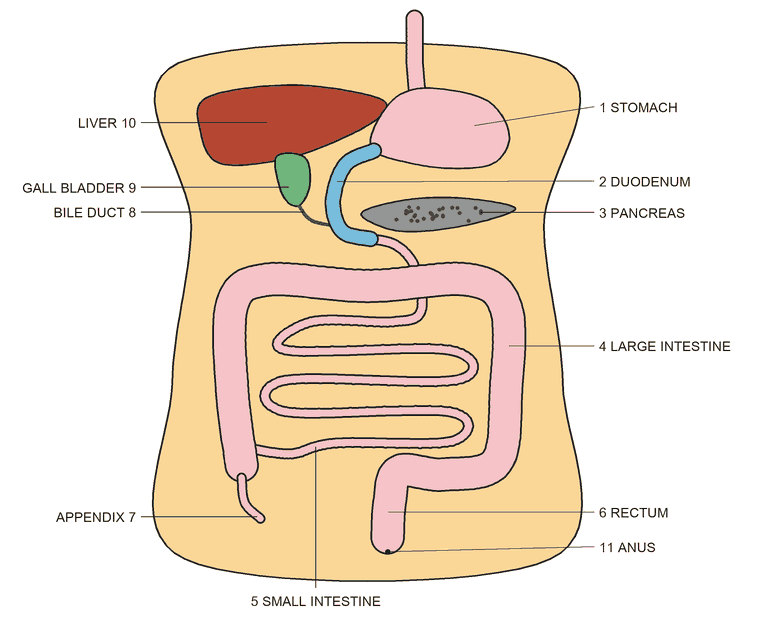
Step 1 — (i) Name the parts 1 to 11.
Following each guideline to the part it ends on gives: 1 stomach, 2 duodenum, 3 pancreas, 4 large intestine (colon), 5 small intestine, 6 rectum, 7 appendix, 8 bile duct, 9 gall bladder, 10 liver, 11 anus.
Step 2 — (ii) Juice of part 1.
Part 1, the stomach, secretes gastric juice. Its hydrochloric acid kills germs that come with food and makes the medium acidic so that pepsin can work. Pepsin breaks proteins into peptones, and rennin curdles the milk protein casein (in people, pepsin also does this).
Step 3 — (iii) Juice of part 3.
Part 3, the pancreas, secretes pancreatic juice into the duodenum. Its three enzymes work as listed below.
- Amylase changes starch into maltose.
- Trypsin changes proteins and peptones into peptides.
- Lipase changes emulsified fats into fatty acids and glycerol.
Watch out: The gall bladder (9) only stores bile; the bile is made by the liver (10).
Therefore, (i) 1 stomach, 2 duodenum, 3 pancreas, 4 large intestine, 5 small intestine, 6 rectum, 7 appendix, 8 bile duct, 9 gall bladder, 10 liver, 11 anus; (ii) gastric juice kills germs and digests proteins into peptones; (iii) amylase, trypsin and lipase digest starch, proteins and fats.

