
Opening your dashboard
Class 6 Biology Chapter 4 Digestive System: Practice Questions
44 questions on Chapter 4, each worked through on its own page with the AI tutor. Class 6 Biology, ICSE 2026-27.
44 questions
1–5 marks · Mixed difficulty
- 11 mark
Question 1
Bloom's level: Remember
Minerals and vitamins are needed by the body in very small (minute) quantities. Hence they are called :
- 21 mark
Question 2
Bloom's level: Remember
The slow, wave-like movement of the walls of the food pipe, which pushes the food down, is called :
- 31 mark
Question 3
Bloom's level: Remember
The undigested waste matter that is stored in the rectum before it is passed out is called :
- 41 mark
Question 4
Bloom's level: Remember
The soft material that fills the hollow space inside the dentine of a tooth, and contains nerves and blood vessels, is the :
- 51 mark
Question 5
Bloom's level: Understand
The hydrochloric acid in gastric juice is useful because it :
- 61 mark
Question 6
Bloom's level: Understand
After absorption, the amino acids reach the body cells. The cells use them mainly for :
- 71 mark
Question 7
Bloom's level: Apply
An old man has lost all his molars but still has all his other teeth. He will find it hardest to :
- 81 mark
Question 8
Bloom's level: Apply
Riya drinks a glass of milk sweetened with ordinary sugar. In her ileum, which pair of enzymes will act on the milk sugar (lactose) and the table sugar (sucrose) ?
- 91 mark
Question 9
Bloom's level: Apply
Ravi's lunch has rice, dal and a spoon of ghee. Which item mainly gives his body building material for growth ?
- 101 mark
Question 10
Bloom's level: Analyse
Assertion (A): The jejunum is a part of the small intestine.
Reason (R): Much of the digested food is absorbed into the blood in the jejunum.
- 111 mark
Question 11
Bloom's level: Evaluate
Assertion (A): Brushing the teeth at night before going to bed is especially important.
Reason (R): While we sleep, very little saliva is made, so food bits and bacteria left on the teeth are not washed away and can damage them.
- 121 mark
Question 12
Bloom's level: Analyse
Assertion (A): Food passes through the liver on its way from the stomach to the small intestine.
Reason (R): The liver is the largest gland in the body, and the bile it makes reaches the duodenum.
- 132 marks
Question 13
Bloom's level: Understand
Using a piece of chapati that you eat, explain in order the five steps of nutrition, in one line each.
- 142 marks
Question 14
Bloom's level: Apply
(a) In each half of one jaw, an adult has 2 incisors, 1 canine, 2 premolars and 3 molars. Show that an adult has 32 teeth in all.
(b) A young child has 20 milk teeth: 8 incisors, 4 canines and the rest molars (no premolars). How many molars does the child have ?
- 152 marks
Question 15
Bloom's level: Understand
A spoonful of plain boiled rice tastes sweet if you chew it for a long time. Explain why.
- 162 marks
Question 16
Bloom's level: Analyse
A person can swallow water even while lying flat, or while doing a headstand. Analyse what this tells you about how food moves down the oesophagus.
- 172 marks
Question 17
Bloom's level: Apply
Sita eats her lunch at 1:00 p.m. Suppose the food stays in her stomach for about 4 hours and then in her small intestine for about 5 hours. At about what time will the food (a) leave her stomach, and (b) finish its stay in the small intestine ? In what form does the food leave the stomach ?
- 182 marks
Question 18
Bloom's level: Understand
Glucose, amino acids and fatty acids are all absorbed in the ileum, but they do not all enter the same kind of vessel. Explain.
- 192 marks
Question 19
Bloom's level: Apply
During an attack of diarrhoea, a person passes very watery stools many times a day. Using the job of the large intestine, explain why the stools are watery, and why the person must drink plenty of clean water.
- 202 marks
Question 20
Bloom's level: Understand
Explain why a cavity that has reached the pulp of a tooth is much more painful than a cavity only in the enamel.
- 212 marks
Question 21
Bloom's level: Apply
Neha eats chocolates every night after dinner and goes to bed without brushing or rinsing her mouth. Predict, step by step, what is likely to happen to her teeth.
- 222 marks
Question 22
Bloom's level: Evaluate
Mohan says, "Once digested food has been absorbed into the blood, the process of nutrition is complete." Do you agree ? Justify your answer.
- 233 marks
Question 23
Bloom's level: Understand
(a) Explain the difference between the alimentary canal and the digestive system.
(b) For each digestive gland — salivary glands, liver and pancreas — state the place where its juice meets the food.
(c) Explain why food must be digested before the body can use it.
- 244 marks
Question 24
Bloom's level: Apply
Case: The school canteen is planning a lunch plate with rice, dal, paneer, a little ghee, spinach and an orange. The nurse says that a Class 6 student needs about 35 g of protein in a day.
(a) Which item(s) on the plate mainly give energy, which mainly give building material, and which mainly give vitamins and minerals ?
(b) Why is it important that the plate is not made of rice and ghee alone ?
(c) One bowl of dal gives about 9 g of protein, and one serving of paneer gives about 18 g. A student eats 1 bowl of dal and 1 serving of paneer in the day. How much more protein does he still need from other food ?
- 254 marks
Question 25
Bloom's level: Analyse
Case: For a project, Aarav followed a breakfast of buttered bread and a boiled egg through the alimentary canal. The bread gives starch, the butter gives fat, and the egg gives protein.
(a) In which organ does the digestion of (i) starch, (ii) protein and (iii) fat begin ?
(b) Trace the digestion of the egg protein from the stomach to its end product, naming each enzyme and the product it forms, in order.
(c) Analyse why the ileum is said to be the place where digestion is completed.
- 263 marks
Question 26
Bloom's level: Apply
Arjun puts a piece of laddoo in his mouth and eats it.
(a) Describe three ways in which his tongue helps him from the time the laddoo enters his mouth till he swallows it.
(b) What does his saliva do to the chewed laddoo before he swallows it ?
(c) Which part of the alimentary canal does the swallowed food enter next ?
- 273 marks
Question 27
Bloom's level: Analyse
Three test tubes, kept warm, each had a small piece of boiled egg white :
- Tube A : pepsin + a few drops of dilute hydrochloric acid
- Tube B : pepsin + water only
- Tube C : water only
After some hours, the egg white in tube A had become much smaller; in tubes B and C it was almost unchanged.
(a) Why did the egg white in tube A get digested ?
(b) Compare tubes A and B. What does this tell you about the role of hydrochloric acid in the stomach ?
(c) Why was tube C included ?
- 284 marks
Question 28
Bloom's level: Evaluate
Check these four statements made by a student. Say whether each is true or false, and correct the false ones.
(a) "Digestion of food begins in the stomach."
(b) "No digestion takes place in the oesophagus."
(c) "The large intestine secretes enzymes to digest the remaining food."
(d) "All five steps of nutrition take place inside the alimentary canal."
- 295 marks
Question 29
Bloom's level: Create
Create a "Journey of a Chapati" flow chart for your class notice board, following a bite of chapati (with a little ghee and dal) from the mouth to the anus.
(a) Show, in order, every part of the alimentary canal it passes through.
(b) At each stop, write the juice or enzyme that acts (if any) and the change that takes place.
(c) End the chart with where the useful products go and what happens to the waste.
- 305 marks
Question 30
Bloom's level: Create
Construct a revision table with the columns Organ / gland, Juice, Enzyme(s), Acts on, Products.
(a) Fill it for the salivary glands, the stomach, the pancreas and the ileum (intestinal glands).
(b) Add one row for the liver, even though its juice has no enzyme, and show what its juice does.
(c) Below the table, write the three final end products of carbohydrate, protein and fat digestion.
- 311 mark
Question 31
Class 6 Sample Paper 1 · Section I
Write the correct sequence of the parts of the alimentary canal given below:
Small intestine, Oesophagus, Large intestine, Pharynx, Stomach.
- 321 mark
Question 32
Class 6 Sample Paper 1 · Section I
Name the different types of teeth.
- 331 mark
Question 33
Class 6 Sample Paper 1 · Section II
The enzyme which digests starch into maltose is
- 345 marks
Question 34
Class 6 Sample Paper 2 · Section V
Identify the diagram and answer the following questions:
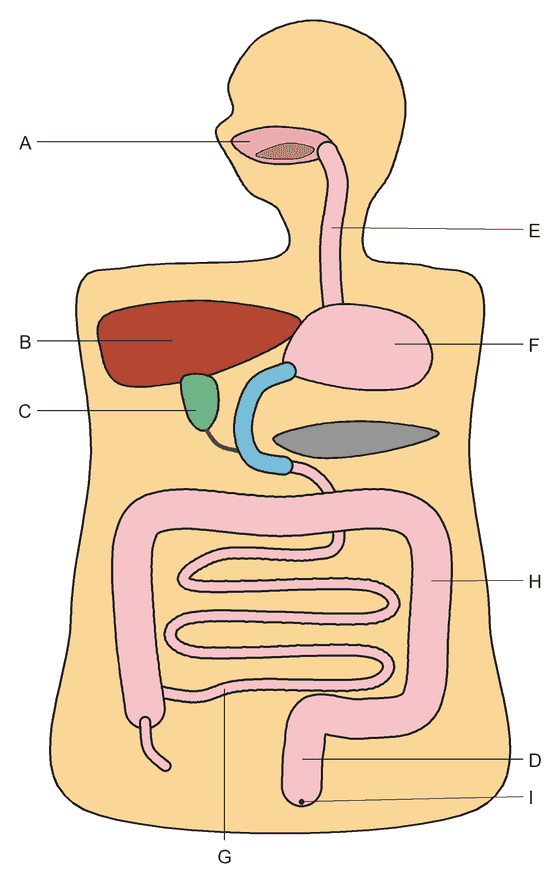
(a) Which system is shown in the diagram?
(b) Label the parts of the given system.
(c) Name the juice secreted by part B. What is the function of this juice?
(d) Name 3 parts of part H.
- 351 mark
Question 35
Ghee, oil and butter are fats. Besides providing energy, fats help the body by :
- 361 mark
Question 36
The intestinal juice contains all of the following enzymes EXCEPT :
- 371 mark
Question 37
Which one of the following statements about the oesophagus is correct ?
- 381 mark
Question 38
Fill in the blank :
The wisdom tooth usually appears at the age of .............. years.
- 391 mark
Question 39
Write true or false :
Fatty acids and glycerol, the end products of fat digestion, cannot be stored in the body and have to be used up at once.
- 402 marks
Question 40
(a) What is plaque ?
(b) How does plaque lead to the formation of cavities (caries) in the teeth ?
- 412 marks
Question 41
The rectum is the last part of the large intestine. It is about 15 cm long and opens to the outside at the anus.
(a) Name the circular muscle that keeps the anus closed.
(b) What is the process of eliminating the undigested food through the anus called ?
- 424 marks
Question 42
Anil drinks a glass of milk. In his stomach the milk turns into curd, and the proteins of his meal are changed into a simpler compound.
(a) Name the protein present in milk and the enzyme that converts it into curd.
(b) Name the enzyme of the gastric juice that digests proteins, and the compound that is formed.
(c) State two functions of the hydrochloric acid present in the gastric juice.
- 435 marks
Question 43
(a) Draw a neat labelled diagram of the human alimentary canal, showing the liver, the gall bladder and the pancreas along with it.
(b) Which is longer, the small intestine or the large intestine ? State the approximate length of each.
(c) Name the three digestive glands associated with the alimentary canal.
- 444 marks
Question 44
The table shows the action of some enzymes of the intestinal juice. Copy it and fill in the blanks.
Food substance Enzyme End product Peptides .............. Amino acids Maltose Maltase .............. Sucrose .............. Glucose and fructose Lactose Lactase .............. (a) Complete the table.
(b) Into which kind of vessels do the villi pass (i) the amino acids and glucose, and (ii) the fatty acids ?