
Opening your dashboard
Class 6 Biology Chapter 4 Digestive System: Competency-Based Questions (CBQ)
40 questions on Chapter 4, each worked through on its own page with the AI tutor. Class 6 Biology, ICSE 2026-27.
40 questions
1–5 marks · Mixed difficulty
- 11 mark
Question 1
Cognitive domain: Application
For a science exhibition, Anil builds a model of the food canal with plastic pipes and a balloon. By mistake, he joins the food pipe straight to the small intestine and leaves out the balloon that stands for the stomach. Suppose food moved through a body built like Anil's model. Which step of digestion would be missed ?
- 21 mark
Question 2
Cognitive domain: Analysis
A dentist counted the teeth of three members of one family and made this chart.
Person Incisors Canines Premolars Molars K 8 4 8 12 L 8 4 0 8 M 8 4 8 8 Which of these is most likely to be correct ?
- 31 mark
Question 3
Cognitive domain: Application
Meena's teacher gives the class a "what if" puzzle. "Suppose that, for one day, no bile reaches the duodenum. Every other part of the digestive system works as usual." Which item of a lunch would the body find hardest to digest on that day ?
- 41 mark
Question 4
Cognitive domain: Analysis
Farah eats a boiled potato, which is rich in starch. Four things that happen to this starch in her body are listed below, but not in the correct order.
- Statement 1 : Maltase of the intestinal juice changes maltose into glucose.
- Statement 2 : Salivary amylase changes some of the starch into maltose.
- Statement 3 : The villi absorb the glucose and pass it into the blood.
- Statement 4 : Amylase of the pancreatic juice changes starch into maltose.
Which is the correct order ?
- 51 mark
Question 5
Cognitive domain: Understanding
Assertion (A): Food can stay in the warm stomach for three to four hours without rotting.
Reason (R): The hydrochloric acid of the gastric juice kills germs and prevents the rotting of food in the stomach.
- 61 mark
Question 6
Cognitive domain: Analysis
Assertion (A): Bile juice contains the enzyme lipase, which changes fats into fatty acids and glycerol.
Reason (R): Emulsification is the breaking down of fats into tiny droplets.
- 71 mark
Question 7
Cognitive domain: Understanding
Kiran is very nervous before her speech on the school stage, and her mouth goes dry. She finds it hard to speak clearly. She also finds it hard to swallow the dry biscuit her friend gives her.
Complete the sentence :
Kiran has this trouble because too little ______ is being secreted in her mouth, and this fluid normally moistens and ______ the mouth cavity and the tongue.
- 81 mark
Question 8
Cognitive domain: Application
Rehan fell off his cycle. A small chip broke off the white outer layer at the tip of his front tooth. To his surprise, the tooth did not bleed and it did not hurt.
Complete the sentence :
The chip was made of ______, and the tooth did not bleed or hurt because the nerves and blood vessels of a tooth lie deep inside, in the ______.
- 91 mark
Question 9
Cognitive domain: Application
A young wrestler trains hard at an akhara in Haryana. During heavy training, some of his muscle cells get worn out and have to be repaired.
Complete the sentence :
To repair the worn-out cells, his body cells use ______, which are the end products of the digestion of ______.
- 102 marks
Question 10
Cognitive domain: Evaluation
Vivek is always in a hurry at lunch. He gulps down big pieces of chapati and potato without chewing them. He says, "Chewing is a waste of time. My stomach will do all the work anyway."
Do you agree with Vivek ? Give two reasons for your answer.
- 112 marks
Question 11
Cognitive domain: Understanding
A towel has thousands of tiny loops of thread on its surface. It soaks up much more water than a flat piece of cloth of the same size.
Use this idea to explain why the inner lining of the small intestine is not smooth, and how this helps the body.
- 122 marks
Question 12
Cognitive domain: Evaluation
Dev reads that the large intestine does not secrete any enzyme. He tells his friend, "Then the large intestine does nothing for the body. It is a useless part of the food canal."
Is Dev's conclusion correct ? Justify your answer.
- 134 marks
Question 13
Cognitive domain: Application
Case: Students of a school in Chandigarh are going on a ten-day trek in the cold mountains of Ladakh. They will walk and climb for many hours every day, and the nights will be very cold. Their teacher is planning the food for the trek.
(a) For the long climbs, the teacher packs plenty of rice and potatoes. Which group of nutrients do these foods mainly supply, and why is it needed on the trek ?
(b) She also adds extra ghee and butter to the food. Give two ways in which these help the trekkers in the cold mountains.
(c) On the third day, a student slips and scrapes her knee badly. Which group of nutrients does her body need to repair the damaged part ? Name two foods that are rich in it.
(d) The teacher makes sure that the food also has minerals and vitamins, though the body needs them only in very small amounts. What are such nutrients called ? Why should they not be left out ?
- 145 marks
Question 14
Cognitive domain: Analysis
Case: A touch-screen in a science museum shows the human alimentary canal. Four places on it are marked P, Q, R and S.
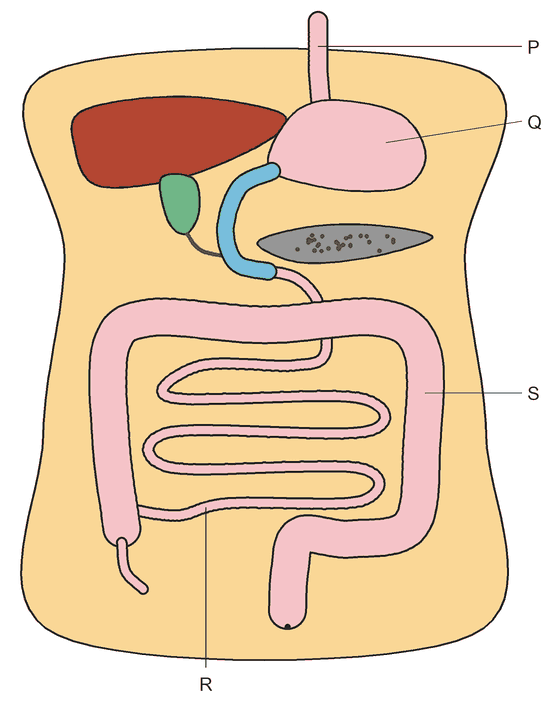
When a visitor touches a place, the screen describes the food found there. Neha noted the four descriptions as W, X, Y and Z, but forgot to write which place each one belongs to.
Description What the food is like at that place W A thick paste like pulp. It is acidic and contains peptones. X Semi-solid waste matter with very little water in it. Y A soft, moist ball of chewed food. It is being pushed along by wave-like movements, and no digestive juice is added to it here. Z A liquid that contains glucose, amino acids, fatty acids and glycerol. (a) Match each description W, X, Y and Z with the correct place P, Q, R or S.
(b) Name the thick paste in description W. Which two substances of the gastric juice explain why it is acidic and why it contains peptones ?
(c) The food that was eaten had starch in it, but description Z shows glucose. Name the two changes, with their enzymes, that turn starch into glucose.
(d) The food in description Z is a liquid, but the matter in description X has very little water. Explain what happened to the water.
- 155 marks
Question 15
Cognitive domain: Creativity
Case: A dentist visited a school in Jaipur and found that many children of Classes 1 and 2 had tooth cavities. The principal has asked Class 6 to plan a "Healthy Teeth Week" to help the younger children look after their teeth.
(a) Think of a catchy title or slogan for a poster. Then write four rules for the poster. Give the reason for each rule in simple words.
(b) Design a chart on which a child can record his or her tooth-care habits for one week. Draw the chart.
(c) Plan a set of four simple pictures, in order, that will show the little children how a tooth cavity forms. Write what each picture should show.
- 161 mark
Question 16
Cognitive domain: Analysis
A packet of ready-to-cook khichdi mix carries this label for every 100 g. (Hypothetical data.)
Item Amount in 100 g Carbohydrates 62 g Proteins 12 g Fats 8 g Iron 4 mg Vitamin C 10 mg Using the grouping of nutrients in the chapter, which statement about this label is correct ?
- 171 mark
Question 17
Cognitive domain: Application
A doctor asks a patient to swallow a tiny camera in a capsule, which takes pictures as it travels along the alimentary canal. (Hypothetical case.) In one part, the pictures show the food being churned with a juice that contains hydrochloric acid. In a later part, they show a lining covered with millions of tiny finger-like projections called villi. Which option names these two parts in the same order ?
- 181 mark
Question 18
Cognitive domain: Analysis
Four digestive fluids, W, X, Y and Z, are tested on starch, proteins and fats in a laboratory. (Hypothetical results.) A tick means the fluid digests that food and a cross means it does not. In the last column, a tick means the fluid breaks fats into tiny droplets.
Fluid Starch Proteins Fats Breaks fats into droplets W ✓ ✗ ✗ ✗ X ✗ ✓ ✗ ✗ Y ✓ ✓ ✓ ✗ Z ✗ ✗ ✗ ✓ Which row names the four fluids correctly ?
- 191 mark
Question 19
Cognitive domain: Evaluation
Four children describe how they look after their teeth. Which child follows all the advice given in the chapter ?
- 201 mark
Question 20
Cognitive domain: Understanding
Assertion (A): The gastric juice digests the starch of a chapati.
Reason (R): The gastric juice contains the enzyme pepsin, which converts proteins into peptones.
- 211 mark
Question 21
Cognitive domain: Analysis
Assertion (A): The digestion of food is completed in the ileum.
Reason (R): The bile juice and the pancreatic juice are poured directly into the ileum.
- 221 mark
Question 22
Cognitive domain: Application
At the end of a long race, a tired runner is given a glass of water in which glucose powder is dissolved. She soon feels better. Which statement best explains why the glucose can be used by her body so quickly ?
- 231 mark
Question 23
Cognitive domain: Understanding
The figure shows the human alimentary canal with four parts marked P, Q, R and S.
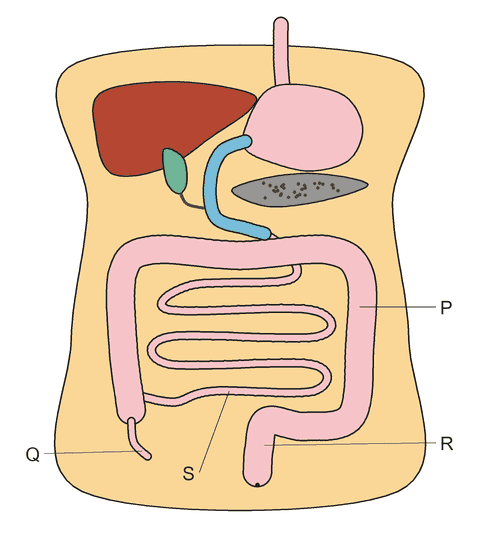
Which option correctly names the part where the undigested waste is stored until it is passed out, and the small tube, closed at its tip, through which the food does not pass ?
- 241 mark
Question 24
Cognitive domain: Analysis
After an illness, all the three pairs of salivary glands of a patient stop working. (Hypothetical case.) Every other part of his digestive system is normal. Which of these would not be affected by the loss of saliva ?
- 251 mark
Question 25
Cognitive domain: Evaluation
A student fills in a chart of organs and their functions. One of the entries is wrong. Which one is it ?
- 262 marks
Question 26
Cognitive domain: Evaluation
Tanvi says, "Peristalsis is the movement that takes place only in the oesophagus, because only the oesophagus is a long tube."
Is Tanvi correct ? Give two points in your answer.
- 272 marks
Question 27
Cognitive domain: Understanding
Pepsin and rennin are both enzymes of the gastric juice.
State one way in which their work is similar and one way in which it is different.
- 282 marks
Question 28
Cognitive domain: Analysis
A small stone blocks the common opening through which the bile duct and the pancreatic duct open into the duodenum. (Hypothetical case.)
Name the two juices that cannot reach the food in the duodenum. Which of the three food types, carbohydrates, proteins or fats, would be affected most by the loss of both juices ? Give a reason.
- 292 marks
Question 29
Cognitive domain: Application
Gopal eats a large helping of halwa made with a lot of ghee at a wedding. His body does not need all the energy at once.
State what happens to the extra fatty acids and glycerol that are absorbed from the fat. Name the step of nutrition in which the cells of the body use the absorbed food.
- 302 marks
Question 30
Cognitive domain: Application
Name the step of nutrition shown by each event: ingestion, digestion, absorption, assimilation or egestion.
- (i) Sonal swallows a spoon of curd rice.
- (ii) The amylase of the pancreatic juice changes the starch of the rice into maltose.
- (iii) The fatty acids pass into a lymph vessel of a villus.
- (iv) A muscle cell of a runner uses glucose to release energy.
- (v) The undigested waste is passed out through the anus.
- 312 marks
Question 31
Cognitive domain: Analysis
Mrs Rao gives her son a chapati for lunch and a vitamin-and-mineral tablet that dissolves in water.
Which of the two must be digested before the body can use it ? Using the chapter, explain why the other one does not need digestion.
- 322 marks
Question 32
Cognitive domain: Analysis
The chapter defines digestion as the breaking down of the complex chemical compounds of the food into simpler substances.
Sort the four actions into those that are digestion and those that only break up or mix the food without changing it into simpler substances :
- (i) The incisors cut a piece of apple.
- (ii) Pepsin changes proteins into peptones.
- (iii) The stomach churns the food with the digestive juices.
- (iv) Amylase changes starch into maltose.
- 333 marks
Question 33
Cognitive domain: Application
Rohan is 7 years old. While eating an apple, he finds that one of his front upper teeth is loose and then falls out. His mother says that this is nothing to worry about.
(a) Which set of teeth is Rohan losing ? At about what age do these teeth start falling, and by about what age are they replaced with new teeth ?
(b) Name the kind of front tooth that has fallen out, and state the job it does.
(c) Besides eating, name one other thing for which teeth help us, which may be difficult for Rohan for a while.
- 343 marks
Question 34
Cognitive domain: Analysis
The small intestine has three parts, one after the other. The notes about them are given in the table.
Part Notes 1 A short, 'U' shaped upper part that continues from the stomach. A common duct brings secretions into it from two organs. 2 The middle part, which joins part 1 to part 3. 3 The last part, a long, narrow, coiled tube. Its inner lining has glands that make a juice. (a) Name the parts 1, 2 and 3.
(b) Name the two juices that reach the food in part 1, and the organs that make them.
(c) The chapter says that one of the parts does two jobs for the food. Name the part and the two jobs.
- 353 marks
Question 35
Cognitive domain: Evaluation
At a school health talk, three students make statements. (Hypothetical statements.)
- Gita : "Ghee and butter give energy, but they do nothing else for the body."
- Hari : "Rice and chapati are mainly proteins, so we eat them to grow."
- Zeba : "Pulses, milk and eggs give the body building material to grow."
Evaluate each statement as correct or wrong, and correct the wrong ones.
- 363 marks
Question 36
Cognitive domain: Analysis
Sunita does the activity on the taste buds of the tongue with her friend Raj. She blindfolds Raj and asks him to keep his tongue out, flat and straight. She puts four samples, sugar solution, salt solution, lemon juice and crushed neem leaf, one by one on different areas of his tongue, using a new clean toothpick for each sample.
(a) Raj says that he could taste the sugar solution on the tip, on the sides and at the back of his tongue. Sunita expected sweet to be tasted only at the tip. What does Raj's result show about where the taste buds for sweet are found ?
(b) Why does Sunita use a new clean toothpick for each sample ?
(c) Why is Raj blindfolded ?
- 374 marks
Question 37
Cognitive domain: Analysis
Case: A dentist visited a school and checked 40 children in each of three groups. Group X brushes twice a day and rinses after every meal. Group Y brushes only once a day. Group Z eats sweets and chocolates every day and hardly ever brushes. The bar graph shows how many children in each group have cavities in their teeth; the number is written above each bar. (Hypothetical data.)
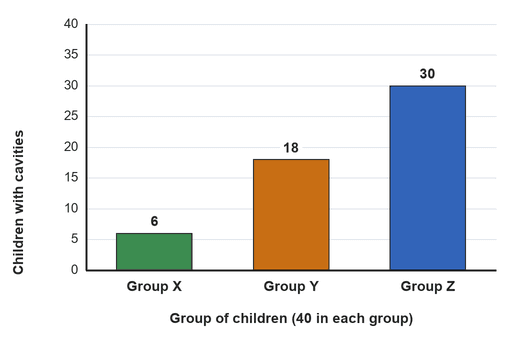
(a) Read the graph. How many children in each group have cavities ? What percentage of Group Z has cavities ?
(b) How many more children of Group Z than of Group X have cavities ? How many children of Group X are free of cavities ?
(c) Explain how sweets that stay on the teeth lead to cavities, using what you know about plaque. Say how this explains the result for Group X.
- 384 marks
Question 38
Cognitive domain: Application
Case: For the science exhibition, a group of students makes a model of the alimentary canal with coloured ribbons. They use a scale in which 1 cm of ribbon stands for 10 cm of the real organ. The real lengths are: small intestine 7 metres, large intestine 1.5 metres and rectum 15 cm.
(a) Find the length of ribbon in centimetres for the small intestine, the large intestine and the rectum.
(b) The rectum is a part of the large intestine. Find the length of ribbon for the rest of the large intestine, the caecum and the colon together.
(c) How many times is the real small intestine as long as the real large intestine ? Give one reason why the small intestine is so much longer.
- 395 marks
Question 39
Cognitive domain: Analysis
Case: After an accident, a man's stomach is damaged, and for some days he cannot eat in the usual way. (Hypothetical case.) The doctors feed him a special liquid through a thin tube placed straight into his small intestine. The liquid already contains glucose, amino acids, fatty acids and glycerol, and some vitamins and minerals, all dissolved in water.
(a) Why does this liquid not need to be digested ? Name the food group from which each of glucose, amino acids, and fatty acids with glycerol comes.
(b) Which step of nutrition must still take place in his small intestine, and through which structures ? Say where each of the three end products goes.
(c) After this step, name the step in which his cells use the three end products, and state one use of each.
- 405 marks
Question 40
Cognitive domain: Creativity
Case: Your group has to make a simple working model of peristalsis for the school science exhibition. You can use things found at home, such as a long soft cloth tube (an old sock with the toe cut open) and a small rubber ball.
(a) Describe your model. Say what the cloth tube, the ball and your hands stand for, and how you will move the ball along the tube.
(b) Write three sentences that the presenter will say to explain the model to visitors, linking it with the chapter.
(c) State two ways in which the model is different from the real alimentary canal, and suggest one way to improve it.