
Opening your dashboard
Class 6 Biology Chapter 2: The Flower Solutions
48 textbook questions with step-by-step answers, free to read, for ICSE 2026-27.
Get talked through Ch 2, not just shown the answer
Reading a finished solution is not the same as being able to do it. The AI tutor takes one question at a time and works it with you, in your own words, until you can.
- Ask it out loud, in your own words
- It gives you the next step, not the answer
- Stuck on part (ii)? Start there
48 questions with solutions
1–13 marks · Mixed difficulty
- 11 mark
Question 1
In a germinating seed, the roots develop from :
Solve with AIAnswer
- Correct
(A) Radicle
(B) Plumule
(C) Tegmen
(D) Hilum
Answer: (A) Radicle
Concept: The embryo of a seed has a radicle, which grows down into the root, and a plumule, which grows up into the shoot. The cotyledons (seed leaves) or the endosperm store food for it.
Step 1 — Recall what the radicle does.
When a seed germinates, the radicle comes out first and grows down into the soil.
Step 2 — Pick the option.
It develops into the root, so the answer is option (A).
Why the other options are wrong:
- (B) Plumule: the plumule grows up into the shoot.
- (C) Tegmen: the tegmen is the thin inner layer of the seed coat; it does not grow into anything.
- (D) Hilum: the hilum is a scar on the seed coat.
Therefore, in a germinating seed the roots develop from the radicle, option (A).
- 21 mark
Question 2
In a germinating seed, the shoot develops from :
Solve with AIAnswer
(A) Radicle
- Correct
(B) Plumule
(C) Tegmen
(D) Hilum
Answer: (B) Plumule
Concept: The embryo of a seed has a radicle, which grows down into the root, and a plumule, which grows up into the shoot. The cotyledons (seed leaves) or the endosperm store food for it.
Step 1 — Recall what the plumule does.
The plumule grows upward and forms the stem and the first leaves.
Step 2 — Pick the option.
So the shoot develops from the plumule, option (B).
Why the other options are wrong:
- (A) Radicle: the radicle grows down into the root.
- (C) Tegmen: the tegmen is the inner seed coat; it does not grow into a shoot.
- (D) Hilum: the hilum only marks where the seed was attached to the fruit wall.
Therefore, in a germinating seed the shoot develops from the plumule, option (B).
- 31 mark
Question 3
Which one of the following is a monocotyledonous seed ?
Solve with AIAnswer
(A) Bean
(B) Pea
- Correct
(C) Maize
(D) Gram
Answer: (C) Maize
Concept: A monocotyledonous seed has one cotyledon; a dicotyledonous seed has two.
Step 1 — Count the cotyledons.
Bean, pea and gram seeds split into two halves, the two cotyledons. The maize grain has only one cotyledon.
Step 2 — Pick the option.
So the monocot seed is maize, option (C).
Why the other options are wrong:
- (A) Bean: it has two cotyledons, so it is a dicot seed.
- (B) Pea: it has two cotyledons, so it is a dicot seed.
- (D) Gram: it has two cotyledons, so it is a dicot seed.
Therefore, maize is a monocotyledonous seed, option (C).
- 41 mark
Question 4
If the cotyledons are pushed above the soil, then such type of germination is called :
Solve with AIAnswer
- Correct
(A) Epigeal
(B) Hypogeal
(C) Perigeal
(D) Progeal
Answer: (A) Epigeal
Concept: In epigeal germination (epi = above, geal = earth) the cotyledons come above the soil, as in bean; in hypogeal germination (hypo = below) they stay in the soil, as in pea and maize.
Step 1 — Use the meaning of the word.
"Epi" means above and "geal" refers to the earth (soil). When the cotyledons are pushed above the soil, the germination is epigeal.
Step 2 — Pick the option.
So the answer is option (A).
Why the other options are wrong:
- (B) Hypogeal: in hypogeal germination the cotyledons stay below the soil.
- (C) Perigeal: "perigeal" is not a type of germination.
- (D) Progeal: "progeal" is not a type of germination.
Therefore, germination with the cotyledons pushed above the soil is epigeal, option (A).
- 51 mark
Question 5
If the cotyledons remain under the soil, then such type of germination is called :
Solve with AIAnswer
(A) Epigeal
- Correct
(B) Hypogeal
(C) Perigeal
(D) Progeal
Answer: (B) Hypogeal
Concept: In epigeal germination (epi = above, geal = earth) the cotyledons come above the soil, as in bean; in hypogeal germination (hypo = below) they stay in the soil, as in pea and maize.
Step 1 — Use the meaning of the word.
"Hypo" means below. When the cotyledons remain under the soil, the germination is hypogeal.
Step 2 — Pick the option.
So the answer is option (B).
Why the other options are wrong:
- (A) Epigeal: in epigeal germination the cotyledons come above the soil.
- (C) Perigeal: "perigeal" is not a type of germination.
- (D) Progeal: "progeal" is not a type of germination.
Therefore, germination with the cotyledons remaining under the soil is hypogeal, option (B).
- 61 mark
Question 6
Pollen is produced in the :
Solve with AIAnswer
(A) Filament
(B) Style
(C) Pistil
- Correct
(D) Anther
Answer: (D) Anther
Concept: A flower has four whorls on the thalamus: calyx (sepals), corolla (petals), androecium (stamens: anther + filament) and gynoecium (pistil: stigma + style + ovary). The stamens and the pistil are the reproductive whorls.
Step 1 — Recall the parts of a stamen.
A stamen has a thin stalk, the filament, and a head, the anther. The anther has pollen sacs in which pollen grains are made.
Step 2 — Pick the option.
So pollen is produced in the anther, option (D).
Watch out: The filament only holds the anther up; the pollen is made in the anther.
Why the other options are wrong:
- (A) Filament: the filament is the thin stalk that holds up the anther.
- (B) Style: the style is the stalk of the pistil that joins the stigma to the ovary.
- (C) Pistil: the pistil is the female part; it receives pollen but does not make it.
Therefore, pollen is produced in the anther, option (D).
- 71 mark
Question 7
Reproductive whorls of a flower are :
Solve with AIAnswer
- Correct
(A) Stamens and carpels
(B) Sepals and petals
(C) Sepals and stamens
(D) Petals and carpels
Answer: (A) Stamens and carpels
Concept: A flower has four whorls on the thalamus: calyx (sepals), corolla (petals), androecium (stamens: anther + filament) and gynoecium (pistil: stigma + style + ovary). The stamens and the pistil are the reproductive whorls.
Step 1 — Sort the whorls.
Sepals and petals protect the flower and attract insects; they are the helping (non-essential) whorls. Stamens (male) and carpels (female) make the gametes.
Step 2 — Pick the option.
So the reproductive whorls are the stamens and carpels, option (A).
Why the other options are wrong:
- (B) Sepals and petals: they are the non-reproductive (helping) whorls.
- (C) Sepals and stamens: stamens are reproductive, but sepals are not.
- (D) Petals and carpels: carpels are reproductive, but petals are not.
Therefore, the reproductive whorls of a flower are the stamens and carpels, option (A).
- 81 mark
Question 8
Which one of the following is a false fruit ?
Solve with AIAnswer
(A) Tomato
- Correct
(B) Apple
(C) Potato
(D) Pea
Answer: (B) Apple
Concept: A true fruit develops from the ovary only; in a false fruit the main fleshy part grows from another part of the flower, such as the thalamus.
Step 1 — Check where the fleshy part comes from.
In an apple the juicy part we eat grows from the thalamus; the real fruit from the ovary is only the core with the seeds.
Step 2 — Pick the option.
So the false fruit is the apple, option (B).
Watch out: Potato is eaten like a fruit or vegetable, but it is not a fruit at all.
Why the other options are wrong:
- (A) Tomato: the tomato is a true fruit; it grows from the ovary.
- (C) Potato: the potato is an underground stem (tuber), not a fruit.
- (D) Pea: the pea pod is a true fruit; it grows from the ovary.
Therefore, the apple is a false fruit, option (B).
- 91 mark
Question 9
In a seed, food is generally stored in :
Solve with AIAnswer
(A) Radicle
(B) Plumule
(C) Fruit
- Correct
(D) Cotyledons or endosperms
Answer: (D) Cotyledons or endosperms
Concept: The embryo of a seed has a radicle, which grows down into the root, and a plumule, which grows up into the shoot. The cotyledons (seed leaves) or the endosperm store food for it.
Step 1 — Recall where food is stored.
In seeds such as bean and gram the food is stored in the thick cotyledons. In maize and other cereals it is stored in the endosperm.
Step 2 — Pick the option.
So the answer is option (D).
Why the other options are wrong:
- (A) Radicle: the radicle grows into the root; it is not a food store.
- (B) Plumule: the plumule grows into the shoot; it is not a food store.
- (C) Fruit: the fruit is the ripened ovary around the seed, not a part of the seed.
Therefore, food in a seed is generally stored in the cotyledons or the endosperm, option (D).
- 101 mark
Question 10
The floral stalk is technically termed as :
Solve with AIAnswer
(A) Petiole
- Correct
(B) Pedicel
(C) Peduncle
(D) Thalamus
Answer: (B) Pedicel
Concept: A flower has four whorls on the thalamus: calyx (sepals), corolla (petals), androecium (stamens: anther + filament) and gynoecium (pistil: stigma + style + ovary). The stamens and the pistil are the reproductive whorls.
Step 1 — Recall the stalk of a flower.
A single flower is joined to the plant by its own stalk, the pedicel.
Step 2 — Pick the option.
So the floral stalk is the pedicel, option (B).
Watch out: The peduncle is the main stalk of a whole bunch of flowers, while the pedicel is the stalk of one flower.
Why the other options are wrong:
- (A) Petiole: the petiole is the stalk of a leaf.
- (C) Peduncle: the peduncle is the main stalk of a whole cluster of flowers (an inflorescence).
- (D) Thalamus: the thalamus is the swollen tip of the stalk on which the floral parts sit.
Therefore, the floral stalk is called the pedicel, option (B).
- 111 mark
Question 11
Which of the following is the fleshy part of a mango ?
Solve with AIAnswer
(A) Pericarp
(B) Endocarp
(C) Epicarp
- Correct
(D) Mesocarp
Answer: (D) Mesocarp
Concept: A fruit is a ripened ovary. Its wall, the pericarp, has three layers: the epicarp (skin), the mesocarp (middle) and the endocarp (inner, hard stone in mango). The ovules become the seeds.
Step 1 — Recall the layers of a mango.
The thin skin is the epicarp, the hard stone round the seed is the endocarp, and the thick, sweet, juicy middle layer is the mesocarp.
Step 2 — Pick the option.
So the fleshy part of the mango is the mesocarp, option (D).
Watch out: The pericarp is the whole fruit wall, so it is more than just the fleshy part.
Why the other options are wrong:
- (A) Pericarp: the pericarp is the whole fruit wall, all three layers, not just the fleshy one.
- (B) Endocarp: the endocarp is the hard stone around the seed.
- (C) Epicarp: the epicarp is the thin outer skin.
Therefore, the fleshy part of a mango is the mesocarp, option (D).
- 121 mark
Question 12
The food material stored in a maize grain is :
Solve with AIAnswer
(A) Protein
(B) Fat
- Correct
(C) Starch
(D) Cellulose
Answer: (C) Starch
Concept: The maize grain stores its food in the endosperm, mainly as starch; the outer aleurone layer of the endosperm is rich in protein.
Step 1 — Recall the main stored food.
Most of the maize endosperm is packed with starch, which is why maize is a cereal rich in carbohydrate.
Step 2 — Pick the option.
So the food material stored in a maize grain is starch, option (C).
Watch out: Maize does contain some protein and oil, but its main stored food is starch.
Why the other options are wrong:
- (A) Protein: it is present (it is richest in the aleurone layer), but it is not the main stored food.
- (B) Fat: maize stores some oil in its embryo, but fat is not its main stored food.
- (D) Cellulose: it forms the cell walls; it is not stored food.
Therefore, the food material stored in a maize grain is starch, option (C).
- 131 mark
Question 13
Gynoecium is made up of :
Solve with AIAnswer
(A) Carpels
(B) Pistils
(C) Stamens
- Correct
(D) Both (a) and (b)
Answer: (D) Both (a) and (b)
Concept: A flower has four whorls on the thalamus: calyx (sepals), corolla (petals), androecium (stamens: anther + filament) and gynoecium (pistil: stigma + style + ovary). The stamens and the pistil are the reproductive whorls.
Step 1 — Recall what makes up the gynoecium.
The gynoecium is the female whorl. It is made of one or more carpels, and each carpel (or group of joined carpels) forms a pistil with a stigma, style and ovary.
Step 2 — Pick the option.
So the gynoecium can be described as made of carpels or of pistils, and the answer is "both (a) and (b)", option (D).
Watch out: Here "(a)" and "(b)" in option (D) refer to options (A) and (B).
Why the other options are wrong:
- (A) Carpels: it is correct, but pistils is also correct, so this answer is incomplete.
- (B) Pistils: it is correct, but carpels is also correct, so this answer is incomplete.
- (C) Stamens: they form the androecium, the male whorl.
Therefore, the gynoecium is made up of carpels or pistils, option (D).
- 141 mark
Question 14
Which part of the flower attracts insects for pollination ?
Solve with AIAnswer
(A) Calyx
- Correct
(B) Corolla
(C) Stamens
(D) Stigma
Answer: (B) Corolla
Concept: A flower has four whorls on the thalamus: calyx (sepals), corolla (petals), androecium (stamens: anther + filament) and gynoecium (pistil: stigma + style + ovary). The stamens and the pistil are the reproductive whorls.
Step 1 — Find the part that attracts insects.
The corolla, made of the petals, is brightly coloured and often scented, and nectar is often found at its base. These attract insects.
Step 2 — Pick the option.
So the answer is option (B).
Why the other options are wrong:
- (A) Calyx: the calyx (sepals) is usually green and protects the flower in the bud.
- (C) Stamens: the stamens make pollen; insects collect it, but it is the petals that draw them in.
- (D) Stigma: the stigma receives pollen; it does not attract insects.
Therefore, the corolla attracts insects for pollination, option (B).
- 151 mark
Question 15
Which of the following is not a necessary condition for the germination of seeds ?
Solve with AIAnswer
(A) Air
(B) Water
- Correct
(C) Soil
(D) Warmth
Answer: (C) Soil
Concept: A seed germinates only when it gets water, air (oxygen) and a suitable temperature; it does not need soil or light to start.
Step 1 — List the three conditions.
A seed needs water, air (oxygen) and warmth to germinate. Seeds germinate even on moist cotton wool, with no soil at all.
Step 2 — Pick the option.
So soil is not a necessary condition, option (C).
Watch out: Soil helps the seedling later, but the seed does not need it to germinate.
Why the other options are wrong:
- (A) Air: it supplies the oxygen the seed needs for respiration.
- (B) Water: it softens the seed coat and starts the seed's activities.
- (D) Warmth: this tissue (a suitable temperature) is needed for the seed's chemical activities.
Therefore, soil is not a necessary condition for germination, option (C).
- 161 mark
Question 16
Assertion (A): Androecium is the third whorl of the flower. It is made up of stamens which produce pollen grains at the time of reproduction.
Reason (R): Pollination and fertilization are essential steps of reproduction in plants during which male gametes fuse with the ovule and a seed is produced inside the ovary.
Solve with AIAnswer
(A) (1) Both A and R are true and R is the correct explanation of A.
- Correct
(B) (2) Both A and R are true but R is not the correct explanation of A.
(C) (3) A is true but R is false.
(D) (4) A is false but R is true.
Answer: (B) (2) Both A and R are true but R is not the correct explanation of A.
Concept: In an assertion-reason item, first judge the Assertion (A) and the Reason (R) separately as true or false; only when both are true do we ask whether R correctly explains A.
Step 1 — Judge the Assertion.
A is true. The androecium is the third whorl of the flower. It is made of stamens, whose anthers produce pollen grains.
Step 2 — Judge the Reason.
R is true as a statement about reproduction: pollination and fertilisation are its essential steps, a male gamete fuses with the egg inside the ovule, and the ovule becomes a seed inside the ovary.
Step 3 — Check whether R explains A.
R describes what happens in reproduction; it does not tell us why the androecium is the third whorl or why it makes pollen. So R is not the correct explanation of A, option (B).
Watch out: Two true statements on the same topic are not enough; R must give the reason for A.
Note: Strictly, the male gamete fuses with the egg cell inside the ovule, not with the whole ovule; R is read here in that sense.
Why the other options are wrong:
- (A): R does not explain A, so this option is wrong.
- (C): R is a true statement.
- (D): A is a true statement.
Therefore, both A and R are true but R is not the correct explanation of A, option (B).
- 171 mark
Question 17
Assertion (A): Cross pollination occurs between different flowers of two plants of the same species. These flowers get pollinated by wind, water, insects, etc.
Reason (R): Wind pollination always occurs between the flowers of plants occuring in close vicinity and not among the flowers of distant plants.
Solve with AIAnswer
(A) (1) Both A and R are true and R is the correct explanation of A.
(B) (2) Both A and R are true but R is not the correct explanation of A.
- Correct
(C) (3) A is true but R is false.
(D) (4) A is false but R is true.
Answer: (C) (3) A is true but R is false.
Concept: In an assertion-reason item, first judge the Assertion (A) and the Reason (R) separately as true or false; only when both are true do we ask whether R correctly explains A.
Step 1 — Judge the Assertion.
A is true. Cross-pollination is between flowers on two different plants of the same species, and agents such as wind, water and insects carry the pollen.
Step 2 — Judge the Reason.
R is false. Wind carries light, dry pollen grains a long way, so wind pollination is not limited to nearby plants.
Step 3 — Pick the option.
A is true and R is false, so the answer is option (C).
Watch out: The word "always" in R makes it false.
Why the other options are wrong:
- (A): R is false, so it cannot explain A.
- (B): R is false, so "both A and R are true" is wrong.
- (D): A is a true statement, not a false one.
Therefore, A is true but R is false, option (C).
- 181 mark
Question 18
Assertion (A): All aquatic plants get pollinated only by the most easily available pollinating agent — water.
Reason (R): Flowers of some aquatic plants are exposed to air and can be pollinated by insects.
Solve with AIAnswer
(A) (1) Both A and R are true and R is the correct explanation of A.
(B) (2) Both A and R are true but R is not the correct explanation of A.
(C) (3) A is true but R is false.
- Correct
(D) (4) A is false but R is true.
Answer: (D) (4) A is false but R is true.
Concept: In an assertion-reason item, first judge the Assertion (A) and the Reason (R) separately as true or false; only when both are true do we ask whether R correctly explains A.
Step 1 — Judge the Assertion.
A is false. Only a few water plants, such as Vallisneria, are pollinated by water. The word "all" makes A false.
Step 2 — Judge the Reason.
R is true. Some water plants, such as the lotus and the water lily, hold their flowers up in the air, where insects pollinate them.
Step 3 — Pick the option.
A is false and R is true, so the answer is option (D).
Watch out: Living in water does not mean pollination by water; many water plants use insects.
Why the other options are wrong:
- (A): A is false, so R cannot explain it.
- (B): A is false, so "both A and R are true" is wrong.
- (C): this says A is true and R is false; in fact it is the other way round.
Therefore, A is false but R is true, option (D).
- 191 mark
Question 19
Assertion (A): The yellow, fleshy, edible part of the peach is mesocarp which develops from the wall of the ovary.
Reason (R): Mesocarp is the middle layer of the pericarp between the protective epicarp and stony endocarp.
Solve with AIAnswer
- Correct
(A) (1) Both A and R are true and R is the correct explanation of A.
(B) (2) Both A and R are true but R is not the correct explanation of A.
(C) (3) A is true but R is false.
(D) (4) A is false but R is true.
Answer: (A) (1) Both A and R are true and R is the correct explanation of A.
Concept: In an assertion-reason item, first judge the Assertion (A) and the Reason (R) separately as true or false; only when both are true do we ask whether R correctly explains A.
Step 1 — Judge the Assertion.
A is true. In a peach, as in a mango, the yellow, fleshy part we eat is the mesocarp, and it is part of the fruit wall, which grows from the ovary wall.
Step 2 — Judge the Reason.
R is true. The mesocarp is the middle layer of the pericarp, between the thin epicarp and the stony endocarp.
Step 3 — Check whether R explains A.
R shows that the mesocarp is a layer of the pericarp (the fruit wall), which is why it comes from the ovary wall. So R is the correct explanation of A, option (A).
Why the other options are wrong:
- (B): R does explain A, so "R is not the correct explanation" is wrong.
- (C): R is a true statement.
- (D): A is a true statement.
Therefore, both A and R are true and R is the correct explanation of A, option (A).
- 201 mark
Question 20
Assertion (A): Both proteins and starch are richly found in the endosperm as well as the cotyledon of the maize grain.
Reason (R): Maize grain is an example of an endospermic seed. Hence, proteins and starch are stored in the endosperm which can be easily utilized by the developing embryo.
Solve with AIAnswer
(A) (1) Both A and R are true and R is the correct explanation of A.
(B) (2) Both A and R are true but R is not the correct explanation of A.
(C) (3) A is true but R is false.
- Correct
(D) (4) A is false but R is true.
Answer: (D) (4) A is false but R is true.
Concept: In an assertion-reason item, first judge the Assertion (A) and the Reason (R) separately as true or false; only when both are true do we ask whether R correctly explains A.
Step 1 — Judge the Assertion.
A is false. In maize the starch (with protein, richest in the aleurone layer) is stored in the endosperm. The single cotyledon of maize is not a starch store; it mainly absorbs food from the endosperm for the embryo.
Step 2 — Judge the Reason.
R is true. Maize is an endospermic seed; its endosperm stores starch and protein, which the growing embryo uses during germination.
Step 3 — Pick the option.
A is false and R is true, so the answer is option (D).
Watch out: In bean the cotyledons store the food, but in maize the endosperm does.
Why the other options are wrong:
- (A): A is false, so R cannot explain it.
- (B): A is false, so "both A and R are true" is wrong.
- (C): this says A is true and R is false; in fact it is the other way round.
Therefore, A is false but R is true, option (D).
- 215 marks
Question 21
Match the terms given in column A with those of column B.
Column A Column B (a) Radicle (i) Shoot (b) Plumule (ii) Store food material (c) Cotyledon (iii) Root (d) Testa (iv) Absorb water needed for germination (e) Micropyle (v) Protection of seed Solve with AIWritten solution
Solution:
Concept: The embryo of a seed has a radicle, which grows down into the root, and a plumule, which grows up into the shoot. The cotyledons (seed leaves) or the endosperm store food for it.
Step 1 — Match the embryo parts.
The radicle grows into the root, so (a) matches (iii). The plumule grows into the shoot, so (b) matches (i). The cotyledon stores food, so (c) matches (ii).
Step 2 — Match the seed coat parts.
The testa is the tough outer coat that protects the seed, so (d) matches (v). The micropyle is the tiny pore through which water enters for germination, so (e) matches (iv).
Step 3 — Write the pairs.
The completed match is shown below.
Column A Column B (a) Radicle (iii) Root (b) Plumule (i) Shoot (c) Cotyledon (ii) Store food material (d) Testa (v) Protection of seed (e) Micropyle (iv) Absorb water needed for germination Therefore, (a) matches (iii), (b) matches (i), (c) matches (ii), (d) matches (v) and (e) matches (iv).
- 225 marks
Question 22
Name the following :
(i) Four whorls of a bisexual flower.
(ii) Four pollinating agents.
(iii) Two types of seeds on the basis of the number of cotyledons.
(iv) Two types of germination.
(v) Two types of pollination.
Solve with AIWritten solution
Solution:
Concept: Recall the names used in the chapter for the whorls of a flower, pollinating agents, seeds, germination and pollination.
Step 1 — (i) Four whorls.
The four whorls are the calyx, corolla, androecium and gynoecium.
Step 2 — (ii) Four pollinating agents.
Pollen is carried by insects, wind, water and animals such as birds and bats.
Step 3 — (iii) Two types of seeds.
Seeds are dicotyledonous (two cotyledons) or monocotyledonous (one cotyledon).
Step 4 — (iv) Two types of germination.
Germination is epigeal or hypogeal.
Step 5 — (v) Two types of pollination.
Pollination is self-pollination or cross-pollination.
Therefore, (i) calyx, corolla, androecium, gynoecium; (ii) insects, wind, water, animals; (iii) dicot and monocot; (iv) epigeal and hypogeal; (v) self and cross.
- 235 marks
Question 23
Given below are sets of four terms. Choose the odd one and write the category of the remaining terms :
(i) Epicarp, Epicalyx, Endocarp, Mesocarp
(ii) Anther, Ovary, Stigma, Style
(iii) Bean, Gram, Rice, Pea
(iv) Tegmen, Cotyledones, Testa, Thalamus
(v) Apple, Mango, Guava, Litchi
Solve with AIWritten solution
Solution:
Concept: In each set, find what three terms have in common; the fourth term, which does not fit, is the odd one.
Step 1 — (i) Epicarp, Epicalyx, Endocarp, Mesocarp.
Epicarp, endocarp and mesocarp are the layers of the pericarp (fruit wall). The epicalyx is an extra whorl of sepal-like parts below the calyx, so epicalyx is the odd one.
Step 2 — (ii) Anther, Ovary, Stigma, Style.
Ovary, stigma and style are the parts of the pistil. The anther is part of a stamen, so anther is the odd one.
Step 3 — (iii) Bean, Gram, Rice, Pea.
Bean, gram and pea are dicot seeds (two cotyledons). Rice has one cotyledon, so rice is the odd one.
Step 4 — (iv) Tegmen, Cotyledones, Testa, Thalamus.
Tegmen, cotyledons and testa are parts of a seed. The thalamus is part of a flower, so thalamus is the odd one.
Step 5 — (v) Apple, Mango, Guava, Litchi.
Mango, guava and litchi are true fruits. The apple is a false fruit, so apple is the odd one.
Therefore, the odd ones are (i) epicalyx, (ii) anther, (iii) rice, (iv) thalamus and (v) apple.
- 245 marks
Question 24
Correct the following statements by changing the first/last word only :
(i) Ovary is the part of a flower from where the petals and other floral parts arise.
(ii) A fruit is the ripened ovule.
(iii) The plumule of an embryo develops into the root system.
(iv) Hilum is a small pore which allows the entry of water inside the seed.
(v) Enzymes act best at a temperature between 45° to 50°C.
Solve with AIWritten solution
Solution:
Concept: Change only the first or the last word (or value) of each statement so that it becomes true.
Step 1 — (i) Where the floral parts arise.
The petals and other floral parts arise from the thalamus, so the first word changes: "Thalamus is the part of a flower from where the petals and other floral parts arise."
Step 2 — (ii) What a fruit is.
A fruit develops from the ovary, so the last word changes: "A fruit is the ripened ovary."
Step 3 — (iii) What forms the root.
The radicle, not the plumule, forms the root, so the first word changes: "The radicle of an embryo develops into the root system."
Step 4 — (iv) The pore for water.
The hilum is a scar; the pore is the micropyle, so the first word changes: "Micropyle is a small pore which allows the entry of water inside the seed."
Step 5 — (v) The best temperature.
The temperature range given in the chapter is 35° to 40°C, so the last value changes: "Enzymes act best at a temperature between 35° to 40°C."
Watch out: Change only one word in each; the rest of the sentence must stay as printed.
Therefore, the corrected words are (i) thalamus, (ii) ovary, (iii) radicle, (iv) micropyle and (v) 35° to 40°C.
- 2510 marks
Question 25
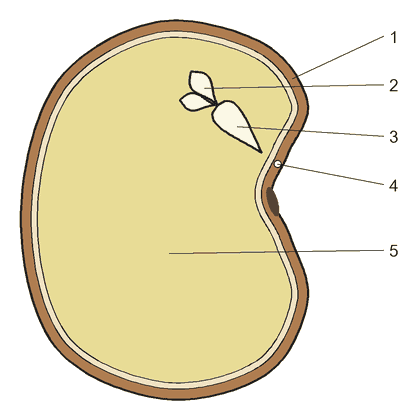
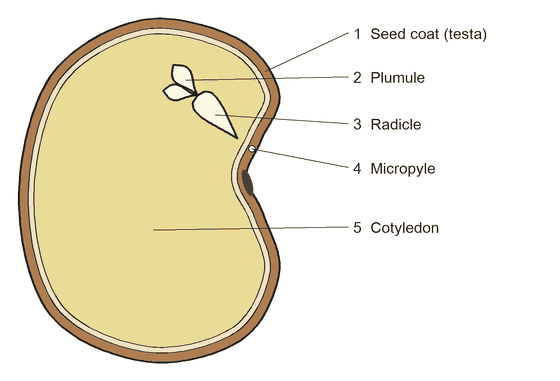
Given below is a longitudinal section of a bean seed. Label the parts marked 1 to 5 and write their functions.
 Solve with AI
Written solution
Solution:
Concept: A bean seed has a seed coat (testa outside, tegmen inside), two cotyledons that store food, and an embryo axis with a plumule and a radicle; the micropyle is a tiny pore near the hilum.
Step 1 — Label the parts.
Compare each guideline with the parts of a bean seed. The labelled diagram is shown below.
Step 2 — Write the functions.
Each part does one main job.
- 1 Seed coat (testa): it protects the seed from injury, insects and germs.
- 2 Plumule: it grows upward and develops into the shoot.
- 3 Radicle: it grows downward and develops into the root.
- 4 Micropyle: it is a small pore that lets water enter the seed for germination.
- 5 Cotyledon: it stores food for the growing seedling.
Watch out: The micropyle is the pore and the hilum is the scar beside it; do not mix them up.
Therefore, 1 seed coat (protection), 2 plumule (shoot), 3 radicle (root), 4 micropyle (water entry), 5 cotyledon (food store).
- 264 marks
Question 26
Name the following :
(a) A seed which shows hypogeal germination.
(b) A monocot seed.
(c) A dicot seed.
(d) A seed which shows epigeal germination.
Solve with AIWritten solution
Solution:
Concept: In epigeal germination (epi = above, geal = earth) the cotyledons come above the soil, as in bean; in hypogeal germination (hypo = below) they stay in the soil, as in pea and maize.
Step 1 — (a) Hypogeal germination.
Pea (or maize) shows hypogeal germination.
Step 2 — (b) A monocot seed.
Maize is a monocot seed.
Step 3 — (c) A dicot seed.
Bean (or gram, pea) is a dicot seed.
Step 4 — (d) Epigeal germination.
Bean (or papaya, cucumber) shows epigeal germination.
Therefore, (a) pea, (b) maize, (c) bean, (d) bean.
- 276 marks
Question 27
Differentiate between the following pairs of terms :
(a) Radicle and plumule.
(b) Hilum and micropyle.
(c) Testa and tegmen.
Solve with AIWritten solution
Solution:
Concept: Compare each pair on what the part is and what it does.
Step 1 — (a) Radicle and plumule.
Both are parts of the embryo, but they grow in opposite directions.
Radicle Plumule Grows downward. Grows upward. Develops into the root. Develops into the shoot. Step 2 — (b) Hilum and micropyle.
Both are on the seed coat, close to each other.
Hilum Micropyle A scar on the seed coat. A tiny pore in the seed coat, near the hilum. Marks where the seed was attached to the fruit wall. Lets water enter the seed for germination. Step 3 — (c) Testa and tegmen.
Both are layers of the seed coat.
Testa Tegmen The outer layer of the seed coat. The inner layer of the seed coat. Thick and tough. Thin and papery, just under the testa. Therefore, the radicle forms the root and the plumule the shoot; the hilum is a scar and the micropyle a pore; the testa is the thick outer coat and the tegmen the thin inner coat.
- 282 marks
Question 28
Give two functions of a fruit.
Solve with AIWritten solution
Solution:
Concept: A fruit is a ripened ovary. Its wall, the pericarp, has three layers: the epicarp (skin), the mesocarp (middle) and the endocarp (inner, hard stone in mango). The ovules become the seeds.
Step 1 — Protection.
The fruit protects the seeds inside it from drying, injury and animals.
Step 2 — Dispersal.
The fruit helps in the dispersal of seeds, that is, spreading them to new places (by animals, wind or water).
Therefore, a fruit protects the seeds and helps to disperse them.
- 292 marks
Question 29
Radicle emerges out of the seed earlier than plumule. State one advantage served by this.
Solve with AIWritten solution
Solution:
Concept: The embryo of a seed has a radicle, which grows down into the root, and a plumule, which grows up into the shoot. The cotyledons (seed leaves) or the endosperm store food for it.
Step 1 — State the advantage.
The radicle comes out first so that it can quickly fix the seedling in the soil.
Step 2 — Explain why it matters.
It also starts absorbing water and minerals, so a supply of water is ready when the plumule begins to grow into the shoot.
Therefore, the early radicle anchors the seedling and supplies water before the shoot grows.
- 304 marks
Question 30
State whether the following statements are True or False.
(a) Some seeds have no cotyledons.
(b) Warmth is necessary for the germination of seeds.
(c) All seeds have two cotyledons.
(d) Oxygen is necessary for the germination of seeds.
Solve with AIWritten solution
Solution:
Concept: The seeds studied in this chapter have either one cotyledon (monocots) or two (dicots), and every seed needs water, air (oxygen) and warmth to germinate.
Step 1 — (a) Some seeds have no cotyledons.
As the chapter teaches, a seed has one or two cotyledons, so the statement is False.
Step 2 — (b) Warmth is necessary.
A seed needs a suitable temperature to germinate, so the statement is True.
Step 3 — (c) All seeds have two cotyledons.
Monocot seeds such as maize have only one cotyledon, so the statement is False.
Step 4 — (d) Oxygen is necessary.
The seed needs oxygen for respiration, which gives energy for growth, so the statement is True.
Note: A few unusual seeds, such as those of dodder and orchids, have embryos without distinct cotyledons, but the seeds of ordinary flowering plants studied here have one or two.
Therefore, (a) False, (b) True, (c) False, (d) True.
- 314 marks
Question 31
State one function of the following :
(a) Radicle
(b) Cotyledons
(c) Endosperm
(d) Micropyle
Solve with AIWritten solution
Solution:
Concept: The embryo of a seed has a radicle, which grows down into the root, and a plumule, which grows up into the shoot. The cotyledons (seed leaves) or the endosperm store food for it.
Step 1 — (a) Radicle.
The radicle develops into the root.
Step 2 — (b) Cotyledons.
The cotyledons store food for the growing seedling (as in bean).
Step 3 — (c) Endosperm.
The endosperm stores food, mainly starch, for the embryo (as in maize).
Step 4 — (d) Micropyle.
The micropyle lets water enter the seed for germination.
Therefore, the radicle forms the root, cotyledons and endosperm store food, and the micropyle lets in water.
- 321 mark
Question 32
The three conditions necessary for germination of seeds are (tick the correct answer) :
(a) Oxygen, suitable temperature and water.
(b) Good soil, water and air.
(c) Good soil, suitable temperature and light.
(d) Light, oxygen, and temperature.
(e) Oxygen, carbon dioxide, and light.
Solve with AIWritten solution
Solution:
Concept: A seed germinates only when it gets water, air (oxygen) and a suitable temperature; it does not need soil or light to start.
Step 1 — Check each choice.
Choices (b) and (c) include soil, and (c), (d) and (e) include light; a seed needs neither to germinate. Choice (e) also includes carbon dioxide, which a seed does not need.
Step 2 — Pick the correct choice.
Only choice (a) lists exactly oxygen, a suitable temperature and water.
Watch out: Light is needed later by the green seedling for photosynthesis, not by the seed to germinate.
Therefore, the correct answer is (a) oxygen, suitable temperature and water.
- 332 marks
Question 33
Name the part of the seed from which the following are given out :
(a) Roots
(b) Leaves
Solve with AIWritten solution
Solution:
Concept: The embryo of a seed has a radicle, which grows down into the root, and a plumule, which grows up into the shoot. The cotyledons (seed leaves) or the endosperm store food for it.
Step 1 — (a) Roots.
The roots come from the radicle.
Step 2 — (b) Leaves.
The first leaves come from the plumule, which forms the shoot.
Therefore, (a) the radicle and (b) the plumule.
- 346 marks
Question 34
In the spaces provided below, draw labelled diagrams to show the three stages in the germination of any seed you have observed.
[Three spaces labelled: Complete seed · Radicle emerged · Plumule emerged]
Solve with AIWritten solution
Solution:
Concept: In a bean seed the radicle comes out first, then the plumule grows up, and the cotyledons are carried above the soil (epigeal germination).
Step 1 — Stage 1: complete seed.
Draw a soaked bean seed showing its seed coat and the hilum.
Step 2 — Stage 2: radicle emerged.
Draw the same seed with the radicle broken out through the seed coat near the micropyle and growing downward.
Step 3 — Stage 3: plumule emerged.
Draw the seedling: the root with side branches in the soil, the stem carrying the two cotyledons above the soil, and the young leaves of the plumule between them.

Labels: seed coat, hilum, radicle, plumule, cotyledons, soil.
Watch out: The radicle always comes out before the plumule.
Therefore, the three stages are the complete seed, the radicle emerged, and the plumule emerged with the cotyledons above the soil.
- 3510 marks
Question 35
Define the terms given below :
(i) Fruit
(ii) Seed
(iii) Fertilization
(iv) Hilum
(v) Dry fruit
Solve with AIWritten solution
Solution:
Concept: A definition gives the exact meaning of a term in one sentence.
Step 1 — (i) Fruit.
A fruit is a ripened ovary of a flower, containing the seeds.
Step 2 — (ii) Seed.
A seed is a ripened, fertilised ovule; it contains an embryo that can grow into a new plant.
Step 3 — (iii) Fertilisation.
Fertilisation is the fusion of a male gamete with a female gamete (the egg) to form a zygote.
Step 4 — (iv) Hilum.
The hilum is a scar on the seed coat that marks where the seed was attached to the fruit wall.
Step 5 — (v) Dry fruit.
A dry fruit is a fruit whose pericarp is dry, not fleshy or juicy, when ripe, as in the pea pod and mustard.
Therefore, a fruit is a ripened ovary, a seed a ripened ovule, fertilisation the fusion of gametes, the hilum the seed's scar of attachment, and a dry fruit one with a dry pericarp.
- 364 marks
Question 36
What is meant by pollination ? Name the two types of pollination.
Solve with AIWritten solution
Solution:
Concept: Pollination is the first step towards the formation of seeds and fruits.
Step 1 — Define pollination.
Pollination is the transfer of pollen grains from the anther to the stigma of a flower.
Step 2 — Name the two types.
There are two types of pollination.
- Self-pollination: pollen reaches the stigma of the same flower, or of another flower on the same plant.
- Cross-pollination: pollen reaches the stigma of a flower on a different plant of the same kind.
Therefore, pollination is the transfer of pollen from anther to stigma; it is self- or cross-pollination.
- 373 marks
Question 37
Imagine all the seeds produced by a plant happen to fall under the same plant and sprout into new plants. Mention any two problems that will be faced by the new plants :
Solve with AIWritten solution
Solution:
Concept: Plants growing close together compete for the same water, minerals, space and light.
Step 1 — Competition below the ground.
The seedlings and the parent plant would all draw water and minerals from the same small patch of soil, and their roots would crowd one another, so none would get enough.
Step 2 — Competition for light.
The parent plant would shade the young plants, so they could not make enough food by photosynthesis.
Step 3 — Conclude.
Most of the new plants would grow weak or die. This is why fruits help to disperse seeds away from the parent plant.
Therefore, the new plants would face crowding with too little water and minerals, and too little sunlight.
- 385 marks
Question 38
What is a flower ? Draw a typical flower and label its different parts.
Solve with AIWritten solution
Solution:
Concept: A flower has four whorls on the thalamus: calyx (sepals), corolla (petals), androecium (stamens: anther + filament) and gynoecium (pistil: stigma + style + ovary). The stamens and the pistil are the reproductive whorls.
Step 1 — Define a flower.
A flower is the reproductive part of a flowering plant, joined to the shoot by a stalk (pedicel). Its sepals, petals, stamens and pistil arise from the swollen top of the stalk, the thalamus, and after fertilisation it forms fruits and seeds.
Step 2 — Draw and label the flower.
Draw a vertical section of a typical flower and label every part.
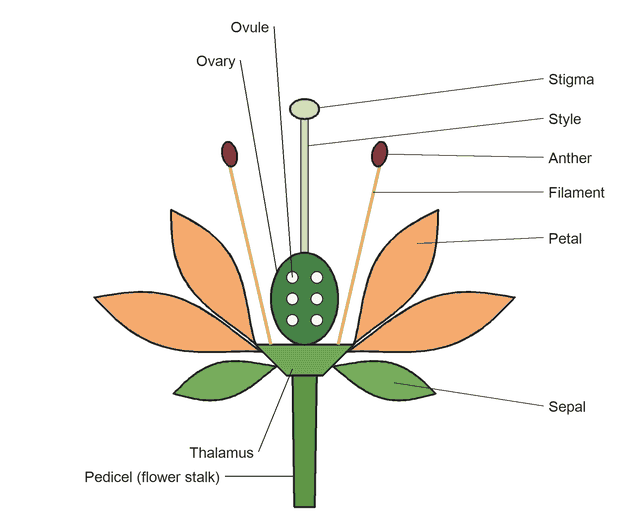
Labels: stigma, style, ovary, ovule, anther, filament, petal, sepal, thalamus, pedicel.
Watch out: The stigma, style and ovary together form the pistil; the anther and filament together form a stamen.
Therefore, a flower is the reproductive part of the plant; the diagram shows its parts.
- 396 marks
Question 39
With the help of a suitable labelled diagram, describe the structure of a dicot seed.
Solve with AIWritten solution
Solution:
Concept: The bean seed is a typical dicot seed: it has a seed coat, two cotyledons and an embryo axis.
Step 1 — Describe the outer parts.
The outer parts protect the seed and let water in.
- Seed coat: a covering of two layers, the thick outer testa and the thin inner tegmen; it protects the seed.
- Hilum: a scar on the concave side, where the seed was attached to the fruit wall.
- Micropyle: a tiny pore just beside the hilum; water enters through it.
Step 2 — Describe the inner parts.
Inside the seed coat lie the food stores and the embryo.
- Cotyledons: two thick, fleshy seed leaves that store food.
- Embryo axis: it lies between the cotyledons, with a radicle (forms the root) pointing towards the micropyle and a plumule (forms the shoot).
Step 3 — Draw the diagram.
Draw the seed with one cotyledon removed and label it.
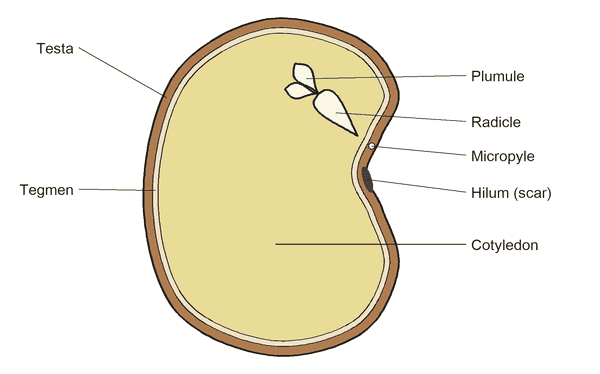
Labels: testa, tegmen, plumule, radicle, micropyle, hilum, cotyledon.
Watch out: The hilum is a scar, not a hole; water enters through the micropyle.
Therefore, a dicot seed has a two-layered seed coat with a hilum and micropyle, two food-storing cotyledons and an embryo axis with a radicle and a plumule.
- 407 marks
Question 40
Define germination ? Name the two types of germination. Explain with examples.
Solve with AIWritten solution
Solution:
Concept: In epigeal germination (epi = above, geal = earth) the cotyledons come above the soil, as in bean; in hypogeal germination (hypo = below) they stay in the soil, as in pea and maize.
Step 1 — Define germination.
Germination is the process by which the embryo of a seed becomes active, in the presence of water, air and a suitable temperature, and grows into a young plant (seedling).
Step 2 — Name the two types.
The two types are epigeal and hypogeal germination.
Step 3 — Explain epigeal germination.
The part of the axis below the cotyledons (hypocotyl) grows fast and pushes the cotyledons above the soil. The cotyledons may turn green and make food for a short time. Examples: bean, papaya, cucumber, tamarind.
Step 4 — Explain hypogeal germination.
The part above the cotyledons (epicotyl) grows fast, so only the plumule comes up and the cotyledons stay in the soil. Examples: pea, maize, rice, gram.
Watch out: The type depends on which part of the axis grows faster, the part below or the part above the cotyledons.
Therefore, germination is the growth of the embryo into a seedling; it is epigeal (bean) or hypogeal (pea).
- 412 marks
Question 41
What are the three conditions necessary for the germination of seeds.
Solve with AIWritten solution
Solution:
Concept: A seed germinates only when it gets water, air (oxygen) and a suitable temperature; it does not need soil or light to start.
Step 1 — Water.
Water (moisture) softens the seed coat, makes the seed swell and starts its chemical activities.
Step 2 — Air.
Air (oxygen) is needed for respiration, which releases energy for the growing embryo.
Step 3 — Suitable temperature.
Warmth is needed because the enzymes of the seed work only within a suitable range; the chapter gives about 35 °C to 40 °C as the best.
Therefore, the three conditions are water, air (oxygen) and a suitable temperature.
- 422 marks
Question 42
Give the main differences between hypogeal and epigeal germination.
Solve with AIWritten solution
Solution:
Concept: In epigeal germination (epi = above, geal = earth) the cotyledons come above the soil, as in bean; in hypogeal germination (hypo = below) they stay in the soil, as in pea and maize.
Step 1 — Compare the two types.
The main differences are shown below.
Hypogeal germination Epigeal germination Cotyledons remain in the soil. Cotyledons are pushed above the soil. The epicotyl grows faster than the hypocotyl. The hypocotyl grows faster than the epicotyl. Examples: maize, pea, rice, gram. Examples: bean, papaya, tamarind, cucumber. Therefore, in hypogeal germination the cotyledons stay in the soil, and in epigeal germination they come above it.
- 438 marks
Question 43
State the location of the following in a flower :
(a) Sepals
(b) Petals
(c) Anthers
(d) Stigma
Solve with AIWritten solution
Solution:
Concept: A flower has four whorls on the thalamus: calyx (sepals), corolla (petals), androecium (stamens: anther + filament) and gynoecium (pistil: stigma + style + ovary). The stamens and the pistil are the reproductive whorls.
Step 1 — (a) Sepals.
The sepals form the outermost whorl (calyx), at the base of the flower on the thalamus.
Step 2 — (b) Petals.
The petals form the second whorl (corolla), just inside the sepals.
Step 3 — (c) Anthers.
The anthers sit at the tips of the filaments of the stamens, in the third whorl (androecium).
Step 4 — (d) Stigma.
The stigma is at the top of the style of the pistil, in the centre of the flower (gynoecium).
Therefore, sepals are outermost, petals next, anthers on the filament tips and the stigma on top of the style.
- 448 marks
Question 44
Give the difference in the function between the following parts :
(a) Ovary and ovule
(b) Petal and sepal
(c) Filament and style
(d) Pollen grains and ovule
Solve with AIWritten solution
Solution:
Concept: A flower has four whorls on the thalamus: calyx (sepals), corolla (petals), androecium (stamens: anther + filament) and gynoecium (pistil: stigma + style + ovary). The stamens and the pistil are the reproductive whorls.
Step 1 — (a) Ovary and ovule.
The ovary holds the ovules and develops into the fruit; each ovule holds an egg cell and develops into a seed.
Step 2 — (b) Petal and sepal.
Petals are colourful and attract insects for pollination; sepals are usually green and protect the flower in the bud.
Step 3 — (c) Filament and style.
The filament holds up the anther; the style is the path along which the pollen tube grows from the stigma down to the ovary.
Step 4 — (d) Pollen grains and ovule.
Pollen grains produce the male gametes; the ovule contains the female gamete (egg cell).
Therefore, the ovary forms the fruit and the ovule the seed; petals attract and sepals protect; the filament holds the anther and the style carries the pollen tube; pollen gives male gametes and the ovule the egg.
- 4513 marks
Question 45
Draw a neat diagram of the 'longitudinal section of a maize grain' and label its seven important parts. Answer the following questions :
(i) Name the structure which divides the embryonic and endospermic region of the grain.
(ii) Among the parts labelled by you above, which one of them is protienaceous in nature ?
(iii) Name the food component which is stored in the endosperm.
(iv) Mention the part of the seed which develops into the root.
(v) Why do we call it as a 'grain' and not as a seed or fruit ?
Solve with AIWritten solution
Solution:
Concept: The maize grain is a one-seeded fruit: its seed coat is fused with the fruit wall, its endosperm stores food, and its single cotyledon lies against the endosperm with the embryo axis beside it.
Step 1 — Draw the grain.
Draw a vertical section of the maize grain and label its seven parts.
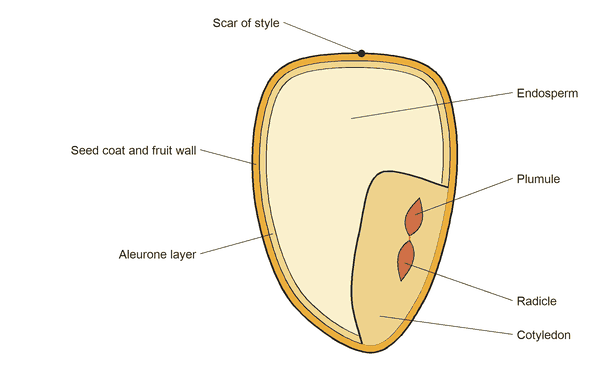
Labels: scar of style, seed coat and fruit wall, aleurone layer, endosperm, cotyledon, plumule, radicle.
Step 2 — (i) What separates embryo and endosperm.
The cotyledon (also called the scutellum) lies between the embryo axis and the endosperm; its surface layer touches the endosperm and absorbs food from it.
Step 3 — (ii) The protein-rich part.
The aleurone layer, the outer layer of the endosperm, is rich in protein.
Step 4 — (iii) The food in the endosperm.
The endosperm stores mainly starch.
Step 5 — (iv) The part that forms the root.
The radicle develops into the root.
Step 6 — (v) Why it is called a grain.
In maize the seed coat is fused with the fruit wall (pericarp), so the seed and the fruit cannot be separated. Such a one-seeded fruit is called a grain.
Watch out: The maize grain is really a fruit with one seed inside, not just a seed.
Therefore, the diagram shows the seven parts; (i) the cotyledon, (ii) the aleurone layer, (iii) starch, (iv) the radicle, (v) its seed coat is fused with the fruit wall.
- 469 marks
Question 46
Given alongside is a figure of the vertical section of a typical bisexual flower. Study the same and answer the following questions :
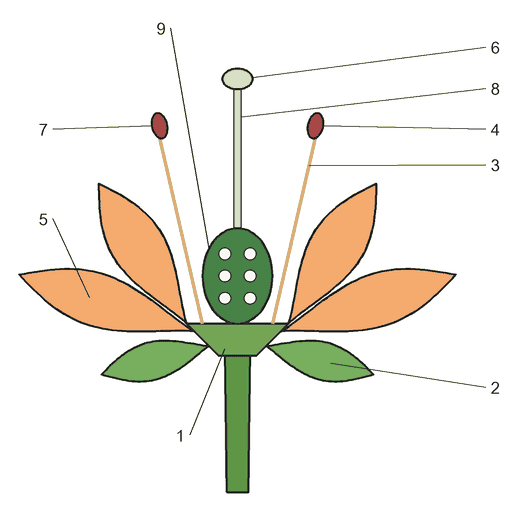
(i) Label the guidelines 1 to 9.
(ii) Which of the above labelled parts constitute the pistil? Write the numbers and names of those parts.
(iii) Name the part which produces pollen grains.
(iv) Is it a complete/incomplete flower ? Give reason in support of your answer.
(v) Write one important role of the part labelled as 6.
Solve with AIWritten solution
Solution:
Concept: A flower has four whorls on the thalamus: calyx (sepals), corolla (petals), androecium (stamens: anther + filament) and gynoecium (pistil: stigma + style + ovary). The stamens and the pistil are the reproductive whorls.
Step 1 — (i) Label the guidelines.
Follow each guideline to its part, starting from the stalk.
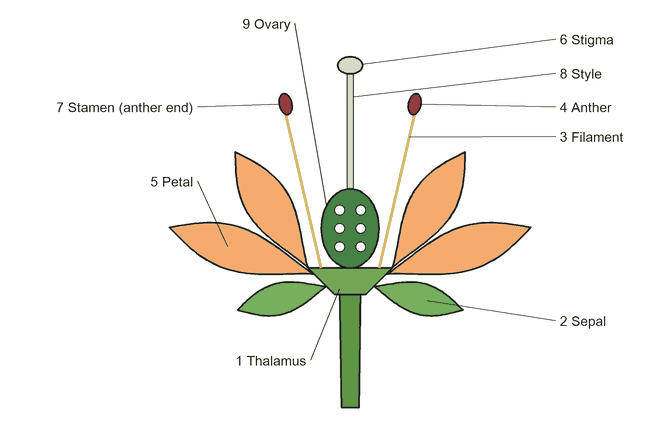
1 is the thalamus, 2 a sepal, 3 a filament, 4 an anther, 5 a petal, 6 the stigma, 7 a stamen (the guideline meets it at its anther end), 8 the style and 9 the ovary.
Step 2 — (ii) Parts of the pistil.
The pistil is made of 6, the stigma, 8, the style and 9, the ovary.
Step 3 — (iii) The part that makes pollen.
The anther (4) produces pollen grains.
Step 4 — (iv) Complete or incomplete.
It is a complete flower, because all four whorls are present: calyx (sepals), corolla (petals), androecium (stamens) and gynoecium (pistil).
Step 5 — (v) Role of part 6.
The stigma (6) receives the pollen grains during pollination.
Watch out: A complete flower has all four whorls; a bisexual flower needs only the stamens and the pistil.
Therefore, (i) as labelled; (ii) 6 stigma, 8 style, 9 ovary; (iii) the anther; (iv) complete, with all four whorls; (v) the stigma receives pollen.
- 479 marks
Question 47
The figure given alongside represents the vertical section of a fruit. Study the same and answer the following questions :
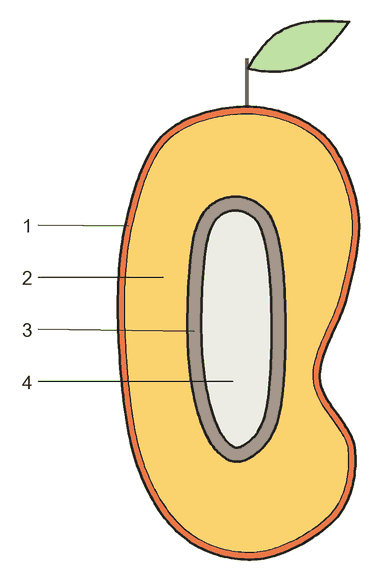
(i) Identify the fruit and mention whether it is a true fruit or a false fruit.
(ii) Label the guidelines 1, 2, 3 and 4.
(iii) Write the collective name for the parts shown as 1, 2 and 3.
(iv) Name the part of the flower which matures into part 4.
(v) Which of the above labelled parts of the fruit is fleshy and edible ?
Solve with AIWritten solution
Solution:
Concept: A fruit is a ripened ovary. Its wall, the pericarp, has three layers: the epicarp (skin), the mesocarp (middle) and the endocarp (inner, hard stone in mango). The ovules become the seeds.
Step 1 — (i) Identify the fruit.
The thin skin, thick fleshy layer and hard stone with one seed show that it is a mango. It develops from the ovary, so it is a true fruit.
Step 2 — (ii) Label the guidelines.
Read the layers from the outside inwards.
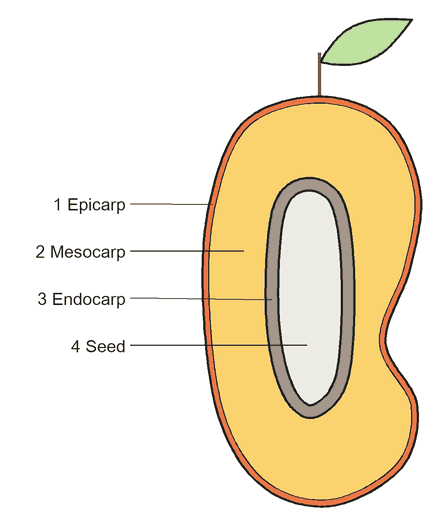
1 is the epicarp, 2 the mesocarp, 3 the endocarp and 4 the seed.
Step 3 — (iii) Collective name.
Parts 1, 2 and 3 together form the pericarp (fruit wall).
Step 4 — (iv) What forms part 4.
The ovule matures into the seed.
Step 5 — (v) The fleshy, edible part.
Part 2, the mesocarp, is fleshy and edible.
Watch out: The hard stone is the endocarp, part of the fruit wall; the seed lies inside it.
Therefore, (i) mango, a true fruit; (ii) epicarp, mesocarp, endocarp, seed; (iii) pericarp; (iv) the ovule; (v) the mesocarp.
- 487 marks
Question 48
One winter morning, Shweta and her mother were sitting in their garden when they noticed fresh pea flowers blooming. Over the next few days, they watched some of these flowers slowly develop into tiny green pea pods. Together, they began tracking each stage of this change and observed how pollination and fertilization occur in plants. Answer the following questions:
(i) What role do insects play in the development of a flower into a fruit?
(ii) Mention the male and female gametes of the flower.
(iii) What is the function of the pollen tube during fertilization?
(iv) What happens to the ovary once fertilization is completed?
(v) Shweta's mother claimed that the pea pod is a fruit and not a vegetable. Explain.
Solve with AIWritten solution
Solution:
Concept: A flower becomes a fruit only after pollination (pollen reaches the stigma) and fertilisation (a male gamete fuses with the egg in the ovule).
Step 1 — (i) Role of insects.
Insects visit flowers for nectar. Pollen sticks to their bodies and is rubbed onto the stigma of the next flower they visit. In this way they bring about pollination, which leads to fertilisation and then to the formation of the fruit.
Step 2 — (ii) The gametes.
The male gametes are formed in the pollen grains; the female gamete is the egg cell inside the ovule.
Step 3 — (iii) The pollen tube.
The pollen tube grows down through the style and carries the male gametes to the egg in the ovule.
Step 4 — (iv) After fertilisation.
The ovary grows larger and develops into the fruit, and the ovules inside it become the seeds.
Step 5 — (v) Why the pea pod is a fruit.
The pea pod is formed from the ripened ovary of the flower and contains seeds (the peas). So, in biology, it is a fruit; we call it a vegetable only because we cook and eat it like one.
Note: Garden pea flowers mostly pollinate themselves, often before they open, so in pea insects such as bees play only a small part; in many other flowers they are the main pollinators.
Therefore, (i) insects carry pollen; (ii) pollen gives male gametes and the ovule holds the egg; (iii) the tube carries the male gametes to the ovule; (iv) the ovary becomes the fruit; (v) the pod is a ripened ovary with seeds.
What Class 6 Biology Ch 2 covers
The sections of the chapter, in the order the book takes them. Every question above comes from one of these.
- 01Types of Flowers
- 02Pollination
- 03Agents of Pollination
- 04Fertilization
- 05The Fruit
- 06Fleshy Fruits and Dry Fruits
- 07The Seed
More ways to study this chapter
The same chapter asked three other ways. Practise it, revise it, and see what the board has set on Ch 2 before.
Class 6 Biology Ch 2 questions students ask
How many questions are there in Class 6 Biology Ch 2?
48 questions. Every one is solved step by step on this page.
Are these Class 6 Biology solutions free?
Yes. Every question and its full working is free to read, with no account needed.
Can I download the Class 6 Biology Ch 2 solutions as a PDF?
There is no PDF to download. Every solution is on this page instead, which means it is searchable, always the current syllabus, and readable on a phone. Use your browser's print option if you want it on paper.