Solution:
Concept: A flower has four whorls on the thalamus: calyx (sepals), corolla (petals), androecium (stamens: anther + filament) and gynoecium (pistil: stigma + style + ovary). The stamens and the pistil are the reproductive whorls.
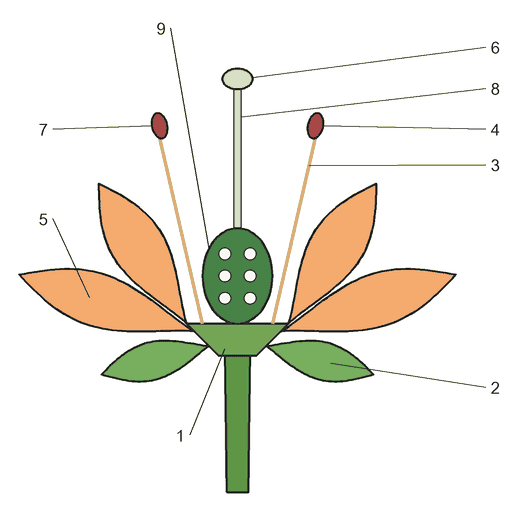
Step 1 — (i) Label the guidelines.
Follow each guideline to its part, starting from the stalk.
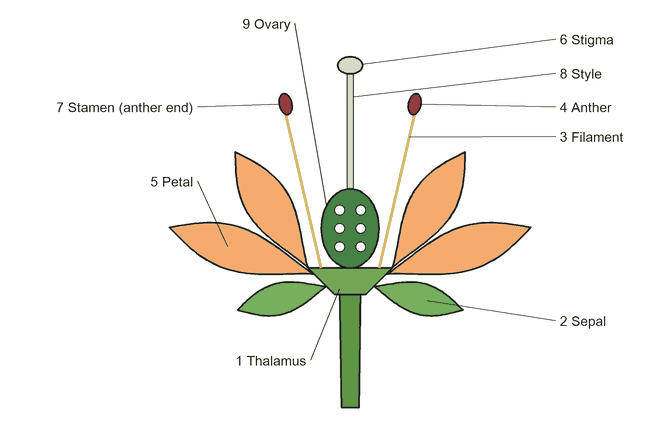
1 is the thalamus, 2 a sepal, 3 a filament, 4 an anther, 5 a petal, 6 the stigma, 7 a stamen (the guideline meets it at its anther end), 8 the style and 9 the ovary.
Step 2 — (ii) Parts of the pistil.
The pistil is made of 6, the stigma, 8, the style and 9, the ovary.
Step 3 — (iii) The part that makes pollen.
The anther (4) produces pollen grains.
Step 4 — (iv) Complete or incomplete.
It is a complete flower, because all four whorls are present: calyx (sepals), corolla (petals), androecium (stamens) and gynoecium (pistil).
Step 5 — (v) Role of part 6.
The stigma (6) receives the pollen grains during pollination.
Watch out: A complete flower has all four whorls; a bisexual flower needs only the stamens and the pistil.
Therefore, (i) as labelled; (ii) 6 stigma, 8 style, 9 ovary; (iii) the anther; (iv) complete, with all four whorls; (v) the stigma receives pollen.