Solution:
Concept: A fruit is a ripened ovary. Its wall, the pericarp, has three layers: the epicarp (skin), the mesocarp (middle) and the endocarp (inner, hard stone in mango). The ovules become the seeds.
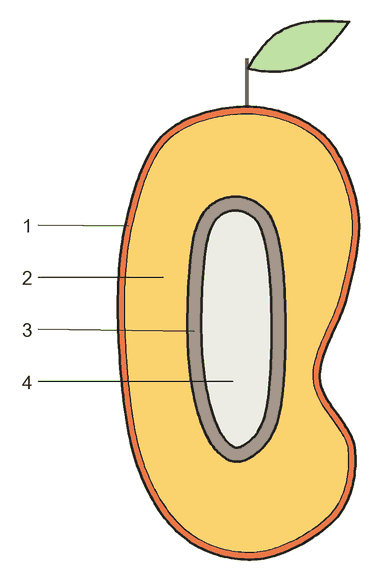
Step 1 — (i) Identify the fruit.
The thin skin, thick fleshy layer and hard stone with one seed show that it is a mango. It develops from the ovary, so it is a true fruit.
Step 2 — (ii) Label the guidelines.
Read the layers from the outside inwards.
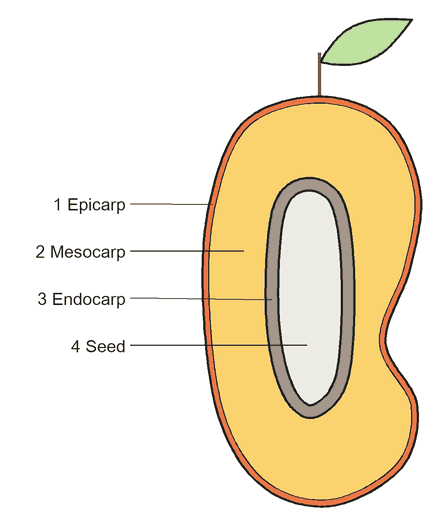
1 is the epicarp, 2 the mesocarp, 3 the endocarp and 4 the seed.
Step 3 — (iii) Collective name.
Parts 1, 2 and 3 together form the pericarp (fruit wall).
Step 4 — (iv) What forms part 4.
The ovule matures into the seed.
Step 5 — (v) The fleshy, edible part.
Part 2, the mesocarp, is fleshy and edible.
Watch out: The hard stone is the endocarp, part of the fruit wall; the seed lies inside it.
Therefore, (i) mango, a true fruit; (ii) epicarp, mesocarp, endocarp, seed; (iii) pericarp; (iv) the ovule; (v) the mesocarp.