
Question 396 marksMedium
With the help of a suitable labelled diagram, describe the structure of a dicot seed.
Confirming your payment
Sign up now and get 250 free tokens.
The Flower · Question 39 of 48
With the help of a suitable labelled diagram, describe the structure of a dicot seed.
Solution:
Concept: The bean seed is a typical dicot seed: it has a seed coat, two cotyledons and an embryo axis.
Step 1 — Describe the outer parts.
The outer parts protect the seed and let water in.
Step 2 — Describe the inner parts.
Inside the seed coat lie the food stores and the embryo.
Step 3 — Draw the diagram.
Draw the seed with one cotyledon removed and label it.
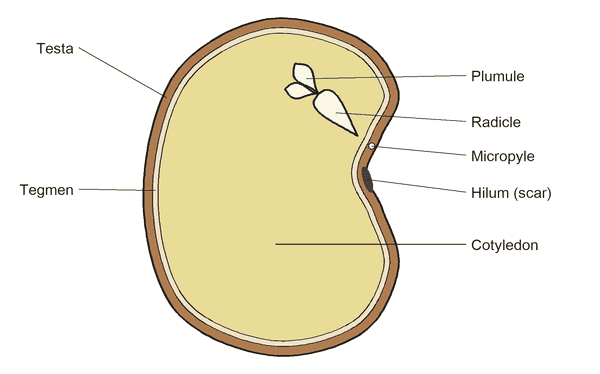
Labels: testa, tegmen, plumule, radicle, micropyle, hilum, cotyledon.
Watch out: The hilum is a scar, not a hole; water enters through the micropyle.
Therefore, a dicot seed has a two-layered seed coat with a hilum and micropyle, two food-storing cotyledons and an embryo axis with a radicle and a plumule.