
Opening your dashboard
Class 6 Biology Chapter 2 The Flower: Competency-Based Questions (CBQ)
40 questions on Chapter 2, each worked through on its own page with the AI tutor. Class 6 Biology, ICSE 2026-27.
40 questions
1–5 marks · Mixed difficulty
- 11 mark
Question 1
Cognitive domain: Application
A bottle gourd (lauki) vine in Meera's kitchen garden bears two kinds of flowers. Flowers of kind 1 have stamens but no pistil. Flowers of kind 2 have a pistil but no stamens. Meera wants to know which flowers will give her bottle gourds. Which statement is correct ?
- 21 mark
Question 2
Cognitive domain: Analysis
Anu drew the female part of a flower after a pollen grain had landed on it. A thin tube has grown out of the pollen grain. Four parts are marked P, Q, R and S.

Inside which part do the male gametes fuse with the egg cell ?
- 31 mark
Question 3
Cognitive domain: Application
A small peepal plant is growing out of a crack high up on the wall of an old building. Nobody planted it there. Mynas and bulbuls feed on the small ripe fruits of a peepal tree at the end of the lane and often sit on this wall. Which function of a fruit does this best show ?
- 41 mark
Question 4
Cognitive domain: Analysis
Asha sowed a bean seed in one pot and a pea seed in another pot. She forgot to label the pots. After some days she carefully removed a little soil and drew the two seedlings, X and Y.
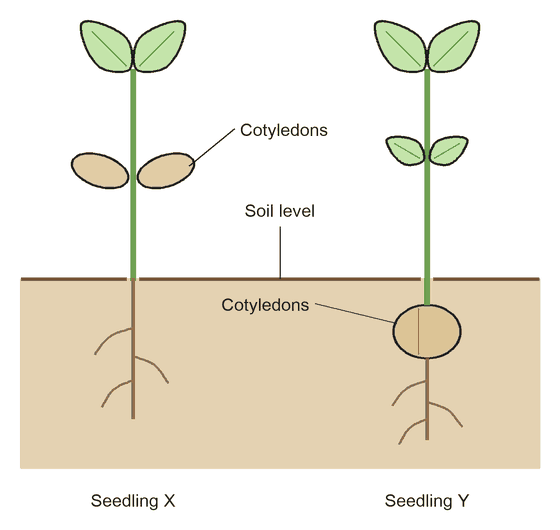
Which of these is correct ?
- 51 mark
Question 5
Cognitive domain: Understanding
Assertion (A): A farmer cannot peel the seed coat off a maize grain the way we slip the skin off a soaked bean seed.
Reason (R): In a maize grain, the seed coat is fused with the fruit wall (pericarp).
- 61 mark
Question 6
Cognitive domain: Analysis
Assertion (A): After fertilization, the petals of a pea flower swell up and slowly grow into the green pea pod.
Reason (R): After fertilization, the ovary of a flower grows into the fruit and the ovules inside it develop into seeds.
- 71 mark
Question 7
Cognitive domain: Understanding
Kabir grows a single pea plant in a pot on his fifth-floor balcony. There is no other pea plant anywhere near his building. Still, the flowers of his plant form pods with seeds.
Complete the sentence :
The pollen grains that reached the stigmas of these flowers must have come from the ______ plant, so this is a case of ______ pollination.
- 81 mark
Question 8
Cognitive domain: Application
Dadi brings walnuts from Kashmir. She cracks one with a small stone, throws away the hard shell and gives the part inside to Aman to eat. Aman notices that no part of the walnut was soft and juicy like the pulp of a mango.
Complete the sentence :
Since its pericarp is hard and not pulpy, the walnut is a ______ fruit, and the part that Aman eats is its ______.
- 91 mark
Question 9
Cognitive domain: Application
For a seed chart, Sunita soaks 12 bean seeds, 8 pea seeds and 10 maize grains overnight. Next day she opens every one of them and counts the cotyledons.
Complete the sentence :
Sunita will count ______ cotyledons in all, because bean and pea are ______ seeds while maize is a monocotyledonous seed.
- 102 marks
Question 10
Cognitive domain: Evaluation
In the school garden, Riya watches a bee sit on a marigold flower. The bee then flies straight to a mustard flower. Riya writes in her notebook, "The bee has cross-pollinated the mustard flower with the pollen of the marigold."
Is Riya's statement correct ? Justify your answer.
- 112 marks
Question 11
Cognitive domain: Understanding
Imran eats a tomato and a mango at lunch. He bites right through the tomato and eats all of it. When he bites into the mango, his teeth stop at a hard stone in the middle.
Both are fleshy fruits. Explain why Imran could eat the whole tomato but not the whole mango. Use the names of the layers of the fruit wall in your answer.
- 122 marks
Question 12
Cognitive domain: Evaluation
Irfan soaked ten bean seeds overnight. From five of them he carefully removed the seed coat and both cotyledons, leaving only the tiny embryo. He placed all ten on moist cotton in a warm room and said, "The embryo is the baby plant. So it will grow just as well without the cotyledons."
Do you agree with Irfan ? Give a reason for your answer.
- 134 marks
Question 13
Cognitive domain: Application
Case: The pond in a school garden in Kolkata has two kinds of water plants. Vallisneria grows rooted at the bottom. The children see many tiny male flowers of Vallisneria floating freely on the water, and a few female flowers at the surface. Lotus also grows in the pond. Its large, pink, sweet-smelling flowers stand well above the water, and bees keep visiting them.
(a) The male flowers of Vallisneria are formed under water. How do they come to float on the surface ?
(b) Explain how the pollen grains of Vallisneria reach the stigma of a female flower. What is this kind of pollination called ?
(c) To keep the pond clean, the gardener now skims off everything that floats on the water every morning. What effect will this have on the pollination of Vallisneria ? Give a reason.
(d) Which agent pollinates the lotus flowers ? Give two features from the case that support your answer.
- 145 marks
Question 14
Cognitive domain: Analysis
Case: Class 6 students wanted to study how temperature affects germination. They took four dishes with moist cotton wool and put 20 bean seeds in each dish. All the dishes were open to air and the cotton wool was kept moist. Each dish was kept at a different temperature. After 5 days they counted the seeds that had germinated.
Dish Temperature Seeds that germinated (out of 20) P 0 Q 11 R 19 S 0 (a) In which dish did the most seeds germinate ? How many more seeds germinated in it than in dish Q ?
(b) Which one condition did the students change from dish to dish ? Name two conditions needed for germination that they kept the same in all four dishes.
(c) No seed germinated in dish P or in dish S. Explain why, for each dish.
(d) After the count, the students moved dish P and dish S to the place where dish R was kept. In which of these two dishes are the seeds more likely to germinate now ? Give a reason.
- 155 marks
Question 15
Cognitive domain: Creativity
Case: The Kitchen Garden Club has a packet of 40 dry bean seeds. Gauri's grandmother always soaks seeds in water overnight before sowing them. She says soaked seeds sprout sooner. The club wants to plan a simple, fair experiment to test this. They have two shallow trays, cotton wool, water and a bowl.
(a) Describe how the club should set up the two trays. What is the one thing that must be different between them ? Name two things that must be kept the same.
(b) What should they look for in each seed to decide that it has sprouted ? Draw a table in which they can record their observations.
(c) What result do you expect ? Give a reason from what you know about how germination starts. Why is it better to use 20 seeds in each tray than only one seed ?
- 161 mark
Question 16
Cognitive domain: Analysis
Four flowers, W, X, Y and Z, from a school garden are examined. The table shows which whorls each flower has.
Flower Calyx Corolla Androecium Gynoecium W Present Present Present Present X Present Present Present Absent Y Present Present Absent Present Z Absent Present Present Present Which flower is bisexual but incomplete ?
- 171 mark
Question 17
Cognitive domain: Analysis
A flower is cut lengthwise and five parts are marked P, Q, R, S and T.
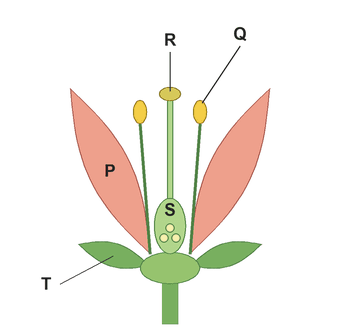
After fertilisation, which marked part grows into the fruit, and which marked part produced the pollen grains ?
- 181 mark
Question 18
Cognitive domain: Application
Vidya's rose bush has many buds. Caterpillars ate the small green leaf-like outer parts (the sepals) of some of the buds. Most of those buds were damaged and dried up, while the buds whose sepals were not touched opened into flowers. (Hypothetical case.)
Which function of the sepals does this best show ?
- 191 mark
Question 19
Cognitive domain: Analysis
Rani wants to find out whether warmth is needed for germination. She sets up four dishes, each with 10 bean seeds of the same kind and the same kind of cotton wool.
Dish Cotton wool Where the open dish is kept K Moist Warm room, about L Moist Refrigerator, about M Dry Warm room, about N Moist Dark cupboard in the warm room, about Which two dishes should she compare ?
- 201 mark
Question 20
Cognitive domain: Analysis
Assertion (A): A maize grain stores its food mainly in the endosperm.
Reason (R): Maize shows hypogeal germination, in which the cotyledon stays below the soil.
- 211 mark
Question 21
Cognitive domain: Evaluation
Assertion (A): A gourd plant that bears separate male flowers and female flowers cannot have self pollination.
Reason (R): In a unisexual flower, either the androecium or the gynoecium is missing.
- 221 mark
Question 22
Cognitive domain: Understanding
Tara cuts open a soaked bean seed and a soaked maize grain for the school science fair and compares them. Which statement is correct ?
- 231 mark
Question 23
Cognitive domain: Application
A pollen grain has just landed on the stigma of a pea flower and has started to grow a tube. At that moment a child snips off the style of the flower with scissors. (Hypothetical case.)
What will most likely happen to the ovules of this flower ?
- 241 mark
Question 24
Cognitive domain: Application
A wild grape vine bears a bunch of 24 grapes. Each grape is a fruit that grew from a different flower with a single ovary, and each grape holds 3 seeds. (Hypothetical data.)
How many flowers must have been fertilised to make this bunch, and how many ovules must have developed into seeds ?
- 251 mark
Question 25
Cognitive domain: Understanding
Ananya pulls the parts off a freshly opened mustard flower one whorl at a time, from the outside inwards: first the calyx, then the corolla, then the androecium. She stops when only one whorl is left on the thalamus.
Which description fits the whorl that is left, from its top to its base ?
- 262 marks
Question 26
Cognitive domain: Application
In the school garden, Ritu touches the anthers of a shoe-flower with her fingertip and a yellow powder sticks to it. She then gently touches this fingertip to the sticky tip of the pistil of a shoe-flower on a different bush of the same kind.
Name the yellow powder and the part of the pistil that received it. Which kind of pollination has Ritu copied, and what does her fingertip stand for in nature ?
- 272 marks
Question 27
Cognitive domain: Application
In March, a farmer stores bean seeds in a dry cloth bag on a shelf of his warm godown. The air in the godown is fresh, yet the seeds stay unchanged for months. After the first heavy rain in July, a few seeds that fell on the moist soil outside the godown sprout within days.
Which condition for germination was missing in the godown, and which condition did the rain supply ? Explain why warmth and fresh air alone were not enough.
- 282 marks
Question 28
Cognitive domain: Evaluation
In a dry-fruit shop, Imran's grandfather says, "Raisins and walnuts are both dry fruits, so they are the same kind of fruit."
Is he correct ? Use the ideas of fleshy fruit and dry fruit in your answer.
- 292 marks
Question 29
Cognitive domain: Analysis
Sneha weighs 20 dry bean seeds and then keeps them soaked in water. She weighs them again after some hours. (Hypothetical data.)
Time in water Mass of the 20 seeds 0 h 20 g 2 h 26 g 6 h 34 g 12 h 38 g 24 h 38 g (a) How much water did the seeds take in by the end of 24 h, and what percentage of their dry mass is this ?
(b) Germination begins with the first change in a dry seed. What does the table suggest this first change is ?
- 302 marks
Question 30
Cognitive domain: Analysis
Zoya dusted pollen on the stigma of a pea flower at 8 a.m. At 8 a.m. the next day she cut open the ovary and saw that a male gamete had just fused with an egg cell inside an ovule. "But I pollinated it yesterday !" she said. (Hypothetical timings.)
Name the structure that grew in this time. Say where it grew and what it carried, and explain why pollination and fertilisation are not the same event.
- 312 marks
Question 31
Cognitive domain: Application
A tree in a village has large, pale flowers that open at night and smell strongly. A fruit bat visits a flower to drink the nectar, and pollen grains stick to the fur on its face. On the next night the same bat visits a flower of another tree of the same kind. (Hypothetical case.)
Name the agent of pollination here, and name the kind of pollination between the two trees. What must happen to the pollen grains on the bat at the second flower for pollination to take place ?
- 323 marks
Question 32
Cognitive domain: Analysis
Two farmers each sow 36 maize plants, 1 m apart. Farmer A sows all 36 in one long row. Farmer B sows them in a square block of 6 rows with 6 plants in each row. Both fields get the same wind. At harvest, 95 out of every 100 grain places on a cob in field B are filled with grains, but only 60 out of every 100 in field A. (Hypothetical data.)
(a) Name the agent that carries the pollen of maize.
(b) Explain, with the help of the data, why the block gives more filled grains than the single row.
(c) How many more grain places out of every 100 are filled in field B than in field A ?
- 333 marks
Question 33
Cognitive domain: Creativity
Write a riddle of three short lines for a bean seed. Line 1 must hint at its scar, line 2 at the small pore above the scar, and line 3 at the two thick parts inside it. Then write the answer to your riddle and name the three parts that your lines hint at.
- 343 marks
Question 34
Cognitive domain: Application
A farmer sows rice, tamarind, maize and cucumber seeds in four rows. A week later he examines the seedlings.
(a) Which two kinds of seedlings have their cotyledons lifted above the soil ?
(b) Name this type of germination, and say which part of the young stem grows faster in it, the hypocotyl or the epicotyl.
(c) Name the type of germination in the other two kinds and say which part of the young stem grows faster in it.
- 353 marks
Question 35
Cognitive domain: Evaluation
Neha says, "A fruit grows from the ovary. So the sepals and petals are not needed for making a fruit, and I can pluck both whorls off every flower and still get fruits."
Decide whether Neha is right, wrong or partly right. Give three points to support your answer.
- 363 marks
Question 36
Cognitive domain: Understanding
Aarti soaks two bowls overnight. One bowl has whole green moong seeds. The other has split moong dal, made by removing the seed coat and splitting each seed into its two halves, which damages or removes the tiny embryo. After three days the whole seeds in one bowl have sprouted but nothing has sprouted in the other bowl.
(a) In which bowl did the seeds sprout ?
(b) Why did the other bowl show no sprouts, although it also has water, air and warmth ?
(c) What do the cotyledons in the split dal still hold, and why is this not enough to make a new plant ?
- 375 marks
Question 37
Cognitive domain: Analysis
Case: A big mango tree outside Nilesh's house is covered with thousands of tiny flowers every spring. Nilesh counts what happens to them. (Hypothetical data.)
Stage Number of flowers Flowers that opened on the tree 4000 Flowers in which pollen reached a stigma 800 Flowers in which fertilisation took place 100 Flowers that ripened into mango fruits 40 (a) What percentage of the flowers ripened into fruits ?
(b) What percentage of the pollinated flowers were fertilised ? How many flowers did not even get pollen on their stigma ?
(c) Name the part of the flower that ripens into the fruit. Give two reasons why a flower whose stigma received pollen may still not give a fruit.
- 384 marks
Question 38
Cognitive domain: Analysis
Case: Class 6 students sow 20 bean seeds in each of five pots, at five different depths. All the pots have the same loose soil, are kept equally moist and are placed in the same warm place. After ten days they count the seedlings that have come up above the soil. The bar chart shows the result. (Hypothetical data.)
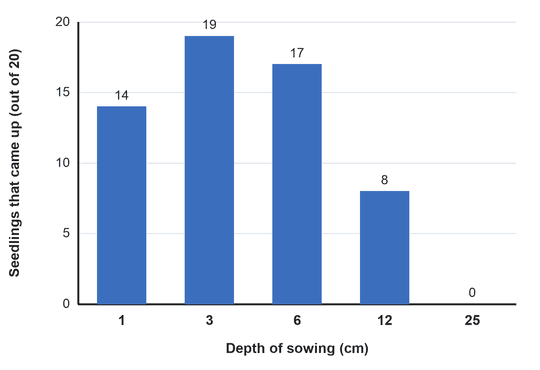
(a) At which depth did the most seedlings come up ? What percentage of the 20 seeds is this ?
(b) How many of the seeds sown at 12 cm did not come up ? What happens to the number of seedlings as the depth increases beyond 6 cm ?
(c) No seedling came up from 25 cm. Name one condition for germination that is likely to be short at that depth, and give one more reason why a deeply buried seedling may fail to reach the surface.
- 394 marks
Question 39
Cognitive domain: Creativity
Case: For the school science fair, Mansi's group has to make a working model of a bisexual flower from kitchen and craft items: green paper, coloured paper, thread, turmeric powder, a small clay ball, a drinking straw, tiny beads, a cotton bud and a lump of cotton. (Hypothetical task.)
(a) Choose one item for each of the four whorls of the flower, and state what each whorl does in a real flower.
(b) Explain how you would arrange the parts on the thalamus so that the model shows the correct positions of the whorls, and how you would show the ovules.
(c) Explain how two such models can be used to show cross pollination. Say what the cotton bud stands for.
- 405 marks
Question 40
Cognitive domain: Evaluation
Case: Rohan studies three plants, P, Q and R, in the school garden and notes what he finds in their flowers. (Hypothetical data.)
Plant Flower Pollen Stigma Nectar Visitors seen P Large, bright orange, sweet smell Sticky, little Rounded and sticky Plenty Bees and butterflies Q Small, dull green, no smell Dry and light, a great deal Feathery None None R Large, red, tube-shaped, no smell Sticky, little Rounded and sticky Plenty Small sunbirds only (a) No visitor was seen on plant Q, yet its flowers later formed seeds. Name the agent that pollinated plant Q. Explain why plant Q makes a great deal of pollen, while P and R make only a little.
(b) Rohan says, "P and R both have large, bright flowers with nectar, so both must be pollinated by insects." Is he correct ? Use the table to support your answer.
(c) A gardener sprays the garden and kills all the insects, but not the birds. Which of the three plants is most likely to be affected badly ? Give a reason.