
Opening your dashboard
Class 6 Biology Chapter 1: The Leaf Solutions
41 textbook questions with step-by-step answers, free to read, for ICSE 2026-27.
Get talked through Ch 1, not just shown the answer
Reading a finished solution is not the same as being able to do it. The AI tutor takes one question at a time and works it with you, in your own words, until you can.
- Ask it out loud, in your own words
- It gives you the next step, not the answer
- Stuck on part (ii)? Start there
41 questions with solutions
1–13 marks · Mixed difficulty
- 11 mark
Question 1
Identify the plant which has compound leaves :
Solve with AIAnswer
(A) Banana
(B) Banyan
(C) Mango
- Correct
(D) Rose
Answer: (D) Rose
Concept: In a simple leaf the lamina (leaf blade) is in one piece, even if its margin is cut; in a compound leaf the lamina is divided right down to the midrib into separate leaflets.
Step 1 — Look at each leaf.
Banana, banyan and mango each have one undivided lamina. The rose leaf has several small leaflets arranged along a main stalk.
Step 2 — Pick the compound leaf.
So the rose has compound leaves, option (D).
Watch out: A deeply cut or torn lamina (as in banana) is still a simple leaf; only true leaflets make a leaf compound.
Why the other options are wrong:
- (A) Banana: it has a large simple leaf; its lamina may tear into strips, but it is not divided into leaflets.
- (B) Banyan: it has a simple leaf with one undivided lamina.
- (C) Mango: it has a simple leaf with one undivided lamina.
Therefore, the plant with compound leaves is the rose, option (D).
- 21 mark
Question 2
Which one of the following is not an insectivorous plant :
Solve with AIAnswer
(A) Pitcher plant
(B) Venus flytrap
(C) Bladderwort
- Correct
(D) Cactus
Answer: (D) Cactus
Concept: Insectivorous plants are green plants that make their own food by photosynthesis, but they grow where the soil (or water) is poor in nitrogen. Their leaves are changed into traps that catch and digest insects for the extra nitrogen.
Step 1 — Recall the insect-trapping plants.
The pitcher plant, the Venus flytrap and bladderwort all have leaves changed into traps that catch insects or tiny water animals.
Step 2 — Find the odd one.
A cactus does not trap insects. Its leaves are changed into spines to reduce water loss, so the answer is option (D).
Watch out: Spines are modified leaves too, but they protect and save water; they do not catch insects.
Why the other options are wrong:
- (A) Pitcher plant: the pitcher plant traps insects inside its jug-shaped pitcher.
- (B) Venus flytrap: the Venus flytrap snaps the two halves of its leaf shut on an insect.
- (C) Bladderwort: it catches tiny water animals in its small bladders.
Therefore, the plant that is not insectivorous is the cactus, option (D).
- 31 mark
Question 3
This leaf shows parallel venation :
Solve with AIAnswer
- Correct
(A) Banana
(B) Mango
(C) Banyan
(D) Guava
Answer: (A) Banana
Concept: Venation is the arrangement of veins in the lamina. In reticulate venation the veins form a net (mostly dicots); in parallel venation they run side by side (mostly monocots).
Step 1 — Recall the venation of each leaf.
In the banana leaf the veins run side by side from the midrib to the margin. Mango, banyan and guava leaves have a net of veins.
Step 2 — Pick the option.
So the leaf with parallel venation is the banana, option (A).
Why the other options are wrong:
- (B) Mango: it is a dicot with reticulate (net-like) venation.
- (C) Banyan: it is a dicot with reticulate venation.
- (D) Guava: it is a dicot with reticulate venation.
Therefore, the banana leaf shows parallel venation, option (A).
- 41 mark
Question 4
The point on the stem from where the leaf arises is :
Solve with AIAnswer
(A) Petiole
(B) Lamina
- Correct
(C) Node
(D) Trunk
Answer: (C) Node
Concept: The stem has nodes (points where leaves and buds arise) and internodes (the parts between two nodes). The bud at the tip of the stem is the apical (terminal) bud, and the bud in the angle between a leaf and the stem is the axillary bud.
Step 1 — Recall the parts of the stem.
Leaves and buds arise from fixed points on the stem called nodes.
Step 2 — Pick the option.
So the point from where a leaf arises is the node, option (C).
Watch out: The petiole is part of the leaf; it joins the leaf to the node, but it is not a point on the stem.
Why the other options are wrong:
- (A) Petiole: the petiole is the stalk of the leaf, not a point on the stem.
- (B) Lamina: the lamina is the flat green blade of the leaf.
- (D) Trunk: the trunk is the whole thick main stem of a tree, not a point on it.
Therefore, the point on the stem from where a leaf arises is the node, option (C).
- 51 mark
Question 5
Which one of the following is essential for photosynthesis :
Solve with AIAnswer
- Correct
(A) Carbon dioxide
(B) Nitrogen
(C) Oxygen
(D) Soil
Answer: (A) Carbon dioxide
Concept: In photosynthesis green leaves make food (glucose) from carbon dioxide and water, using the energy of sunlight trapped by chlorophyll; oxygen is given out.
Step 1 — List what photosynthesis needs.
A leaf needs carbon dioxide, water, chlorophyll and sunlight to make food.
Step 2 — Pick the option.
Of the four options, only carbon dioxide is on this list, so the answer is option (A).
Watch out: Oxygen is a product of photosynthesis, not a raw material.
Why the other options are wrong:
- (B) Nitrogen: it gas from the air is not used in photosynthesis.
- (C) Oxygen: it is given out during photosynthesis; it is not needed to make food.
- (D) Soil: it itself is not needed; the plant uses only the water (and minerals) taken from it.
Therefore, carbon dioxide is essential for photosynthesis, option (A).
- 61 mark
Question 6
Which part of the leaf attaches the leaf base to the stem ?
Solve with AIAnswer
(A) Leaf blade
(B) Lamina
(C) Leaf apex
- Correct
(D) Petiole
Answer: (D) Petiole
Concept: A typical leaf has a petiole (leaf stalk), a flat lamina (leaf blade) with a midrib and veins, a margin (edge) and an apex (tip).
Step 1 — Find the part that joins leaf and stem.
The petiole is the stalk of the leaf. One end carries the lamina and the other end is attached to the stem at a node.
Step 2 — Pick the option.
So the answer is option (D).
Watch out: Leaf blade and lamina are two names for the same part, so neither can be the answer.
Why the other options are wrong:
- (A) Leaf blade: the leaf blade is the flat green part, not the stalk.
- (B) Lamina: it is another name for the leaf blade.
- (C) Leaf apex: the leaf apex is the tip of the leaf.
Therefore, the petiole attaches the leaf to the stem, option (D).
- 71 mark
Question 7
The bud found at the tip of the shoot is termed as :
Solve with AIAnswer
(A) Axillary bud
- Correct
(B) Apical bud
(C) Adventitious bud
(D) Floral bud
Answer: (B) Apical bud
Concept: The stem has nodes (points where leaves and buds arise) and internodes (the parts between two nodes). The bud at the tip of the stem is the apical (terminal) bud, and the bud in the angle between a leaf and the stem is the axillary bud.
Step 1 — Recall where each bud grows.
The bud at the very tip of the main stem or a branch is the apical (terminal) bud; it makes the shoot grow longer.
Step 2 — Pick the option.
So the bud at the tip of the shoot is the apical bud, option (B).
Why the other options are wrong:
- (A) Axillary bud: an axillary bud grows in the axil, the angle between a leaf and the stem.
- (C) Adventitious bud: adventitious buds grow from unusual places, such as the leaf margin of Bryophyllum.
- (D) Floral bud: a floral bud is a bud that opens into a flower, wherever it grows.
Therefore, the bud at the tip of the shoot is the apical bud, option (B).
- 81 mark
Question 8
The divided, smaller parts of the lamina of a compound leaf are called as :
Solve with AIAnswer
(A) Leaf spines
(B) Stipules
- Correct
(C) Leaflets
(D) Tendrils
Answer: (C) Leaflets
Concept: In a simple leaf the lamina (leaf blade) is in one piece, even if its margin is cut; in a compound leaf the lamina is divided right down to the midrib into separate leaflets.
Step 1 — Recall what a compound leaf is made of.
The lamina of a compound leaf is divided into small separate parts called leaflets, as in rose and neem.
Step 2 — Pick the option.
So the answer is option (C).
Why the other options are wrong:
- (A) Leaf spines: they are whole leaves (or parts) changed into sharp points, as in cactus.
- (B) Stipules: they are small leaf-like outgrowths at the base of the petiole.
- (D) Tendrils: they are thin coiled threads that help a plant climb.
Therefore, the divided parts of the lamina of a compound leaf are leaflets, option (C).
- 91 mark
Question 9
Which of the following is not an example of a compound leaf ?
Solve with AIAnswer
(A) Rose
(B) Silk cotton
(C) Neem
- Correct
(D) Prickly poppy
Answer: (D) Prickly poppy
Concept: In a simple leaf the lamina (leaf blade) is in one piece, even if its margin is cut; in a compound leaf the lamina is divided right down to the midrib into separate leaflets.
Step 1 — Check each leaf.
Rose, silk cotton and neem leaves are divided into separate leaflets. The prickly poppy leaf has deep cuts in its margin, but the cuts do not reach the midrib.
Step 2 — Pick the simple leaf.
A lamina that is cut but not divided into leaflets is a simple leaf, so the answer is option (D).
Watch out: Deep cuts in the margin do not make a leaf compound; the lamina must be divided into leaflets.
Why the other options are wrong:
- (A) Rose: it has a compound leaf with leaflets along the main stalk.
- (B) Silk cotton: it has a compound leaf with all its leaflets arising from one point.
- (C) Neem: it has a compound leaf with many leaflets along the main stalk.
Therefore, the prickly poppy leaf is not compound, option (D).
- 101 mark
Question 10
The plant which has whorled phyllotaxy is :
Solve with AIAnswer
- Correct
(A) Nerium
(B) Jasmine
(C) Mint
(D) Peepal
Answer: (A) Nerium
Concept: Phyllotaxy is the arrangement of leaves on the stem: alternate (one leaf at a node), opposite (two leaves at a node, facing each other) or whorled (three or more leaves at a node in a ring).
Step 1 — Count the leaves at a node.
In oleander (Nerium) three leaves arise together at each node, in a ring. That is whorled phyllotaxy.
Step 2 — Pick the option.
So the plant with whorled phyllotaxy is Nerium, option (A).
Watch out: Two leaves at a node is opposite phyllotaxy; whorled needs three or more.
Why the other options are wrong:
- (B) Jasmine: it has opposite phyllotaxy, two leaves at each node.
- (C) Mint: it bears its leaves in opposite pairs, each pair at right angles to the next, not in whorls.
- (D) Peepal: it has alternate phyllotaxy, one leaf at each node.
Therefore, the plant with whorled phyllotaxy is Nerium, option (A).
- 111 mark
Question 11
Assertion (A): Root hairs are fine hair-like projections found on plant roots and they help in absorbing water and minerals from the soil.
Reason (R): Fibrous root system consists of numerous fine branches arising from the base of the stem, providing a large surface area for the absorption of water and minerals. So root hairs are not found.
Solve with AIAnswer
(A) (1) Both A and R are true and R is the correct explanation of A.
(B) (2) Both A and R are true but R is not the correct explanation of A.
- Correct
(C) (3) A is true but R is false.
(D) (4) A is false but R is true.
Answer: (C) (3) A is true but R is false.
Concept: In an assertion-reason item, first judge the Assertion (A) and the Reason (R) separately as true or false; only when both are true do we ask whether R correctly explains A.
Step 1 — Judge the Assertion.
A is true. Root hairs are fine outgrowths just behind the root tip, and they absorb water and minerals from the soil.
Step 2 — Judge the Reason.
R is false. Its first part is right: a fibrous root system has many fine roots from the base of the stem. But its last sentence is wrong, because fibrous roots also bear root hairs.
Step 3 — Pick the option.
A is true and R is false, so the answer is option (C).
Watch out: One false part makes the whole Reason false, even when the rest of it is correct.
Why the other options are wrong:
- (A): R is false, so it cannot explain A.
- (B): R is false, so "both A and R are true" is wrong.
- (D): A is a true statement, not a false one.
Therefore, A is true but R is false, option (C).
- 121 mark
Question 12
Assertion (A): The leaves which are directly attached to the stem without a petiole are called 'sessile' leaves.
Reason (R): Sessile leaves do not participate in the process of photosynthesis as they lack chlorophyll and petiole.
Solve with AIAnswer
(A) (1) Both A and R are true and R is the correct explanation of A.
(B) (2) Both A and R are true but R is not the correct explanation of A.
- Correct
(C) (3) A is true but R is false.
(D) (4) A is false but R is true.
Answer: (C) (3) A is true but R is false.
Concept: In an assertion-reason item, first judge the Assertion (A) and the Reason (R) separately as true or false; only when both are true do we ask whether R correctly explains A.
Step 1 — Judge the Assertion.
A is true. A leaf with no petiole, attached directly to the stem, is called a sessile leaf.
Step 2 — Judge the Reason.
R is false. A sessile leaf only lacks a stalk. It is green, has chlorophyll and makes food by photosynthesis like any other leaf.
Step 3 — Pick the option.
A is true and R is false, so the answer is option (C).
Watch out: The petiole has nothing to do with chlorophyll; a leaf without a stalk is still a green, food-making leaf.
Why the other options are wrong:
- (A): R is false, so it cannot explain A.
- (B): R is false, so "both A and R are true" is wrong.
- (D): A is a true statement, not a false one.
Therefore, A is true but R is false, option (C).
- 131 mark
Question 13
Assertion (A): Terminal and axillary buds help plants to grow in length.
Reason (R): Apical buds are present at the tips of stems and are responsible for the vertical growth of the plant.
Solve with AIAnswer
(A) (1) Both A and R are true and R is the correct explanation of A.
(B) (2) Both A and R are true but R is not the correct explanation of A.
(C) (3) A is true but R is false.
- Correct
(D) (4) A is false but R is true.
Answer: (D) (4) A is false but R is true.
Concept: In an assertion-reason item, first judge the Assertion (A) and the Reason (R) separately as true or false; only when both are true do we ask whether R correctly explains A.
Step 1 — Judge the Assertion.
A is false. The terminal (apical) bud makes the stem grow in length. An axillary bud does not lengthen the main stem; it grows out sideways into a new branch (with leaves or flowers).
Step 2 — Judge the Reason.
R is true. Apical buds sit at the tips of stems and cause the upward (vertical) growth of the plant.
Step 3 — Pick the option.
A is false and R is true, so the answer is option (D).
Watch out: A is false because it gives axillary buds the job of the apical bud.
Note: A branch that grows from an axillary bud does get longer itself, but it does not add to the height of the main stem, which is what A claims.
Why the other options are wrong:
- (A): A is false, so R cannot explain it.
- (B): A is false, so "both A and R are true" is wrong.
- (C): this says A is true and R is false; in fact it is the other way round.
Therefore, A is false but R is true, option (D).
- 141 mark
Question 14
Assertion (A): Insectivorous plants are dependent on insects, which they trap and digest for their nutrition.
Reason (R): Insectivorous plants grow in soil that is poor in nitrogen and need to obtain it from other sources.
Solve with AIAnswer
- Correct
(A) (1) Both A and R are true and R is the correct explanation of A.
(B) (2) Both A and R are true but R is not the correct explanation of A.
(C) (3) A is true but R is false.
(D) (4) A is false but R is true.
Answer: (A) (1) Both A and R are true and R is the correct explanation of A.
Concept: In an assertion-reason item, first judge the Assertion (A) and the Reason (R) separately as true or false; only when both are true do we ask whether R correctly explains A.
Step 1 — Judge the Assertion.
A is true. Insectivorous plants trap insects and digest them, and the insects supply part of their nourishment.
Step 2 — Judge the Reason.
R is true. These plants grow in soil (or water) that is poor in nitrogen, so they need another source of it.
Step 3 — Check whether R explains A.
R tells us why they depend on insects: insects are rich in protein, which gives the plant the nitrogen the soil lacks. So R is the correct explanation of A, option (A).
Note: These plants are still green and make their own food by photosynthesis; they depend on insects only for extra nitrogen, not for all their food.
Why the other options are wrong:
- (B): R does explain A, so "R is not the correct explanation" is wrong.
- (C): R is a true statement.
- (D): A is a true statement.
Therefore, both A and R are true and R is the correct explanation of A, option (A).
- 155 marks
Question 15
Match the terms given in column A with those of column B.
Column A Column B (i) Root system (a) Photosynthesis (ii) Stem (b) New branches (iii) Leaves (c) Vegetative propagation (iv) Axillary bud (d) Node and internode (v) Bryophyllum (e) Fixation of the plant Solve with AIWritten solution
Solution:
Concept: Match each plant part with its main feature or job: roots fix the plant, the stem has nodes and internodes, leaves make food, axillary buds form branches and Bryophyllum leaves form new plants.
Step 1 — Match the parts of the plant body.
The root system holds the plant firmly in the soil, so (i) matches (e). The stem is divided into nodes and internodes, so (ii) matches (d).
Step 2 — Match the leaf, bud and Bryophyllum.
Leaves make food by photosynthesis, so (iii) matches (a). An axillary bud grows into a new branch, so (iv) matches (b). Bryophyllum grows new plants from buds on its leaf margin, which is vegetative propagation, so (v) matches (c).
Step 3 — Write the pairs.
The completed match is shown below.
Column A Column B (i) Root system (e) Fixation of the plant (ii) Stem (d) Node and internode (iii) Leaves (a) Photosynthesis (iv) Axillary bud (b) New branches (v) Bryophyllum (c) Vegetative propagation Therefore, (i) matches (e), (ii) matches (d), (iii) matches (a), (iv) matches (b) and (v) matches (c).
- 163 marks
Question 16
Name the following :
(i) The part of the plant which grows under the ground.
(ii) The part of the plant which grows above the soil.
(iii) The wide flat portion of the leaf.
Solve with AIWritten solution
Solution:
Concept: A flowering plant has two main parts: the root system below the ground and the shoot system (stem, leaves, buds, flowers and fruits) above it.
Step 1 — (i) Below the ground.
The part that grows under the ground is the root (root system).
Step 2 — (ii) Above the soil.
The part that grows above the soil is the shoot (shoot system).
Step 3 — (iii) The wide flat part of the leaf.
This is the lamina, also called the leaf blade.
Therefore, (i) root, (ii) shoot, (iii) lamina.
- 172 marks
Question 17
What are the four functions of roots ?
Solve with AIWritten solution
Solution:
Concept: Roots grow down into the soil; besides holding the plant, they take in water and minerals and may store food.
Step 1 — Fixing the plant.
Roots fix the plant firmly in the soil, so that wind and rain cannot uproot it.
Step 2 — Absorbing water and minerals.
Roots, mainly through their root hairs, absorb water and minerals from the soil for the whole plant.
Step 3 — Binding the soil.
The network of roots binds the soil particles together, so the soil is not washed away by rain or blown away by wind.
Step 4 — Storing food.
Some roots become swollen and store food, for example carrot, radish and beetroot.
Therefore, roots fix the plant, absorb water and minerals, bind the soil and (in some plants) store food.
- 186 marks
Question 18
Mention the functions of the following :
(i) Spines
(ii) Tendril
(iii) Scale leaves
Solve with AIWritten solution
Solution:
Concept: A leaf, or part of it, may be modified (changed in form) to do a special job: tendrils for climbing, spines for saving water, scale leaves for storage and protection, traps for catching insects, and buds for making new plants.
Step 1 — (i) Spines.
In cactus the leaves are reduced to sharp spines. Their tiny surface reduces the loss of water, and they also protect the plant from grazing animals.
Step 2 — (ii) Tendril.
A tendril is a thin, coiled thread made from a leaf or leaflet (as in sweet pea). It winds round a support and helps a weak-stemmed plant to climb up towards light.
Step 3 — (iii) Scale leaves.
Scale leaves store food when thick and fleshy, as in the onion bulb, and protect the buds when thin and dry, as on the ginger rhizome.
Watch out: The same word "scale leaf" covers two kinds: fleshy ones that store food and dry ones that protect buds.
Therefore, spines reduce water loss and protect, tendrils help the plant climb, and scale leaves store food and protect buds.
- 193 marks
Question 19
Define venation. What are the different types of venation found in the leaves ?
Solve with AIWritten solution
Solution:
Concept: Venation is the arrangement of veins in the lamina. In reticulate venation the veins form a net (mostly dicots); in parallel venation they run side by side (mostly monocots).
Step 1 — Define venation.
The arrangement of veins in the lamina of a leaf is called venation.
Step 2 — Name the two types.
There are two types of venation.
- Reticulate venation: the veins branch and join to form a network, as in peepal and mango (mostly dicot plants).
- Parallel venation: the veins run parallel to each other, as in banana and grass (mostly monocot plants).
Therefore, venation is the arrangement of veins in the lamina; it is reticulate or parallel.
- 202 marks
Question 20
Describe the modifications of leaf in any one insectivorous plant.
Solve with AIWritten solution
Solution:
Concept: Insectivorous plants are green plants that make their own food by photosynthesis, but they grow where the soil (or water) is poor in nitrogen. Their leaves are changed into traps that catch and digest insects for the extra nitrogen.
Step 1 — Name the plant.
In the pitcher plant (Nepenthes), part of the leaf is changed into a jug-shaped trap called the pitcher.
Step 2 — Describe the modification.
The parts of the leaf are changed as follows.
- The leaf base is flat and green and makes food.
- The midrib runs on as a thin tendril that holds up the pitcher.
- The lamina forms the pitcher, which holds digestive juice at the bottom.
- The leaf apex forms a lid over the mouth of the pitcher.
Step 3 — Explain how insects are caught.
The rim of the pitcher is brightly coloured and has nectar, which attracts insects. Its surface is waxy and slippery, so an insect that lands on it slips into the pitcher and cannot climb out. It drowns and is digested, and the plant absorbs the nitrogen from it.
Watch out: The lid does not snap shut on the insect; it mainly keeps rain out, and the insect is caught by slipping in.
Therefore, in the pitcher plant the lamina becomes a pitcher and the leaf apex its lid; insects slip in and are digested for their nitrogen.
- 212 marks
Question 21
Write the two main functions of leaves.
Solve with AIWritten solution
Solution:
Concept: In photosynthesis green leaves make food (glucose) from carbon dioxide and water, using the energy of sunlight trapped by chlorophyll; oxygen is given out.
Step 1 — Photosynthesis.
Leaves make food (glucose) by photosynthesis, using carbon dioxide, water and sunlight trapped by chlorophyll.
Step 2 — Transpiration.
Leaves lose extra water as water vapour, mostly through tiny pores (stomata), in transpiration.
Therefore, the two main functions of leaves are photosynthesis and transpiration.
- 224 marks
Question 22
Define :
(i) Photosynthesis
(ii) Transpiration
Solve with AIWritten solution
Solution:
Concept: Photosynthesis and transpiration are the two main processes that take place in green leaves.
Step 1 — (i) Photosynthesis.
Photosynthesis is the process by which green plants make their food (glucose) from carbon dioxide and water in the presence of sunlight and chlorophyll, giving out oxygen.
Step 2 — (ii) Transpiration.
Transpiration is the loss of water in the form of water vapour from the aerial parts of a plant, mainly through the stomata of the leaves.
Watch out: Transpiration is a loss of water vapour, not of liquid water drops.
Therefore, photosynthesis is food-making by green leaves in sunlight, and transpiration is the loss of water vapour from the plant's aerial parts.
- 235 marks
Question 23
Name the following :
(i) Two organ systems of the plant
(ii) Two main types of the root system
(iii) Five parts of the shoot system
(iv) Three types of phyllotaxy
(v) Two types of venation
Solve with AIWritten solution
Solution:
Concept: A flowering plant has a root system and a shoot system; roots, leaves and phyllotaxy each come in a few named types.
Step 1 — (i) Two organ systems.
The two organ systems are the root system and the shoot system.
Step 2 — (ii) Two types of root system.
The two types are the tap root system and the fibrous root system.
Step 3 — (iii) Five parts of the shoot system.
The shoot system has the stem, buds, leaves, flowers and fruits.
Step 4 — (iv) Three types of phyllotaxy.
Leaves may be arranged in alternate, opposite or whorled phyllotaxy.
Step 5 — (v) Two types of venation.
The two types are reticulate and parallel venation.
Therefore, (i) root and shoot systems; (ii) tap and fibrous roots; (iii) stem, buds, leaves, flowers, fruits; (iv) alternate, opposite, whorled; (v) reticulate and parallel.
- 2410 marks
Question 24
Define the terms given below :
(i) Phyllotaxy
(ii) Leaf
(iii) Autotrophic nutrition
(iv) Leaf tendril
(v) Vegetative propagation
Solve with AIWritten solution
Solution:
Concept: A definition gives the exact meaning of a term in one sentence, with an example where it helps.
Step 1 — (i) Phyllotaxy.
Phyllotaxy is the arrangement of leaves on a stem or branch.
Step 2 — (ii) Leaf.
A leaf is a flat, green, usually thin part of the shoot that grows sideways from a node of the stem and makes food for the plant.
Step 3 — (iii) Autotrophic nutrition.
Autotrophic nutrition is the mode of nutrition in which green plants make their own food by photosynthesis.
Step 4 — (iv) Leaf tendril.
A leaf tendril is a leaf or leaflet changed into a thin, coiled thread that winds round a support and helps a weak plant to climb, as in sweet pea.
Step 5 — (v) Vegetative propagation.
Vegetative propagation is the growing of new plants from a vegetative part (root, stem or leaf) instead of from seeds, as from the leaf of Bryophyllum.
Therefore, phyllotaxy is leaf arrangement, a leaf is the green food-making outgrowth at a node, autotrophic nutrition is making one's own food, a leaf tendril is a climbing thread, and vegetative propagation is new plants from vegetative parts.
- 255 marks
Question 25
Give a term for the following :
(i) The fine hair-like projections from the ends of the root branches.
(ii) The part of the stem between two successive nodes.
(iii) The kind of leaves without a petiole.
(iv) The technical term of a leaf stalk.
(v) The pigment which traps solar energy for the process of photosynthesis.
Solve with AIWritten solution
Solution:
Concept: Each description names one part or term from the chapter.
Step 1 — (i) Fine projections near the root ends.
These are root hairs.
Step 2 — (ii) The part of the stem between two nodes.
This is the internode.
Step 3 — (iii) Leaves without a petiole.
These are sessile leaves.
Step 4 — (iv) The leaf stalk.
Its technical term is the petiole.
Step 5 — (v) The pigment that traps solar energy.
This green pigment is chlorophyll.
Therefore, (i) root hairs, (ii) internode, (iii) sessile, (iv) petiole, (v) chlorophyll.
- 266 marks
Question 26
Giving examples, differentiate between the following :
(i) Tap root and fibrous root.
(ii) Simple leaf and compound leaf.
(iii) Parallel venation and reticulate venation.
Solve with AIWritten solution
Solution:
Concept: Each pair differs in one main feature: the kind of roots, whether the lamina is divided, and how the veins run.
Step 1 — (i) Tap root and fibrous root.
Compare how the roots grow.
Tap root Fibrous root One thick main (primary) root grows down, with thinner side branches. A cluster of thin roots of about the same size grows from the base of the stem. Found mostly in dicots, e.g. gram, pea. Found mostly in monocots, e.g. maize, grass. Step 2 — (ii) Simple leaf and compound leaf.
Compare the lamina.
Simple leaf Compound leaf The lamina is in one piece (it may be cut, but not into leaflets). The lamina is divided into leaflets. e.g. mango, banyan. e.g. rose, silk cotton. Step 3 — (iii) Parallel venation and reticulate venation.
Compare how the veins run.
Parallel venation Reticulate venation Veins run parallel to each other. Veins form a network. Mostly monocots, e.g. banana, grass. Mostly dicots, e.g. peepal, mango. Therefore, tap roots have one main root and fibrous roots a cluster; simple leaves are undivided and compound leaves have leaflets; parallel veins run side by side and reticulate veins form a net.
- 275 marks
Question 27
What is the modification seen in Bryophyllum ? Explain.
Solve with AIWritten solution
Solution:
Concept: In vegetative propagation a new plant grows from a root, stem or leaf instead of a seed. Bryophyllum does this with its leaves.
Step 1 — State the modification.
The leaves of Bryophyllum are modified for vegetative propagation: they bear adventitious buds in the notches along their margin.
Step 2 — Explain how it works.
When a leaf falls on moist soil, these buds put out tiny roots and leaves and grow into small new plants (plantlets).
Step 3 — Say what it shows.
A whole new plant is formed from a leaf, without any seed. This is vegetative propagation by leaves.
Watch out: The buds grow from the leaf margin, not from the stem, so they are called adventitious buds.
Therefore, Bryophyllum leaves bear buds on their margin that grow into new plants, which is vegetative propagation by leaves.
- 282 marks
Question 28
What purpose is served by the spines borne on the leaves of cactus ?
Solve with AIWritten solution
Solution:
Concept: Cactus grows in hot, dry deserts, where saving water is the plant's biggest need.
Step 1 — Reducing water loss.
The leaves of cactus are reduced to spines. Spines have a very small surface, so far less water is lost by transpiration than from broad leaves.
Step 2 — Protection.
The sharp spines protect the juicy stem from animals that might eat it.
Step 3 — Who makes the food.
Since the leaves are only spines, the green, fleshy stem carries out photosynthesis and also stores water.
Therefore, the spines of cactus reduce water loss and protect the plant from animals.
- 293 marks
Question 29
Explain why leaf survival is so important to the plant ?
Solve with AIWritten solution
Solution:
Concept: The leaf is the plant's food factory and also controls its water supply and temperature.
Step 1 — Food for the whole plant.
Leaves make food by photosynthesis. The roots, stem, flowers and fruits cannot make food, so they all depend on the leaves.
Step 2 — Oxygen.
During photosynthesis leaves give out oxygen, which living things (the plant included) use in respiration.
Step 3 — Water and cooling.
By transpiration leaves keep the plant cool and create a pull that draws water and minerals up from the roots.
Step 4 — Conclude.
Without healthy leaves a plant gets no food and cannot move water properly, so it weakens and dies.
Therefore, leaf survival is vital because leaves make the plant's food and drive its water supply.
- 304 marks
Question 30
Give an example of the following and draw generalized diagrams for the same :
(i) Simple leaf and compound leaf.
(ii) Parallel venation and reticulate venation.
Solve with AIWritten solution
Solution:
Concept: A simple leaf has one undivided lamina and a compound leaf has leaflets; in reticulate venation the veins form a net and in parallel venation they run side by side.
Step 1 — (i) Simple and compound leaf.
A banyan (or mango) leaf is a simple leaf. A rose leaf (leaflets along the main stalk) and a silk cotton leaf (leaflets from one point) are compound leaves. Draw them as below, with the labels lamina, petiole, leaflet and rachis.
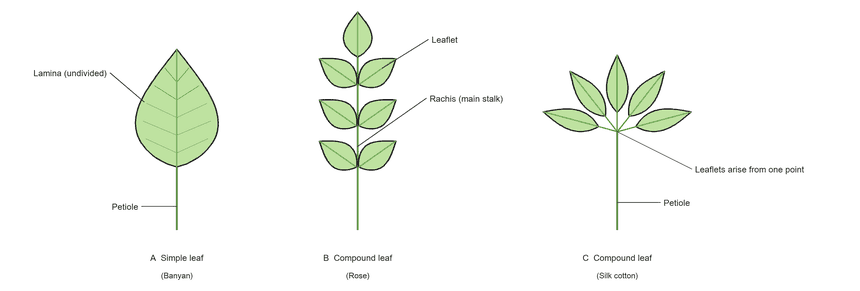
Step 2 — (ii) Parallel and reticulate venation.
A banana leaf (also grass, maize) shows parallel venation. A peepal leaf (also mango, guava) shows reticulate venation. Draw them as below, labelling the midrib, the net of veins and the parallel veins.
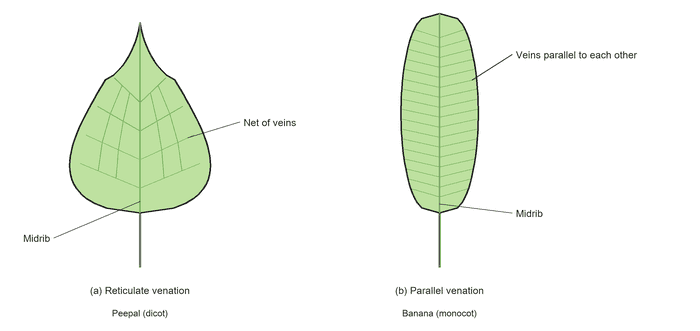
Watch out: Draw the leaflets of a compound leaf as separate small blades, each with its own midrib, not as cuts in one blade.
Therefore, simple leaf: banyan; compound leaf: rose or silk cotton; parallel venation: banana; reticulate venation: peepal.
- 313 marks
Question 31
Enlist some of the advantages of transpiration to green plants.
Solve with AIWritten solution
Solution:
Concept: Transpiration is the loss of water vapour from the leaves; it is not just a waste of water but helps the plant in several ways.
Step 1 — Cooling.
Water takes heat from the leaf as it evaporates, so the plant stays cool on hot days.
Step 2 — Transpirational pull.
As water evaporates from the leaves, more water is pulled up from the roots through the stem.
Step 3 — Supply of minerals.
The rising water carries mineral salts from the soil to all parts of the plant.
Step 4 — Removal of extra water.
It removes the extra water that the roots have absorbed.
Therefore, transpiration cools the plant, pulls up water, carries minerals upward and removes extra water.
- 322 marks
Question 32
Why do some plants have to trap insects ?
Solve with AIWritten solution
Solution:
Concept: Insectivorous plants are green plants that make their own food by photosynthesis, but they grow where the soil (or water) is poor in nitrogen. Their leaves are changed into traps that catch and digest insects for the extra nitrogen.
Step 1 — The problem.
Insectivorous plants such as the pitcher plant grow in soil that is poor in nitrogen (nitrates).
Step 2 — Why nitrogen matters.
Plants need nitrogen to make proteins for growth.
Step 3 — The solution.
So these plants trap and digest insects, whose bodies are rich in protein, and absorb the nitrogen from them.
Watch out: They still make their own food by photosynthesis; insects are only their extra source of nitrogen.
Therefore, some plants trap insects to get the nitrogen that their soil lacks.
- 333 marks
Question 33
Explain some of the modifications of leaves found in plants.
Solve with AIWritten solution
Solution:
Concept: A leaf, or part of it, may be modified (changed in form) to do a special job: tendrils for climbing, spines for saving water, scale leaves for storage and protection, traps for catching insects, and buds for making new plants.
Step 1 — Leaf tendrils.
Leaves or leaflets become thin coiled tendrils that wind round a support and help weak plants climb, as in sweet pea.
Step 2 — Spines.
Leaves become sharp spines that reduce water loss and protect the plant, as in cactus; the prickly poppy has spines on its leaf margin.
Step 3 — Scale leaves.
Thick fleshy scale leaves store food (onion), and thin dry scale leaves protect buds (ginger).
Step 4 — Insect-trapping leaves.
Leaves become traps that catch insects for nitrogen: the pitcher of the pitcher plant, the hinged leaf of the Venus flytrap and the bladders of bladderwort.
Step 5 — Leaves for propagation.
Bryophyllum leaves bear buds on their margin that grow into new plants.
Therefore, leaves may be modified into tendrils, spines, scale leaves, insect traps or buds for new plants.
- 345 marks
Question 34
What is a tendril ? Explain its use to the plant.
Solve with AIWritten solution
Solution:
Concept: A tendril is a thin, wiry, coiled structure that is sensitive to touch; it is a climbing organ.
Step 1 — Define a tendril.
A tendril is a thin, coiled thread that bends towards and coils round anything it touches. In sweet pea the upper leaflets of the compound leaf are changed into tendrils (leaf tendrils).
Step 2 — Explain its use.
By coiling round a support, the tendril holds up a weak-stemmed plant and helps it climb.
Step 3 — Say why climbing helps.
Climbing lifts the leaves up into sunlight, so the plant can make more food by photosynthesis.
Therefore, a tendril is a coiled climbing thread; it helps a weak plant climb towards sunlight.
- 3510 marks
Question 35
Distinguish between the following pairs on the basis of the words indicated in the brackets [ ].
(i) Spines and scale leaves [significance].
(ii) Vegetative and reproductive parts [parts of the plant].
(iii) Alternate and opposite phyllotaxy [number of leaves at each node].
(iv) Pine and peepal [shape of the leaf].
(v) Reticulate and parallel venation [2 examples of each].
Solve with AIWritten solution
Solution:
Concept: Compare each pair only on the point given in the brackets.
Step 1 — (i) Spines and scale leaves: significance.
Compare what each one does for the plant.
Spines Scale leaves Reduce water loss and protect the plant (cactus). Store food when fleshy (onion) and protect buds when dry (ginger). Step 2 — (ii) Vegetative and reproductive parts: parts of the plant.
Name the parts in each group.
Vegetative parts Reproductive parts Root, stem and leaves. Flowers, which form fruits and seeds. Step 3 — (iii) Alternate and opposite phyllotaxy: leaves at each node.
Count the leaves at one node.
Alternate phyllotaxy Opposite phyllotaxy One leaf at each node. Two leaves at each node, facing each other. Step 4 — (iv) Pine and peepal: shape of the leaf.
Compare the shapes.
Pine Peepal Needle-shaped leaf. Heart-shaped leaf with a long, pointed tip. Step 5 — (v) Reticulate and parallel venation: two examples.
Give two examples of each.
Reticulate venation Parallel venation Peepal, mango Banana, grass Therefore, spines save water while scale leaves store food and protect buds; root, stem and leaves are vegetative and flowers reproductive; alternate has one leaf per node and opposite two; pine leaves are needles and peepal leaves heart-shaped; peepal and mango are reticulate, banana and grass parallel.
- 3613 marks
Question 36
Draw a neat diagram of a simple, petiolate leaf showing reticulate venation and label its seven important parts. Answer the following questions :
(i) Write one important function of axillary buds.
(ii) What are the two main function of leaves ?
(iii) Name two plants which have leaves with serrated margins.
(iv) Why do some plants have tendrils (modified leaflets) ?
(v) Name a plant in which the leaves are modified into spines.
Solve with AIWritten solution
Solution:
Concept: A typical simple leaf has a petiole and a lamina with a midrib, a network of veins, a margin and an apex; an axillary bud sits in the angle between the petiole and the stem.
Step 1 — Draw the leaf.
Draw a piece of stem, a leaf joined to it by a petiole, a bud in the axil and a lamina with a midrib and a net of veins. Label the seven parts.
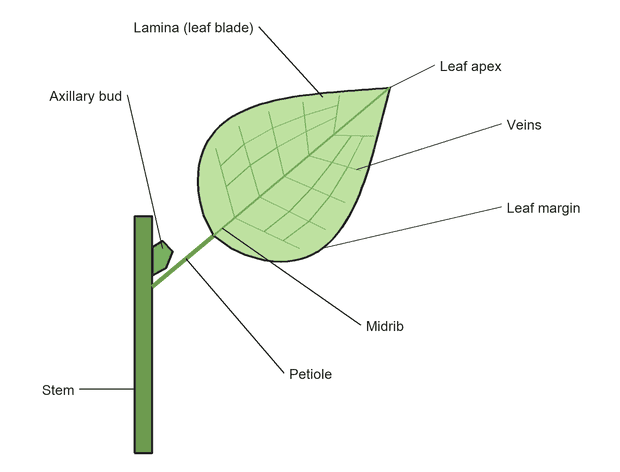
Labels: leaf apex, leaf margin, lamina (leaf blade), midrib, veins, petiole, axillary bud (the stem is labelled too, for reference).
Step 2 — (i) Function of axillary buds.
Axillary buds grow into new branches bearing leaves or flowers.
Step 3 — (ii) Two main functions of leaves.
Leaves carry out photosynthesis and transpiration.
Step 4 — (iii) Leaves with serrated margins.
Rose and china rose (hibiscus) have saw-toothed margins.
Step 5 — (iv) Why some plants have tendrils.
Tendrils coil round a support and help weak-stemmed plants climb, as in sweet pea.
Step 6 — (v) Leaves modified into spines.
In cactus (Opuntia) the leaves are changed into spines.
Watch out: The axillary bud sits above the petiole, in the angle it makes with the stem, not on the leaf itself.
Therefore, the diagram shows the seven parts; (i) new branches, (ii) photosynthesis and transpiration, (iii) rose and china rose, (iv) to climb, (v) cactus.
- 3710 marks
Question 37
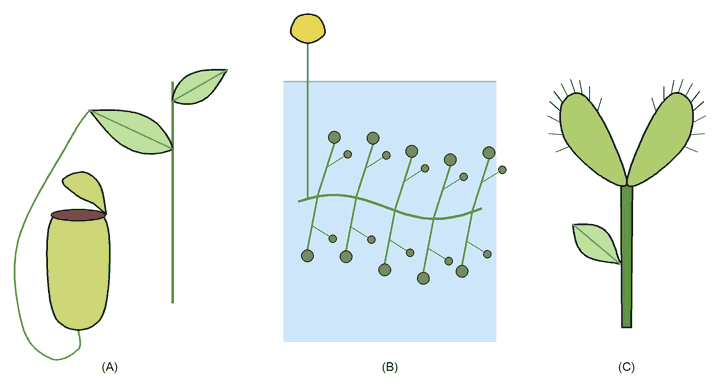
The figures given below show three insectivorous plants. Study the same and answer the following questions :
(i) Name the plants shown as A, B and C.
(ii) For which specific nutritional element do these plants trap insects ?
(iii) In which Indian state is plant A found abundantly ?
(iv) Which part of the leaf is modified into a pitcher in plant A ?
(v) Write one specific feature of the soil in which these plants usually grow.
Solve with AIWritten solution
Solution:
Concept: Insectivorous plants are green plants that make their own food by photosynthesis, but they grow where the soil (or water) is poor in nitrogen. Their leaves are changed into traps that catch and digest insects for the extra nitrogen.
Step 1 — (i) Name the plants.
A has a jug with a lid hanging from a tendril at the leaf tip, so it is the pitcher plant. B floats in water with tiny bladders on thread-like leaves, so it is bladderwort. C has two hinged leaf halves with bristles on the edges, so it is the Venus flytrap.
Step 2 — (ii) The element they need.
These plants trap insects to get nitrogen.
Step 3 — (iii) Where plant A grows.
The Indian pitcher plant grows abundantly in Meghalaya (in the Garo and Khasi Hills).
Step 4 — (iv) The part that forms the pitcher.
The lamina (leaf blade) is changed into the pitcher; the leaf apex forms its lid.
Step 5 — (v) The soil.
They grow in soil (or, like bladderwort, in water) that is poor in nitrogen (deficient in nitrates).
Therefore, (i) A pitcher plant, B bladderwort, C Venus flytrap; (ii) nitrogen; (iii) Meghalaya; (iv) the lamina; (v) poor in nitrogen.
- 386 marks
Question 38
The figures given alongside represent the different kinds of leaf arrangements on the stem. Study the figures and answer the following :

(i) Give a technical term for the arrangement of leaves on the stem.
(ii) Name the three kinds of arrangements shown in the figure A, B and C respectively.
(iii) Give one example of each kind of arrangement.
Solve with AIWritten solution
Solution:
Concept: Phyllotaxy is the arrangement of leaves on the stem: alternate (one leaf at a node), opposite (two leaves at a node, facing each other) or whorled (three or more leaves at a node in a ring).
Step 1 — (i) The technical term.
The arrangement of leaves on the stem is called phyllotaxy.
Step 2 — (ii) Identify A, B and C.
In A there is one leaf at each node, so it is alternate. In B there are two leaves facing each other at each node, so it is opposite. In C there are three leaves in a ring at each node, so it is whorled.
Step 3 — (iii) One example of each.
China rose (or peepal, sunflower) has alternate leaves, guava (or jasmine) has opposite leaves, and oleander (Nerium) has whorled leaves.
Watch out: Count the leaves at ONE node: one is alternate, two is opposite, three or more is whorled.
Therefore, (i) phyllotaxy; (ii) A alternate, B opposite, C whorled; (iii) china rose, guava and oleander.
- 3910 marks
Question 39
Draw neat diagrams of the following and give an example of each :
(i) A simple leaf.
(ii) A compound leaf with leaflets arising from different points along the main stalk.
(iii) A compound leaf with leaflets arising from one single point.
(iv) A simple leaf with reticulate venation.
(v) A simple leaf with parallel venation.
Solve with AIWritten solution
Solution:
Concept: In a simple leaf the lamina (leaf blade) is in one piece, even if its margin is cut; in a compound leaf the lamina is divided right down to the midrib into separate leaflets.
Step 1 — (i) to (iii) Simple and compound leaves.
The banyan has a simple leaf (diagram A), the rose has a compound leaf with leaflets along the main stalk (diagram B), and silk cotton has a compound leaf with all its leaflets from one point (diagram C).
Labels: lamina, petiole, leaflet, rachis (main stalk).
Step 2 — (iv) and (v) Venation.
The peepal has a simple leaf with reticulate venation (diagram a), and the banana has a simple leaf with parallel venation (diagram b).
Labels: midrib, net of veins, parallel veins.
Watch out: In diagram C all the leaflets must start from the same point at the tip of the petiole.
Therefore, (i) banyan, (ii) rose, (iii) silk cotton, (iv) peepal and (v) banana, drawn as shown.
- 403 marks
Question 40
Complete the crossword using the clues given below. Check your performance with the correct solutions given at the end of the chapter.
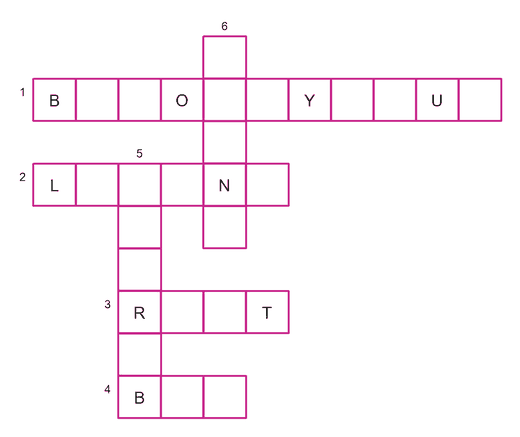
Clues across :
-
Plant that bears buds in leaves for propagation.
-
The flattened green part of leaf.
-
Underground plant part.
-
Structure that develops into flower.
Clues down :
-
The central big vein of a leaf.
-
A modification seen in cactus.
Solve with AIWritten solution
Solution:
Concept: Use the letters already printed in the grid to check that each word fits its clue and its number of boxes.
Step 1 — Solve the across clues.
The plant that bears buds on its leaves (clue 1, 11 boxes) is BRYOPHYLLUM. The flattened green part of the leaf (clue 2) is the LAMINA, the underground part (clue 3) is the ROOT, and the structure that develops into a flower (clue 4) is a BUD.
Step 2 — Solve the down clues.
The central big vein (clue 5) is the MIDRIB; its M, R and B are shared with the third letter of LAMINA, the first of ROOT and the first of BUD. The modification seen in cactus (clue 6) is a SPINE; its P and N are shared with the fifth letters of BRYOPHYLLUM and LAMINA.
Step 3 — See the completed grid.
The filled crossword is shown below.
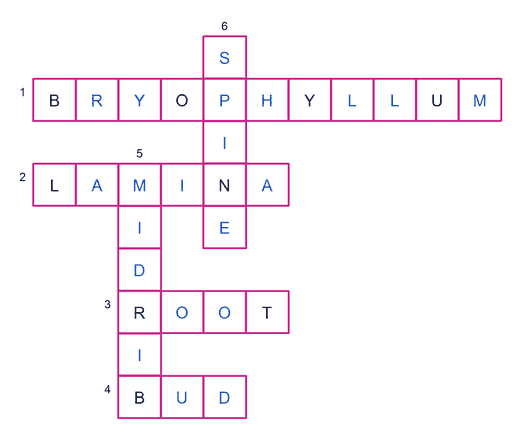
Therefore, across: Bryophyllum, lamina, root, bud; down: midrib, spine.
-
- 415 marks
Question 41
John, Sandeep and Shubham, three class 6 students, were discussing their school garden project. They had collected leaves of Banyan, Rose and Silk cotton for a herbarium. While comparing them, they noticed that the Banyan leaf looked quite different from the other two. Shubham, who was confident about leaf types, explained that Banyan has a simple leaf, whereas Rose and Silk cotton have compound leaves. Answer the following questions:
(i) What is the main difference between a simple leaf and a compound leaf?
(ii) How do the leaves of Rose and Silk cotton differ from each other even though both are compound leaves?
(iii) Segregate the following leaves as simple and compound: Neem, Peepal, Guava, Mango, Gulmohar and Banana.
(iv) What is the difference between 'petiole' and 'midrib' ?
Solve with AIWritten solution
Solution:
Concept: In a simple leaf the lamina (leaf blade) is in one piece, even if its margin is cut; in a compound leaf the lamina is divided right down to the midrib into separate leaflets.
Step 1 — (i) Simple versus compound.
In a simple leaf the lamina is undivided (one piece); in a compound leaf the lamina is divided into leaflets.
Step 2 — (ii) Rose versus silk cotton.
In rose the leaflets arise at different points along the main stalk (rachis). In silk cotton all the leaflets arise from one point at the tip of the petiole.
Step 3 — (iii) Sort the leaves.
The simple leaves are peepal, guava, mango and banana; the compound leaves are neem and gulmohar.
Step 4 — (iv) Petiole versus midrib.
The petiole is the stalk that joins the leaf to the stem. The midrib is the main central vein running through the lamina, as a continuation of the petiole.
Watch out: Banana leaves often tear into strips, but they are simple leaves because the lamina is not divided into leaflets.
Therefore, (i) undivided versus leaflets; (ii) along the stalk versus from one point; (iii) peepal, guava, mango, banana simple and neem, gulmohar compound; (iv) the leaf stalk versus the central vein.
What Class 6 Biology Ch 1 covers
The sections of the chapter, in the order the book takes them. Every question above comes from one of these.
- 01The Root System
- 02The Shoot System
- 03Structure of a Leaf
- 04Types of Leaves
- 05Arrangement of Leaves
- 06Venation of Leaves
More ways to study this chapter
The same chapter asked three other ways. Practise it, revise it, and see what the board has set on Ch 1 before.
Class 6 Biology Ch 1 questions students ask
How many questions are there in Class 6 Biology Ch 1?
41 questions. Every one is solved step by step on this page.
Are these Class 6 Biology solutions free?
Yes. Every question and its full working is free to read, with no account needed.
Can I download the Class 6 Biology Ch 1 solutions as a PDF?
There is no PDF to download. Every solution is on this page instead, which means it is searchable, always the current syllabus, and readable on a phone. Use your browser's print option if you want it on paper.