
Question 304 marksMedium
Give an example of the following and draw generalized diagrams for the same :
(i) Simple leaf and compound leaf.
(ii) Parallel venation and reticulate venation.
Confirming your payment
Sign up now and get 250 free tokens.
The Leaf · Question 30 of 41
Give an example of the following and draw generalized diagrams for the same :
(i) Simple leaf and compound leaf.
(ii) Parallel venation and reticulate venation.
Solution:
Concept: A simple leaf has one undivided lamina and a compound leaf has leaflets; in reticulate venation the veins form a net and in parallel venation they run side by side.
Step 1 — (i) Simple and compound leaf.
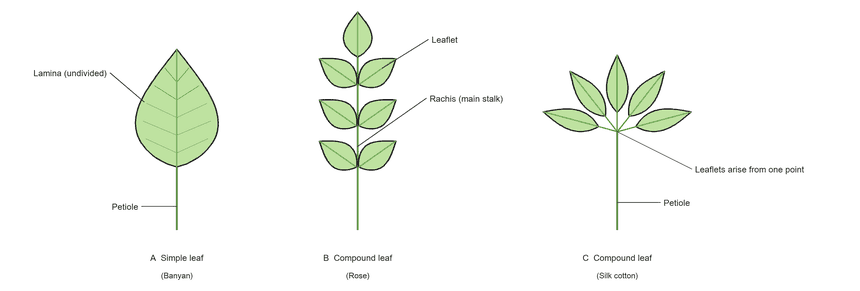
A banyan (or mango) leaf is a simple leaf. A rose leaf (leaflets along the main stalk) and a silk cotton leaf (leaflets from one point) are compound leaves. Draw them as below, with the labels lamina, petiole, leaflet and rachis.
Step 2 — (ii) Parallel and reticulate venation.
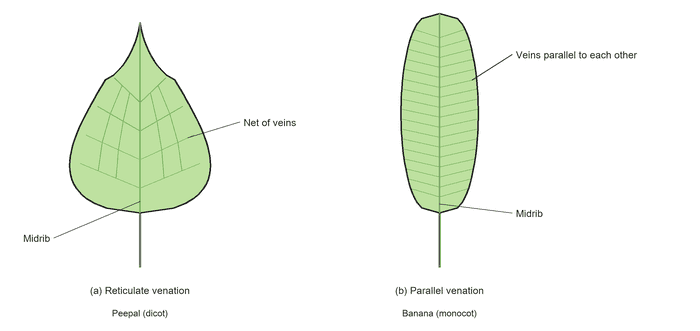
A banana leaf (also grass, maize) shows parallel venation. A peepal leaf (also mango, guava) shows reticulate venation. Draw them as below, labelling the midrib, the net of veins and the parallel veins.
Watch out: Draw the leaflets of a compound leaf as separate small blades, each with its own midrib, not as cuts in one blade.
Therefore, simple leaf: banyan; compound leaf: rose or silk cotton; parallel venation: banana; reticulate venation: peepal.