Solution:
Concept: A typical simple leaf has a petiole and a lamina with a midrib, a network of veins, a margin and an apex; an axillary bud sits in the angle between the petiole and the stem.
Step 1 — Draw the leaf.
Draw a piece of stem, a leaf joined to it by a petiole, a bud in the axil and a lamina with a midrib and a net of veins. Label the seven parts.
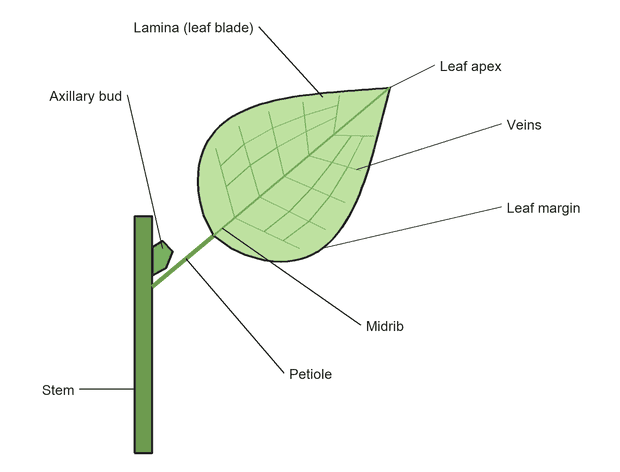
Labels: leaf apex, leaf margin, lamina (leaf blade), midrib, veins, petiole, axillary bud (the stem is labelled too, for reference).
Step 2 — (i) Function of axillary buds.
Axillary buds grow into new branches bearing leaves or flowers.
Step 3 — (ii) Two main functions of leaves.
Leaves carry out photosynthesis and transpiration.
Step 4 — (iii) Leaves with serrated margins.
Rose and china rose (hibiscus) have saw-toothed margins.
Step 5 — (iv) Why some plants have tendrils.
Tendrils coil round a support and help weak-stemmed plants climb, as in sweet pea.
Step 6 — (v) Leaves modified into spines.
In cactus (Opuntia) the leaves are changed into spines.
Watch out: The axillary bud sits above the petiole, in the angle it makes with the stem, not on the leaf itself.
Therefore, the diagram shows the seven parts; (i) new branches, (ii) photosynthesis and transpiration, (iii) rose and china rose, (iv) to climb, (v) cactus.
