Solution:
Concept: Insectivorous plants are green plants that make their own food by photosynthesis, but they grow where the soil (or water) is poor in nitrogen. Their leaves are changed into traps that catch and digest insects for the extra nitrogen.
Step 1 — (i) Name the plants.
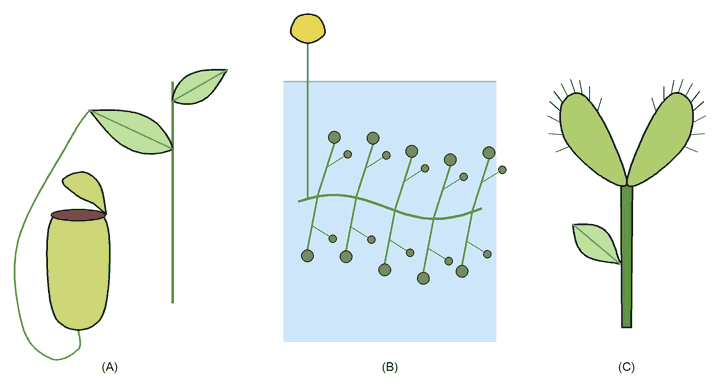
A has a jug with a lid hanging from a tendril at the leaf tip, so it is the pitcher plant. B floats in water with tiny bladders on thread-like leaves, so it is bladderwort. C has two hinged leaf halves with bristles on the edges, so it is the Venus flytrap.
Step 2 — (ii) The element they need.
These plants trap insects to get nitrogen.
Step 3 — (iii) Where plant A grows.
The Indian pitcher plant grows abundantly in Meghalaya (in the Garo and Khasi Hills).
Step 4 — (iv) The part that forms the pitcher.
The lamina (leaf blade) is changed into the pitcher; the leaf apex forms its lid.
Step 5 — (v) The soil.
They grow in soil (or, like bladderwort, in water) that is poor in nitrogen (deficient in nitrates).
Therefore, (i) A pitcher plant, B bladderwort, C Venus flytrap; (ii) nitrogen; (iii) Meghalaya; (iv) the lamina; (v) poor in nitrogen.